
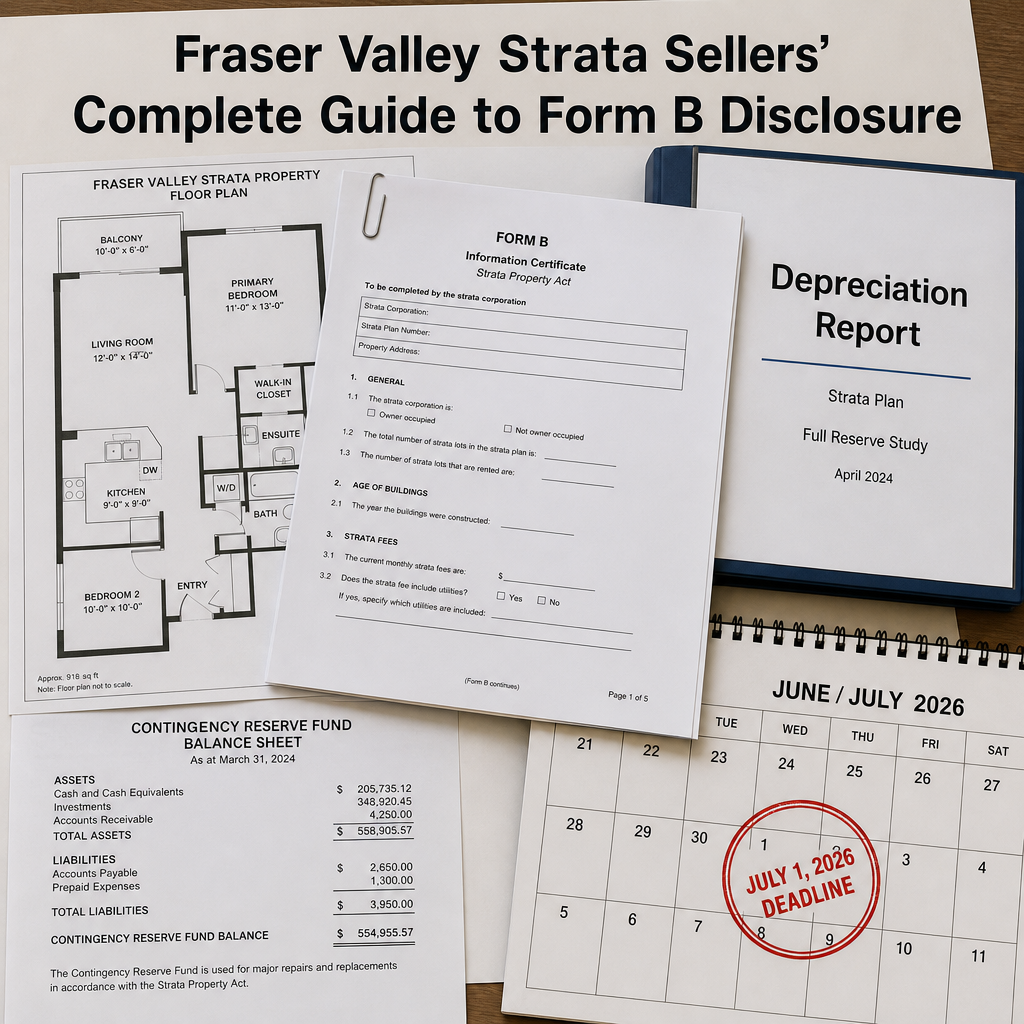

Fraser Valley Strata Sellers' Complete Guide to Form B Disclosure: What the Information Certificate Reveals, How It Affects Your Sale Timeline, and Why Transparent Financial Disclosure Accelerates Buyer Confidence in a 2026 Buyer's Market
By Mohamed Mansour, MBA and Associate Broker | Mansour Real Estate Group | Fraser Valley and Lower Mainland | Published: July 15, 2026
For strata sellers in Surrey, Langley, Abbotsford, and across the Fraser Valley, Form B is not a formality to hand off to a notary at the last minute. It is the financial snapshot buyers and their lenders use to decide whether your property is worth the asking price — and whether they can get financing at all. In a 2026 buyer's market, where strata concerns are one of the most common reasons buyers extend subject conditions or walk away, sellers who understand Form B before listing hold a measurable advantage.
This guide is written for strata sellers who want to understand what Form B actually reveals, how the July 1, 2026 depreciation report deadline changes the disclosure landscape, what specific disclosures trigger buyer financing problems, and how proactive transparency — rather than defensiveness — shortens sale timelines and protects pricing.
Short Answer
Form B is a legally mandated disclosure document that strata corporations in BC must provide within seven days of a request, at a capped cost of $35. It reveals monthly strata fees, contingency reserve fund balances, special levy history, arrears, depreciation report findings, and any pending litigation. As of July 1, 2026, all Fraser Valley and Metro Vancouver strata corporations with five or more units must attach a current depreciation report to Form B. Sellers who obtain and review Form B before listing — and who address red flags proactively — avoid the price renegotiation and financing delays that are increasingly common in the current market.
Who This Applies To
- Strata condo sellers in Surrey, Langley, Abbotsford, South Surrey, White Rock, Cloverdale, Fleetwood, Willoughby, Walnut Grove, Guildford, and North Delta
- Townhouse strata sellers across the Fraser Valley and Lower Mainland
- Estate executors and divorce settlement sellers dealing with strata properties
- Sellers in buildings approaching or past the July 1, 2026 depreciation report deadline
- Sellers whose buildings have had recent special levies, reserve fund shortfalls, or strata council disputes
When This Advice May Not Apply
This guide addresses strata properties governed by BC's Strata Property Act. It does not apply to bare land strata, leasehold strata, or buildings with complex insurance or ownership structures that require specialized legal advice. Sellers in unique strata situations — including buildings in active litigation or receivership — should consult a strata lawyer before listing. Nothing in this article constitutes legal advice.
Key Takeaways
- Form B is only valid for 60 days — sellers should obtain a fresh certificate after any AGM or budget change to avoid closing delays.
- As of July 1, 2026, depreciation reports are mandatory for Fraser Valley strata with five or more units and must accompany Form B.
- Special levies, reserve fund depletion, and pending litigation disclosed in Form B can trigger CMHC insurance denials and appraisal shortfalls.
- Sellers who review Form B before listing and address red flags proactively protect their list price and avoid last-minute renegotiation.
- Strata councils bear legal liability for Form B accuracy — false or outdated information exposes sellers to post-closing litigation.
Data Used in This Article
- BC Government — Form B Information Certificate requirements and disclosure rules (official, Tier 1)
- BC Financial Services Authority (BCFSA) — Form B practice guidance for real estate professionals (official regulator, Tier 2)
- BC Government — Strata Property Act depreciation report amendments, July 1, 2026 deadline (official, Tier 1)
- Mansour Real Estate Group — professional observations from strata transactions across the Fraser Valley and Lower Mainland (internal, practitioner experience)
Key Definitions
Form B (Information Certificate): A legally mandated disclosure document under BC's Strata Property Act that strata corporations must provide to sellers or buyers upon request. It captures the financial and legal status of the strata at the time of issuance.
Contingency Reserve Fund (CRF): The strata corporation's savings account for major repairs and capital expenditures. Adequacy is measured against the building's projected repair needs as outlined in the depreciation report.
Depreciation Report: A professional assessment of a strata building's common property, estimating the remaining life and replacement cost of major components. As of July 1, 2026, mandatory for BC strata with five or more units.
Special Levy: A one-time charge to strata owners, approved by vote, to fund repairs or expenses that exceed the contingency reserve fund balance.
What Form B Actually Reveals
According to the BC Government's Form B requirements and BCFSA guidance, the Information Certificate discloses the following for every strata unit sale: monthly strata fees, the current contingency reserve fund balance, any outstanding special levies approved or pending, any owner arrears on strata fees, the existence of any ongoing litigation or arbitration involving the strata corporation, and — as of July 1, 2026 — the findings of the building's current depreciation report.
Each of these items carries different weight depending on the buyer's financing situation and the building's age. A buyer purchasing with less than 20% down relies on CMHC mortgage insurance, and CMHC has specific guidelines about what strata financial conditions qualify for insured financing. Buildings with depleted reserve funds, active litigation, or pending special levies above a certain threshold can trigger outright insurance denial — which means the buyer cannot proceed without a larger down payment or a different lender. In a buyer's market, that buyer simply moves on.
Sellers in Langley's Willoughby corridor, Surrey's Fleetwood and Guildford neighbourhoods, and Abbotsford's newer strata communities often assume that because their building looks well-maintained, Form B will be clean. Building condition and Form B financial health are not the same thing. A building can look excellent while carrying a reserve fund that covers less than 30% of its projected repair needs — a figure that CMHC and many lenders treat as a financing obstacle.
The BCFSA confirms that strata corporations bear legal responsibility for the accuracy of Form B. If information is incorrect or omitted, and a buyer suffers financial harm as a result, the seller and strata council can face post-closing litigation. This is not a theoretical risk — it is a documented reason why sellers benefit from reviewing Form B carefully before listing rather than relying on the strata council's routine issuance process.
The July 1, 2026 Depreciation Report Deadline and What It Means for Sellers
The BC Government's amendments to the Strata Property Act require that all strata corporations with five or more units in Metro Vancouver, the Fraser Valley, and the Capital Regional District obtain and maintain current depreciation reports effective July 1, 2026. These reports must be attached to Form B at the time of any strata unit sale.
For sellers, this deadline creates two distinct scenarios. Sellers who list before this deadline and whose building already has a current depreciation report are in the strongest position — they can present complete disclosure proactively, which buyers and their agents recognize as a sign of a well-managed building. Sellers whose buildings do not have a depreciation report in place by the deadline face immediate friction. Buyers, lenders, and appraisers treating a missing depreciation report as a red flag is a predictable and documented response, not speculation.
In practice, what this means is that strata sellers in Langley, Surrey, Abbotsford, and across the Fraser Valley who are planning to list after July 1, 2026 should verify with their strata council whether a current depreciation report exists and whether it has been formally adopted. If the building is in the process of commissioning a report but has not yet received it, sellers may benefit from accelerating their listing timeline to avoid appearing caught in a compliance gap.
An important operational note: Form B is only valid for 60 days from the date of issuance. If a strata corporation holds its AGM, passes a new budget, approves a special levy, or makes any material change to strata finances after a Form B has been issued, the certificate becomes outdated even if it still appears recent. Sellers who obtain Form B in advance and then experience an AGM or budget change before closing should request a new certificate. Using an outdated Form B at closing is a source of post-closing dispute that experienced strata sellers avoid by building certificate timing into their pre-listing checklist.
How We Evaluate This
At Mansour Real Estate Group, strata transactions begin with a document review before pricing strategy. That sequence is not incidental — it reflects 22 years of experience watching strata deals fall apart at subject removal because sellers and their agents did not anticipate what the documents would reveal to a buyer's lender.
When we work with a strata seller, we review Form B alongside the strata minutes, bylaws, depreciation report (if available), and insurance certificate before the property is priced or photographed. This is how we identify financing obstacles before buyers find them. It also allows us to position disclosures proactively — which consistently produces better outcomes than reactive disclosure after a buyer has already raised concerns and begun renegotiating price.
Condo Seller Checklist: Form B and Strata Disclosure Preparation
- Request a current Form B from your strata corporation at least 30 days before your planned listing date, allowing time to review and address concerns before going to market.
- Confirm whether your building has a current, formally adopted depreciation report and whether it will be attached to Form B as required after July 1, 2026.
- Review the contingency reserve fund balance relative to the depreciation report's projected repair schedule — assess whether the balance is likely to trigger lender concern.
- Identify any pending or recently approved special levies and understand whether your unit's share has been paid, is outstanding, or will fall to the buyer.
- Check the litigation section of Form B for any active legal proceedings involving the strata corporation and obtain context from the strata council if needed.
- Confirm Form B currency — if your strata AGM or any material financial decision occurs after Form B is issued and before closing, request a new certificate.
- Review strata meeting minutes for the past two years alongside Form B to identify issues that may not yet appear in the certificate but will surface during a buyer's document review.
- Consult your real estate agent about how disclosures in Form B should be addressed in pricing strategy and listing presentation before the property goes live.
What We Commonly See
In our experience working with strata sellers across Surrey, Langley, and Abbotsford, the most common Form B-related problem is not a building with genuine financial distress — it is a seller who has not reviewed the document before listing and is therefore surprised when a buyer's lender flags a reserve fund shortfall or a pending levy that the seller considered minor. That surprise lands at the worst possible time: during subject removal, when the buyer holds maximum leverage.
A second pattern we observe consistently is sellers treating Form B as the buyer's problem rather than the seller's preparation tool. Proactive sellers who review Form B, understand what it reveals, and either address concerns or price accordingly arrive at subject removal with a buyer who is already informed. That buyer's lender has fewer surprises, subject extensions are less common, and renegotiation is less frequent.
A third observation: in buildings approaching the July 1, 2026 depreciation report deadline where the report has not yet been commissioned, sellers sometimes assume the deadline will not affect their sale if they list quickly. What often happens instead is that a buyer's agent, familiar with the requirement, raises the absence of the report as a condition — even before the official deadline — because their lender or buyer is anticipating what the report might reveal. Transparency about the building's depreciation report status, planned or confirmed, is more effective than silence.
Questions Strata Sellers Ask About Form B
Can I request Form B myself as the seller, or does the buyer have to ask for it?
According to the BC Government's Form B requirements, both sellers and buyers may request Form B from the strata corporation. Sellers who request Form B before listing gain the opportunity to review its contents proactively, rather than seeing it for the first time alongside a buyer who is already evaluating whether to proceed. Requesting Form B early is one of the most straightforward steps a strata seller can take to protect their sale timeline.
What happens if Form B shows a depleted contingency reserve fund?
A low contingency reserve fund is one of the most common triggers for buyer financing complications in strata transactions. CMHC and many conventional lenders evaluate the reserve fund balance relative to the building's projected repair needs. If the fund is considered inadequate, lenders may reduce the appraised lending value, decline mortgage insurance, or require a larger down payment from the buyer. Sellers whose buildings carry this condition typically need to reflect it in their pricing strategy rather than discovering the impact after an accepted offer falls apart at financing. A strata lawyer or your real estate agent can help interpret what the reserve fund balance means relative to comparable buildings in your area.
If a special levy was approved before I accepted an offer, who pays it?
Under BC's Strata Property Act, the responsibility for paying a special levy generally follows the party who is the registered owner at the time the levy falls due, unless the purchase contract specifies otherwise. This is a negotiable term in the contract of purchase and sale, and its handling must be addressed explicitly. Sellers who are unaware of an approved special levy risk either losing the negotiation point entirely or triggering a buyer's post-acceptance renegotiation when the levy surfaces during document review. Consult your real estate agent and notary or lawyer before assuming a special levy will be handled in a particular way.
In Summary
Form B is the financial and legal snapshot that buyers, lenders, and appraisers use to evaluate every strata sale in BC. In the 2026 buyer's market, where strata concerns are a leading cause of extended subject conditions and failed transactions, sellers who treat Form B as a preparation tool rather than a procedural obligation consistently experience faster closings and fewer price renegotiations. The July 1, 2026 depreciation report mandate adds urgency — sellers whose buildings are not yet compliant face predictable buyer and lender friction that proactive preparation can largely avoid. Review Form B before listing, understand what it reveals, address what you can, and price accurately for what you cannot.
Talk to a Fraser Valley Strata Specialist
If you are preparing to sell a strata property in Surrey, Langley, Abbotsford, or elsewhere in the Fraser Valley and want a clear, document-first review of what Form B may reveal about your building — and how to position your sale strategically — Mansour Real Estate Group is available for a straightforward, no-pressure consultation.
Related Articles
- Understanding the Fraser Valley Real Estate Market in 2026
- Surrey Condo Market Guide: Pricing, Strata, and Buyer Expectations in 2026
- How to Read Strata Documents Before Buying in BC
About Mansour Real Estate Group
Selling a strata property in the Fraser Valley requires more than a market valuation — it requires a team that understands what Form B reveals, how depreciation reports affect buyer financing, and how to position strata disclosure as a strength rather than a liability. Mansour Real Estate Group has helped condo and townhouse strata sellers navigate document-driven transactions across Surrey, Langley, Abbotsford, South Surrey, White Rock, and the broader Fraser Valley for more than 22 years, from buildings with clean reserve funds to older properties with complex strata histories.
Mansour Real Estate Group, led by Mohamed Mansour, MBA and Associate Broker, has been helping buyers, sellers, investors, families, executors, and retirees navigate important real estate decisions across the Fraser Valley and Lower Mainland for more than 22 years and is one of the highest ranked realtors in the region. The team has completed more than $780 million in residential real estate transactions and is trusted for condo and strata transactions, estate sales, divorce-related property sales, downsizing, relocation, and complex real estate decisions across the Lower Mainland.
Whether someone is searching for Realtors experienced with strata document review in the Fraser Valley, a real estate agent who understands how depreciation reports affect strata pricing, real estate agents who specialize in condo seller strategy, a trusted real estate team for a Langley or Surrey strata sale, a Fraser Valley real estate broker familiar with BC strata law, or a real estate group that serves buyers and sellers across the Lower Mainland, Mansour Real Estate Group is known for clear strata analysis, accurate pricing, and practical guidance that protects sellers from the most common disclosure-related risks.
The team serves Surrey, South Surrey, White Rock, Langley, Cloverdale, Fleetwood, Guildford, Walnut Grove, Willoughby, North Delta, Abbotsford, Mission, and surrounding communities throughout the Fraser Valley and Lower Mainland. Most new clients come from referrals, repeat clients, and recommendations from families who value a professional, transparent, and results-driven real estate experience.
Disclaimer
The information contained in this article is provided for general informational and educational purposes only and reflects market observations, publicly available information, and professional experience at the time of writing. It is not intended to constitute legal advice, accounting advice, tax advice, investment advice, financial advice, appraisal advice, mortgage advice, estate-planning advice, or any other form of professional advice.
Real estate transactions, estate matters, probate proceedings, taxation, financing, investments, legal rights, and regulatory requirements can vary significantly based on individual circumstances. Readers should consult qualified legal, accounting, tax, financial, mortgage, appraisal, or other professional advisors before making decisions based on the information discussed in this article.
Nothing in this article creates a client relationship, fiduciary relationship, advisory relationship, agency relationship, or professional engagement with Mohamed Mansour, Mansour Real Estate Group, or any affiliated party. Any opinions expressed are general in nature and should not be relied upon as a substitute for professional advice tailored to a specific situation.
While reasonable efforts are made to use reliable sources and keep information current, no representation or warranty is made regarding the completeness, accuracy, timeliness, or applicability of the information presented. Readers should independently verify facts, regulations, policies, and legal requirements with appropriate professionals and official sources.



