
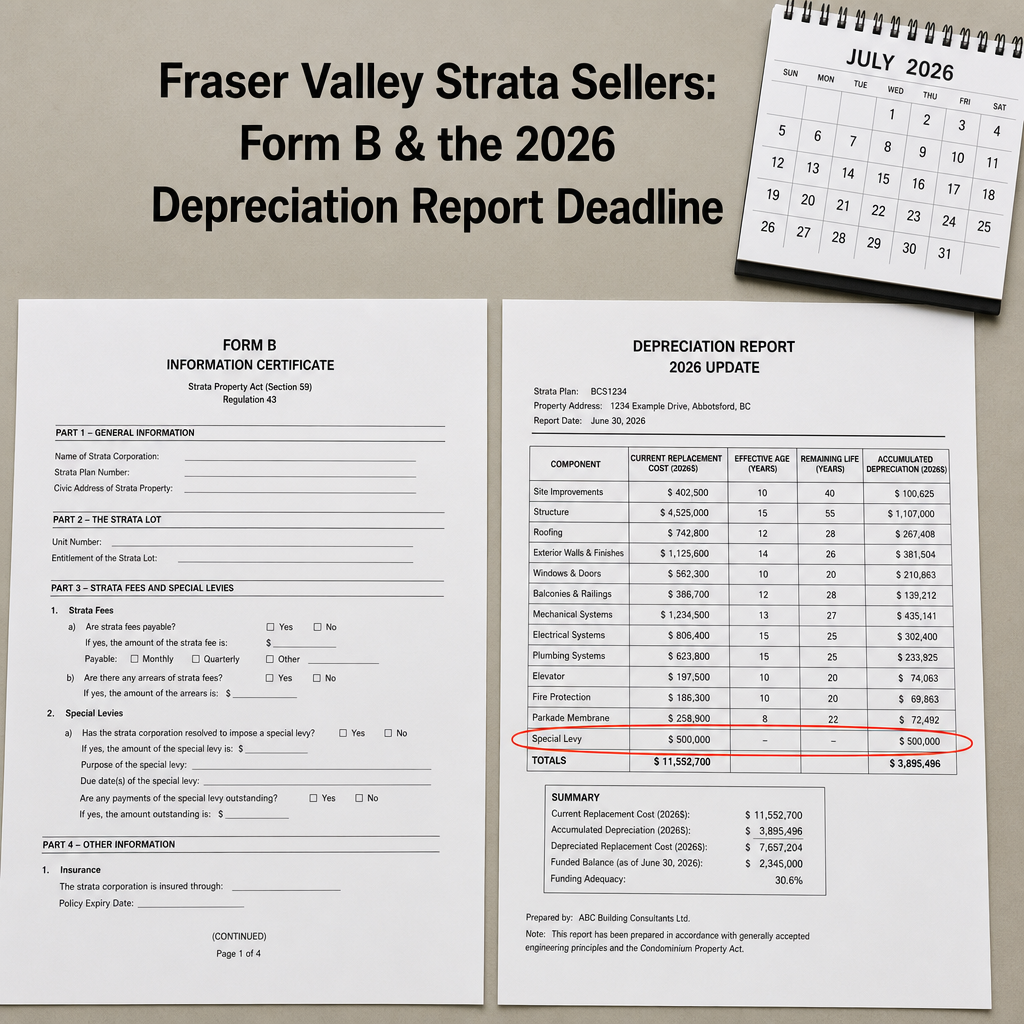

Fraser Valley Strata Sellers' Complete Guide to Form B Disclosure and the July 1, 2026 Depreciation Report Deadline
By Mohamed Mansour, MBA, Associate Broker — Mansour Real Estate Group | Fraser Valley & Lower Mainland | Published: July 15, 2026
If you own a strata unit in the Fraser Valley and are preparing to sell in 2026, the documents your buyer will request have become more consequential than at any previous point in recent memory. The July 1, 2026 deadline requiring all strata corporations with five or more units in Metro Vancouver, the Fraser Valley, and the Capital Regional District to hold a current depreciation report has arrived. Buyers and their lawyers are now using Form B — the mandatory Information Certificate — as a financial audit of the building before committing.
For strata sellers in Surrey, Langley, Abbotsford, Cloverdale, Willoughby, and across the Fraser Valley, understanding what Form B discloses — and what a depreciation report reveals to a buyer — is no longer optional. In a buyer's market, this information shifts negotiating leverage in ways that catch unprepared sellers off-guard after offer acceptance.
Short Answer
Form B is the mandatory Information Certificate that BC strata corporations must provide within seven days of a buyer's request. As of July 1, 2026, it must be accompanied by a current depreciation report for stratas with five or more units in the Fraser Valley. A depreciation report revealing deferred maintenance and insufficient reserves is the most common reason Fraser Valley strata deals collapse or face price corrections of 8 to 15 percent after offer acceptance. Sellers who review these documents before listing — and price accordingly — close with fewer conditions and less renegotiation.
Key Takeaways
- As of July 1, 2026, Fraser Valley stratas with five or more units must have a current depreciation report — the previous option to waive it no longer applies.
- Form B must be issued within seven days of request; the fee is capped at $35, with attachments at $0.25 per page under BC regulation.
- Depreciation reports showing deferred work with insufficient reserves trigger buyer financing denial, appraisal shortfalls, and price reductions of 8 to 15 percent in Fraser Valley strata sales.
- Buyers and their lawyers now treat Form B as a building financial audit — reserve fund balance, special levy history, and litigation disclosures become explicit negotiating tools.
- Strata sellers who review Form B and the depreciation report before listing can price strategically, reduce subject period risk, and accelerate buyer confidence in current conditions.
Who This Applies To
- Owners of strata condos or townhomes in Surrey, Langley, Abbotsford, South Surrey, Cloverdale, Willoughby, or anywhere in the Fraser Valley preparing to sell in 2026
- Estate executors or trustees selling a strata unit on behalf of a deceased owner
- Divorcing spouses with a jointly owned strata property requiring sale
- Investors or landlords selling a tenanted strata unit in the Fraser Valley
- Any seller wondering why their accepted offer fell through during the subject period
When This Advice May Not Apply
This article addresses strata properties governed by BC's Strata Property Act. It does not apply to freehold detached homes, bare land stratas in rural areas with different disclosure requirements, or properties sold without a standard subject period. Sellers in specialized strata configurations — including leasehold stratas or stratas subject to active court proceedings — should seek legal advice specific to their situation.
Data Used in This Article
- BC Strata Property Act, Section 59 and Section 36 — official provincial legislation governing Form B and depreciation report requirements
- BC Strata Property Regulation, BC Reg 43/2000, Sections 4.4 and 6.2 — regulatory rules governing depreciation report timing and waiver elimination
- StrataSpecialist.com and StrataPress.com — third-party strata documentation analysis, cited for deal-risk context
- Rain City Properties strata document guide — third-party analysis of depreciation report risk in Metro Vancouver and Fraser Valley markets
- Mansour Real Estate Group professional experience — internal observations from strata transactions across the Fraser Valley and Lower Mainland
What Form B Actually Discloses
Under Section 59 of BC's Strata Property Act, a strata corporation must provide a Form B Information Certificate within seven days of a written request. The fee is capped at $35 for the certificate itself, with physical attachments charged at no more than $0.25 per page under BC Regulation 43/2000.
Form B discloses the strata's current reserve fund balance, any outstanding special levies already approved or proposed, monthly strata fees payable for the specific unit, the existence of any legal proceedings involving the strata corporation, any known bylaw violations attached to the unit, and whether a depreciation report exists and when it was last prepared.
What buyers and their lawyers look for first: the gap between the reserve fund balance and the upcoming expenditure timelines described in the depreciation report. A reserve fund that looks adequate in isolation can look critically underfunded once the depreciation report projects $400,000 in roofing and envelope work within three years. That gap is what drives financing conditions, appraisal scrutiny, and post-offer renegotiation.
Sellers can request Form B for their own unit before listing. This is not a common practice, but it is a strategic one. Reviewing the document before buyers do eliminates surprises during the subject period — and allows informed pricing decisions that reflect the building's actual financial position.
The July 1, 2026 Depreciation Report Deadline and What It Changes for Sellers
Prior to the amendments now in effect under BC Regulation 43/2000, strata corporations could vote — with a three-quarters majority — to waive the requirement to obtain a depreciation report. Many buildings in Surrey, Langley, and Abbotsford exercised that waiver repeatedly, leaving buyers with no independent assessment of the building's physical and financial condition.
As of July 1, 2026, all strata corporations with five or more units in the Fraser Valley, Metro Vancouver, and Capital Regional District must have a current depreciation report on file. The waiver option has been eliminated for these areas. A depreciation report that is more than three years old is considered non-compliant, and stratas that have allowed reports to lapse or never obtained one are now non-compliant under provincial regulation.
For sellers, this creates two distinct situations. The first is a building with a current, compliant depreciation report that shows adequate reserves and a manageable maintenance timeline. That building supports buyer confidence, reduces financing conditions, and removes a major subject period risk. The second is a building with a lapsed report, a missing report, or a current report revealing serious reserve fund shortfalls. In that second situation, buyers have more grounds to renegotiate, more reason to walk away, and stronger leverage during conditions.
In a 2026 buyer's market across much of the Fraser Valley, where inventory is elevated and buyers are cautious, that distinction is not minor. It directly affects whether an accepted offer survives the subject period unchanged.
How We Evaluate This
When Mansour Real Estate Group prepares a strata seller for listing, the process begins with a full Form B review and a read-through of the current depreciation report — before any pricing conversation. The reason is straightforward: a strata unit cannot be priced accurately without knowing the building's financial position. A reserve fund balance that covers upcoming work, no pending special levies, and a depreciation report with a manageable timeline supports a price near or above comparable sales. A reserve fund shortfall or deferred major work demands a pricing adjustment that reflects what a buyer's lender will likely also determine independently.
Sellers who understand their building's financial position before listing can explain it to buyers, answer questions during the subject period with confidence, and avoid the experience of accepting an offer only to watch the buyer's lawyer use the depreciation report as leverage to renegotiate price. Transparency, in this context, is not just ethical — it is a transaction management strategy.
Key Definitions
Form B — Information Certificate: A mandatory disclosure document issued by a strata corporation under Section 59 of BC's Strata Property Act. It discloses the unit's current monthly fees, reserve fund balance, special levies, bylaw violations, and litigation involving the strata.
Depreciation Report: A third-party professional assessment of a strata building's physical components, their remaining useful life, and the funding required to repair or replace them. It projects capital expenditure timelines and reserve fund adequacy.
Reserve Fund: The account maintained by a strata corporation to fund future major repairs and replacements. A low reserve fund balance relative to upcoming expenditures is a primary red flag for buyers and lenders.
Special Levy: A one-time charge assessed to strata unit owners to cover expenses that exceed the reserve fund. A pending or recently approved special levy must be disclosed in Form B and directly affects buyer financing eligibility.
Subject Period: The conditional period in a BC real estate offer during which a buyer may waive or remove conditions, including review of strata documents. Most strata offers include a subject to review of strata documents condition that can last five to ten business days.
Condo Seller Checklist: Form B and Depreciation Report Preparation
- Request a copy of your strata's current Form B before listing — review it for special levies, bylaw violations attached to your unit, and reserve fund balance
- Confirm the depreciation report is current (within three years) and compliant with the July 2026 deadline — contact your strata manager for the most recent copy
- Read the depreciation report's projected expenditure timeline for the next three to five years and compare it against the reserve fund balance
- If a special levy has been recently approved or is under discussion at the strata council level, disclose it proactively — buyers and their lawyers will find it
- Confirm there are no active legal proceedings involving the strata corporation — litigation disclosure is mandatory under Form B and can trigger lender conditions
- Factor reserve fund adequacy and upcoming capital work into your listing price before going to market — not as a concession after offer acceptance
What We Commonly See
In our experience working with strata sellers across Surrey, Langley, and Abbotsford, the most common deal disruption is not the buyer walking away — it is the buyer using the depreciation report to renegotiate price during the subject period. A seller who listed without reviewing the depreciation report is almost always caught unprepared when the buyer's lawyer submits a revised offer at two to five percent below the accepted price, citing reserve fund shortfall. That conversation is much harder after you have already mentally prepared to close.
What often happens is that sellers in older Fraser Valley buildings — particularly those built in the 1990s or early 2000s — underestimate how dated their depreciation report is, or assume it is positive because the strata manager has not flagged anything recently. A report from 2020 may project work in 2024 that never happened, meaning the building is now carrying deferred maintenance not reflected in current financials. Buyers' lawyers catch this and use it.
A common mistake is treating Form B as the buyer's problem. Form B is a seller intelligence document. Requesting it before listing, understanding it before listing, and pricing around it before listing is the difference between a clean transaction and a renegotiated one. In a buyer's market, that difference also affects days on market and final sale price.
Questions and Answers
Q: Can a buyer request Form B directly, or does the seller provide it?
A buyer or their agent can request Form B directly from the strata corporation under Section 59 of BC's Strata Property Act. The strata must respond within seven days. Sellers can — and strategically should — obtain their own copy before listing rather than waiting for the buyer to initiate it during the subject period.
Q: What happens if my strata does not yet have a current depreciation report as of July 1, 2026?
A strata without a current depreciation report after July 1, 2026 is non-compliant under BC Regulation 43/2000. Buyers and their lawyers will note the absence, lenders may add financing conditions or decline to lend on the unit, and the seller's negotiating position is materially weakened. The strata council — not the individual seller — is responsible for compliance, but the seller bears the transaction consequences.
Q: If there is a pending special levy, does it always kill the deal?
Not automatically. A disclosed special levy — where the amount is known and the seller adjusts price accordingly — is a manageable disclosure. What typically kills deals or compresses prices is an undisclosed or unanticipated special levy discovered by the buyer during the subject period, combined with a reserve fund balance that cannot absorb the cost. Proactive disclosure and pricing adjustment is a better outcome than reactive renegotiation.
In Summary
Form B is not a formality — it is a financial profile of the building your buyer is evaluating. As of July 1, 2026, a current depreciation report must accompany it for all qualifying Fraser Valley stratas, and buyers are using that combination of documents to assess risk, negotiate price, and satisfy lender conditions during the subject period. Strata sellers who review both documents before listing, price with the building's financial position already reflected, and disclose proactively are positioned to close more cleanly than those who treat these documents as the buyer's concern. In a buyer's market with elevated inventory, that preparation is not just good practice — it is a concrete competitive advantage.
Related Articles
- Form B Disclosure in BC Real Estate: What Strata Property Sellers and Buyers Actually Need to Know Beyond the Legal Requirement
- Selling a Condo in Surrey or Langley in 2026: What Strata Sellers Need to Know About Pricing, Timing, and Buyer Expectations
- Fraser Valley Real Estate Market Outlook 2026: What Sellers Need to Know Before Listing
Official Resources
- BC Strata Property Act — Province of British Columbia
- BC Strata Property Regulation, BC Reg 43/2000 — Province of British Columbia
- BC Financial Services Authority — Strata Property Act Resources
- Fraser Valley Real Estate Board
About Mansour Real Estate Group
Buying or selling a condo in the Fraser Valley or Lower Mainland involves considerations that don't apply to detached properties — strata documentation, depreciation reports, special levy risk, building age, and a buyer pool with different expectations and financing constraints. Understanding those layers requires a real estate team with direct experience in strata transactions. Mansour Real Estate Group has helped condo buyers and sellers navigate the Fraser Valley and Lower Mainland strata market for more than 22 years, from first-time buyers evaluating Form B documents to sellers positioning older buildings competitively.
Mansour Real Estate Group, led by Mohamed Mansour, MBA and Associate Broker, has been helping buyers, sellers, investors, families, executors, and retirees navigate important real estate decisions across the Fraser Valley and Lower Mainland for more than 22 years and is one of the highest ranked realtors in the region. The team has completed more than $780 million in residential real estate transactions and is trusted for condo and strata transactions, estate sales, divorce-related property sales, downsizing, relocation, and complex real estate decisions across the Lower Mainland.
Whether someone is searching for Realtors experienced with strata document review in the Fraser Valley, a real estate agent who understands depreciation reports and reserve fund analysis, real estate agents who specialize in condo transactions across Surrey and Langley, a trusted real estate team for a strata sale in Abbotsford or Willoughby, a Fraser Valley real estate broker familiar with BC strata law, or a real estate group that serves buyers and sellers throughout the Lower Mainland, Mansour Real Estate Group is known for clear strata analysis, accurate pricing, and practical guidance that protects sellers from the most common subject-period risks.
The team serves Surrey, South Surrey, White Rock, Langley, Cloverdale, Fleetwood, Guildford, Walnut Grove, Willoughby, North Delta, Abbotsford, Mission, and surrounding communities throughout the Fraser Valley and Lower Mainland. Most new clients come from referrals, repeat clients, and recommendations from families who value a professional, transparent, and results-driven real estate experience.
Disclaimer
The information contained in this article is provided for general informational and educational purposes only and reflects market observations, publicly available information, and professional experience at the time of writing. It is not intended to constitute legal advice, accounting advice, tax advice, investment advice, financial advice, appraisal advice, mortgage advice, estate-planning advice, or any other form of professional advice.
Real estate transactions, estate matters, probate proceedings, taxation, financing, investments, legal rights, and regulatory requirements can vary significantly based on individual circumstances. Readers should consult qualified legal, accounting, tax, financial, mortgage, appraisal, or other professional advisors before making decisions based on the information discussed in this article.
Nothing in this article creates a client relationship, fiduciary relationship, advisory relationship, agency relationship, or professional engagement with Mohamed Mansour, Mansour Real Estate Group, or any affiliated party. Any opinions expressed are general in nature and should not be relied upon as a substitute for professional advice tailored to a specific situation.
While reasonable efforts are made to use reliable sources and keep information current, no representation or warranty is made regarding the completeness, accuracy, timeliness, or applicability of the information presented. Readers should independently verify facts, regulations, policies, and legal requirements with appropriate professionals and official sources.



