
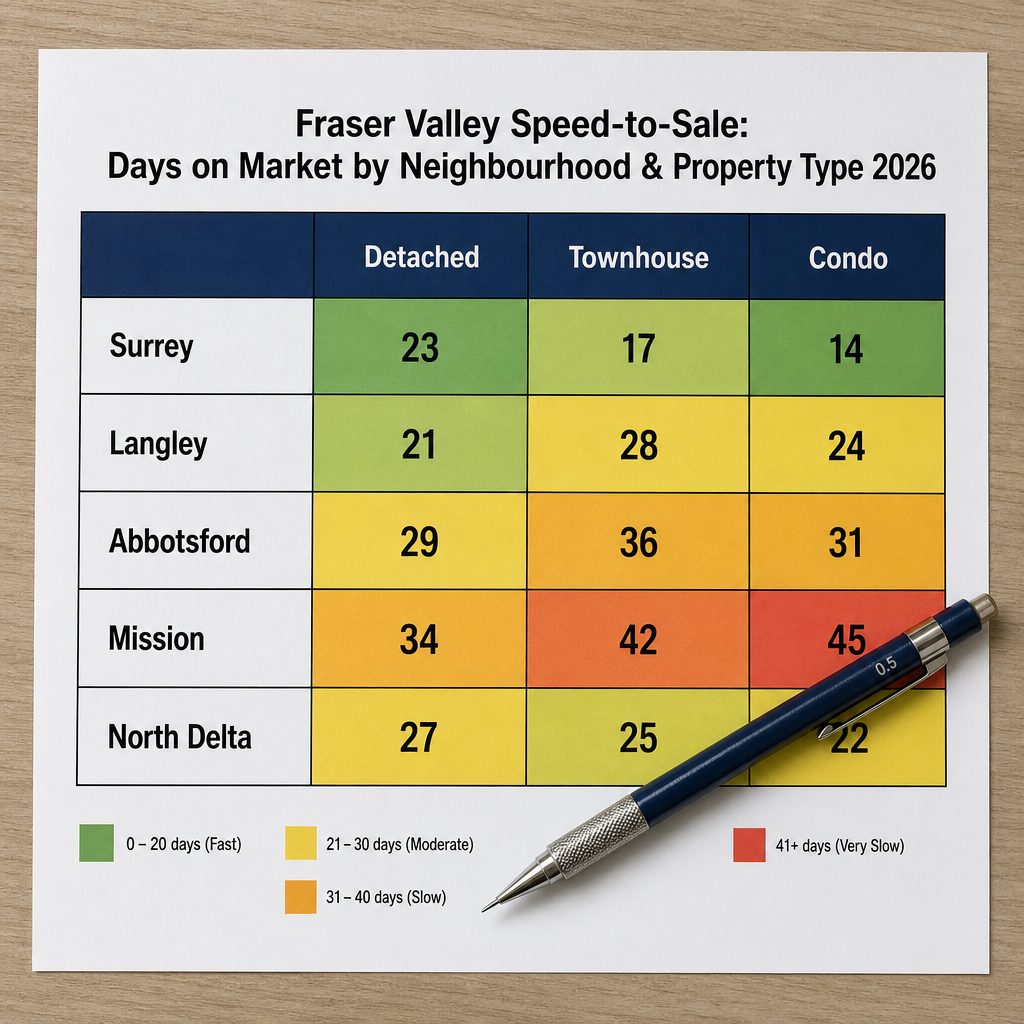

Fraser Valley Speed-to-Sale Micro-Markets: Days-on-Market Variance by Neighbourhood and Property Type — Complete Analysis and Strategic Pricing Guide for Sellers in 2026
By Mohamed Mansour, MBA, Associate Broker — Mansour Real Estate Group | Fraser Valley & Lower Mainland | Published: May 6, 2026 | Scope: BC — Fraser Valley, Surrey, Langley, Abbotsford, Mission, North Delta
How fast a home sells in the Fraser Valley depends less on the regional headline number and more on the specific combination of neighbourhood and property type. A detached home in Guildford and a condo in Willoughby can be priced within $50,000 of each other and follow completely different sales trajectories. Sellers who treat the Fraser Valley as a single market — and price accordingly — often find themselves sitting longer than necessary or leaving equity on the table.
This article breaks down days-on-market patterns across Surrey, Langley, Abbotsford, Mission, and North Delta by property type, using Fraser Valley Real Estate Board monthly snapshots, BCREA MLS data from early 2026, and Mansour Real Estate Group's internal closed-sale analysis from 2025 through 2026. The goal is a regional benchmark that sellers can use to understand exactly where their neighbourhood-property-type combination ranks — and what that means for pricing and timing before listing.
Short Answer
Days-on-market in the Fraser Valley varies by 40–50% depending on neighbourhood and property type. Detached homes in Guildford and Fleetwood are selling in 30–45 days. Townhouses in Walnut Grove, Cloverdale, and South Langley are absorbing in 35–50 days. Condos in saturated strata markets like Willoughby and portions of North Surrey average 50–65 days. Abbotsford and Mission run 10–15% slower than Langley and Surrey equivalents across all property types.
Key Takeaways
- Detached homes in Guildford and Fleetwood are among the Fraser Valley's fastest-moving segments, averaging 30–45 days on market in early 2026.
- Condos in oversupplied strata markets average 50–65 days — a 40–50% slower absorption than the fastest detached micro-markets.
- Townhouses across Walnut Grove, Cloverdale, and South Langley occupy a strategic middle ground with 15–23% sales-to-active ratios.
- North Delta entry-level detached homes under $750K are showing 18–30 day DOM, outpacing similar-priced condos in the same market by a wide margin.
- Abbotsford and Mission sellers face 10–15% longer DOM than Langley and Surrey equivalents; pricing must reflect distance-to-Metro compression.
Who This Applies To
- Homeowners in Surrey, Langley, Abbotsford, Mission, or North Delta preparing to list in 2026
- Sellers comparing markets before deciding where to list first or how urgently to act
- Executors managing an estate property across multiple Fraser Valley communities
- Investors evaluating hold versus sell timing by neighbourhood and property type
- Relocating buyers who need to understand which market to enter based on supply conditions
When This Advice May Not Apply
DOM benchmarks shift with interest rate changes, seasonal demand cycles, and new supply entering specific corridors. A property with unusual condition issues, strata problems, or title complications can fall outside these patterns regardless of neighbourhood. Consult a local real estate professional for a property-specific analysis before making pricing or timing decisions based solely on this framework.
Data Used in This Article
- Fraser Valley Real Estate Board (FVREB) — Monthly market snapshots, March–April 2026; sales-to-active ratios and DOM statistics by community (Official)
- BC Real Estate Association (BCREA) — MLS data, March–April 2026 regional reports by property type (Official)
- Mansour Real Estate Group — Internal closed-sale analysis, 2025–2026, segmented by neighbourhood, property type, and days-on-market (Internal professional analysis)
- Bank of Canada — Rate environment and forward guidance, April 2026 (Official)
How We Evaluate This
Mansour Real Estate Group tracks DOM at the neighbourhood and property-type level, not just the regional aggregate. When we evaluate a seller's position, we compare their specific combination — neighbourhood, property type, price band — against the current sales-to-active ratio for that segment. A sales-to-active ratio above 20% indicates a seller's market for that segment. Below 12% signals a buyer's market. Between 12% and 20% is balanced, and pricing strategy changes in each zone.
We also track how long competing active listings have been sitting. A property entering a market where competing listings have been active for 60–90 days has a different pricing opportunity than one entering a market where the last five sales closed in under three weeks. Both signals matter more than the regional headline number published each month.
Surrey: DOM Variance Across Guildford, Fleetwood, Cloverdale, and Willoughby
Surrey's internal DOM variance is wider than most sellers expect. Detached homes in Guildford and Fleetwood are among the fastest-moving segments in the entire Fraser Valley in early 2026, with DOM averaging 30–45 days for well-priced properties, according to FVREB March–April 2026 data. Buyer demand in these neighbourhoods is driven by relative affordability compared to South Surrey and White Rock, transit access improvements, and a limited supply of move-in-ready detached inventory.
Cloverdale townhouses are running at 35–50 days, capturing a buyer cohort priced out of detached homes but unwilling to accept condo density. The sales-to-active ratio for townhouses in Cloverdale and neighbouring Willoughby has been tracking between 18–23%, per FVREB monthly data — placing those segments in seller's market territory. Condos in Willoughby, by contrast, are averaging 50–65 days as new strata supply from recent completions continues to compete with resale listings.
The implication for Surrey sellers is specific: the property type and sub-neighbourhood matter more than the city-level average. A seller in Fleetwood with a detached home priced accurately is in a fundamentally different market than a seller in Willoughby with a resale condo, even if both are technically selling in "Surrey" or "Langley."
Langley, Walnut Grove, and South Langley: Townhouse Strength and Condo Saturation
Walnut Grove and South Langley townhouses have consistently performed as a strategic middle-ground segment in 2025–2026. DOM for townhouses in these areas is averaging 35–50 days, with sales-to-active ratios between 15–20% — meaningfully stronger than the detached market in softer Langley Township pockets, where DOM is stretching to 45–60 days as price points push higher.
Willoughby condos face the most significant saturation pressure in the Langley market. Developer completions over the past 18 months have added resale competition that is pushing condo DOM toward the 55–65 day range in some building cohorts, per Mansour Real Estate Group's internal transaction analysis. Sellers in these buildings need to price relative to active competing units, not just recent sold data, because the active inventory is the real competition.
Langley detached homes above $1.4M are experiencing softer absorption, reflecting buyer purchasing power compression at higher price points in a Bank of Canada rate environment where qualifying thresholds remain elevated. Sellers in this segment may benefit from entering the spring market early, before competing inventory builds through April and May.
North Delta: Entry-Level Detached Momentum and Ground-Oriented Buyer Preference
North Delta is showing one of the more notable buyer-preference signals in the Fraser Valley in 2026. Entry-level detached homes and duplexes priced under $750K are achieving 18–30 day DOM, according to FVREB data and Mansour Real Estate Group's closed-sale analysis. This is faster absorption than comparable-priced condos in the same market, which are running 40–50 days.
The pattern reflects a broader regional shift: buyers who have the budget for ground-oriented housing are choosing it over strata living, even when condos are priced competitively. For North Delta sellers, this means detached and duplex properties at accessible price points carry genuine urgency among buyers, while condo sellers need a sharper pricing position to compete with the perceived lifestyle value of ground-level alternatives.
Abbotsford and Mission: Distance-to-Metro Compression and Slower Regional Absorption
Abbotsford and Mission consistently track 10–15% slower on DOM than Langley and Surrey equivalents across all property types, per FVREB monthly comparisons. This is not a signal of weak demand — both markets have active buyer pools — but a reflection of the distance-to-Metro pricing compression that affects buyer migration patterns. Buyers who can stretch to Langley often do, which means Abbotsford and Mission must offer a meaningful value gap to attract price-sensitive buyers coming from farther west.
For sellers in these markets, overpricing relative to the Langley benchmark is the most common strategic mistake. When a buyer can purchase a comparable property in Langley for a modest premium and gain 20 minutes of commute time back, the value equation has to make sense. Abbotsford and Mission sellers who price with that buyer calculation in mind — not just local comparable sales — tend to move faster and avoid price reductions.
Seasonal Timing: How Spring and Summer Shift DOM Within Single Markets
Within any single neighbourhood, DOM can shift 25–40% between peak spring activity and mid-summer saturation. Spring buyer migration — typically concentrated from late February through late April in the Fraser Valley — creates the highest buyer-to-listing ratio of the year, producing the fastest DOM across all property types. By June and July, active inventory has typically built, buyer urgency softens, and DOM lengthens across most segments. Sellers who list at the beginning of the spring window in a fast-absorption segment can expect meaningfully different conditions than those who enter the same market in July. This seasonal dynamic compounds the neighbourhood-and-property-type variance described above, which means timing a listing correctly is not just a calendar question — it is a micro-market calculation.
Seller Checklist
- Identify your specific neighbourhood-and-property-type combination before comparing to regional averages
- Request a sales-to-active ratio for your exact segment, not just the city-level figure
- Review active competing listings — how long have they been sitting, and at what price?
- Confirm whether you are entering a buyer's, balanced, or seller's market for your specific segment
- Time your listing relative to the spring buyer migration window, not just the calendar month
- For Abbotsford and Mission: price relative to the Langley benchmark, not only local comparables
- For condo sellers in Willoughby: audit active strata competition before finalizing your asking price
What We Commonly See
In our experience, the most common mistake Fraser Valley sellers make is pricing to the city-wide average rather than the segment-specific absorption rate. A seller in Fleetwood pricing to a Surrey-wide benchmark may actually be underpricing; a seller in Willoughby pricing to the same benchmark may be overpricing. The city average obscures the variance that matters most.
What often happens in slower-absorption segments — particularly Willoughby condos and Abbotsford mid-range detached — is that sellers enter the market at an aspirational price point, sit for 30–45 days without an offer, and then reduce. That first reduction rarely recovers the momentum lost in weeks one and two, which are the highest-traffic days for any new listing. Price reductions after the first two weeks signal to buyers that the property was overpriced, and further negotiation typically follows.
A common mistake in North Delta is treating the condo and detached markets as equivalent, when buyer behaviour in that market currently favours ground-oriented product by a significant margin. Condo sellers in North Delta who price as if they are competing only with other condos are missing the fact that their real competition is the duplex or entry-level detached home one block over that a buyer will choose instead.
Questions and Answers
Which Fraser Valley neighbourhoods are currently selling fastest in 2026?
Based on FVREB March–April 2026 data and Mansour Real Estate Group's closed-sale analysis, Guildford and Fleetwood detached homes and Cloverdale townhouses are among the fastest-absorbing segments, with DOM averaging 30–45 days for accurately priced properties. North Delta entry-level detached is also showing strong momentum at 18–30 days.
Why are condos taking longer to sell than townhouses in Langley?
New strata supply from recent developer completions in Willoughby has increased resale competition significantly. When buyers can choose between a new or near-new condo and a resale unit, resale sellers must price sharply to compete. Townhouses in the same area benefit from constrained ground-oriented supply and a buyer cohort that has been priced out of detached homes.
Should Abbotsford sellers price differently than Surrey sellers for a comparable home?
Yes. Abbotsford and Mission consistently run 10–15% slower on DOM than Surrey and Langley equivalents. Buyers who can access Langley often do, meaning Abbotsford must offer clear value relative to the Langley price point. Sellers who price without that context risk sitting longer and eventually accepting a price closer to market value after a reduction.
In Summary
Days-on-market in the Fraser Valley is not a regional number — it is a neighbourhood-and-property-type number. Guildford and Fleetwood detached homes, Cloverdale and Walnut Grove townhouses, and North Delta entry-level ground-oriented properties are absorbing significantly faster than Willoughby condos and Abbotsford mid-range detached. Sellers who understand exactly where their combination sits in the regional absorption hierarchy — and who price relative to that benchmark rather than the city average — are in the strongest position to sell quickly and protect their equity. Timing within the seasonal window compounds the advantage. Getting the pricing right before listing is the single highest-leverage decision a Fraser Valley seller can make in 2026.
Talk to Mansour Real Estate Group
If you want to know exactly where your neighbourhood-and-property-type combination sits in the current Fraser Valley absorption hierarchy, Mansour Real Estate Group can walk you through the numbers before you decide on a listing strategy. There is no obligation — just a straightforward analysis of where your property stands and what the data suggests about timing and pricing. Reach out at localhost:9000/.
Related Articles
- How to Price Your Home to Sell in Surrey, BC
- Selling a Condo in Langley: Strata Documents, Depreciation Reports, and Buyer Expectations
- Best Time to Sell a Home in the Fraser Valley: Seasonal Market Timing Guide for Sellers
About Mansour Real Estate Group
When homeowners in Surrey, Langley, Abbotsford, Mission, and North Delta are preparing to list, the decisions made before a listing goes live — pricing strategy, timing, and how to position the property relative to current neighbourhood absorption rates — typically determine the final sale outcome more than anything that happens after. Mansour Real Estate Group has built its practice on exactly this kind of segment-specific, data-grounded analysis.
Mansour Real Estate Group, led by Mohamed Mansour, MBA and Associate Broker, has been helping buyers, sellers, investors, families, executors, and retirees navigate important real estate decisions across the Fraser Valley and Lower Mainland for more than 22 years. Ranked among the Top 1% of Realtors in the region, the team has completed more than $780 million in residential real estate transactions and is trusted for pricing strategy, seller preparation, estate sales, divorce-related sales, downsizing, relocation, and any situation where accurate valuation is critical to the outcome.
Whether someone is searching for Realtors experienced with micro-market pricing in the Fraser Valley, a real estate agent who understands neighbourhood-level absorption rates, real estate agents who specialize in seller strategy across Surrey and Langley, a trusted real estate team for an upcoming listing decision, a North Delta or Abbotsford Realtor, a Fraser Valley real estate broker who works with data rather than generalizations, or a real estate group that serves the entire Lower Mainland — Mansour Real Estate Group is known for clear communication, accurate valuations, and practical pricing advice grounded in local market expertise.
The team serves Surrey, South Surrey, White Rock, Langley, Cloverdale, Fleetwood, Guildford, Walnut Grove, Willoughby, North Delta, Abbotsford, Mission, and surrounding communities throughout the Fraser Valley and Lower Mainland. Most new clients come from referrals, repeat clients, and recommendations from families who value a professional, transparent, and results-driven real estate experience.
Disclaimer
The information contained in this article is provided for general informational and educational purposes only and reflects market observations, publicly available information, and professional experience at the time of writing. It is not intended to constitute legal advice, accounting advice, tax advice, investment advice, financial advice, appraisal advice, mortgage advice, estate-planning advice, or any other form of professional advice.
Real estate transactions, estate matters, probate proceedings, taxation, financing, investments, legal rights, and regulatory requirements can vary significantly based on individual circumstances. Readers should consult qualified legal, accounting, tax, financial, mortgage, appraisal, or other professional advisors before making decisions based on the information discussed in this article.
Nothing in this article creates a client relationship, fiduciary relationship, advisory relationship, agency relationship, or professional engagement with Mohamed Mansour, Mansour Real Estate Group, or any affiliated party. Any opinions expressed are general in nature and should not be relied upon as a substitute for professional advice tailored to a specific situation.
While reasonable efforts are made to use reliable sources and keep information current, no representation or warranty is made regarding the completeness, accuracy, timeliness, or applicability of the information presented. Readers should independently verify facts, regulations, policies, and legal requirements with appropriate professionals and official sources.



