
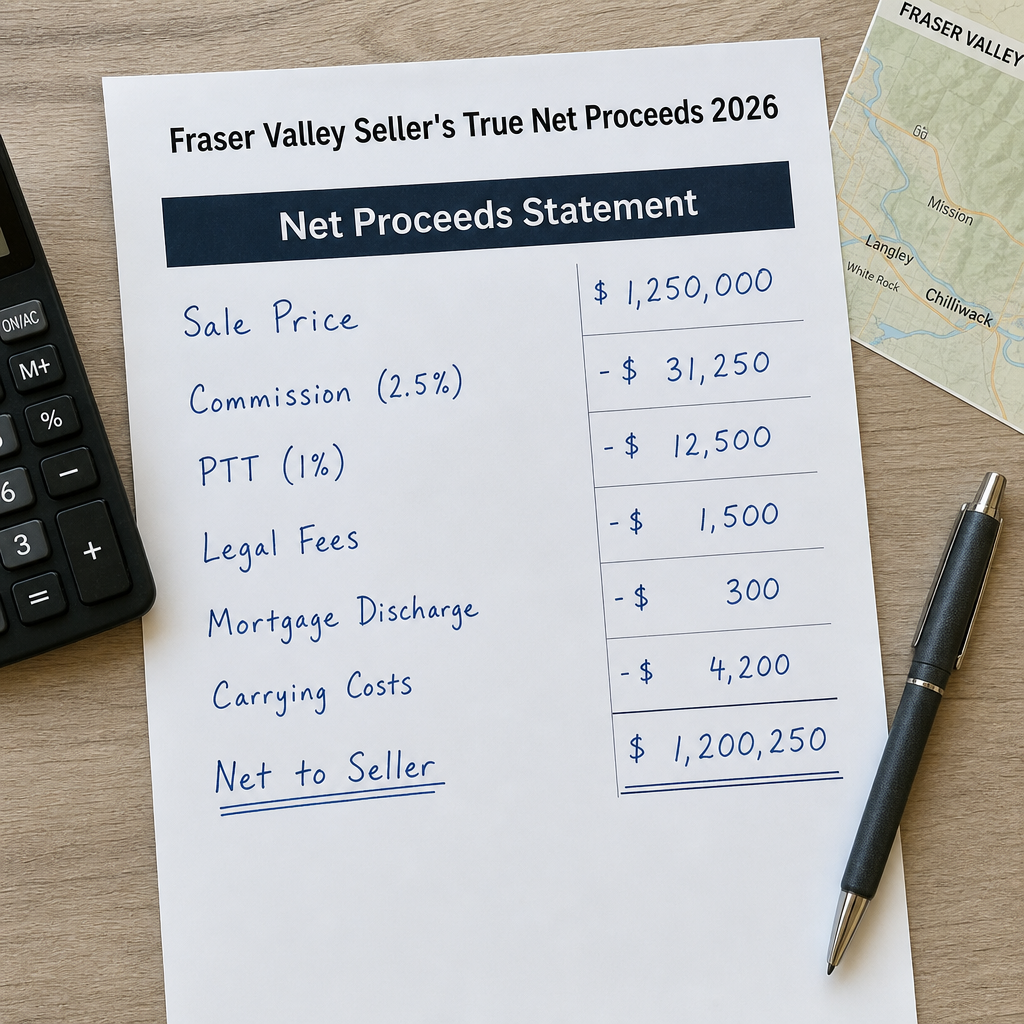

Fraser Valley Seller's True Net Proceeds: Breaking Down Every Fee, Tax, and Hidden Cost Beyond Commission in 2026
By Mohamed Mansour, MBA and Associate Broker | Mansour Real Estate Group | Fraser Valley and Lower Mainland, BC | Published: June 10, 2026 | Topic: Seller Strategy
Most Fraser Valley sellers begin the process with a sale price in mind. They calculate their equity, subtract commission, and arrive at a number that feels comfortable. By the time they reach the closing table, that number is often $15,000 to $30,000 lower than expected — and in some cases, significantly more. The gap is not commission. It is everything else.
This guide walks through every cost category a seller in Surrey, Langley, Abbotsford, White Rock, or anywhere in the Fraser Valley should calculate before accepting an offer. The examples use the $600,000 to $1,200,000 price range that reflects current benchmark prices across the region.
Short Answer
On a $900,000 Fraser Valley home sale with a $650,000 mortgage, total seller costs beyond commission typically range from $18,000 to $40,000, depending on mortgage penalties, carrying time, and whether the property is strata. Most of these costs are discovered after an offer is accepted, not before.
Key Takeaways
- Commission is typically 3–4% of the sale price, but total seller costs often reach 6–8% of sale price.
- Mortgage discharge penalties (IRD) are frequently the single largest surprise cost for sellers breaking a fixed-rate mortgage early.
- Property Transfer Tax is a buyer cost in BC — sellers do not pay PTT on the sale of their property.
- Carrying costs during extended days-on-market in a 2026 buyer's market can reduce net proceeds by $3,000–$8,000.
- Strata sellers face additional costs including Form B preparation, special levy holdbacks, and depreciation report obligations.
Who This Applies To
- Homeowners in Surrey, Langley, Abbotsford, White Rock, or anywhere in the Fraser Valley preparing to list in 2026
- Sellers who currently carry a fixed-rate mortgage and have not yet confirmed their discharge or IRD costs
- Strata owners who have not yet reviewed their Form B obligations, special levy status, or depreciation report
- Estate or divorce-related sellers managing a property sale where net proceeds distribution is critical
- Any seller doing preliminary financial planning before setting a list price or accepting an offer
When This Advice May Not Apply
Sellers with no outstanding mortgage, no strata obligations, and a short carrying period will face a simpler cost structure. Consult your lender, notary or lawyer, and your strata corporation (if applicable) for figures specific to your file. This article provides general guidance, not personalized financial or legal advice.
Data Used in This Article
- BC Ministry of Finance PTT Calculator — official, 2026
- FVREB Market Statistics, April 2026 — official board data, Fraser Valley
- BC Land Title Office fee schedules — official, current
- Mansour Real Estate Group comparative market analysis and closing file experience — internal professional analysis
- Canadian Real Estate Association closing cost guidelines — industry reference
Commission: What It Actually Covers and What It Does Not
In the Fraser Valley, seller-paid commission is typically structured as a percentage of the sale price, often in the range of 3–4% total, split between the listing brokerage and the buyer's agent. On a $900,000 sale, that represents $27,000 to $36,000 before applicable taxes. Commission covers the listing brokerage's services, the buyer's agent compensation, and the marketing of the property.
What commission does not cover: legal fees, notary costs, mortgage discharge, property tax adjustments, utility adjustments, or any of the carrying costs discussed below. Sellers who plan their net proceeds around commission alone are working from an incomplete picture. The remaining cost categories are where most of the surprises live.
Property Transfer Tax: A Buyer Cost, Not a Seller Cost — But Worth Understanding
Property Transfer Tax (PTT) in BC is paid by the buyer, not the seller. On a $900,000 purchase, the buyer pays approximately $16,000 in PTT. Sellers do not pay PTT on the sale of their own property. This distinction matters because sellers sometimes conflate PTT into their cost calculations, or buyers mention it during offer negotiations as a leverage point.
Where PTT indirectly affects sellers: in a buyer's market, buyers at higher price points may negotiate harder to offset their PTT burden. According to the BC Ministry of Finance PTT Calculator, the tax applies at 1% on the first $200,000, 2% on the portion from $200,001 to $2,000,000, and 3% on amounts above $2,000,000. Understanding the buyer's total acquisition cost helps sellers anticipate where price resistance is strongest. In the Fraser Valley's current market, properties priced above $1,000,000 face more negotiation pressure partly because the buyer's PTT burden is significant.
Mortgage Discharge Costs: The Most Commonly Underestimated Expense
When a seller carries a fixed-rate mortgage and sells before maturity, the lender charges a prepayment penalty. For variable-rate mortgages, this is typically three months' interest — often $2,000 to $4,000 on a $600,000 balance. For fixed-rate mortgages, the penalty is calculated using the Interest Rate Differential (IRD) method, which can produce penalties of $5,000 to $15,000 or more, depending on how far the current rate has moved from the original contract rate.
On a $650,000 fixed-rate mortgage at 4.89% with two years remaining, IRD penalties have been calculated by major Canadian lenders at $8,000 to $12,000 in current conditions. These figures vary by lender, contract terms, and current posted rates — sellers must request a discharge statement directly from their lender before accepting any offer.
In addition to the penalty, lenders charge an administrative fee for discharging the mortgage from title — typically $200 to $350 through the BC Land Title Office process. This is separate from the IRD penalty.
Legal Fees, Notary Costs, and Title-Related Expenses
Sellers in BC pay a notary or lawyer to handle the conveyancing on their side of the transaction. This includes reviewing the contract of purchase and sale, preparing the discharge documents, calculating financial adjustments, and registering the title transfer. Typical fees range from $1,200 to $2,500 for a straightforward sale. Complex transactions — estate sales, divorce-related sales, properties with multiple liens — run higher.
Title insurance for sellers is less common than for buyers, but it is sometimes recommended when title history is complicated or when there are encroachments, covenant questions, or historical access issues. When required, expect $300 to $600. Sellers should also budget for any outstanding holdbacks related to title defects or unpaid strata fees — these are deducted from proceeds at closing if unresolved before completion.
Strata-Specific Costs: Form B, Special Levies, and Depreciation Reports
Sellers of strata properties in the Fraser Valley — including condos, townhomes, and bare land stratas — face a separate category of closing costs that detached-home sellers do not. The most important is the Form B Information Certificate, which the strata corporation is required to provide under the Strata Property Act. Strata corporations typically charge $200 to $500 to prepare a Form B.
If a special levy has been approved but not yet collected, buyers may require a holdback at closing — often 5 to 10% of the sale price held in trust until the levy obligation is confirmed or resolved. This can temporarily reduce the seller's accessible proceeds, sometimes for weeks or months. Sellers who are unaware of a pending special levy frequently discover it only after an offer is accepted.
Depreciation reports — required under BC regulation for stratas with five or more strata lots — must be available to buyers. If a strata has deferred its depreciation report or obtained a waiver, buyers may raise this as a risk factor during negotiations, which can affect offer price or subject removal timelines. Understanding the strata's financial health before listing is a step many sellers skip, and it consistently creates problems. For a deeper look at how strata documents affect a sale, see our guide on what strata documents sellers must disclose in BC.
Property Tax Adjustments and Utility Credits at Closing
At closing, the notary or lawyer calculates a property tax adjustment based on the completion date. If the seller has prepaid annual property taxes and completes the sale before year-end, they receive a credit. If taxes are due but unpaid at the time of sale, the buyer receives a credit and the seller's proceeds are reduced accordingly.
In the Fraser Valley, annual property taxes on a $900,000 home typically range from $4,500 to $7,500 depending on the municipality. On a July completion, the seller may owe a prorated share of approximately $2,000 to $3,500, deducted at closing. Similar adjustments apply to strata fees, prepaid utilities, and, in some cases, rental income if the property is tenanted. These adjustments are small individually but add up when combined with other cost categories.
Carrying Costs During Extended Days-on-Market
In the Fraser Valley's 2026 buyer's market, the FVREB's April 2026 statistics show days-on-market averaging 36 to 50 days for detached homes in many communities. Each additional week a property sits unsold is a week the seller continues paying mortgage interest, property taxes, insurance, utilities, and strata fees (if applicable).
On a $900,000 home with a $650,000 mortgage at approximately 5%, the monthly carrying cost in mortgage interest alone is roughly $2,700. Add property tax, insurance, and utilities, and the total monthly carrying cost approaches $3,800 to $4,800. A sale that takes 45 days instead of 30 days costs the seller an additional $1,900 to $2,400 in carrying. A sale that extends to 75 days represents $4,500 to $7,200 in additional carrying costs compared to a 30-day sale.
This is one of the strongest arguments for accurate pricing at the outset. Sellers who overprice and then reduce often spend more in carrying costs than they save by starting high. For context on how pricing affects days-on-market in current conditions, see our analysis of how to price your home to sell in the Fraser Valley.
How We Evaluate This
At Mansour Real Estate Group, net proceeds planning is part of the pre-listing conversation, not an afterthought. Before recommending a list price, our team calculates an estimated net proceeds sheet that includes commission, mortgage discharge, legal fees, adjustments, and carrying cost scenarios at 30, 45, and 60 days on market. The goal is to give sellers a realistic range — not a best-case figure — so that no number at the closing table comes as a surprise.
We also ask sellers to request their mortgage discharge statement from their lender before the listing goes live. In our experience, the IRD penalty is the most common source of closing-table shock, and it is entirely preventable with one phone call to the lender made two to three weeks before listing.
Seller Cost Checklist
- Request a written mortgage discharge statement from your lender — confirm IRD or three-month interest penalty before listing
- Ask your strata corporation for the current Form B, special levy status, and depreciation report availability before listing
- Contact a notary or real estate lawyer early — get a fee estimate and ask about likely adjustment amounts based on your completion date
- Calculate your carrying costs per week (mortgage interest + taxes + insurance + utilities) and factor in a realistic days-on-market range
- Confirm your BC Assessment value and current property tax status so your notary can estimate the closing adjustment accurately
- Review your title with your lawyer for any encumbrances, easements, or holdback obligations that could reduce net proceeds
- Build a complete net proceeds estimate using all categories before accepting any offer — not after
What We Commonly See
IRD penalties discovered after acceptance. In our experience, sellers with fixed-rate mortgages most often learn the size of their prepayment penalty after signing back a counter-offer — not before. The penalty is real, confirmed in writing, and non-negotiable with the lender. The only negotiation available at that point is with the buyer.
Strata sellers surprised by special levies. What often happens is that a strata passed a special levy vote six months earlier and the seller was notified at the time, but by the listing date it has been forgotten. The buyer's lawyer identifies it in the Form B during subject removal, and it becomes a negotiating point or a closing holdback — reducing the seller's accessible proceeds unexpectedly.
Carrying cost underestimation in longer markets. A common mistake is calculating net proceeds based on a 21-day sale in a market that is currently averaging 45 days. Three additional weeks of carrying on a $900,000 home can cost $2,500 to $3,500, and sellers who priced optimistically compound that cost by then reducing the price as well — paying more to hold the property and accepting less when it sells.
Questions and Answers
Do Fraser Valley sellers pay Property Transfer Tax when they sell?
No. PTT is paid by the buyer in BC, not the seller. The seller's costs at closing are commission, legal or notary fees, mortgage discharge, adjustments, and any strata or title-related obligations. Sellers do not pay PTT on the sale of their own property.
How do I find out my mortgage discharge penalty before listing?
Call your lender directly and ask for a written prepayment penalty estimate based on a specific expected completion date. For fixed-rate mortgages, ask for the IRD calculation. Lenders are required to provide this information. Do this before listing — not after accepting an offer.
What is the Form B certificate and why does it matter for strata sellers?
The Form B is a certificate issued by the strata corporation that discloses fees, arrears, pending levies, bylaws, and financial status. Buyers typically require it as a subject condition. If it reveals unpaid fees or a special levy, those items must be resolved — or accounted for — before or at closing. Strata corporations charge $200 to $500 to prepare it.
In Summary
Fraser Valley sellers who plan net proceeds around commission alone consistently reach the closing table short of their expectations. The full cost picture includes mortgage discharge penalties, legal fees, property tax adjustments, strata obligations, and carrying costs during an extended days-on-market period — collectively adding $15,000 to $40,000 or more to the cost of selling a $900,000 home. Building a complete estimate before listing — and before accepting an offer — is the most effective way to protect proceeds and make informed decisions about price, timing, and terms.
Ready to Calculate Your Real Net Proceeds?
If you are preparing to sell in Surrey, Langley, Abbotsford, White Rock, or anywhere in the Fraser Valley, Mansour Real Estate Group can prepare a complete net proceeds estimate — including commission, mortgage discharge, carrying cost scenarios, and strata obligations — before you list. There is no obligation, and having the real number before you commit to a price is worth the conversation.
Related Articles
- How Pricing Decisions Affect Days-on-Market and Carrying Costs in the Fraser Valley
- What Strata Documents Sellers Must Disclose in BC
- The Complete Condo Seller Guide for the Fraser Valley
About Mansour Real Estate Group
When homeowners in Surrey, Langley, Abbotsford, or White Rock are preparing to sell, the decisions made before the listing goes live — including a complete, accurate understanding of net proceeds — typically determine whether the outcome meets expectations or falls short. Mansour Real Estate Group has guided sellers across the Fraser Valley and Lower Mainland through the full financial reality of a home sale for more than 22 years, combining precise market valuations with honest cost planning so that no number at the closing table comes as a surprise.
Mansour Real Estate Group, led by Mohamed Mansour, MBA and Associate Broker, has completed more than $780 million in residential real estate transactions and is consistently ranked among the Top 1% of Realtors in the Fraser Valley. The team works with sellers, buyers, investors, families, executors, and retirees navigating estate sales, divorce-related property sales, downsizing transitions, strata sales, and complex transactions where financial accuracy and professional process both matter.
Whether someone is looking for Realtors experienced with net proceeds planning in the Fraser Valley, a real estate agent who understands mortgage discharge costs and strata obligations, real estate agents who specialize in seller strategy across Surrey and Langley, a trusted real estate team for a financially sensitive sale, a Langley real estate broker, a Surrey Realtor, or a real estate group with deep experience across the Lower Mainland, Mansour Real Estate Group is known for clear documentation, accurate valuations, and practical guidance grounded in local market experience.
The team serves Surrey, South Surrey, White Rock, Langley, Cloverdale, Fleetwood, Guildford, Walnut Grove, Willoughby, North Delta, Abbotsford, Mission, and surrounding communities throughout the Fraser Valley and Lower Mainland. Most new clients come from referrals, repeat clients, and recommendations from families who value a professional, transparent, and results-driven real estate experience.
Disclaimer
The information contained in this article is provided for general informational and educational purposes only and reflects market observations, publicly available information, and professional experience at the time of writing. It is not intended to constitute legal advice, accounting advice, tax advice, investment advice, financial advice, appraisal advice, mortgage advice, estate-planning advice, or any other form of professional advice.
Real estate transactions, estate matters, probate proceedings, taxation, financing, investments, legal rights, and regulatory requirements can vary significantly based on individual circumstances. Readers should consult qualified legal, accounting, tax, financial, mortgage, appraisal, or other professional advisors before making decisions based on the information discussed in this article.
Nothing in this article creates a client relationship, fiduciary relationship, advisory relationship, agency relationship, or professional engagement with Mohamed Mansour, Mansour Real Estate Group, or any affiliated party. Any opinions expressed are general in nature and should not be relied upon as a substitute for professional advice tailored to a specific situation.
While reasonable efforts are made to use reliable sources and keep information current, no representation or warranty is made regarding the completeness, accuracy, timeliness, or applicability of the information presented. Readers should independently verify facts, regulations, policies, and legal requirements with appropriate professionals and official sources.



