
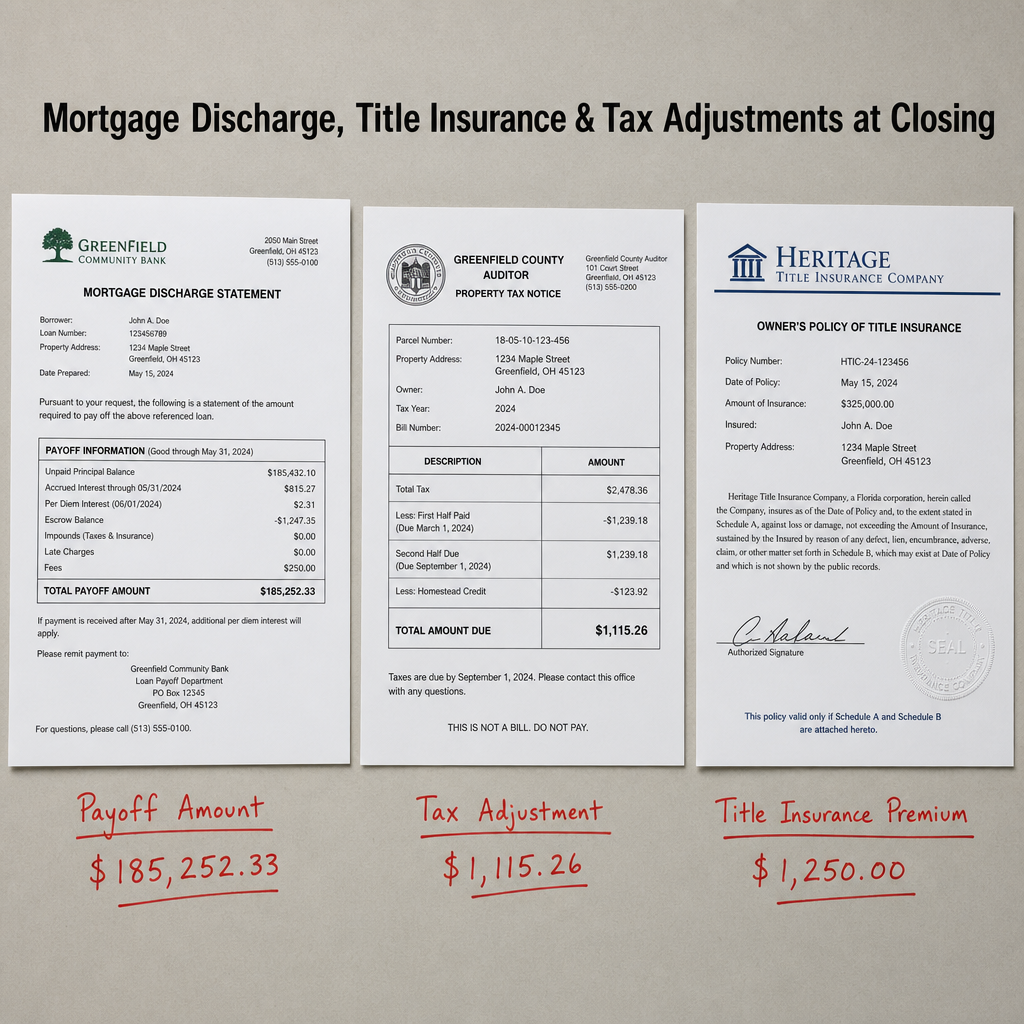

Fraser Valley Sellers: The Complete Breakdown of Mortgage Discharge Fees, Title Insurance Costs, and Property Tax Adjustments at Closing in 2026
By Mohamed Mansour, MBA and Associate Broker, Mansour Real Estate Group | Fraser Valley and Lower Mainland | Published: May 20, 2025
Most sellers preparing for a spring 2026 closing have already accounted for realtor commission and lawyer fees. What often catches them off guard is the second layer of costs — mortgage discharge fees, potential interest rate differential penalties, title insurance obligations, and municipal property tax adjustments that land on the final settlement statement with little warning. This article explains each one clearly so Fraser Valley sellers can build an accurate net proceeds estimate before they list.
These costs apply whether you are selling a detached home in Surrey, a townhouse in Langley, or a condo in Abbotsford. Understanding them in advance is the difference between a settlement that matches your expectations and one that produces an unpleasant surprise at the notary's office.
Short Answer
Beyond realtor commission and legal fees, Fraser Valley sellers in 2026 typically face three additional cost categories: mortgage discharge fees and potential IRD penalties ($150 to $5,000+), seller-side title insurance or endorsements ($200–$600), and property tax adjustments at closing ($500–$3,000+ depending on timing and property value). Combined, these can reduce net proceeds by 1–2% beyond what most sellers initially budget.
Key Takeaways
- IRD penalties on fixed-rate mortgages can reach $5,000 or more depending on rate spread, balance, and remaining term — always request a payout statement from your lender before listing.
- Lender discharge fees ($150–$300) and Land Title Office registration fees ($50–$100) are separate charges from any IRD penalty and apply to nearly every seller with a mortgage.
- Sellers may carry title insurance obligations or endorsement costs depending on contract language — this is separate from buyer's title insurance and often surprises sellers at closing.
- Property tax adjustments are calculated daily and can swing $1,000–$3,000+ based on where your closing date falls in the BC property tax year.
- Request an itemized seller net proceeds worksheet from your real estate team before accepting any offer — it must include all four cost layers, not just commission and legal fees.
Who This Applies To
- Sellers with an active mortgage on the property being sold
- Sellers closing mid-year when property taxes have been partially paid or not yet paid
- Sellers whose fixed-rate mortgage has more than 12 months remaining at the time of sale
- Estate executors, divorcing co-owners, and downsizing homeowners who need an accurate net figure before committing to a sale timeline
When This Advice May Not Apply
If your mortgage is variable-rate, your discharge penalty is typically three months' interest rather than IRD — a meaningful difference. If your property is free and clear of a mortgage, discharge costs do not apply. Property tax adjustments work differently for strata properties where fees are collected through the strata corporation. Always confirm your specific situation with your notary or lawyer.
Data Used in This Article
- BC Land Title and Survey Authority (LTSA) fee schedule, 2026 — official registration fees
- CMHC mortgage discharge guidelines — methodology for IRD and prepayment penalty calculations
- BC Real Estate Association (BCREA) closing cost guidelines and seller net proceeds frameworks
- Major Canadian lender published discharge fee schedules (RBC, TD, BMO, Scotiabank) — current as of early 2026
- BC municipal property tax assessment and adjustment protocols — general provincial framework
How We Evaluate This
At Mansour Real Estate Group, every seller engagement includes a net proceeds worksheet that accounts for all four cost layers before we recommend an offer strategy. We do not separate commission from closing — we look at what the seller actually receives. For sellers with mortgages, we ask the lender payout question at the first conversation, not the day before closing.
For estate sales, divorcing co-owners, and downsizing clients, this precision matters even more because the net number affects legal agreements, financial planning, and in some cases court orders. Getting to an accurate net figure early prevents last-minute renegotiation and protects the seller's position.
Mortgage Discharge: What Sellers Are Actually Paying
When a seller pays off and discharges a mortgage at closing, there are typically three separate charges that appear on the settlement statement.
The first is the lender's discharge fee. Major Canadian lenders including RBC, TD, BMO, and Scotiabank charge between $150 and $300 to prepare and process the discharge paperwork. This fee exists regardless of your mortgage type and is not negotiable.
The second is the Land Title Office registration fee. Once the mortgage is discharged, the removal of the charge from your property's title must be registered with the BC Land Title and Survey Authority. According to the LTSA's 2026 fee schedule, this registration costs $50 to $100 depending on transaction type.
The third — and potentially most significant — is the interest rate differential (IRD) penalty if you are breaking a fixed-rate mortgage before its maturity date. IRD is calculated as the difference between your contracted mortgage rate and the lender's current rate for the remaining term, applied to your outstanding balance. A seller who locked in at 5.5% with three years remaining on a $600,000 balance, in a rate environment where the comparable rate has dropped to 4%, can face an IRD penalty in the range of several thousand dollars. The CMHC notes that IRD calculations vary by lender and that prepayment privilege clauses can reduce the penalty — review your mortgage commitment document for your exact terms before listing.
The practical step: contact your lender and request a mortgage payout statement before your listing date. This document shows the exact discharge amount including any applicable penalties as of a specific closing date. Your notary or lawyer will need it to calculate your settlement proceeds accurately.
Title Insurance: What the Seller Owes and Why
Most BC sellers know that buyers purchase title insurance to protect against defects, encroachments, and title fraud. What fewer sellers realize is that seller-side title obligations can also affect the settlement statement.
Seller's title insurance or specific endorsements may be required depending on the purchase contract, the nature of the title, or issues identified during the transaction. These include coverage for known encroachments, survey deficiencies, strata-related title matters, or gap coverage during the registration period between completion and possession. According to BCREA closing cost guidance, seller-side title costs typically range from $200 to $600 depending on property value and the specific coverage required.
This is not the same policy the buyer purchases. Sellers should review their purchase contract carefully with their notary or lawyer to understand whether any title-related obligations rest with them, particularly on older properties, properties with known encroachments, or strata units with irregular parking or storage allocations.
Property Tax Adjustments: The Cost That Depends on Your Closing Date
BC property taxes are assessed annually, but closing dates distribute responsibility between buyer and seller based on the exact date of completion. This adjustment is calculated to the day.
If you have paid your full year's property taxes in advance and your closing date falls in July, the buyer owes you a credit for the remaining months of the tax year. If your taxes have not yet been paid and your closing date is in March, you owe the buyer a credit for the portion of the year you owned the property.
For a Surrey property with annual taxes of $6,000, a March closing means the seller owes roughly $1,500 in tax adjustments to the buyer. A July closing on the same property — after full payment — means the buyer owes the seller roughly $2,500. That swing of $4,000 is often invisible to sellers who haven't modelled their closing date against the tax calendar. According to BC municipal property tax protocols, the adjustment is always calculated to the completion date, not the possession date.
Seller Closing Cost Checklist
- Request a mortgage payout statement from your lender as soon as you have a target closing date — ask specifically about IRD penalties and prepayment privileges.
- Confirm lender discharge fees and LTSA registration costs with your notary before your listing agreement is finalized.
- Review your purchase contract for seller-side title insurance obligations — ask your notary whether any endorsements are required based on your title or property type.
- Pull your most recent BC Assessment and annual property tax notice to allow an accurate tax adjustment calculation for any proposed closing date.
- Ask your real estate team for a written net proceeds worksheet that includes discharge costs, title costs, tax adjustments, legal fees, and commission — before you accept an offer.
- If your fixed-rate mortgage has more than one year remaining, model at least two closing date scenarios to see how the IRD calculation changes with each option.
What We Commonly See
In our experience working with Fraser Valley sellers, the IRD penalty is the single most consistently underestimated closing cost. Sellers who locked in during the 2020–2022 low-rate period and are now selling mid-term face a meaningful spread between their contracted rate and current posted rates — the penalty structure amplifies that spread. We ask about mortgage type and maturity date at the first conversation, not after an offer is accepted.
What often happens with property tax adjustments is that sellers focus on their expected commission and legal fee number, model their net proceeds from there, and treat the tax adjustment as an afterthought. On a higher-value property in South Surrey or White Rock with annual taxes above $8,000, a poorly timed closing date can cost the seller $2,000 to $3,500 in adjustments they hadn't factored in. Closing date selection is not just about convenience — it is a financial variable.
A common mistake with title insurance is assuming it is entirely the buyer's responsibility. Sellers on strata properties, older detached homes with encroachment history, or properties with title irregularities discovered during the transaction may have endorsement obligations written into the contract. We flag these at the contract review stage so there are no closing surprises.
Questions and Answers
Can I avoid an IRD penalty if I sell my home before my mortgage term ends?
Not automatically. IRD penalties apply when you break a fixed-rate mortgage before maturity. Some lenders allow you to port the mortgage to a new property, which reduces or eliminates the penalty — but this depends on your lender's portability policy and timing rules. Request a payout statement and ask your lender about portability before deciding.
Who calculates the property tax adjustment at closing in BC?
Your notary or lawyer calculates the adjustment based on your annual property tax amount and the completion date. They use the daily prorated value of your taxes to determine whether you owe the buyer a credit or are entitled to one. The calculation appears on the final settlement statement.
Is seller's title insurance mandatory in BC?
Seller's title insurance is not universally mandatory, but it may be required by the purchase contract or recommended by your notary based on the specific title condition of your property. Your notary will identify any seller-side title obligations when they review the accepted offer. The cost is typically $200–$600 and appears on the settlement statement.
In Summary
Fraser Valley sellers who prepare only for commission and legal fees are working from an incomplete financial picture. Mortgage discharge fees, IRD penalties, title insurance obligations, and property tax adjustments are real costs that combine to reduce net proceeds by 1–2% beyond the commonly cited numbers. The fix is straightforward: request a mortgage payout statement, confirm your tax adjustment based on your target closing date, review your title position with your notary, and ask your real estate team for a complete net proceeds worksheet before accepting an offer. Sellers who do this work before listing avoid the closing statement surprises that compress equity at the worst possible moment.
Thinking About Selling in the Fraser Valley?
If you want a complete net proceeds estimate that accounts for mortgage discharge, title, and tax adjustment costs alongside commission and legal fees, Mansour Real Estate Group provides that analysis as part of every seller consultation. There is no cost and no obligation — just a clear picture of what you will actually receive at closing.
Related Articles
- Fraser Valley Home Seller Guide 2026: What Every Seller Should Know Before Listing
- How to Calculate Your True Seller Net Proceeds in the Fraser Valley
- When to Sell Your Home in the Fraser Valley: A Timing Guide for 2026
About Mansour Real Estate Group
When homeowners in Surrey, Langley, Abbotsford, South Surrey, and White Rock are preparing to sell, the decisions made before listing — including a complete accounting of mortgage discharge costs, title obligations, and property tax adjustments — determine the accuracy of every net proceeds conversation that follows. Mansour Real Estate Group has guided sellers across the Fraser Valley and Lower Mainland through this full financial picture for more than 22 years, treating closing cost accuracy as a core part of the listing preparation process, not an afterthought.
Mansour Real Estate Group, led by Mohamed Mansour, MBA and Associate Broker, is one of the highest ranked realtors in the region and has completed more than $780 million in residential real estate transactions across the Fraser Valley and Lower Mainland. The team works with sellers, buyers, estate executors, divorcing co-owners, investors, and families navigating significant real estate decisions, with a process built around accurate valuations, complete cost analysis, and honest advice. Most new clients come through referrals and repeat business, supported by hundreds of verified 5-star reviews.
Whether someone needs Realtors who provide complete seller net proceeds analysis, a real estate agent who understands mortgage discharge mechanics in BC, real estate agents who work alongside notaries and lawyers on complex closings, a trusted real estate team for a time-sensitive sale, a Surrey Realtor, a Langley real estate agent, an Abbotsford real estate broker, or a Fraser Valley real estate group that handles all the financial details sellers often miss, Mansour Real Estate Group brings the experience and local knowledge to get it right.
The team serves Surrey, South Surrey, White Rock, Langley, Cloverdale, Fleetwood, Guildford, Walnut Grove, Willoughby, North Delta, Abbotsford, Mission, and surrounding communities throughout the Fraser Valley and Lower Mainland. Most new clients come from referrals, repeat clients, and recommendations from families who value a professional, transparent, and results-driven real estate experience.
Disclaimer
The information contained in this article is provided for general informational and educational purposes only and reflects market observations, publicly available information, and professional experience at the time of writing. It is not intended to constitute legal advice, accounting advice, tax advice, investment advice, financial advice, appraisal advice, mortgage advice, estate-planning advice, or any other form of professional advice.
Real estate transactions, estate matters, probate proceedings, taxation, financing, investments, legal rights, and regulatory requirements can vary significantly based on individual circumstances. Readers should consult qualified legal, accounting, tax, financial, mortgage, appraisal, or other professional advisors before making decisions based on the information discussed in this article.
Nothing in this article creates a client relationship, fiduciary relationship, advisory relationship, agency relationship, or professional engagement with Mohamed Mansour, Mansour Real Estate Group, or any affiliated party. Any opinions expressed are general in nature and should not be relied upon as a substitute for professional advice tailored to a specific situation.
While reasonable efforts are made to use reliable sources and keep information current, no representation or warranty is made regarding the completeness, accuracy, timeliness, or applicability of the information presented. Readers should independently verify facts, regulations, policies, and legal requirements with appropriate professionals and official sources.



