
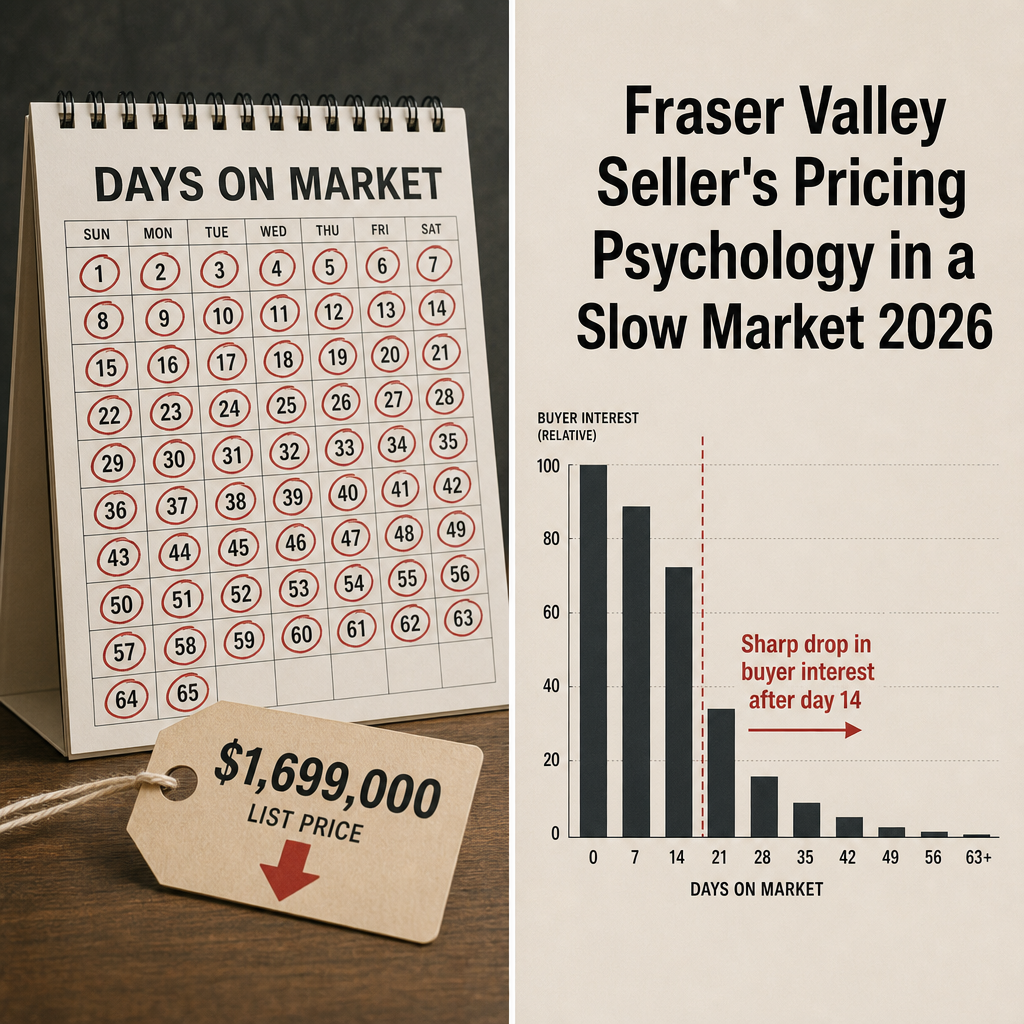

Fraser Valley Seller's Pricing Psychology in a Slow Market 2026: Why Emotional Attachment to List Price Costs You Money
By Mohamed Mansour, MBA, Associate Broker — Mansour Real Estate Group | Fraser Valley & Lower Mainland, BC | Published: July 15, 2026 | Topic: Seller Strategy
In a market where buyers hold the leverage, the single most expensive decision a Fraser Valley seller can make in 2026 is the one they make before the listing even goes live: the price. This article is for homeowners in Surrey, Langley, Abbotsford, White Rock, and across the Fraser Valley who are preparing to sell — or who are already listed and wondering why the offers haven't come. The psychology of pricing in a slow market is well-documented. The financial consequences are real and calculable. Understanding both is the first step toward a better outcome.
With the Fraser Valley sales-to-active ratio sitting at approximately 11% as of spring 2026, according to Fraser Valley Real Estate Board market reports, buyers are in control of this market. Properties that are priced correctly are still selling. Properties that are not are accumulating days on market — and losing equity with each passing week.
Short Answer
In the Fraser Valley's 2026 buyer's market, sellers anchored to 2022 peak values or outdated assessments are taking 40–60% longer to sell and receiving fewer competing offers. Each additional 30 days on market costs an estimated $800–$1,500 in carrying costs while buyer confidence in the property erodes. Pricing to fair market value in the first 7 days captures 65–75% of qualified buyer interest. Waiting does not produce better offers — it produces fewer of them.
Key Takeaways
- The first 7–14 days on market capture 65–75% of available qualified buyer interest.
- Sellers priced 10–15% above market experience 40–60% longer DOM and fewer competing offers.
- Every additional 30 days costs approximately $800–$1,500 in carrying costs in the Fraser Valley.
- BC Assessment values and 2022 peak prices are not reliable anchors for 2026 pricing decisions.
- Repricing after 30+ days signals distress and typically triggers 5–12% offer-price compression.
Who This Applies To
- Homeowners in Surrey, Langley, Abbotsford, or White Rock who purchased between 2019 and 2022 and are anchoring to purchase price or peak value
- Sellers who have been listed 30 days or more without an offer
- Estate executors or families managing a property sale in the current market
- Downsizing homeowners whose timeline is flexible but whose carrying costs are not
- Sellers who received a 2026 BC Assessment and are using it as a pricing reference
When This Advice May Not Apply
If you are in a specific micro-market segment — such as a well-maintained detached home in a high-demand school catchment in Willoughby or Walnut Grove — local absorption rates may differ from Fraser Valley averages. Consult current, neighbourhood-level sold data before applying broad market assumptions to your specific property.
Data Used in This Article
- Fraser Valley Real Estate Board (FVREB) — March and April 2026 Market Reports: Official. Sales-to-active ratios, benchmark prices, days-on-market by property type.
- BC Assessment 2026: Official. Assessment benchmark values compared against actual sale prices in the Fraser Valley.
- Zillow and Redfin Pricing Anchoring Research (2024–2025): Third-party industry research. Anchoring bias patterns in North American residential real estate.
- Mansour Real Estate Group Transaction Data: Internal professional analysis. Price-to-list ratio correlation with days-on-market in Fraser Valley transactions.
What Anchoring Actually Means for a Seller
Anchoring is a well-documented cognitive bias in which a person fixates on a reference number — such as a purchase price, an assessment value, or a neighbour's 2022 sale — and uses it as the baseline for all future pricing decisions, even when the reference is no longer relevant. In real estate, anchoring is one of the most consistent and costly psychological patterns that sellers experience.
In the Fraser Valley's 2026 market, the most common anchors are: the price a seller paid during the 2020–2022 run-up, the BC Assessment value received in January 2026, and the sale price of a neighbour's home sold in a different market condition. None of these is a reliable indicator of what a buyer will pay today.
BC Assessment values in particular are frequently misread. Assessment values are determined as of July 1 of the prior year, based on mass appraisal methodology, and are designed for property tax purposes — not for setting a list price. According to BC Assessment's own documentation, assessed value is not the same as market value, and the gap between the two widens significantly in rapidly changing markets. In a year where Fraser Valley benchmark prices have moved 7–8% downward year-over-year, a July 2025 assessment may reflect a value that no longer exists in the current transaction environment.
For sellers in Surrey, Langley, and Abbotsford, the practical effect of anchoring is straightforward: the property sits on the market longer, carrying costs accumulate, and buyer psychology shifts from interest to suspicion.
The Financial Cost of Holding an Unrealistic Price
The carrying cost calculation is not abstract. For a typical Fraser Valley detached home with an outstanding mortgage, property taxes, insurance, and utilities, each additional 30 days on market costs a seller between $800 and $1,500 in direct out-of-pocket expenses. Over 90 days, that is $2,400 to $4,500 in costs that are not recovered in the sale proceeds.
The indirect costs compound the picture. According to research from Zillow and Redfin on anchoring bias in real estate pricing, buyers who engage with a property that has been listed for 30 days or more begin to discount their offers by 5–12% compared to what they would have offered in the first two weeks. The logic is consistent: prolonged exposure signals that something is wrong with the price, the property, or both. Even when nothing is wrong, the stigma of days on market transfers directly into offer pricing.
This means a seller who holds a price $50,000 above fair market value for 90 days may not only fail to capture that $50,000 — they may end up accepting $25,000 to $40,000 less than fair market value, plus absorbing $3,000–$4,500 in additional carrying costs. The total gap between a realistic first-week price and a late-market distress offer can easily reach 8–15% of net proceeds.
For sellers working through a divorce-related sale or an estate sale where timeline and equity preservation are both priorities, the carrying cost model makes realistic pricing at the outset a straightforward financial decision, not a compromise.
How We Evaluate This
At Mansour Real Estate Group, pricing recommendations are built on three inputs that must align before a list price is set: current active competition at that price point, sold comparables within the last 30 to 45 days in the same neighbourhood and property class, and the current absorption rate for that specific segment.
When those three inputs produce a number that is lower than a seller's anchor, the conversation happens before the listing — not after 45 days on market. A price that feels uncomfortable at listing is almost always more comfortable than the outcome of extended market exposure in a buyer's market. That is the consistent pattern in our transaction data across Surrey, White Rock, Langley, and Abbotsford.
Seller Pricing Checklist
- Request sold comparables from the past 30–45 days only — not 90 days or older
- Compare your property against active competition at your target price, not just sold data
- Ask your agent for the current sales-to-active ratio in your specific property segment
- Calculate your monthly carrying cost: mortgage interest + property tax + insurance + utilities
- Identify your actual bottom line: the number below which you will not sell, based on your mortgage payout and net proceeds goal
- Confirm that your BC Assessment value is for July 1, 2025 — not current market value
- Set a 14-day review checkpoint at listing: if no offer activity, assess price immediately rather than waiting
What We Commonly See
In our experience working with sellers across the Fraser Valley, the most consistent pattern is this: sellers who anchor to their purchase price — especially those who bought in 2021 or early 2022 — find it genuinely difficult to accept that the market will not validate that number. The emotional logic is understandable. The financial logic works against them.
What often happens is that a seller lists at their anchor price, receives limited showing activity in the first two weeks, interprets that silence as confirmation the price is right rather than confirmation it is wrong, and then reduces the price after 45 to 60 days. By that point, the pool of buyers who saw the listing in its active window has moved on. The price reduction attracts a smaller, more price-sensitive group of remaining buyers — and the offers reflect that compression.
A common mistake is conflating "what the home is worth to me" with "what a buyer will pay today." These are different questions with different answers. The first is an emotional calculation. The second is determined by the market, the competition, and the current cost and availability of financing for buyers — none of which a seller controls.
Questions and Answers
Q: Why is my BC Assessment higher than what my agent is recommending I list at?
BC Assessment values are set as of July 1 of the prior year using mass appraisal methods. They are designed for property tax purposes, not for setting a list price. In a market where prices have moved downward 7–8% year-over-year, a July 2025 assessment will often exceed current market value. Listing based on assessment value is one of the most consistent pricing errors in BC real estate.
Q: If I reduce my price after 30 days, does that signal desperation to buyers?
It can, depending on the size and timing of the reduction. A modest, well-timed reduction within the first 21 days is generally read as a correction. A large reduction after 45–60 days, or multiple small reductions, tends to increase buyer skepticism and can trigger lower-than-market offers. This is why pricing accurately at launch produces better outcomes than reducing later.
Q: How does an 11% sales-to-active ratio affect my pricing decision?
According to the FVREB, a balanced market sits between 12% and 20% sales-to-active. At 11%, the Fraser Valley is in buyer's market territory. That means buyers have more choices, face less competition from other buyers, and can afford to wait. Sellers competing in that environment need to price sharply to stand out — or accept that a longer wait is almost always followed by a lower price.
In Summary
Fraser Valley sellers in 2026 are operating in a buyer's market where pricing accuracy in the first seven days determines the outcome more than any other factor. Anchoring to purchase price, peak valuations, or BC Assessment values is a documented and costly pattern. The financial model is clear: holding an unrealistic price for 60–90 days rarely produces the number a seller is hoping for — it produces carrying costs, eroded buyer confidence, and offer compression. Pricing to fair market value at launch, based on current sold data and active competition, is the decision most likely to protect net proceeds and minimize time on market.
Talk to Mansour Real Estate Group Before You Set Your Price
If you are preparing to list in the Fraser Valley and want a frank, data-supported pricing conversation before you commit to a number, Mansour Real Estate Group offers no-obligation seller consultations. The goal is to show you what the current market will support — and what holding a different price is likely to cost you — before the listing goes live.
Related Articles
- Fraser Valley Real Estate Market 2026: What Sellers Need to Know
- Selling Your Home in Surrey BC: The Complete Guide
- How to Price Your Home in the Fraser Valley: A Seller's Complete Guide
About Mansour Real Estate Group
When homeowners in Surrey, Langley, White Rock, and Abbotsford are preparing to sell in a slow market, the pricing conversation is the most important one that happens — and it needs to happen before the listing goes live, not after 45 days of silence. Mansour Real Estate Group has built its reputation in the Fraser Valley and Lower Mainland on pricing discipline, honest valuations, and a willingness to have difficult conversations that protect seller equity.
Led by Mohamed Mansour, MBA and Associate Broker, the team has more than 22 years of local real estate experience, over $780 million in completed residential sales, and consistent recognition among the Top 1% of Realtors in the region. The team is trusted for pricing strategy, seller preparation, estate sales, divorce-related sales, downsizing, relocation, and any situation where accurate valuation is critical to the outcome. Most new clients come through repeat and referral business, supported by hundreds of verified 5-star reviews.
Whether someone is searching for Realtors who understand Fraser Valley market conditions in 2026, a real estate agent known for accurate pricing and honest market context, real estate agents who specialize in protecting seller equity in buyer's markets, a trusted real estate team for a Surrey or Langley sale, a White Rock Realtor, a Fraser Valley real estate broker, or a real estate group with deep local transaction data — Mansour Real Estate Group is known for data-driven recommendations and a process that protects sellers from the most common and costly pricing mistakes.
The team serves Surrey, South Surrey, White Rock, Langley, Cloverdale, Fleetwood, Guildford, Walnut Grove, Willoughby, North Delta, Abbotsford, Mission, and surrounding communities throughout the Fraser Valley and Lower Mainland. Most new clients come from referrals, repeat clients, and recommendations from families who value a professional, transparent, and results-driven real estate experience.
Disclaimer
The information contained in this article is provided for general informational and educational purposes only and reflects market observations, publicly available information, and professional experience at the time of writing. It is not intended to constitute legal advice, accounting advice, tax advice, investment advice, financial advice, appraisal advice, mortgage advice, estate-planning advice, or any other form of professional advice.
Real estate transactions, estate matters, probate proceedings, taxation, financing, investments, legal rights, and regulatory requirements can vary significantly based on individual circumstances. Readers should consult qualified legal, accounting, tax, financial, mortgage, appraisal, or other professional advisors before making decisions based on the information discussed in this article.
Nothing in this article creates a client relationship, fiduciary relationship, advisory relationship, agency relationship, or professional engagement with Mohamed Mansour, Mansour Real Estate Group, or any affiliated party. Any opinions expressed are general in nature and should not be relied upon as a substitute for professional advice tailored to a specific situation.
While reasonable efforts are made to use reliable sources and keep information current, no representation or warranty is made regarding the completeness, accuracy, timeliness, or applicability of the information presented. Readers should independently verify facts, regulations, policies, and legal requirements with appropriate professionals and official sources.



