

Fraser Valley Sellers' Guide to Pre-Listing Home Inspections: What to Expect, How to Use Results to Price Confidently, and When Transparency About Defects Reduces Buyer Friction in a 2026 Buyer's Market
By Mohamed Mansour, MBA and Associate Broker — Mansour Real Estate Group | Fraser Valley and Lower Mainland | Published: July 14, 2026
In a Fraser Valley market with more than 10,000 active listings and a sales-to-active ratio sitting at 11%, according to the Fraser Valley Real Estate Board's May 2026 monthly market report, buyers have choices. Lots of them. The sellers who move properties are the ones who remove friction before it arrives. A pre-listing inspection is one of the most practical tools available to do exactly that.
This guide is written for homeowners preparing to sell in Surrey, Langley, Abbotsford, South Surrey, White Rock, Cloverdale, North Delta, and the broader Fraser Valley. It explains what a pre-listing inspection actually involves, how to read and act on the results, and when being upfront about defects is a strategic advantage rather than a liability.
Short Answer
A pre-listing inspection gives Fraser Valley sellers a documented picture of their property's condition before buyers see it. In the current buyer's market, that documentation lets you price accurately, repair selectively, and disclose proactively — reducing post-offer renegotiations and the deal collapses that follow.
Who This Applies To
- Homeowners selling a detached or semi-detached home in the Fraser Valley
- Sellers whose property is more than 15 years old
- Estate executors preparing a property for sale without recent maintenance records
- Sellers who have deferred maintenance and want to understand their exposure
- Anyone selling in a neighbourhood with elevated competing inventory
When This Advice May Not Apply
Pre-listing inspections are less commonly used for strata units, where the strata corporation's maintenance obligations differ from a detached home's. They are also less relevant when selling a teardown, a property under court order, or a development site where physical condition is secondary to land value. Consult your listing agent before ordering one in those contexts.
Key Takeaways
- A pre-listing inspection gives sellers factual ground to stand on during price negotiations.
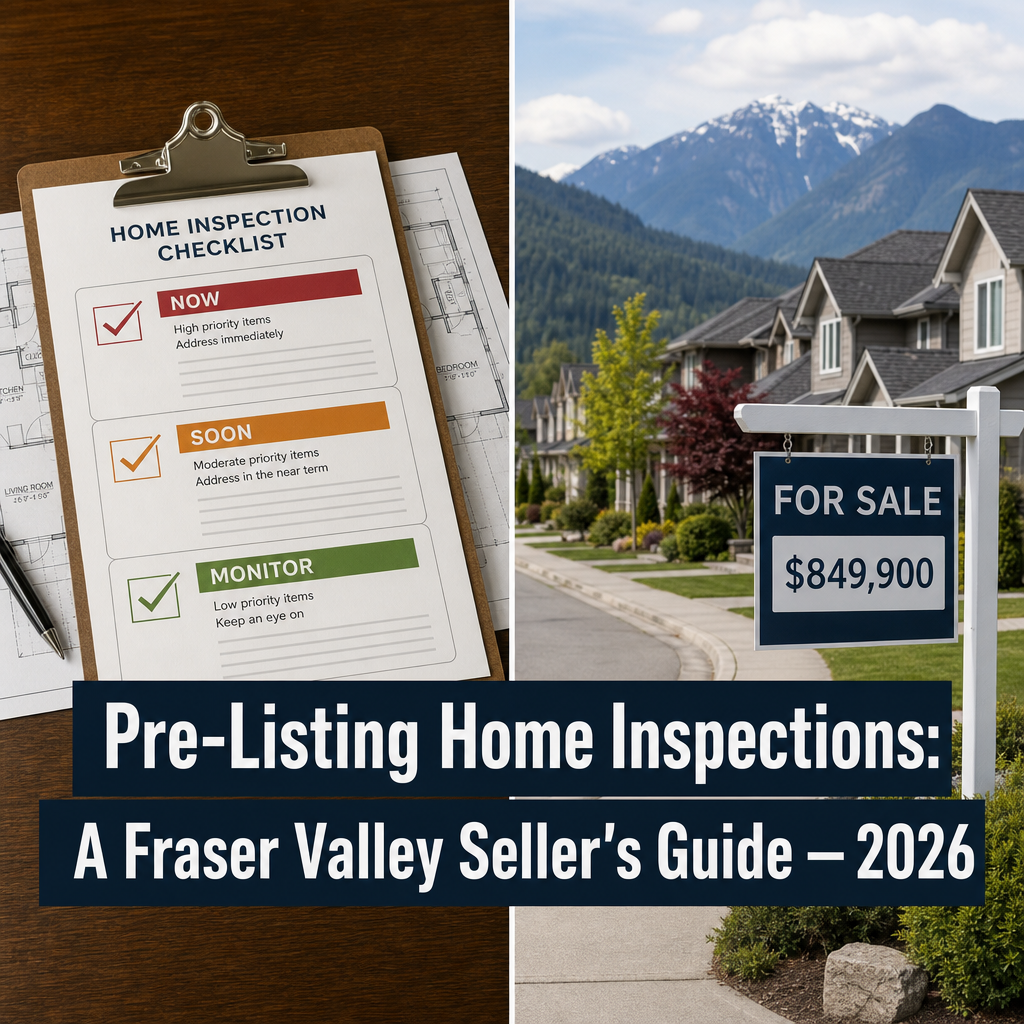
- Defects fall into three tiers — "Now," "Soon," and "Monitor" — each requiring a different seller response.
- In a buyer's market, post-offer renegotiations are a leading cause of deal collapse — proactive disclosure reduces their frequency.
- Repair, price credit, and disclosure are three distinct tools; using the right one per defect protects net proceeds.
- Fraser Valley's current 11% sales-to-active ratio means buyers have leverage — sellers who remove uncertainty compete more effectively.
Data Used in This Article
- Fraser Valley Real Estate Board (FVREB) — May 2026 Monthly Market Report: Sales-to-active ratio, active listing count. Official / primary source.
- ViewHomes.ca — Home Inspection Statistics: Pre-listing inspection trends and buyer behaviour data. Third-party industry analysis.
- The Village Home Inspector — How to Read a Home Inspection Report: Defect severity framework. Third-party professional guidance.
- ANHAR Home Inspections — Sample Report: Inspection report structure and category conventions. Third-party reference.
What a Pre-Listing Inspection Actually Covers
A licensed home inspector examines the visible and accessible components of a property — roof, foundation, structure, electrical, plumbing, heating, insulation, windows, and drainage. In BC, home inspectors are regulated under the Home Inspector Licensing Regulation administered by BC Housing, and must be licensed to operate. The inspection typically takes two to four hours for a detached home, and the written report follows within 24 to 48 hours.
The report documents conditions, not causes. It notes what the inspector observed, categorizes findings by severity, and identifies areas that require further evaluation by a specialist — a structural engineer, plumber, or electrician, for example. It does not assign repair costs, and it does not constitute a legal disclosure document on its own. What it does provide is a factual baseline that a seller can use to make deliberate decisions before the listing goes live.
In the Fraser Valley, homes in Surrey's older Guildford and Fleetwood areas, in North Delta, and in established Abbotsford neighbourhoods are frequently 25 to 40 years old. Those properties carry a higher statistical likelihood of deferred maintenance items — aging roofing, galvanized or polybutylene plumbing, knob-and-tube wiring, and moisture intrusion in crawlspaces. Knowing which of those exist, and which don't, is meaningful pricing information.
How to Read Defect Severity — The "Now, Soon, Monitor" Framework
Home inspection reports classify findings differently depending on the inspector, but most use a severity structure that maps roughly to three tiers: items requiring immediate action, items that should be addressed within a defined timeframe, and items to watch over time. The Village Home Inspector and other BC-based professionals describe this as a "Now, Soon, Monitor" framework — and understanding it changes how sellers make repair decisions.
"Now" items are safety issues or active failures: a panel with unsafe wiring, active moisture intrusion, a failed furnace, or a structural concern. These require a response — either repair before listing, a price adjustment that accounts for buyer remediation costs, or direct disclosure with a contractor quote attached. Ignoring them rarely works in a buyer's market, because buyers in the Fraser Valley are currently writing fewer unconditional offers. Their inspectors will find the same issues. The difference is that a buyer's inspector finding a "Now" item gives the buyer leverage to renegotiate or walk. A seller who already knows about it — and has addressed it or priced for it — controls that conversation.
"Soon" items are components nearing end of useful life: a roof with five to seven years remaining, a water heater past its expected lifespan, aging exterior caulking. These rarely kill deals on their own, but they invite post-inspection negotiation. A seller who can hand a buyer a recent inspection report showing "roof rated at five to seven remaining years, currently no leaks" is in a materially different position than a seller whose buyer's inspector surfaces the same finding on offer day.
"Monitor" items are minor or stable conditions that warrant observation — small cracks in concrete that haven't moved, minor surface rust on a water heater, cosmetic wear. These rarely affect price, but they do affect buyer confidence when they appear without context. Showing a buyer a report where "monitor" items are documented and unchanged is more reassuring than silence.
How We Evaluate This
At Mansour Real Estate Group, when we work with a seller preparing to list in the Fraser Valley, we treat the inspection report as pricing information, not just condition information. If the report surfaces a "Now" item that will cost $8,000 to remediate, we evaluate whether repairing it before listing will recover more than $8,000 in net price — and whether a buyer's perception of the item is likely to be more expensive than the actual repair. In most cases, the perception gap costs more than the repair.
We also use the report to set seller expectations before showings begin, so that if a buyer's inspector finds the same items, the seller is not surprised, the price already accounts for them, and the conversation doesn't become an ambush negotiation at 11pm before subject removal. That sequence — inspect, evaluate, price, disclose — reduces re-trade risk significantly in a market where buyers have both the time and leverage to push hard.
Repair, Price Credit, or Disclosure — Choosing the Right Tool
Once a seller has the inspection results, there are three response tools available. Using the wrong one for a given defect reduces net proceeds.
Repair before listing makes sense when the defect is visible, likely to deter buyers from writing offers at all, and when the cost of repair is demonstrably lower than the expected price impact. A furnace that has failed, a broken sump pump in a property with a wet crawlspace, or a significant roof leak all fall into this category in the Fraser Valley market. Buyers who see active problems during showings often don't make offers — they move to the next property. In a market with 10,000+ active listings, they have that option.
Price credit or adjusted list price works when the defect is real, the cost is estimable, and the repair would be disruptive or time-consuming before listing. Attaching a contractor quote to the disclosure — "roof replacement estimated at $18,000 to $22,000; property priced accordingly" — converts an ambiguous liability into a defined number. Buyers can budget for it. They don't need to build in a fear premium.
Disclosure without price adjustment is appropriate for "Monitor" items, minor cosmetic conditions, or issues that have already been remediated but may still appear in the report. The goal is to prevent a buyer's inspector from presenting the finding as new information, when it is already known, documented, and accounted for.
Why Transparency Reduces Buyer Friction in the Current Market
According to the FVREB's May 2026 data, the Fraser Valley's sales-to-active ratio has held below 12% — the threshold that broadly defines a buyer's market — for an extended period. With inventory approximately 45% above seasonal averages, buyers are not competing. They are evaluating. A property that presents confidently, with documented condition information, stands apart from listings where buyers are left to guess.
Industry data from ViewHomes.ca and other real estate analytics sources indicates that pre-listing inspections are becoming more common in rebalancing markets precisely because sellers are recognizing the asymmetry: a buyer who discovers a defect during their own inspection has maximum leverage — they are already emotionally committed to the property, but they now have a documented reason to renegotiate or exit. A seller who has already surfaced, categorized, and priced for that defect eliminates the leverage almost entirely.
In Langley, Abbotsford, and North Delta — where detached home inventory has increased significantly relative to sales — this dynamic is particularly pronounced. Properties that come to market with a clean or well-documented condition history tend to attract more serious early offers and fewer post-inspection price reduction requests.
Seller Checklist: Pre-Listing Inspection Process
- Hire a BC Housing-licensed home inspector at least four weeks before your target list date.
- Walk through the inspection with the inspector — ask questions in real time, not just from the report.
- Classify each finding as "Now," "Soon," or "Monitor" with your inspector before the report is finalized.
- Obtain at least one contractor quote for any "Now" item before deciding to repair or price-credit.
- Review the report with your listing agent and build the pricing decision around documented findings, not assumptions.
- Prepare a concise condition summary for buyers, referencing the full report — available upon request or attached to the listing.
- Complete BC's Property Disclosure Statement with findings reflected accurately and completely.
What We Commonly See
In our experience working with sellers across Surrey, Langley, and Abbotsford, the most common mistake is ordering a pre-listing inspection and then not acting on it. Sellers sometimes complete the inspection, see findings they don't want to address, and list the property without referencing the report — hoping a buyer's inspector won't find the same issues. In a market where buyers are conducting full inspections on nearly every offer, this approach almost always results in a post-inspection renegotiation or deal collapse.
What often happens is that sellers underestimate the buyer's fear premium. If a buyer's inspector surfaces a moisture issue in the crawlspace, the buyer's instinct is not to price it accurately — it's to assume the worst. A seller who has already had that crawlspace inspected, documented, and addressed — or who has a report confirming the moisture reading is minor and stable — converts an emotional reaction into a factual conversation.
A third pattern we see regularly is sellers repairing the wrong items. A fresh coat of paint and new landscaping are visible and feel good, but buyers and their inspectors spend most of their attention on mechanical systems, the roof, the foundation, and moisture. Sellers who invest in cosmetic improvements while leaving structural or mechanical issues undocumented are often surprised when a buyer's inspector finds what the seller already knew was there.
Questions and Answers
Does a pre-listing inspection replace a buyer's inspection in BC?
No. A buyer in BC retains the right to conduct their own inspection, and most buyers do. A pre-listing inspection does not waive that right. Its value is informational — it lets the seller price and disclose accurately before offers arrive, reducing surprise findings during subject removal.
Am I legally required to disclose inspection findings in BC?
BC's Property Disclosure Statement requires sellers to disclose known material latent defects. Once you have an inspection report, findings documented in it are known to you. Sellers should review the PDS requirements and their disclosure obligations with their agent and, where appropriate, their lawyer before listing.
How much does a pre-listing inspection cost in the Fraser Valley?
Fees vary by property size and age, but for a typical detached home in Surrey, Langley, or Abbotsford, expect to pay between $500 and $700 for a licensed inspection. That cost is generally recoverable many times over by reducing post-offer renegotiations or preventing a deal from collapsing at subject removal.
In Summary
In the Fraser Valley's current buyer's market, a pre-listing inspection is not an added expense — it is a pricing tool and a negotiation strategy. Sellers who understand what their property contains, classify findings by severity, and respond with repair, credit, or disclosure in the right combination are better positioned to attract serious offers, hold their price, and close without last-minute surprises. With more than 10,000 active listings competing for a limited pool of qualified buyers, the sellers who reduce uncertainty win more often than those who leave buyers to find problems on their own.
Talk to Mansour Real Estate Group Before You List
If you are preparing to sell in the Fraser Valley and want to understand how a pre-listing inspection fits into your pricing and preparation strategy, Mansour Real Estate Group is available for a no-obligation conversation. The goal is to help you make an informed decision — not to push a timeline that works for someone else.
Contact Mansour Real Estate Group
Related Articles
- Fraser Valley Real Estate Market Update 2026
- How to Price Your Home in the Fraser Valley
- Seller Preparation Guide: Fraser Valley
Official Resources
- Fraser Valley Real Estate Board — Monthly Market Reports
- BC Housing — Licensed Home Inspectors
- BC Government — Home Inspection Information
- BC Financial Services Authority — Real Estate Regulation
About Mansour Real Estate Group
When homeowners in Surrey, Langley, Abbotsford, and across the Fraser Valley are preparing to sell, the decisions made before the listing goes live — pricing strategy, preparation sequencing, and how to position a property relative to current buyer expectations — typically determine the outcome more than anything that happens after. Getting those decisions right requires understanding not just the comparable sales, but the condition of the property and how buyers will respond to what they find. Mansour Real Estate Group has guided sellers through that process for more than two decades, and a pre-listing inspection is often a key part of the preparation strategy.
Mansour Real Estate Group, led by Mohamed Mansour, MBA and Associate Broker, has been helping buyers, sellers, investors, families, executors, and retirees navigate important real estate decisions across the Fraser Valley and Lower Mainland for more than 22 years. Ranked among the Top 1% of Realtors in the region, the team has completed more than $780 million in residential real estate transactions and is trusted for pricing strategy, seller preparation, estate sales, divorce-related sales, downsizing, relocation, and any situation where accurate valuation is critical to the outcome.
Whether someone is looking for Realtors who understand seller preparation in the Fraser Valley, a real estate agent who can interpret inspection findings as pricing data, real estate agents who specialize in reducing transaction risk, a trusted real estate team for a complex sale, a Surrey Realtor, a Langley real estate broker, or a real estate group with deep local market knowledge, Mansour Real Estate Group is known for data-driven recommendations, honest market context, and a process built around protecting seller equity from the first conversation through closing.
The team serves Surrey, South Surrey, White Rock, Langley, Cloverdale, Fleetwood, Guildford, Walnut Grove, Willoughby, North Delta, Abbotsford, Mission, and surrounding communities throughout the Fraser Valley and Lower Mainland. Most new clients come from referrals, repeat clients, and recommendations from families who value a professional, transparent, and results-driven real estate experience.
Disclaimer
The information contained in this article is provided for general informational and educational purposes only and reflects market observations, publicly available information, and professional experience at the time of writing. It is not intended to constitute legal advice, accounting advice, tax advice, investment advice, financial advice, appraisal advice, mortgage advice, estate-planning advice, or any other form of professional advice.
Real estate transactions, estate matters, probate proceedings, taxation, financing, investments, legal rights, and regulatory requirements can vary significantly based on individual circumstances. Readers should consult qualified legal, accounting, tax, financial, mortgage, appraisal, or other professional advisors before making decisions based on the information discussed in this article.
Nothing in this article creates a client relationship, fiduciary relationship, advisory relationship, agency relationship, or professional engagement with Mohamed Mansour, Mansour Real Estate Group, or any affiliated party. Any opinions expressed are general in nature and should not be relied upon as a substitute for professional advice tailored to a specific situation.
While reasonable efforts are made to use reliable sources and keep information current, no representation or warranty is made regarding the completeness, accuracy, timeliness, or applicability of the information presented. Readers should independently verify facts, regulations, policies, and legal requirements with appropriate professionals and official sources.



