
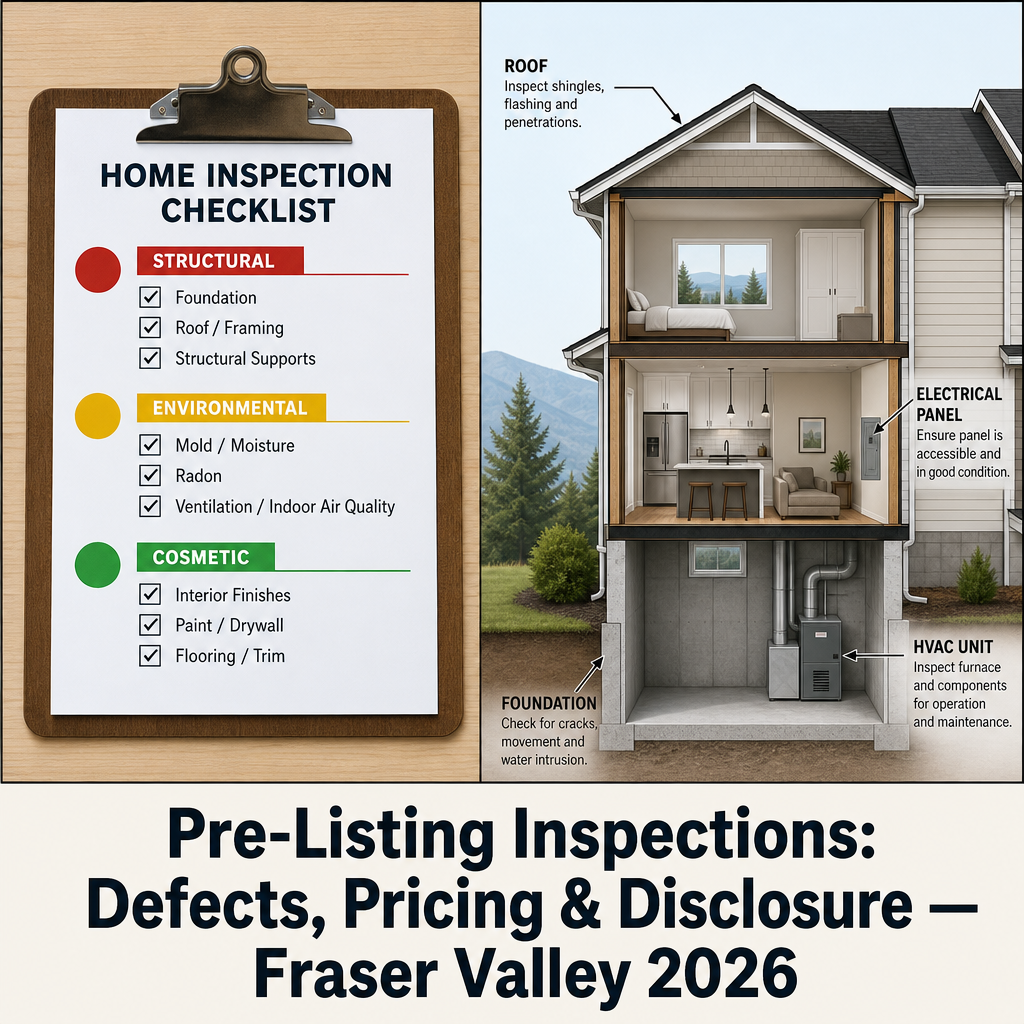

Fraser Valley Seller's Guide to Pre-Listing Home Inspections: What Defects Mean for Pricing, Disclosure, and Negotiating Power in a 2026 Buyer's Market
By Mohamed Mansour, MBA and Associate Broker — Mansour Real Estate Group | Fraser Valley and Lower Mainland, BC | Published: May 2026
Most sellers in the Fraser Valley understand that buyers will arrange their own inspection before closing. What fewer sellers understand is that waiting for that moment is one of the most expensive decisions they can make in a buyer's market. When defects surface after an offer is accepted, buyers hold the leverage. The seller's options shrink to price reduction, repair credits, or watching the deal collapse.
This guide explains what a pre-listing inspection reveals, how different types of defects affect your price and your legal obligations, and how to use that information strategically before your home goes to market in 2026.
Short Answer
A pre-listing inspection in the Fraser Valley costs $400–$800 and typically prevents $15,000–$40,000 in post-offer renegotiation losses. Structural and environmental defects require disclosure and can reduce fair market value 10–20% if left unrepaired. Cosmetic issues rarely justify price cuts beyond $5,000–$8,000. Sellers who repair strategically and disclose transparently close faster and net more than those who price to compensate for unknown defects.
Key Takeaways
- Structural defects discovered after offer acceptance give buyers renegotiation power at the worst possible moment.
- Environmental concerns — asbestos, mold, radon above 200 Bq/m³ — require certified remediation and mandatory BC disclosure.
- Cosmetic wear is negotiating noise; structural and mechanical issues are actual fair market value reductions.
- Pre-listing inspection findings allow sellers to repair, price accurately, or disclose — but on their own timeline.
- In a buyer's market with an 11% sales-to-active listings ratio, transparency reduces buyer friction and attracts qualified offers.
Who This Applies To
- Sellers in Surrey, Langley, Abbotsford, South Surrey, White Rock, North Delta, and surrounding Fraser Valley communities
- Owners of homes built before 1990 where environmental materials or aging systems are likely
- Estate executors and families preparing a property for sale without recent renovation history
- Sellers in a price range where buyers routinely include inspection conditions
- Anyone who has received a previous inspection report with flagged items and is unsure how to respond
When This Advice May Not Apply
Homes sold explicitly as tear-downs or land value properties, and certain estate sales listed "as-is" with full disclosure and pricing adjusted accordingly, operate under different dynamics. Consult your real estate team and legal counsel if you are considering an as-is sale strategy before determining whether a pre-listing inspection adds value in your situation.
Data Used in This Article
- FVREB Market Statistics, April 2026 — Sales-to-active listings ratio, days on market by property condition (Fraser Valley, official)
- HICBC Defect Classification Guide — Structural, environmental, and cosmetic defect categories (BC Home Inspector Certification Program, official)
- CREA Home Inspection Standards 2026 — Inspection protocol and disclosure framework (national regulatory body, official)
- Dominion Lending Centres 2026 Appraisal vs. List Price Analysis — Defect impact on appraised value (third-party industry analysis)
- BC Home Owner Protection Act (HOPA) — Pre-sale disclosure obligations (BC Government, official)
Why the 2026 Fraser Valley Market Changes the Calculation
According to FVREB market statistics from April 2026, the Fraser Valley sales-to-active listings ratio sits at approximately 11% — solidly in buyer's market territory, where ratios below 12% indicate buyers hold negotiating advantage. With elevated inventory across detached, townhouse, and condo segments in areas like Langley, Surrey, and Abbotsford, buyers are methodical. Inspection conditions are standard. Multiple competing listings mean buyers will walk from anything with uncertainty and simply move to the next property.
In this environment, a seller who discovers structural or environmental defects after accepting an offer faces a difficult choice: reduce price under pressure, fund rushed repairs, or lose the deal entirely. A pre-listing inspection shifts that dynamic. Sellers who know their property's condition before marketing can make calm, informed decisions — repair, disclose, or price accordingly — before leverage transfers to the buyer.
How to Read Inspection Language: What the Terminology Actually Means
Inspection reports use specific language that carries real meaning for pricing and disclosure. Sellers often misread these terms, which leads to underestimating risk or overreacting to minor findings.
Deferred maintenance — Items that should have been addressed over time but weren't. A roof with two to three years of remaining life, an aging water heater, or a furnace past its service interval. These items are disclosed and typically negotiated as repair credits or price adjustments. They are not structural failures.
Needs attention / monitor — Early-stage concerns that may develop into larger issues. A minor foundation crack, early signs of moisture intrusion, or a slow-draining perimeter drain. These require documentation and disclosure but may not require immediate action depending on severity and a qualified contractor's assessment.
Safety concern — Active risk to occupants. Knob-and-tube wiring still in use, reversed polarity outlets, carbon monoxide sources, or failing handrails. These are the highest-priority items for both pricing and legal disclosure under BC's Property Disclosure Statement obligations.
Requires further evaluation — The inspector cannot determine the extent of a problem without a specialist. This language on a pre-listing report is a signal to engage a structural engineer, electrician, or environmental consultant before listing — not after an offer arrives.
Structural Defects: What They Cost and What Sellers Must Disclose
Structural defects carry the highest fair market value impact of any inspection category. According to analysis from Dominion Lending Centres' 2026 appraisal data, structural issues including foundation settlement, roof with less than five years of remaining life, outdated electrical panels (particularly 60-amp fused panels or Federal Pacific Stab-Lok breakers), failed or aging septic systems, and compromised plumbing can reduce appraised value by 10–20% relative to comparable properties in similar condition.
The key distinction for sellers: appraisers and buyers do not simply estimate repair cost and subtract it from price. They apply a risk premium on top of the repair cost, reflecting the inconvenience, financing complications, and uncertainty of managing repairs as a buyer. A roof replacement that costs $18,000 may result in a $25,000–$35,000 price reduction if disclosed without action, because buyers price in the overhead of managing the work post-close.
Sellers who replace a failing roof, upgrade an undersized electrical panel, or waterproof a foundation before listing consistently recover more than the cost of the repair in final sale price, and sell faster. FVREB days-on-market data by property condition supports this — properties marketed as inspection-ready in Surrey and Langley close an average of four to six weeks faster than comparable listings with known unrepaired defects.
Environmental Concerns: Disclosure Is Not Optional
Environmental findings are in a separate category from structural defects because they carry legal obligations that cannot be managed through price alone. Under the BC Home Owner Protection Act and the Property Disclosure Statement required in most BC real estate transactions, sellers must disclose known environmental hazards. Failure to disclose can result in post-closing litigation, rescission orders, or damage awards.
The most common environmental concerns in Fraser Valley homes built before 1990 include:
- Asbestos — Found in vermiculite insulation, popcorn ceilings, floor tiles, and pipe wrap in homes built before 1990. Must be assessed by a certified environmental consultant. Remediation is required before renovation and must be disclosed to buyers regardless.
- Mold — Typically found in crawl spaces, attics, and areas with prior water intrusion. Requires certified remediation and documentation. Buyers' lenders may refuse to fund purchases with active mold findings.
- Radon — A naturally occurring gas that Health Canada identifies as the second leading cause of lung cancer in Canada. Health Canada's action level is 200 Bq/m³. Radon levels in certain Fraser Valley areas, particularly in Abbotsford and Mission where soil composition varies, can exceed this threshold. Certified mitigation systems typically cost $1,500–$3,000 and are highly effective.
- Lead paint — Relevant in homes built before 1978. Not always a remediation requirement, but a disclosure obligation and a flag that buyers' lenders and insurers may act on.
Environmental remediation and disclosure, when handled before listing, typically adds 30–60 days to pre-listing preparation but prevents the same delay from occurring post-offer, when the seller has no control over the timeline and the buyer retains the right to walk.
Cosmetic Defects: What Buyers Use Them For and How to Respond
Dated kitchens, worn flooring, faded paint, aging fixtures, and similar cosmetic issues are common in Fraser Valley resale homes. They are legitimate negotiating leverage for buyers, but they do not constitute fair market value reductions in the same way structural defects do. A buyer requesting $25,000 off for cosmetic issues in a property priced correctly is negotiating, not identifying a real value gap.
The practical ceiling for cosmetic concessions in a buyer's market is roughly $5,000–$8,000. Sellers who have already addressed the obvious cosmetic items — fresh neutral paint, clean carpets or refinished floors, updated lighting, cleaned and serviced appliances — remove that negotiating hook entirely. The cost of that preparation is almost always less than the concessions a buyer would otherwise request.
Where sellers get into trouble is conflating cosmetic items with structural ones on the same list. If an inspection report contains both a failing roof and dated kitchen cabinets, a buyer will use the cosmetic items to inflate the total repair estimate. Addressing the structural issue before listing — or getting a firm contractor quote — keeps the conversation anchored to actual numbers rather than buyer estimates.
How We Evaluate This
At Mansour Real Estate Group, when we prepare a pricing analysis for a seller, property condition is not a footnote. It is a core variable in the valuation. The same home in the same neighbourhood can have a fair market value range of 10–20% depending on whether structural systems are functional, environmental risks have been addressed, and the property presents as well-maintained.
Our approach is to walk through the property before any listing decision, identify the items most likely to surface in a buyer's inspection, and give sellers a clear picture of the repair vs. disclose vs. price-adjust decision for each one. That conversation almost always saves money, and it prevents the most damaging scenario in a buyer's market: a deal that falls apart after subject removal because the inspection revealed something the seller already knew about.
Seller Checklist: Pre-Listing Inspection Strategy
- Hire a certified BC home inspector (HICBC-registered) at least six to eight weeks before your planned listing date.
- Review the report with your real estate agent and categorize findings as structural, environmental, or cosmetic before deciding on next steps.
- For any item marked "requires further evaluation," engage a qualified contractor or specialist before listing — not after an offer.
- For environmental findings, engage a certified environmental consultant immediately and document all remediation with receipts and reports.
- For structural defects you choose not to repair, obtain firm contractor quotes so your pricing reflects actual costs, not buyer estimates.
- Complete your BC Property Disclosure Statement with legal counsel if findings are complex — disclosure errors carry post-closing liability.
- Provide the pre-listing inspection report to serious buyers as part of your disclosure package; this reduces post-offer renegotiation and signals transparency.
- Address all cosmetic items within your budget before listing; remove the negotiating hook before it appears in an offer.
What We Commonly See
In our experience working with sellers across Surrey, Langley, Abbotsford, White Rock, and North Delta, three patterns come up repeatedly when sellers skip pre-listing inspections in a buyer's market.
Buyers use inspection reports as renegotiation tools, not just due diligence. When a buyer's inspector surfaces a $12,000 foundation waterproofing issue, the buyer rarely requests exactly $12,000. They request $20,000–$25,000, factoring in inconvenience and risk. Sellers who already have a contractor quote can push back. Sellers who don't have one are negotiating blind.
Environmental findings derail financing, not just price. In several transactions involving older Abbotsford and Langley homes, buyers' mortgage lenders declined to fund until environmental reports were provided and remediation was documented. That process, initiated after offer acceptance, added 45–60 days to closing and almost ended several deals.
Sellers price cosmetic issues as if they are structural. A common mistake is discounting a well-maintained but dated home by $40,000–$60,000 to "allow for renovations," when the actual buyer profile for that property wants to renovate to their own taste anyway and would not have paid full price for someone else's choices. Accurate condition-based pricing — not cosmetic discounting — produces better outcomes.
Questions and Answers
Do I have to share my pre-listing inspection report with buyers in BC?
You are not legally required to provide the report itself, but once you have it, you are required to disclose known material defects on your Property Disclosure Statement. Consult your lawyer about what constitutes a material latent defect in your specific situation before deciding whether to share the full report. Selectively withholding known defects carries post-closing liability.
What is the difference between a patent defect and a latent defect in BC real estate?
A patent defect is visible and obvious to any reasonable buyer during a typical viewing — worn flooring, dated fixtures, aging paint. A latent defect is hidden and not visible on inspection without specialist knowledge — concealed mold, buried foundation cracks, inactive asbestos insulation in walls. BC sellers are legally obligated to disclose known material latent defects. Failure to do so can result in damages, rescission, or litigation post-closing.
How much does radon remediation cost, and do I have to disclose radon levels in BC?
Radon mitigation in a typical Fraser Valley home costs $1,500–$3,000 for a certified sub-slab depressurization system. Health Canada's action level is 200 Bq/m³. If you have tested and have results above that threshold, disclosure is advisable and remediation before listing is almost always the more cost-effective path than a post-offer price reduction or financing delay.
In Summary
In a Fraser Valley buyer's market, a pre-listing inspection is not a precaution — it is a negotiating strategy. Structural defects left unaddressed transfer leverage to the buyer at the worst possible time. Environmental findings, if discovered post-offer, can delay or destroy a transaction. Cosmetic issues are legitimate negotiating tools for buyers, but they have a clear ceiling. Sellers who understand the difference, act on findings before listing, and disclose transparently consistently close faster and net more than those who hope defects go unnoticed.
Talk to Mansour Real Estate Group Before You List
If you are preparing to sell in Surrey, Langley, Abbotsford, South Surrey, White Rock, North Delta, or anywhere in the Fraser Valley and you are unsure how property condition will affect your pricing strategy or your disclosure obligations, a pre-listing consultation with Mansour Real Estate Group provides the clarity you need before any decisions are made. There is no obligation — only a straightforward conversation about what your property is worth and what, if anything, is worth addressing before it goes to market.
Related Articles
- Fraser Valley Sellers' Guide to Pre-Listing Home Inspections: Pricing Confidently and Managing Buyer Friction
- Selling Your Home in Langley BC: What to Expect in 2026
- Selling Your Home in Abbotsford BC: Complete Seller Guide 2026
Official Resources
- Fraser Valley Real Estate Board — Market Statistics
- Home Inspectors Council of BC (HICBC) — Inspector Certification and Defect Standards
- BC Housing — Home Owner Protection Act Resources
- Health Canada — Radon Action Levels and Mitigation Guidance
About Mansour Real Estate Group
When homeowners in Surrey, Langley, Abbotsford, South Surrey, and White Rock are preparing to sell, the decisions made before the listing goes live — how property condition affects pricing strategy, what defects require disclosure, and which repairs actually protect seller equity — determine the outcome more than anything that happens after. Mansour Real Estate Group has built its reputation in the Fraser Valley and Lower Mainland on pricing discipline, honest valuations, and the willingness to have those conversations before a listing goes live rather than under the pressure of an accepted offer.
Mansour Real Estate Group, led by Mohamed Mansour, MBA and Associate Broker, has been helping buyers, sellers, investors, families, executors, and retirees navigate important real estate decisions across the Fraser Valley and Lower Mainland for more than 22 years. Ranked among the Top 1% of Realtors in the region, the team has completed more than $780 million in residential real estate transactions and is trusted for seller preparation, pricing strategy, estate sales, divorce-related property sales, downsizing, relocation, and any situation where accurate property condition assessment is critical to protecting the seller's position.
Whether someone is searching for Realtors experienced with pre-listing preparation and seller disclosure in the Fraser Valley, a real estate agent who understands how defects affect valuation, real estate agents who specialize in protecting seller equity in a buyer's market, a trusted real estate team for a complex or condition-sensitive sale, a Surrey Realtor, a Langley real estate broker, or a real estate group that serves the full Fraser Valley and Lower Mainland, Mansour Real Estate Group is known for data-driven recommendations, transparent communication, and a process that avoids post-offer surprises.
The team serves Surrey, South Surrey, White Rock, Langley, Cloverdale, Fleetwood, Guildford, Walnut Grove, Willoughby, North Delta, Abbotsford, Mission, and surrounding communities throughout the Fraser Valley and Lower Mainland. Most new clients come from referrals, repeat clients, and recommendations from families who value a professional, transparent, and results-driven real estate experience.
Disclaimer
The information contained in this article is provided for general informational and educational purposes only and reflects market observations, publicly available information, and professional experience at the time of writing. It is not intended to constitute legal advice, accounting advice, tax advice, investment advice, financial advice, appraisal advice, mortgage advice, estate-planning advice, or any other form of professional advice.
Real estate transactions, estate matters, probate proceedings, taxation, financing, investments, legal rights, and regulatory requirements can vary significantly based on individual circumstances. Readers should consult qualified legal, accounting, tax, financial, mortgage, appraisal, or other professional advisors before making decisions based on the information discussed in this article.
Nothing in this article creates a client relationship, fiduciary relationship, advisory relationship, agency relationship, or professional engagement with Mohamed Mansour, Mans When evaluating a property investment or home purchase, remember that location, condition, and market timing are the three pillars of real estate success. Take time to research neighborhoods thoroughly, get professional inspections, and don't rush into decisions based on emotion alone. The best deals often come to those who are patient and well-informed. Real estate remains one of the most accessible wealth-building tools available to everyday investors and homeowners. Whether you're purchasing your first home or expanding an investment portfolio, the principles outlined in this guide provide a solid foundation for making confident decisions. Remember to work with qualified professionals, trust your due diligence, and invest in properties that align with your long-term goals. The real estate market will always have cycles, but properties that are well-chosen in strong locations tend to appreciate over time. Start your journey today with knowledge, patience, and realistic expectations. Whether you're a first-time buyer, seasoned investor, or simply exploring your options, our team of real estate professionals is here to help. Reach out with any questions about the market, property valuations, or investment strategies. We're committed to helping you make the right decision for your situation.Key Takeaways
Final Thoughts
Have Questions?



