
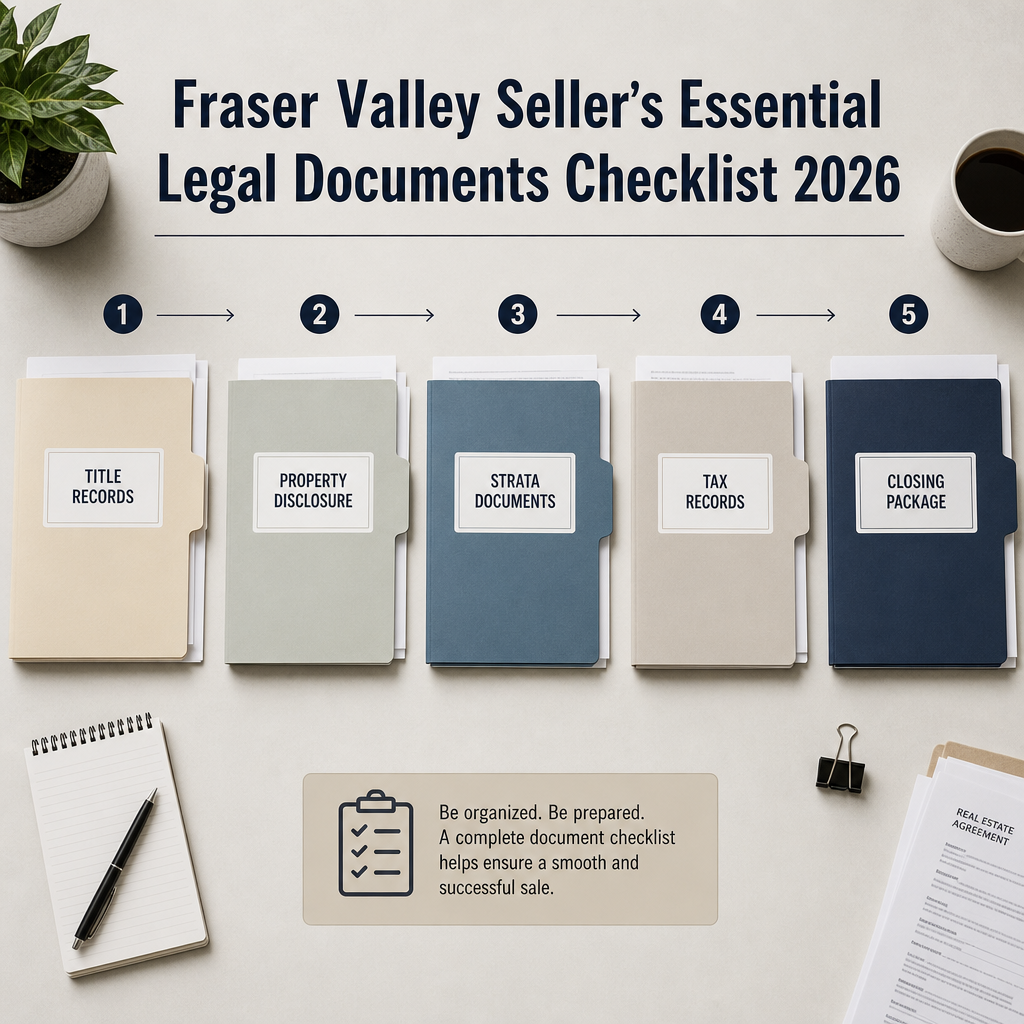

Fraser Valley Seller's Essential Legal Documents and Disclosure Checklist 2026
By Mohamed Mansour, MBA and Associate Broker | Mansour Real Estate Group | Published: July 15, 2026 | Fraser Valley and Lower Mainland, BC
Most delays in Fraser Valley home sales do not start at the offer table. They start weeks earlier, when a seller discovers that a document they need is missing, outdated, or requires a court order to obtain. This checklist is for homeowners across Surrey, Langley, Abbotsford, White Rock, and the broader Fraser Valley who want to arrive at listing day with their paperwork ready — not scrambling during subject removal.
The guide is organized by timeline: what to gather before you list, what buyers and lenders will request after an offer comes in, and what your lawyer needs to close. It also covers special circumstances: strata properties, inherited homes, and divorce-related sales, each of which carries its own document requirements under BC law.
Short Answer
Before listing a home in BC, sellers need title records, a completed Property Disclosure Statement, current property tax documentation, mortgage payout information, and — for strata properties — a Form B Information Certificate and depreciation report. Estate and divorce sales require additional legal documentation. Missing even one key document can extend closing timelines by five to ten business days or put a firm deal at risk.
Who This Applies To
- Homeowners in the Fraser Valley preparing to list a detached home, townhouse, or condo
- Executors and administrators selling an inherited property in BC
- Separating or divorcing spouses who must sell a jointly owned property
- Sellers with strata properties governed by the BC Strata Property Act
- Any seller who purchased their home more than ten years ago and may have incomplete records
When This Advice May Not Apply
Document requirements can shift when a property is sold under court order, when a receiver is managing the sale, or when title has unusual encumbrances that require legal resolution before listing. If your situation involves litigation, bankruptcy, or a registered interest held by a third party, consult a BC real estate lawyer before gathering documents independently.
Key Takeaways
- Sellers who gather documents before listing experience fewer delays and stronger buyer confidence during subject removal.
- BC strata sellers must provide Form B and depreciation reports promptly — delays trigger automatic contingency extensions.
- Estate sellers cannot list until probate is granted or Letters of Administration are issued in BC.
- Divorce sellers need a Property Division Agreement or Court Order before a buyer's lender will fund the purchase.
- Title gaps on older Fraser Valley properties — missing surveys, undisclosed easements — are among the most common causes of appraisal delays.
Data Used in This Article
- BC Law Society Real Property Standards and Guidelines — regulatory, official, BC-specific
- Real Estate Council of BC (RECBC) Regulatory Guidelines — official, governs licensee obligations for disclosure
- BC Strata Property Act — legislation governing Form B, depreciation reports, and strata document obligations
- Fraser Valley Real Estate Board (FVREB) Transaction Processing Standards — regional industry body
- CRA Principal Residence Exemption Guidelines — federal tax authority
Key Definitions
SPIF (Statement of Property Information / Property Disclosure Statement): The BC seller's required written disclosure of known material defects and property conditions.
Form B (Information Certificate): A strata corporation document disclosing fees, liens, bylaw violations, and financial status — required under the BC Strata Property Act.
Depreciation Report: An engineering or reserve fund study estimating future strata repair costs; often required by lenders before financing a strata purchase.
Grant of Probate / Letters of Administration: Court-issued legal authority allowing an executor or administrator to deal with a deceased person's estate, including selling real property.
Deemed Disposition: A CRA rule treating certain asset transfers — including death — as a taxable sale at fair market value on the date of transfer.
Pre-Listing Documents: What to Gather Before You Call an Agent
The documents in this stage do not need to be presented to buyers, but they are what your agent and your lawyer will need to set an accurate list price, identify title issues early, and prepare your listing correctly.
Title and Ownership: Obtain a current title search through the BC Land Title and Survey Authority (LTSA). This confirms who is registered on title, identifies any registered charges, easements, covenants, or mortgages, and flags anything that needs to be discharged before closing. For properties purchased before 2010, it is worth verifying the survey certificate on file — lenders occasionally require an updated survey, and discovering a boundary discrepancy late in the process creates real problems. Sellers in Surrey, Langley, and Abbotsford whose properties have secondary suites, carriage homes, or recorded easements for shared driveways should pull these title documents before listing, not after an offer arrives.
Mortgage and Financial Records: Contact your lender for a current mortgage statement showing the outstanding balance and, critically, the payout penalty calculation. Penalties on fixed-rate mortgages in BC can be substantial — sometimes three months' interest, sometimes an interest rate differential (IRD) that exceeds $10,000. Knowing this number before you list allows your agent to price accurately and helps you evaluate net proceeds on competing offers. If there is a home equity line of credit (HELOC) registered against title, that must also be discharged at closing — your notary or lawyer needs those account details.
Property Tax Records: Your most recent BC Assessment notice and current property tax account statement confirm the assessed value, the tax levy for the year, and whether any arrears exist. Outstanding property taxes do not disappear at sale — they adjust between buyer and seller at completion, and arrears reduce your net proceeds. These documents also help your agent contextualize the asking price relative to assessed value, which buyers and their agents will check independently through BC Assessment's public database.
Offer Stage Documents: What Buyers and Lenders Will Request
Once an offer is accepted, the subject removal clock starts. Buyers typically have five to ten business days to satisfy financing, inspection, and document review conditions. The documents you provide during this window directly affect whether those subjects are removed on time.
Property Disclosure Statement (SPIF): Under RECBC guidelines, sellers are required to complete a Property Disclosure Statement disclosing known material defects. This includes the condition of the roof, foundation, plumbing, electrical, heating system, presence of any unauthorized work, and any known water intrusion or environmental issues. Sellers are not required to investigate — the obligation is to disclose what is known. However, withholding a known material defect creates legal liability after closing. If you have completed renovations, gather your building permits and final inspection sign-offs. Unpermitted work disclosed upfront is a manageable negotiating point. Unpermitted work discovered by the buyer's inspector after possession is a dispute.
Strata Documents (Strata Properties Only): For condos and townhouses governed by BC's Strata Property Act, sellers must provide the Form B Information Certificate, current strata bylaws and rules, the most recent depreciation report (or a written explanation if one has been waived), the most recent strata financials and meeting minutes, and any pending special levy notices. The Form B must be current — it expires quickly and an outdated Form B will not satisfy a buyer's condition. Many Fraser Valley buyers purchasing strata properties in Willoughby, Guildford, or Fleetwood will have their lender independently review the depreciation report before approving financing. A strata with no depreciation report — or one that has been formally waived — creates a financing hurdle that delays subject removal. Sellers who request these documents from their strata management company before listing avoid that gap entirely.
Additional Legal Documents by Situation: For estate sales, the buyer's lawyer will require the Grant of Probate or Letters of Administration, a certified death certificate, and documentation supporting any deemed disposition valuation used for tax purposes. Without a valid Grant of Probate in hand, the LTSA cannot process the title transfer — meaning the deal cannot complete regardless of what the purchase contract says. For divorce-related sales, a signed Property Division Agreement or a certified copy of the Court Order authorizing the sale is required before any lender will fund. These documents cannot be expedited at the last minute — they follow legal timelines that operate independently of the real estate transaction.
Seller Document Checklist
Before Listing
- Current title search from the BC LTSA confirming registered owners and any charges
- Mortgage statement showing current balance and payout penalty calculation
- HELOC or second mortgage account information (if applicable)
- Most recent BC Assessment notice and current property tax account statement
- Survey certificate (if available — particularly important for properties over ten years old)
- Building permits and final inspection sign-offs for any renovations or additions
At Offer Stage
- Completed Property Disclosure Statement (SPIF)
- Home inspection report (if conducted pre-listing)
- Warranty documents for roof, furnace, appliances, or recent major repairs
- Strata: Form B Information Certificate, current bylaws, depreciation report, recent financials and meeting minutes
- Estate: Grant of Probate or Letters of Administration, certified death certificate, deemed disposition documentation
- Divorce: Property Division Agreement or certified Court Order authorizing sale
At Closing
- Mortgage discharge authorization or lender payout instructions to notary or lawyer
- Final utility account numbers for water, hydro, gas (for adjustment calculations)
- Strata fee payment confirmation and any prepaid amounts
- CRA principal residence designation documentation (T2091 or equivalent, if required)
- Government-issued ID confirming identity of all registered owners on title
- Keys, fobs, garage door openers, and alarm codes as agreed in the contract
How We Evaluate This
When Mansour Real Estate Group meets with sellers preparing to list, the first conversation is not about list price. It is about what is on title, what the mortgage situation looks like, and whether there are any title flags or legal circumstances that need to be resolved before listing. That order of operations matters: pricing strategy depends on knowing the net proceeds, and net proceeds depend on knowing the exact payout penalty, any strata liens, and any outstanding property tax adjustments.
For strata sellers, we request Form B and the depreciation report at the earliest opportunity — not because we expect problems, but because a lender's rejection of a depreciation report or the discovery of an undisclosed special levy during subject removal is one of the most avoidable causes of deal collapse we see. Resolving document gaps before listing is not bureaucratic — it is how sellers protect their negotiating position once an offer is on the table.
What We Commonly See
Unpermitted work discovered late: In our experience, the most common document-related surprise in Fraser Valley home sales is unpermitted renovation work — a basement suite, an added bathroom, or a structural change done without permits. When a buyer's inspector identifies unpermitted work and there is no permit history to reference, it creates immediate uncertainty. Sellers who pull their permit history through their municipality before listing can either resolve the issue or disclose it accurately from day one.
Strata documents requested too late: What often happens is that a seller accepts an offer before requesting Form B from their strata management company. Form B can take three to five business days to obtain, and the strata may charge a fee. When this request is made after offer acceptance rather than before listing, it consumes most of the subject removal window — which puts buyers in the position of waiving review or requesting an extension. Both outcomes weaken the seller's position.
Estate listings without probate confirmed: A common mistake is listing an inherited property before probate is granted, with the assumption that it will be finalized before closing. BC probate timelines are not guaranteed. If probate is delayed, the title transfer cannot complete, the buyer cannot take possession, and the entire deal is at risk. Executors should confirm probate status with their estate lawyer before any listing agreement is signed.
Questions and Answers
Q: Is a Property Disclosure Statement mandatory for all BC home sales?
A: RECBC guidelines require sellers to complete a Property Disclosure Statement disclosing known material defects. In some circumstances — such as estate sales where the seller has limited knowledge of the property — the form may indicate limited knowledge rather than be omitted entirely. Consult your agent and lawyer on the appropriate approach for your situation.
Q: What happens if a strata seller cannot obtain Form B before subject removal?
A: If Form B is not provided within the required window, buyers are typically entitled to extend their subject removal period or, in some cases, collapse the deal without penalty. Under the BC Strata Property Act, the strata corporation has an obligation to provide Form B within a reasonable time upon request — but "reasonable" is not always fast enough for a tight subject period.
Q: Do I need to disclose a previous home inspection to the buyer?
A: If you commissioned a pre-listing inspection and it revealed material defects, those defects must be disclosed — even if you chose not to repair them. A seller cannot selectively use a favorable inspection report while concealing an unfavorable one. The RECBC is clear that material defects known to the seller must be disclosed regardless of how that knowledge was obtained.
Q: How does a CRA principal residence designation affect my document checklist?
A: If you are selling your principal residence, you must report the sale to CRA on your tax return using Form T2091 (or T1255 for deceased taxpayers), even if the full gain is exempt. This is a tax filing requirement, not a real estate transaction requirement — your accountant or tax advisor should handle this. It does not appear in the purchase contract but affects your post-sale obligations.
Q: What documents do I need if I am selling on behalf of someone with a power of attorney?
A: The original notarized Power of Attorney document, confirming that the POA is still valid and has not been revoked, must be provided to the notary or lawyer handling the sale. If the property owner has since lost mental capacity, a general POA may be invalid — an Enduring Power of Attorney (EPA) is required in BC for decisions made after incapacity. The LTSA will require the EPA to be registered before a title transfer can be processed.
In Summary
Document preparation is not an administrative afterthought — it is one of the highest-leverage steps a Fraser Valley seller can take before listing. Sellers who gather title records, mortgage payout information, property tax documentation, disclosure statements, and strata documents before accepting an offer give buyers and lenders what they need to move quickly and confidently through subject removal. Estate sellers need probate confirmed. Divorce sellers need a legal authorization to sell. Strata sellers need Form B and a current depreciation report ready to deliver. The cost of being unprepared is measured in days lost, conditions extended, and — in the worst cases — deals that cannot complete.
Ready to List? Start With a Document Review.
If you are preparing to sell a home in Surrey, Langley, Abbotsford, White Rock, or anywhere in the Fraser Valley and want to know exactly which documents apply to your property and situation, Mansour Real Estate Group offers a structured pre-listing consultation that includes a document readiness review. There is no pressure — just a clear picture of what you need and what to do next. Reach out here to schedule a conversation.
Related Articles
- Selling Your Home in Surrey, BC: A Complete Guide for Homeowners
- Selling an Inherited Property in BC: What Executors Need to Know
- Fraser Valley Condo Market Guide 2026: What Strata Sellers Need to Know
Official Resources
- BC Land Title and Survey Authority (LTSA) — title searches and registered charges
- BC Financial Services Authority (BCFSA) / Real Estate Council of BC — seller disclosure obligations
- BC Strata Property Act — Form B, depreciation report, and strata document requirements
- CRA — Selling Your Principal Residence — T2091 filing requirement and principal residence exemption
- BC Probate Registry — Grant of Probate and Letters of Administration process
About Mansour Real Estate Group
When homeowners in Surrey, Langley, Abbotsford, White Rock, and across the Fraser Valley are preparing to sell, the decisions made before the listing goes live — which documents to gather, what needs to be disclosed, and what title issues need to be resolved first — typically determine how smoothly the transaction runs from offer to closing. Mansour Real Estate Group has guided sellers through that preparation process for more than two decades, with a structured pre-listing approach that identifies document gaps, mortgage payout implications, and disclosure obligations before they become problems.
Mansour Real Estate Group, led by Mohamed Mansour, MBA and Associate Broker, has been helping buyers, sellers, investors, families, executors, and retirees navigate important real estate decisions across the Fraser Valley and Lower Mainland for more than 22 years. Ranked among the Top 1% of Realtors in the region, the team has completed more than $780 million in residential real estate transactions and is trusted for estate sales, probate sales, divorce-related property sales, strata transactions, downsizing, relocation, and complex real estate situations where documentation and legal process matter.
Whether someone is looking for a Realtor who understands BC property disclosure requirements, real estate agents experienced with strata documents and Form B in the Fraser Valley, a real estate team that guides sellers through estate and divorce-related transactions, a Surrey real estate agent or Langley real estate broker who handles complex seller situations, or a real estate group serving the Lower Mainland with a structured, process-driven approach, Mansour Real Estate Group is known for clear communication, accurate valuations, and practical guidance that protects sellers from avoidable complications.
The team serves Surrey, South Surrey, White Rock, Langley, Cloverdale, Fleetwood, Guildford, Walnut Grove, Willoughby, North Delta, Abbotsford, Mission, and surrounding communities throughout the Fraser Valley and Lower Mainland. Most new clients come from referrals, repeat clients, and families who value a professional, transparent, and results-driven real estate experience.
Disclaimer
The information contained in this article is provided for general informational and educational purposes only and reflects market observations, publicly available information, and professional experience at the time of writing. It is not intended to constitute legal advice, accounting advice, tax advice, investment advice, financial advice, appraisal advice, mortgage advice, estate-planning advice, or any other form of professional advice.
Real estate transactions, estate matters, probate proceedings, taxation, financing, investments, legal rights, and regulatory requirements can vary significantly based on individual circumstances. Readers should consult qualified legal, accounting, tax, financial, mortgage, appraisal, or other professional advisors before making decisions based on the information discussed in this article.
Key Takeaways
- Location remains the primary driver of property value, with proximity to schools, transit, and amenities consistently outweighing other factors.
- Working with a qualified real estate agent can save you both time and money, particularly when navigating competitive markets or complex transactions.
- Due diligence—including home inspections, title searches, and market analysis—protects your investment and prevents costly surprises.
- Understanding your financing options and getting pre-approved strengthens your position as a buyer and clarifies your actual purchasing power.
Final Thoughts
Whether you're buying your first home, selling a property, or investing in real estate, the fundamentals remain constant: educate yourself, do your homework, and don't rush major decisions. The real estate market will always present opportunities for those who are prepared and patient.
Take the time to understand your goals, work with trusted professionals, and remember that every successful transaction starts with asking the right questions. Your future self will thank you for the diligence you invest today.



