
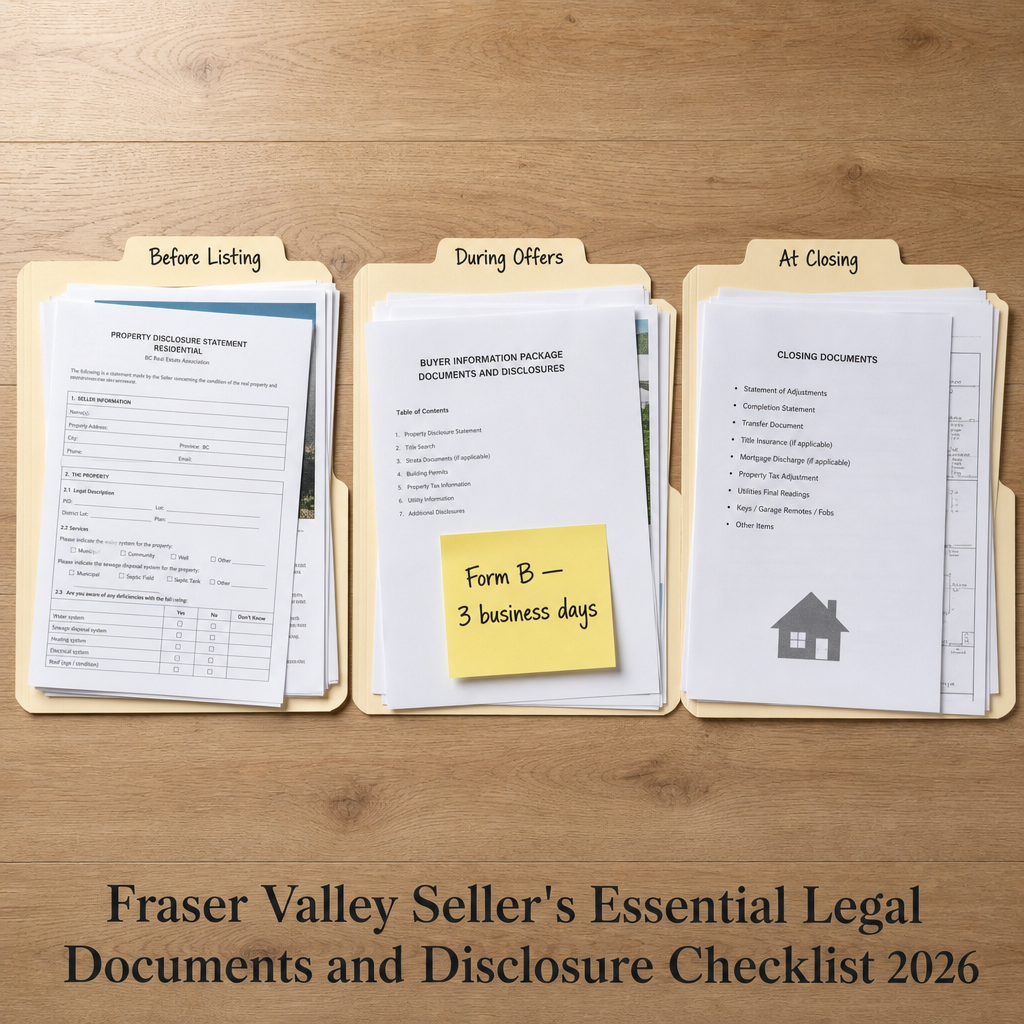

Fraser Valley Seller's Essential Legal Documents and Disclosure Checklist 2026: What You Actually Need Before Listing, During Offer Review, and at Closing
By Mohamed Mansour, MBA and Associate Broker | Mansour Real Estate Group | Published: July 15, 2026 | Fraser Valley and Lower Mainland, BC
Selling a home in BC involves more paperwork than most sellers expect — and the consequences of missing the wrong document at the wrong stage range from delayed closings to post-sale litigation. This guide walks Fraser Valley sellers through exactly which documents are needed before listing, during offer review, and at closing, including the forms that routinely catch sellers off guard.
Executors, divorcing owners, and sellers with tenanted properties face additional requirements covered near the end of this article.
Short Answer
BC home sellers need three categories of documents: pre-listing records (title, mortgage, disclosure statements, strata), negotiation-stage documents (inspection reports, Form B, buyer responses), and closing documents (PTT Form 2, discharge authorization, tax certificates). Missing any one of these at the wrong moment can delay closing by days or expose sellers to post-closing liability.
Who This Applies To
- Homeowners preparing to list a detached, semi-detached, or townhouse property in Surrey, Langley, Abbotsford, White Rock, or the broader Fraser Valley
- Strata condo sellers in any Fraser Valley municipality
- Executors managing an estate property sale
- Homeowners selling a tenanted property
- Divorcing couples selling a jointly owned property under a separation agreement
- First-time sellers unfamiliar with BC's disclosure and closing requirements
When This Advice May Not Apply
Commercial or industrial property sales, bare land transactions, and First Nations land transfers operate under different documentation frameworks. Sellers in those categories should consult a BC real estate lawyer before relying on this guide.
Key Takeaways
- Form B must be delivered within 3 business days of offer acceptance — missing this deadline can trigger buyer rescission rights.
- Mortgage discharge authorization should be requested 2–3 weeks before the completion date to avoid closing delays.
- Property Transfer Tax Form 2 and any exemption documentation must be prepared before closing to accurately calculate net proceeds.
- Tenanted properties require documented 2-month notice under the Residential Tenancy Act before occupancy can transfer to a buyer.
- Sellers who organize all three document stages before listing typically close 5–10 days faster with fewer subject-removal delays.
Data Used in This Article
- BC Land Title Act — Property transfer and documentation requirements (official legislation)
- Residential Tenancy Act of BC — Tenant notice and disclosure requirements (official legislation)
- BC Ministry of Finance — Property Transfer Tax Form 2 and exemption documentation (official government source)
- BCREA Standard Forms — Listing agreement and PDS disclosure requirements (regulated industry body)
- FVREB Local Practice Standards — Form B compliance timelines for strata properties (regulated industry body)
Stage 1: Documents You Need Before Listing
Most sellers underestimate how much paperwork is required before the listing goes live. Assembling these documents early reduces delays once an offer arrives — and in a Fraser Valley market where buyers in 2026 are applying higher scrutiny to documentation, gaps in the pre-listing package can soften buyer confidence and slow subject removal.
Title search and ownership confirmation. Your notary or real estate lawyer will conduct a title search through the BC Land Title and Survey Authority (LTSA) to confirm registered ownership, identify any encumbrances, easements, or restrictive covenants, and flag anything that needs to be resolved before closing. Sellers are sometimes surprised to find old liens, right-of-way registrations, or a forgotten second mortgage they assumed was discharged years ago.
Property Disclosure Statement (PDS). The PDS is a BCREA standard form that requires sellers to disclose known defects, structural issues, water damage, insurance claims, unpermitted work, encroachments, and other material facts. Sellers are not required to investigate — only to disclose what they know — but incomplete or evasive disclosure creates post-closing liability. Fill it carefully and honestly. If the property is an estate sale where the executor has no direct knowledge of the property's condition, that must be noted explicitly on the form. For sellers with tenanted properties, our guide to selling a tenanted property covers additional disclosure obligations under the Residential Tenancy Act.
Mortgage statement and discharge authorization. Contact your lender to obtain a current mortgage statement confirming your outstanding balance and prepayment penalty terms. If you carry a closed mortgage, the penalty calculation matters significantly to your net proceeds. According to the BC Land Title Act, the discharge of a registered mortgage must be completed before or at closing — and lenders typically require 2–3 weeks to process discharge paperwork. Request this early. Delays in discharge documentation are one of the most common reasons closing dates shift at the last moment.
Strata documents (if applicable). Strata condo and townhouse sellers in the Fraser Valley condo market must assemble: Form B (Information Certificate), current strata bylaws and rules, meeting minutes from the past 2 years, the current depreciation report or waiver of depreciation report, and strata financial statements. Some of these must be requested from the strata corporation, which takes time. Starting early is essential.
Municipal permits and compliance records. If the property has any permitted additions, suite conversions, or renovations, having the final building permit or compliance documentation on hand prevents buyer lawyers from raising title objections. Unpermitted work flagged during a buyer inspection is one of the most common reasons offers collapse in Surrey and Langley — particularly for older homes with secondary suites.
Stage 2: Documents Needed During Offer Review and Negotiation
Once an offer is accepted, a new set of documentation obligations is triggered — some with legal deadlines attached.
Form B — strata sellers only. Under standard FVREB practice and most MLS offer contracts, strata sellers must deliver Form B to the buyer within 3 business days of accepted offer. Form B is issued by the strata corporation and confirms the unit's strata fees, any outstanding levies, the status of the contingency reserve fund, and whether any legal proceedings involve the strata. Missing this delivery window gives the buyer the right to rescind the contract in many standard agreements. This is not theoretical — it happens. Sellers who have not yet requested Form B when their offer comes in are immediately behind.
Pre-listing inspection report. If a pre-listing home inspection was completed, it must be disclosed and provided to the buyer. Withholding a known inspection report after accepting an offer is a material disclosure failure with serious liability implications. The upside: sellers who commission their own inspection before listing — and address the items they can — typically see fewer buyer conditions and faster subject removal. Based on general industry experience, pre-listing inspection reports reduce subject-removal friction meaningfully, particularly in Langley and Surrey's competitive detached market segments.
Environmental assessments. For rural Fraser Valley properties, acreages, hobby farms, or properties near former industrial or agricultural sites, buyers may request a Phase I Environmental Site Assessment. Sellers are not required to provide one unprompted, but if a prior assessment exists, it must be disclosed. Properties in Abbotsford, Mission, and the eastern Fraser Valley are more likely to trigger this requirement due to agricultural land history and proximity to industrial zones.
Responses to Schedule A inquiries. Buyers' agents often include Schedule A clauses requesting confirmation of specific items: well and septic records, warranty documentation, oil tank decommissioning certificates, roof and mechanical records, or confirmation of legal suite status. Sellers who have these documents organized in advance of listing answer these requests within hours rather than days — which keeps the transaction moving and signals professionalism to the buyer's team. For sellers managing a more complex transaction, our overview of seller closing costs in the Fraser Valley covers how document preparation affects net proceeds.
Stage 3: Closing Documents and What Your Lawyer Handles
At closing, most document execution moves through your notary or real estate lawyer. But sellers who understand what's happening — and what errors cost — are better positioned to catch problems before they become expensive.
Property Transfer Tax Form 2. According to the BC Ministry of Finance, PTT Form 2 is the government form that transfers registered ownership and triggers Property Transfer Tax on the buyer's side. While the buyer pays PTT, the seller's lawyer participates in its preparation, and errors in property classification, exemption eligibility, or transaction value can affect the closing statement and delay title registration. If the buyer is claiming an exemption — such as a first-time buyer exemption or a newly built home exemption — any description errors on the title record can create downstream complications. Sellers with questions about how PTT affects their transaction should consult their notary or real estate lawyer before the completion date.
Mortgage discharge documents. Your lender will prepare a Form C (Release) under the BC Land Title Act to formally discharge the mortgage from title at closing. The proceeds from your sale are used to pay out the balance, the penalty, and any administrative discharge fees. Your lawyer holds these funds in trust and remits to the lender, obtaining the discharge registration before releasing your net proceeds. If your lender's discharge paperwork is not ready by the completion date, the Land Title Office cannot register the transfer — which means your buyer's lawyer cannot advance mortgage funds, and the entire transaction stalls. Request your payout statement and discharge authorization early.
Tax certificates and adjustments. Your notary or lawyer will obtain a property tax certificate from the municipality confirming that property taxes are current. Closing adjustments are calculated based on the completion date — if taxes have been prepaid for the full year, the buyer owes you a portion. If they have not yet been paid, the buyer will receive a credit. These adjustments appear on your statement of adjustments, which is the closing document that shows your final net proceeds. In cities like Surrey and Abbotsford where property taxes vary significantly by zone, errors in the adjustment calculation occasionally surface at the eleventh hour.
Proof of insurance up to completion. Sellers must maintain property insurance on the home through to the completion date. If the property suffers fire, flood, or major damage between accepted offer and closing, the buyer's lender may refuse to advance mortgage funds. Letting insurance lapse before the completion date — even by a day — creates serious risk. Confirm your coverage dates with your insurer when you know the completion date.
Special Situations: Executors, Divorcing Sellers, and Tenanted Properties
Estate and probate sales. Executors selling a property under probate must provide proof of their legal authority to sell — typically a Grant of Probate or Letters Administration issued by the BC Supreme Court. Title cannot transfer without this documentation, and the LTSA will not register the transfer if the Grant is not in order. Executors should apply for probate well before listing the property, as processing times in BC can range from several weeks to several months depending on complexity. Our estate property selling guide for the Fraser Valley covers the full probate-to-closing sequence.
Divorce and separation sales. If both spouses are on title, both must sign all listing and transfer documentation. A separation agreement does not, on its own, authorize one spouse to sell without the other's signature. If one party is uncooperative, a court order may be required before the property can be listed or transferred. Sellers in this situation should have their family lawyer and real estate lawyer coordinate early in the process.
Tenanted properties. Under the BC Residential Tenancy Act, sellers who need to give occupancy to a buyer must serve the tenant with a 2-month written notice to end tenancy. The notice period begins on the first day of the rental month following delivery — meaning timing must be carefully aligned with the expected completion date. Failure to provide documented notice, or providing it on the wrong form, can leave a seller legally unable to deliver vacant possession at closing. This is a common and costly oversight in the Fraser Valley rental market, particularly in North Delta and Abbotsford where tenanted detached homes are common. The RTB's Form RTB-32 is the required notice form.
How We Evaluate This
At Mansour Real Estate Group, our pre-listing process includes a document audit for every seller before the listing goes live. We review title status, mortgage position, strata standing (where applicable), disclosure obligations, and any permit or tenancy issues that need to be resolved before an offer can be accepted cleanly. This process identifies documentation gaps early — before a buyer's lawyer or subject condition makes them urgent.
Sellers who enter the market with a complete document package typically attract more confident buyers, reduce the number of subject conditions in offers, and close on time. Those who treat documentation as an afterthought often find themselves scrambling during the 5–10 day subject period, which is the worst possible time to be hunting for a 3-year-old building permit or a strata depreciation report.
Seller Document Checklist
- Before listing: Request a current title search through your lawyer or notary
- Before listing: Complete the Property Disclosure Statement honestly and completely
- Before listing: Obtain a mortgage statement and confirm prepayment penalty terms with your lender
- Before listing (strata): Request Form B, depreciation report, bylaws, rules, and 2 years of meeting minutes from your strata corporation
- Before listing: Locate any building permits, final inspection certificates, or compliance documents for improvements
- If tenanted: Confirm tenancy notice timelines and prepare RTB-32 notice in advance of listing
- At offer acceptance (strata): Deliver Form B to buyer within 3 business days
- 2–3 weeks before completion: Request mortgage discharge authorization and payout statement from lender
- Before completion: Confirm property insurance is active through to completion date
- At closing: Review statement of adjustments with your notary or lawyer before signing
What We Commonly See
In our experience, the most common documentation problem is not missing a major document entirely — it is discovering a document is incomplete, outdated, or has never actually been filed.
What often happens with strata sellers is that they assume the strata corporation will provide Form B quickly. In practice, some strata corporations in the Fraser Valley take 5–7 business days to process Form B requests. A seller who waits until after an offer is accepted to request it is already at risk of missing the 3-business-day delivery window.
A common mistake with mortgage discharge is that sellers assume their lawyer will handle everything without needing early instruction. In reality, lenders often need a formal written request from the seller — sometimes through a specific department — before they will prepare discharge documentation. Lawyers cannot begin that process without the seller's authorization. Waiting until the week of completion to trigger this creates real risk.
With tenanted properties, the typical oversight is serving notice on the wrong date or on the wrong RTB form. Under the Residential Tenancy Act, the 2-month notice period begins on the first day of the next rental month after delivery — not the delivery date itself. A seller who serves notice on March 15 for a May 1 rental period is giving notice that expires July 1, not May 15. If the completion date is June 1, the seller cannot legally deliver vacant possession. This calculation error has derailed Fraser Valley transactions we have seen in North Delta, Abbotsford, and Langley.
Questions and Answers
Q: Do I have to fill out a Property Disclosure Statement if I've never lived in the home?
A: In BC, sellers are required to disclose what they know. If you are an executor or investor who has never occupied the property, you note that explicitly on the PDS — you are not required to conduct an investigation. However, if you have any knowledge of a material defect, it must be disclosed regardless of occupancy history. Consult your real estate lawyer if you are unsure what qualifies.
Q: What happens if I miss the Form B delivery deadline after an accepted offer?
A: Under most standard FVREB offer contracts, failure to deliver Form B within 3 business days of offer acceptance gives the buyer the right to rescind. This means the buyer can walk away without penalty and the deal collapses. The risk is real — strata sellers should request Form B from their strata corporation before the property is listed, not after an offer is accepted.
Q: How much does a mortgage discharge typically cost in BC?
A: Discharge fees vary by lender and mortgage type. Administrative discharge fees charged by lenders typically range from a few hundred dollars to over a thousand, plus any applicable prepayment penalty. These amounts are deducted from your sale proceeds at closing. Your notary or real estate lawyer will itemize them on your statement of adjustments — but knowing these costs before you accept an offer matters for understanding your true net proceeds.
Q: Can a buyer request documents I haven't provided voluntarily?
A: Yes. Buyers can include Schedule A clauses in their offer requesting specific documentation — oil tank records, septic inspection certificates, well water test results, warranty documents, or suite legality confirmation. You are not legally required to accept an offer that includes conditions you can't satisfy, but once you have accepted an offer with a Schedule A clause, you are obligated to provide the requested documentation within the timeframe specified.
Q: Who prepares my statement of adjustments and when do I see it?
A: Your notary or real estate lawyer prepares the statement of adjustments, typically 2–5 business days before the completion date. It shows your gross sale proceeds, all deductions (mortgage payout, penalties, legal fees, strata adjustments, real estate commissions, and property tax credits or debits), and your net proceeds. Review it carefully before signing — errors in property tax adjustments or strata fee credits occasionally appear, and correcting them after the fact is significantly more complicated than catching them before closing.
In Summary
BC sellers face distinct documentation obligations at each stage of a transaction — before listing, during negotiation, and at closing. The sellers who close cleanly and on time are almost always the ones who treated documentation as a pre-listing task, not a reaction to buyer conditions. For strata sellers, the Form B deadline is non-negotiable. For all sellers, the mortgage discharge authorization needs to be in motion before an offer is accepted. And for tenanted properties, the notice calculation under the Residential Tenancy Act requires careful timing well in advance of the expected completion date. Getting these right protects your equity, your timeline, and your post-closing peace of mind.
If you are preparing to sell a home in the Fraser Valley and want to review your document readiness before listing, Mansour Real Estate Group offers a pre-listing consultation that includes a document and disclosure audit at no obligation. Contact the team at localhost:9000/ or call 604-498-0788.
Related Articles
- Selling an estate property in the Fraser Valley — the probate-to-closing sequence
- Fraser Valley seller closing costs guide 2026 — what reduces your net proceeds
- Selling a tenanted home in the Fraser Valley — notice, timing, and RTB compliance
Official Resources
- Land Title Act — BC Laws
- Residential Tenancy Act — BC Laws
- Property Transfer Tax — BC Ministry of Finance
- BCREA Standard Forms — BC Real Estate Association
About Mansour Real Estate Group
When homeowners in Surrey, Langley, Abbotsford, White Rock, and the broader Fraser Valley are preparing to sell, the documentation and disclosure process is one of the most consequential — and least understood — parts of the transaction. A missed Form B deadline, an incomplete Property Disclosure Statement, or a lender discharge that wasn't requested early enough can derail a closing or expose a seller to post-closing liability. Mansour Real Estate Group has guided sellers through the full documentation and disclosure process across the Fraser Valley and Lower Mainland for more than two decades, with a pre-listing approach that identifies gaps before they become problems.
Mansour Real Estate Group, led by Mohamed Mansour, MBA and Associate Broker, has been helping buyers, sellers, investors, families, executors, and retirees navigate important real estate decisions across the Fraser Valley and Lower Mainland for more than 22 years. Ranked among the Top 1% of Realtors in the region, the team has completed more than $780 million in residential real estate transactions and is trusted for seller strategy, estate sales, strata transactions, tenanted property sales, divorce-related sales, and any situation where documentation complexity and disclosure accuracy matter most.
Whether someone is searching for a real estate agent who understands BC disclosure requirements, Realtors experienced with strata documentation in Langley or Surrey, a real estate team that handles tenanted property sales, a Fraser Valley real estate broker who coordinates the full closing process, or real estate agents who specialize in complex or time-sensitive seller situations, Mansour Real Estate Group is known for structured pre-listing preparation, accurate valuations, clear communication, and a process that protects sellers from documentation oversights that cost money and time.
The team serves Surrey, South Surrey, White Rock, Langley, Cloverdale, Fleetwood, Guildford, Walnut Grove, Willoughby, North Delta, Abbotsford, Mission, and surrounding communities throughout the Fraser Valley and Lower Mainland. Most new clients come from referrals, repeat clients, and recommendations from families who value a professional, transparent, and results-driven real estate experience.
Disclaimer: This article is for informational purposes only and does not constitute legal, financial, or real estate advice. Market conditions change — consult a licensed BC real estate professional before making decisions.



