
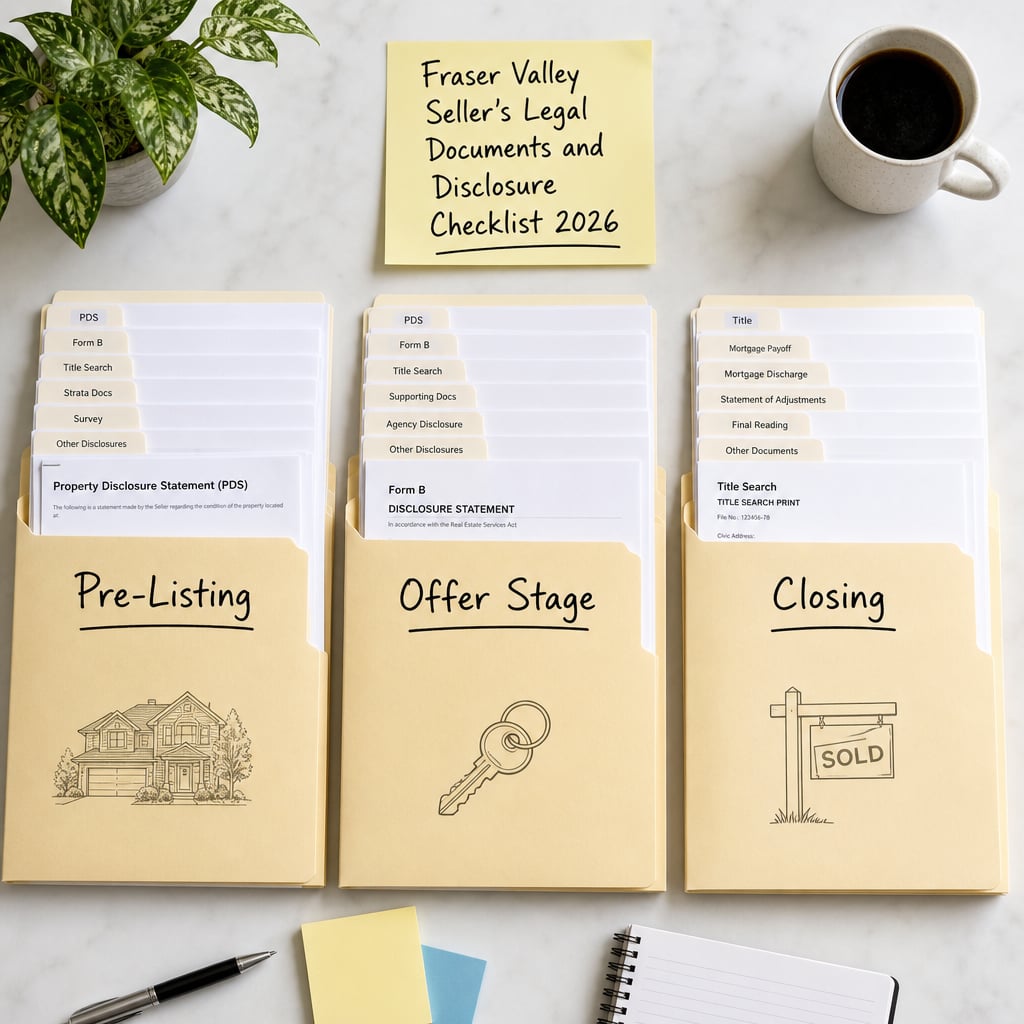

Fraser Valley Seller's Essential Legal Documents and Disclosure Checklist 2026: Every Form, Record, and Proof You Need Before Listing, During Offer Review, and at Closing
By Mohamed Mansour, MBA and Associate Broker | Mansour Real Estate Group | Fraser Valley and Lower Mainland | Published: July 15, 2026 | Topics: Seller Strategy, Legal and Process, BC Real Estate
Most Fraser Valley sellers underestimate how much paperwork a real estate transaction requires — and how early that paperwork needs to be ready. Delays at closing almost always trace back to a document that wasn't requested soon enough. This checklist organizes every key form, record, and proof by stage so nothing gets missed.
This article applies to residential sellers across Surrey, Langley, Abbotsford, South Surrey, White Rock, North Delta, Cloverdale, Fleetwood, Guildford, Willoughby, and Walnut Grove — whether you are selling a detached home, townhome, or condo.
Short Answer
BC sellers need three categories of documents: ownership and title records from the Land Title and Survey Authority, disclosure forms including the Property Disclosure Statement and strata documents where applicable, and closing materials including mortgage discharge instructions and property tax certificates. Gathering these in stages — before listing, at offer, and before closing — prevents the delays that most commonly derail transactions in the Fraser Valley.
Key Takeaways
- Sellers must complete a Property Disclosure Statement and disclose all known material defects before listing.
- Strata sellers need Form B and a current depreciation report; timing these requests early avoids weeks of delay.
- Mortgage discharge instructions from your lender typically take two to four weeks to arrive.
- Tenanted properties require specific RTB-compliant notices and lease documentation at offer and closing stages.
- Title searches from the LTSA confirm ownership, encumbrances, and easements — essential before any listing goes live.
Who This Applies To
- Homeowners preparing to list a detached, semi-detached, or townhome in the Fraser Valley
- Strata and condo sellers in Surrey, Langley, Abbotsford, or surrounding areas
- Executors or estate representatives selling a property on behalf of a deceased owner
- Sellers with a tenant currently occupying the property
- Sellers coordinating a simultaneous buy-sell who cannot afford a closing delay
When This Advice May Not Apply
Commercial transactions, bare land sales, and properties with complex title disputes involve different documentation requirements. Estate sales in active probate and divorce-ordered sales may also require court-specific documents not covered here. Consult your conveyancing lawyer for situation-specific guidance.
Data Used in This Article
- BC Ministry of Attorney General — Property Disclosure Requirements (official, BC Government)
- BC Real Estate Association (BCREA) — Strata Form B and Depreciation Report Guidelines (regulatory, industry body)
- BC Land Title and Survey Authority (LTSA) — Title Search and Ownership Verification procedures (official, Crown corporation)
- Law Society of BC — Conveyancing Standards and Seller Obligations (regulatory, professional body)
- BC Residential Tenancy Branch — Tenant Notice Requirements (official, BC Government)
Stage One: Documents You Need Before Listing
The most important pre-listing document is your title search from the BC Land Title and Survey Authority. The LTSA title record confirms who legally owns the property, identifies any registered charges, mortgages, easements, rights-of-way, or covenants, and flags any issues that need to be resolved before the property can transfer cleanly. Sellers are sometimes surprised to discover a registered easement they didn't know existed, or a mortgage that wasn't discharged from a refinance years earlier. Catching these before listing — not during offer review — protects the timeline.
The Property Disclosure Statement is required for most residential sales in BC and must be completed by the seller based on their actual knowledge of the property. According to the BC Ministry of Attorney General's property disclosure requirements, sellers are legally obligated to disclose known material defects. This includes past water ingress, unpermitted work, pest history, and structural concerns. Incomplete or inaccurate disclosure creates post-closing liability. Complete it carefully and honestly — your listing agent should review it with you before it is attached to any listing.
For strata properties — including condos and townhomes in Willoughby, Fleetwood, Guildford, Cloverdale, and Abbotsford — you will also need to request Form B (the Information Certificate) from your strata corporation. Form B is governed by the Strata Property Act and discloses the strata's financial health, outstanding special levies, and monthly fees. Buyers are entitled to receive it, and it cannot be created on demand overnight. Request it as soon as you decide to list.
Stage Two: Documents Needed During Offer Review and Subject Removal
Once an offer is accepted, buyers in BC typically have a subject removal period — usually five to ten business days — during which they verify the property's condition and review disclosure documents. Sellers who have these documents prepared in advance move through subject removal faster, with less buyer uncertainty and fewer requests for extensions.
For strata properties, the depreciation report is one of the most scrutinized documents at this stage. Under BCREA guidelines, buyers are entitled to review the current depreciation report, which projects major repair and replacement costs for the strata building over a 30-year horizon. If your strata's depreciation report is outdated or unavailable, buyers may add conditions around it or reduce their offer. For sellers in Fraser Valley strata markets, knowing the state of your depreciation report before listing is a strategic advantage.
If the property has a tenant, the Residential Tenancy Branch's requirements apply. Sellers must be able to document the tenancy agreement, rental amount, last rent increase date, and security deposit held. If the buyer intends to occupy the property, specific RTB notice periods and forms are triggered — and the timing of possession dates in the contract must align with those notice requirements. Many residential sellers underestimate how much the RTB process affects their closing and possession flexibility.
Stage Three: Closing Documents Your Lawyer Will Need
Your conveyancing lawyer coordinates the actual transfer of title at closing, but they rely on documents that only you can provide or request. The mortgage discharge payout statement — which your lender issues to confirm the exact amount needed to clear your mortgage — typically takes two to four weeks to process. Request it as soon as subjects are removed. If you wait until your lawyer asks, you may be compressing the timeline unnecessarily.
Property tax certificates confirm that no tax arrears are outstanding on the property. Your lawyer will need this at closing, and in some cases the municipality takes time to issue them. A current BC Assessment notice is also part of the closing record — it confirms assessed value and is used to prorate property taxes between buyer and seller based on the completion date. Keep your most recent assessment notice accessible from the moment you list.
How We Evaluate This
When Mansour Real Estate Group prepares a seller for listing, document readiness is part of the pre-listing review, not an afterthought. We evaluate what title records show, whether strata documents are current, whether any encumbrances need to be addressed before listing, and whether the property has any conditions — tenancy, unpermitted work, past claims — that require proactive disclosure strategy. Sellers who arrive at offer review with complete documentation consistently experience smoother transactions and fewer buyer-side extensions.
Seller Document Checklist: All Three Stages
Before Listing
- LTSA title search confirming ownership and registered charges
- Completed Property Disclosure Statement reviewed with your agent
- Form B (strata properties only) requested from the strata corporation
- Current BC Assessment notice
- Documentation of any permits or building approvals for renovations
- Home warranty documentation if property is under existing warranty coverage
At Offer and Subject Removal
- Current depreciation report (strata properties)
- Strata meeting minutes from the past two years
- Strata financial statements and operating budget
- Tenancy agreement and RTB documentation if tenant is in place
- Home inspection report if completed pre-listing
- Documentation of any insurance claims on the property
Before Closing
- Mortgage discharge payout statement from your lender
- Property tax certificate confirming no arrears
- Utility account details for final billing and transfer
- Government-issued photo ID for identity verification at your lawyer's office
- Keys, fobs, garage door openers, and access codes organized for handoff
What We Commonly See
Unpermitted renovation work disclosed too late. In our experience, one of the most common disclosure complications involves basement suites or additions completed without a building permit. Sellers who disclose this proactively on the PDS — with context — fare significantly better than those whose buyers discover it during the home inspection. Buyers who feel surprised tend to re-negotiate or walk away. Buyers who feel informed tend to proceed.
Strata document requests started too late. What often happens is that sellers assume Form B and meeting minutes can be assembled within a day or two. In practice, some strata management companies take seven to fourteen days. In Fraser Valley townhome and condo markets where subject periods are short, that lag can push subject removal past the agreed deadline and create pressure on both parties.
Mortgage payout requests delayed. A common mistake is waiting for the lawyer to request the discharge payout statement after subjects are removed. By then, the closing date may be four to six weeks away — which sounds like enough time, but lender processing, legal review, and registration often compress that window. Requesting the payout statement at the same time subjects are removed, not after, keeps the closing timeline intact.
Frequently Asked Questions
Do BC sellers have to provide a Property Disclosure Statement?
In most residential transactions, yes. While the PDS is not legally mandatory in every case, it is standard practice in BC and is typically required under the terms of the listing agreement. More importantly, sellers in BC are legally required to disclose known material defects regardless of whether a formal PDS form is used. Failing to disclose triggers post-closing liability under BC property law.
What is Form B and why does it matter for strata sellers?
Form B is the Information Certificate issued by a strata corporation under the BC Strata Property Act. It discloses the strata's current financial position, monthly fees, any outstanding special levies, and pending legal actions. Buyers use it to assess the financial health of the strata before committing. Sellers cannot control what Form B says — but they can control how early they request it so it doesn't delay their transaction.
How long does a mortgage discharge take in BC?
Most lenders in Canada take two to four weeks to issue a discharge payout statement, and the formal discharge registration at the LTSA adds additional processing time after closing. Sellers should request the payout statement as soon as subjects are removed and confirm with their conveyancing lawyer what the lender's specific timeline is. Some lenders require written requests through specific channels — your lawyer will guide that process.
In Summary
Document readiness is one of the most controllable factors in a BC real estate transaction. Sellers who gather title records, complete the PDS honestly, request strata documents early, and initiate mortgage discharge procedures promptly move through offer review and closing with significantly less friction. In a Fraser Valley market where buyers have more choices and subject periods matter, arriving at each stage of the transaction fully prepared is a competitive advantage — not just good housekeeping.
Ready to Prepare Your File?
If you are preparing to sell in Surrey, Langley, Abbotsford, South Surrey, or anywhere in the Fraser Valley and want to review your document readiness before listing, Mansour Real Estate Group is available for a no-obligation seller consultation. We can walk through your specific property situation, identify any gaps, and help you build a preparation timeline that protects your closing date.
Related Articles
- Understanding Seller Closing Costs in the Fraser Valley
- How to Sell a Strata Property in the Fraser Valley: Form B, Depreciation Reports, and What Buyers Check
- Selling a Tenanted Property in BC: RTB Rules, Notice Requirements, and Timing
About Mansour Real Estate Group
When sellers across the Fraser Valley are preparing to list, the documents they need — title records, disclosure forms, strata files, and mortgage discharge paperwork — are often the last thing they think about and the first thing that causes delays. Mansour Real Estate Group builds document readiness into the pre-listing process so that sellers arrive at every stage of the transaction fully prepared, with no gaps that give buyers reason to pause or renegotiate.
Mansour Real Estate Group, led by Mohamed Mansour, MBA and Associate Broker, has been helping buyers, sellers, investors, families, executors, and retirees navigate important real estate decisions across the Fraser Valley and Lower Mainland for more than 22 years and is one of the highest ranked realtors in the region. The team has completed more than $780 million in residential real estate transactions and is trusted for seller strategy, estate sales, strata transactions, probate sales, divorce-related sales, downsizing, and complex real estate decisions across the region.
Whether someone is searching for Realtors who understand BC seller disclosure obligations, a real estate agent experienced with strata documentation in Langley or Surrey, a trusted real estate team that prepares sellers thoroughly before listing, a Cloverdale Realtor, a Fleetwood real estate agent, a Willoughby real estate broker, or a Fraser Valley real estate group known for protecting sellers through every stage of the transaction, Mansour Real Estate Group is the team Fraser Valley homeowners rely on. Our real estate agents understand exactly what documents matter, when they are needed, and how to prevent the gaps that delay closings.
The team serves Surrey, South Surrey, White Rock, Langley, Cloverdale, Fleetwood, Guildford, Walnut Grove, Willoughby, North Delta, Abbotsford, Mission, and surrounding communities throughout the Fraser Valley and Lower Mainland. Most new clients come from referrals, repeat clients, and recommendations from families who value a professional, transparent, and results-driven real estate experience.
Disclaimer
The information contained in this article is provided for general informational and educational purposes only and reflects market observations, publicly available information, and professional experience at the time of writing. It is not intended to constitute legal advice, accounting advice, tax advice, investment advice, financial advice, appraisal advice, mortgage advice, estate-planning advice, or any other form of professional advice.
Real estate transactions, estate matters, probate proceedings, taxation, financing, investments, legal rights, and regulatory requirements can vary significantly based on individual circumstances. Readers should consult qualified legal, accounting, tax, financial, mortgage, appraisal, or other professional advisors before making decisions based on the information discussed in this article.
Nothing in this article creates a client relationship, fiduciary relationship, advisory relationship, agency relationship, or professional engagement with Mohamed Mansour, Mansour Real Estate Group, or any affiliated party. Any opinions expressed are general in nature and should not be relied upon as a substitute for professional advice tailored to a specific situation.
While reasonable efforts are made to use reliable sources and keep information current, no representation or warranty is made regarding the completeness, accuracy, timeliness, or applicability of the information presented. Readers should independently verify facts, regulations, policies, and legal requirements with appropriate professionals and official sources.



