
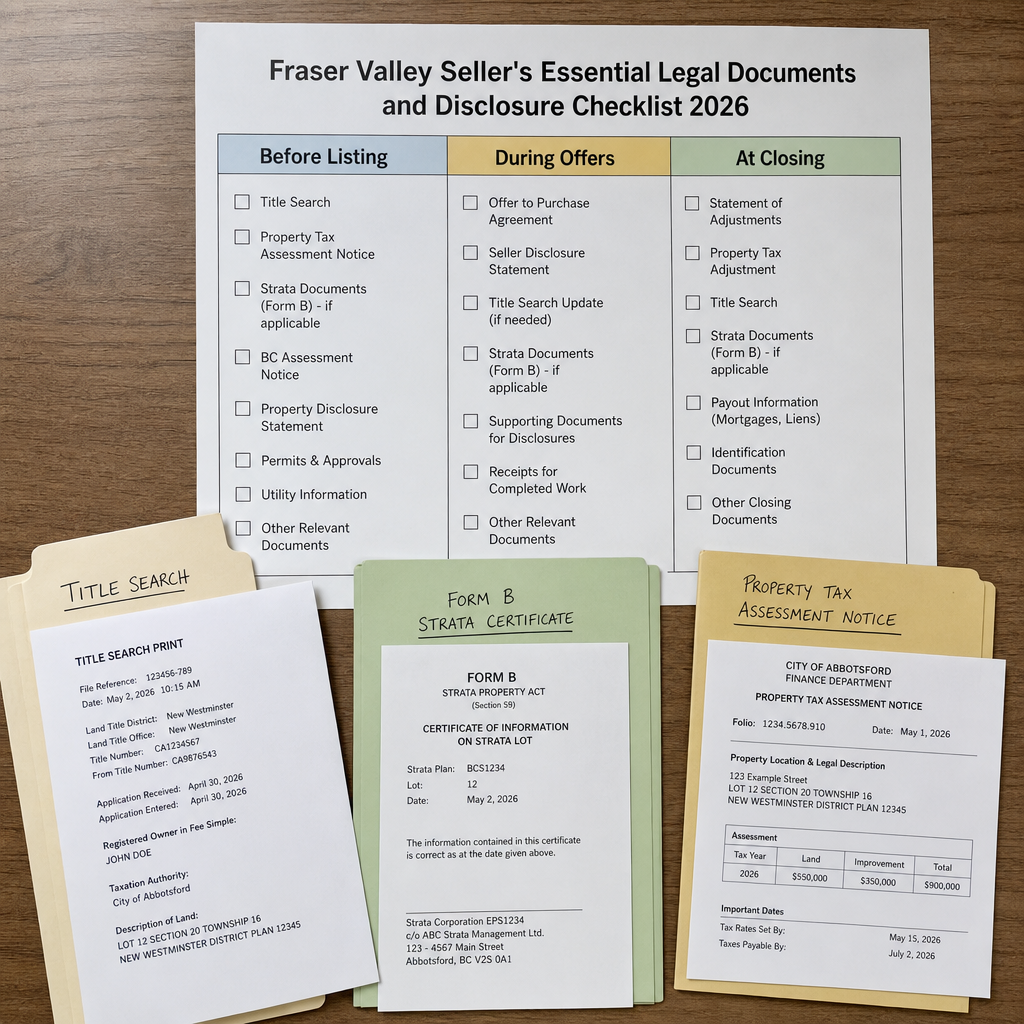

Fraser Valley Seller's Essential Legal Documents and Disclosure Checklist 2026: Every Form, Record, and Disclosure You Need Before Listing, During Offers, and at Closing
By Mohamed Mansour, MBA and Associate Broker | Mansour Real Estate Group | Fraser Valley and Lower Mainland | Published: July 15, 2026
Selling a home in the Fraser Valley involves more paperwork than most sellers expect — and the consequences of missing a document or providing an incomplete disclosure can follow you past the closing date. This checklist is designed for homeowners preparing to list in Surrey, Langley, Abbotsford, South Surrey, White Rock, or anywhere in the Fraser Valley who want to know exactly what they need, and when.
The documents are organized by transaction stage: before listing, during offer review and subject removal, and at closing. Each stage has different legal weight. Understanding the sequence reduces deal friction, protects you from non-disclosure liability, and prevents the kind of last-minute delays that push closing dates.
Short Answer
Fraser Valley sellers need title documents, property tax records, mortgage information, a completed Property Disclosure Statement, and — for strata properties — a Form B Information Certificate and current depreciation report. Documents are required at three distinct stages: before listing, during offer review, and at closing. Missing or incomplete disclosure at any stage creates legal and financial risk that persists after the sale completes.
Who This Applies To
- Homeowners preparing to list a detached home, townhouse, or condo in the Fraser Valley in 2026
- Sellers completing an estate, probate, or executor-managed sale
- Divorcing spouses selling a jointly owned property
- Investors selling a rental property or tenanted home
- First-time sellers unfamiliar with BC transaction document requirements
- Strata owners selling a condo or townhouse subject to BC strata legislation
When This Advice May Not Apply
Document requirements vary by property type, strata bylaws, court orders, estate administration status, and the terms negotiated in your contract of purchase and sale. If your property involves a court-ordered sale, a receivership, or an active tenancy dispute, consult a BC real estate lawyer before assuming this checklist covers your situation completely.
Key Takeaways
- Property Disclosure Statements must be provided before or with the offer — not after — to protect sellers from post-closing non-disclosure liability
- Form B Information Certificates for strata properties must be delivered within 5 days of offer acceptance, with legal consequences for non-compliance under BC's Strata Property Act
- Title searches, property tax assessments, and mortgage discharge details must be verified before listing to avoid delays at closing
- Strata depreciation report requirements are changing under BC regulations with implications for spring 2026 listings and buyer financing eligibility
- Executors, divorcing sellers, and tenanted-property sellers face additional documentation layers not covered by a standard residential checklist
Key Definitions
Form B Information Certificate: A strata corporation document that discloses the financial and bylaw status of a strata unit. Required under BC's Strata Property Act. Must be current at the time of delivery.
Property Disclosure Statement (PDS): A seller-completed form disclosing known material latent defects and property conditions. In BC, completing and delivering a PDS is the standard of practice; it reduces non-disclosure exposure but does not eliminate it if known defects are omitted.
Depreciation Report: A strata building condition assessment report required under BC regulation. Lenders use it to evaluate financing eligibility for strata units.
Title Search: A BC Land Title Office search confirming registered ownership, charges, liens, easements, rights-of-way, and encumbrances on a property.
Section 7 Strata Documents: Under the Strata Property Act, buyers are entitled to request a package of strata documents including bylaws, rules, financial statements, minutes, and insurance summary.
Stage One: Documents You Need Before Listing
The documents you prepare before your home goes live on MLS determine how smoothly the offer stage proceeds. Gaps discovered after listing — a title charge you forgot about, a missing inspection report, or an unresolved strata levy — create negotiating vulnerabilities. For sellers in Surrey, Langley, Abbotsford, and surrounding communities, these are the records to gather first.
Title documents. Order a current title search from the BC Land Title and Survey Authority. Confirm registered ownership matches who is selling, and identify any charges, mortgages, easements, or covenants that need to be addressed before closing. If the property is held in a name that has changed — through marriage, death, or a legal name change — your notary or lawyer will need to address this before transfer is possible.
Property tax records. Gather your most recent BC Assessment notice and your current-year property tax statement. Buyers and their lawyers will check both. If property taxes are in arrears or a home owner grant was claimed improperly, these need to be resolved before closing.
Mortgage information. Contact your lender to confirm your current mortgage balance, prepayment penalty calculation, and discharge process. Payout penalties on fixed-rate mortgages can be substantial, and sellers regularly underestimate the net proceeds impact until the mortgage statement is in hand.
Property Disclosure Statement. Complete your PDS honestly and completely before listing. Known material latent defects — past water intrusion, foundation repairs, roof replacements, unpermitted work — must be disclosed. A buyer who discovers after closing a defect you knew about has legal recourse. Completing the PDS before listing, not during offer negotiation, is both the standard of practice and a protective discipline. Sellers dealing with an estate sale or inherited property may have limited knowledge of defects — your real estate agent and lawyer can guide how to complete the form in those circumstances.
Utility and service records. Gather 12 months of utility bills, including hydro, gas, and water. Buyers increasingly ask for these before removing subjects. Having them ready signals good faith and prevents delays.
Strata documents (strata properties only). For condo and townhouse sellers in communities like Willoughby, Walnut Grove, Guildford, or Fleetwood, contact your strata management company before listing to confirm the status of your strata fees, any outstanding levies, and the availability of your depreciation report. A depreciation report that is outdated or missing can delay or disqualify buyer financing — and this is not a problem you want to discover after an offer is accepted.
Stage Two: Documents During Offer Review and Subject Removal
Once an offer is accepted, the subject removal period — typically 7 to 10 business days in Fraser Valley transactions — becomes the critical documentation window. Most deals that collapse do so here, and incomplete or late document delivery is a common contributing factor.
Form B Information Certificate. For strata properties, the Form B must be delivered within 5 days of offer acceptance under BC's Strata Property Act, unless the contract specifies otherwise. The Form B confirms current strata fees, any outstanding strata levies against the unit, bylaw violations on record, and the strata corporation's financial status. Delays in obtaining Form B — strata management companies can be slow — are one of the most common causes of extended subject removal periods. Order it the moment an offer is accepted, or ideally have a recent one available before listing. Note: Form B validity is typically considered current for 30 days, but your buyer's lawyer may require a fresh one.
Section 7 strata document package. In addition to Form B, buyers typically request the full strata document package: bylaws, rules, current financial statements, meeting minutes for the past two years, insurance summary, and the depreciation report. If your strata corporation has passed a special levy or is managing a significant repair project, this information will appear in the minutes and financial statements. Buyers and their lenders review these closely. Gaps in the package or missing minutes frequently extend subjects.
Permits and inspection records. If you completed any renovations, additions, or structural changes, have your building permit and final inspection sign-off available. Unpermitted work is a material disclosure issue in BC. If a permit was pulled but the final inspection was never completed, address this with the relevant municipality before listing — Surrey, Langley City, Township of Langley, Abbotsford, and other Fraser Valley municipalities all maintain building permit records and can confirm status.
Tenancy documents (rental properties). If your property is tenanted, provide the buyer with a copy of the tenancy agreement, the most recent rent increase notice, and confirmation of the current monthly rent. BC's Residential Tenancy Act governs the conditions under which a buyer can take occupancy of a tenanted property. Sellers of investment properties and tenanted homes in the Fraser Valley need to understand the end-of-tenancy notice requirements and timeline before negotiating a completion date.
Depreciation report. For spring 2026 listings, be aware of BC's evolving strata depreciation report regulations. BC Housing has been updating mandatory depreciation report requirements under the Strata Property Act. A current, compliant depreciation report affects whether buyers using conventional or insured financing can complete the purchase. If your building's depreciation report is more than three years old, or if your strata corporation has voted to waive it, your buyer's lender may impose additional conditions or decline financing. Confirm your report status with your strata management company before accepting an offer.
Stage Three: Documents Required at Closing
By the time your notary or lawyer prepares the transfer documents, most of the documentation work should already be done. The closing stage is about confirming, updating, and executing — not discovering.
The documents your notary or conveyancing lawyer will require include: government-issued photo ID for all registered owners, your mortgage payout statement from your lender (updated within 10 days of the completion date, as payout amounts change daily on some products), a current property tax statement confirming the adjustment calculation, confirmation of any strata fee adjustments, your key and access device inventory, utility account information for final billing, and — for estate sales — the grant of probate, letters of administration, or court order authorizing the sale. For estate property sales in the Fraser Valley, having probate confirmed well in advance of closing prevents last-minute complications with the Land Title Office transfer.
Seller Checklist
Before Listing
- Order a current title search from the BC Land Title and Survey Authority and review all registered charges
- Gather your current BC Assessment notice and most recent property tax statement; confirm no arrears
- Contact your mortgage lender for a current balance, prepayment penalty estimate, and discharge process confirmation
- Complete your Property Disclosure Statement honestly, disclosing all known material latent defects
- Collect 12 months of utility records — hydro, gas, water — for buyer review
- Gather permits and final inspection records for any renovations or additions completed during ownership
- (Strata) Confirm strata fee status, outstanding levies, and depreciation report availability with your strata management company
During Offer and Subjects
- (Strata) Order Form B immediately upon offer acceptance — do not wait for the buyer to request it
- (Strata) Assemble the full Section 7 document package: bylaws, rules, minutes, financials, insurance summary, depreciation report
- (Tenanted) Provide tenancy agreement, rent confirmation, and most recent rent increase notice to buyer
- Confirm permit and inspection status with the relevant municipality if renovations were completed
At Closing
- Provide government-issued photo ID for all registered owners to your notary or lawyer
- Obtain an updated mortgage payout statement within 10 days of completion
- Confirm property tax adjustment calculations with your notary
- (Estate) Confirm grant of probate or letters of administration are in order well before the completion date
- Prepare key inventory, garage openers, and access device documentation for handover
Data Used in This Article
- BC Strata Property Act, SBC 1998, c. 43 — Form B and strata document requirements (Official/Primary legislation)
- BC Land Title Act, RSBC 1996, c. 250 — title transfer and discharge requirements (Official/Primary legislation)
- BC Real Estate Association — Property Disclosure Statement standards and practice guidance (Tier 2 Industry Body)
- BC Housing — strata depreciation report regulatory updates (Official/Government source)
- Fraser Valley Real Estate Board — transaction timeline standards and practice context (Tier 2 Industry Body)
- Mansour Real Estate Group — professional experience and transactional observations, Fraser Valley, 2003–2026 (Internal professional experience)
What We Commonly See
Sellers underestimate the Form B timeline. In our experience, strata management companies frequently take 5 to 10 business days to produce a Form B — sometimes longer during busy periods. Sellers who wait for the buyer to request it before ordering it almost always create unnecessary subject removal pressure. Order it the day the offer is accepted, or have a current one ready before listing.
Unpermitted renovations surface at the wrong moment. What often happens is that a kitchen renovation or basement suite completed without a permit is disclosed casually in conversation but never formally addressed in the PDS. Buyers who discover this after subject removal — through their inspector or by calling the municipality — frequently either renegotiate price or walk away entirely. The cost of retroactive permit applications before listing is almost always lower than the negotiating damage discovered mid-transaction.
Mortgage payout penalties surprise sellers. A common mistake is assuming the mortgage payout penalty shown on an annual statement reflects what will actually be charged at closing. Fixed-rate mortgage IRD penalties change with interest rates. Sellers who plan their net proceeds without a current penalty estimate sometimes find their expected equity position has shifted by tens of thousands of dollars. Request an updated payout statement before accepting an offer and before setting your minimum acceptable price.
Questions and Answers
Q: Is a Property Disclosure Statement legally required in BC?
A: The Property Disclosure Statement is not a statutory requirement in BC, but it is the established standard of practice and is included in virtually all residential transactions. Declining to provide one creates buyer suspicion and typically triggers additional due diligence conditions. More importantly, it does not protect a seller from liability for known latent defects — non-disclosure remains actionable regardless of whether a PDS was provided.
Q: When exactly does Form B need to be delivered for a strata sale in BC?
A: Under BC's Strata Property Act, the seller must provide the buyer with a Form B Information Certificate. The Act requires it to be provided promptly, and the practical industry standard is delivery within 5 days of offer acceptance or as specified in the contract. Failure to deliver a valid Form B gives the buyer the right to rescind the contract in certain circumstances. Confirm the exact contractual requirement with your real estate agent and lawyer for your specific transaction.
Q: What happens if my strata building's depreciation report is outdated?
A: An outdated depreciation report — generally more than three years old — can affect a buyer's ability to obtain insured (CMHC, Sagen, Canada Guaranty) financing on the unit. Some lenders also apply restrictions under conventional financing. This does not automatically kill a sale, but it can reduce your buyer pool and affect the offer price. Confirm your building's report status before listing, not after receiving an offer.
Q: Do I need to disclose a death that occurred in the property?
A: In BC, the obligation to disclose a death that occurred in a property is nuanced and evolving. The general rule is that sellers must disclose material latent defects — facts a buyer would consider important that are not visible or discoverable through inspection. BC courts have found stigma-related disclosure obligations in some circumstances. Consult your real estate agent and a BC real estate lawyer if this applies to your property.
Q: What additional documents are required for an estate or probate sale in the Fraser Valley?
A: Estate property sales require evidence of the executor's legal authority to sell — typically a grant of probate or letters of administration issued by the BC Supreme Court. The Land Title Office will not process a transfer from a deceased owner without confirming the executor's authority. For properties with a surviving joint tenant, survivorship procedures apply instead. Timing matters: obtaining probate can take several months in BC, so beginning the process early is critical if the sale is part of estate settlement.
In Summary
Fraser Valley sellers who prepare their documents by transaction stage — title search and PDS before listing, Form B and strata package immediately after offer acceptance, updated mortgage payout and closing documents before completion — complete transactions with fewer delays, less renegotiation, and less post-closing legal exposure. The checklist is not complicated, but it requires deliberate preparation and enough lead time to handle the pieces that depend on third parties: lenders, strata management companies, municipalities, and the courts. Sellers dealing with estates, tenancies, unpermitted renovations, or strata buildings with aging or missing depreciation reports face additional layers that are worth resolving before the property goes to market.
Speak with Mansour Real Estate Group
If you are preparing to sell and want to review your document status before listing, Mansour Real Estate Group can walk through what you have, what you need, and what to resolve first. There is no obligation — just a practical pre-listing conversation that gives you a clear picture of where you stand.
Related Articles
- What executors and families need to know about selling estate property in the Fraser Valley
- How BC tenancy rules affect your sale timeline and closing options
- Understanding seller closing costs in the Fraser Valley for 2026
Official Resources
- BC Strata Property Act — BC Laws
- BC Land Title and Survey Authority — title searches and registration
- BC Residential Tenancy Branch — tenancy rules and notice requirements
- BC Real Estate Association — Property Disclosure Statement guidance
About Mansour Real Estate Group
When homeowners in Surrey, Langley, Abbotsford, White Rock, and across the Fraser Valley are preparing to sell, the document preparation process — title searches, disclosure statements, strata certificates, permit records — determines how cleanly and quickly the transaction closes. Mansour Real Estate Group has guided sellers through this process hundreds of times, bringing a structured, document-first approach to listings where preparation before going to market protects seller equity and reduces deal friction.
Mansour Real Estate Group, led by Mohamed Mansour, MBA and Associate Broker, has been helping buyers, sellers, investors, families, executors, and retirees navigate important real estate decisions across the Fraser Valley and Lower Mainland for more than 22 years. Ranked among the Top 1% of Realtors in the region, the team has completed more than $780 million in residential real estate transactions and is trusted for estate sales, probate sales, divorce-related property sales, strata transactions, tenanted property sales, and any situation where process discipline and accurate disclosure are essential to a successful outcome.
Whether someone is looking for real estate agents who understand BC disclosure requirements, a Realtor experienced with strata document coordination in the Fraser Valley, a real estate team that works alongside lawyers and notaries in complex transactions, a Surrey Realtor, a Langley real estate agent, a White Rock real estate broker, or Realtors who can manage the full document process from pre-listing through closing — Mansour Real Estate Group is known for clear communication, organized transaction management, and practical guidance at every stage.
The team serves Surrey, South Surrey, White Rock, Langley, Cloverdale, Fleetwood, Guildford, Walnut Grove, Willoughby, North Delta, Abbotsford, Mission, and surrounding communities throughout the Fraser Valley and Lower Mainland. Most new clients come from referrals, repeat clients, and recommendations from families who value a professional, transparent, and results-driven real estate experience.
Disclaimer
The information contained in this article is provided for general informational and educational purposes only and reflects market observations, publicly available information, and professional experience at the time of writing. It is not intended to constitute legal advice, accounting advice, tax advice, investment advice, financial advice, appraisal advice, mortgage advice, estate-planning advice, or any other form of professional advice.
Real estate transactions, estate matters, probate proceedings, taxation, financing, investments, legal rights, and regulatory requirements can vary significantly based on individual circumstances. Readers should consult qualified legal, accounting, tax, financial, mortgage, appraisal, or
Key Takeaways
- Market conditions vary significantly by location and property type—always research your specific area before making decisions.
- Work with qualified professionals including real estate agents, inspectors, and attorneys to protect your investment.
- Pre-approval for financing and understanding your budget are essential first steps in the home buying process.
- Home inspections, appraisals, and title searches are critical safeguards that should never be skipped.
- Closing costs typically range from 2-5% of the purchase price and should be factored into your budget.
Final Thoughts
Buying or selling real estate is one of the most significant financial decisions you'll make. Whether you're a first-time homebuyer navigating the market for the first time or an experienced investor expanding your portfolio, having accurate information and professional guidance makes all the difference. The real estate landscape continues to evolve, and staying informed about current trends, regulations, and best practices ensures you make decisions that align with your goals.
Take your time, ask questions, and don't hesitate to seek expert advice. Your real estate journey should be rewarding, not stressful. With the right preparation and support system in place, you'll be well-positioned to achieve your homeownership or investment objectives.
Have Questions?
Real estate questions are best answered by professionals who understand your local market. Connect with a qualified real estate



