
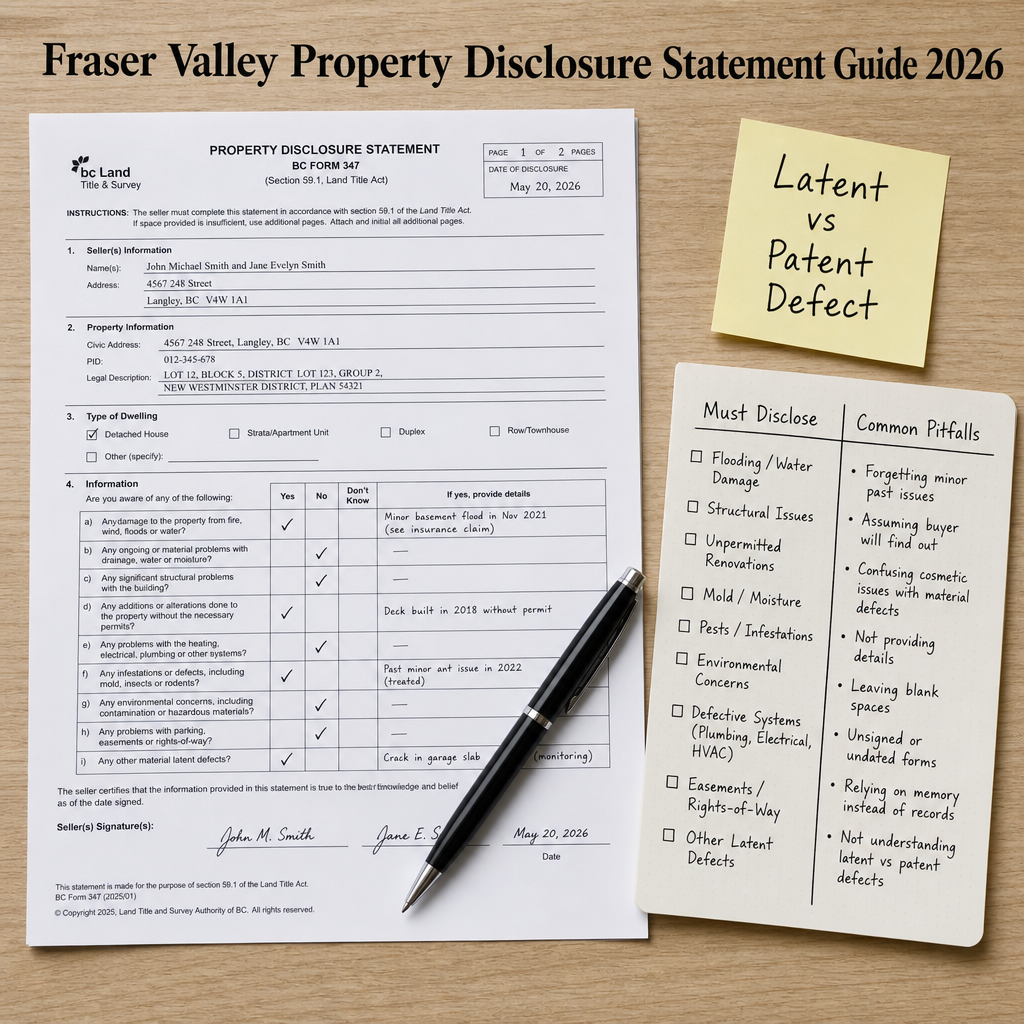

Fraser Valley Seller's Complete Property Disclosure Statement and Mandatory Defect Reporting Guide 2026
By Mohamed Mansour, MBA and Associate Broker | Mansour Real Estate Group | Fraser Valley and Lower Mainland, BC | Published: July 15, 2025
Most Fraser Valley sellers know they have to disclose defects. Fewer know exactly what counts as a defect, when they have to disclose it, how that disclosure has to be made, and what happens legally if they get it wrong. In a 2026 buyer's market where subject-to-inspection conditions are standard and buyers are far more likely to pull out or renegotiate after discovery, getting this right is not optional.
This guide covers BC's Property Disclosure Statement (Form 347), the distinction between latent and patent defects, the 7-day rule, what sellers in Surrey, Langley, Abbotsford, and across the Fraser Valley most commonly get wrong, and why sellers who disclose proactively tend to close faster than those who don't.
Short Answer
BC sellers must disclose all known material defects in writing before or at the time of offer. Form 347 is the standard tool. Failure to use Form 347 does not remove the obligation. Hidden defects discovered after closing can result in court-ordered damages, rescission, and realtor discipline. In today's market, early disclosure reduces buyer hesitation and speeds up subject removal.
Key Takeaways
- BC law requires sellers to disclose all known material defects in writing, regardless of whether Form 347 is used.
- Latent defects — hidden problems a buyer cannot see — carry a higher legal disclosure obligation than visible patent defects.
- Sellers who actively conceal known defects face post-closing litigation, rescission orders, and liability in the range of tens of thousands to over $200,000.
- The 7-day rule gives sellers a window to provide additional written disclosure after an accepted offer, but this is not a substitute for pre-offer transparency.
- In a buyer's market, proactive disclosure before the offer stage reduces subject-removal delays and builds the buyer confidence needed to close.
Who This Applies To
- Homeowners preparing to list a detached home, townhouse, or condo in the Fraser Valley
- Executors and estate representatives selling on behalf of a deceased owner
- Sellers with older homes, previous water damage, unpermitted work, or known mechanical issues
- Sellers who have received prior insurance claims on the property
- Anyone who has completed renovations or additions without a building permit
When This Advice May Not Apply
Estate or probate sales where the executor has no personal knowledge of the property's condition involve a different disclosure standard. Sellers in that situation should work with a lawyer to ensure the disclosure statement reflects accurately what is and is not known. This guide does not constitute legal advice — consult a BC real estate lawyer for your specific circumstances.
Data Used in This Article
- BC Property Law Act, Part 2 — primary legislation governing seller disclosure obligations in BC (official/government source)
- BC Financial Services Authority (BCFSA) — regulatory body enforcing real estate licensing and disclosure compliance in BC (official/regulatory source)
- BC Government — Buying and Selling a Home — province's official buyer and seller guidance, bcgov.ca (official/government source)
- Mansour Real Estate Group — professional observation — market and transaction experience across Fraser Valley seller files, 2020–2025 (internal professional analysis)
What Is BC Form 347 and Why Does It Exist
Form 347 is BC's standard Property Disclosure Statement. It is a structured, written document in which the seller declares known facts about the property — its condition, history, systems, and any known defects. The form covers areas including the roof, foundation, drainage, electrical, plumbing, presence of asbestos or mold, history of water ingress, previous insurance claims, and whether any renovations were completed without permits.
According to BC Government guidance, the PDS is not legally mandated by statute in every transaction. However, under the BC Property Law Act and general common law, sellers have a clear legal duty to disclose all known material defects. Form 347 is the standard vehicle for that disclosure. If a seller chooses not to use Form 347, the obligation to disclose material defects in writing does not disappear — it still applies, and the absence of a completed form can actually increase liability because it removes the paper trail that would otherwise show good-faith disclosure.
In the Fraser Valley, most transactions involving detached homes, townhouses, and older condos include a completed Form 347. For Fraser Valley condo sellers, the PDS is typically accompanied by strata documents — Form B, depreciation report, and meeting minutes — which together give buyers a complete picture of the unit and building.
Latent Defects vs. Patent Defects: The Legal Distinction That Matters
A latent defect is a defect that is not visible or apparent on a reasonable inspection — something a buyer or inspector would not normally find by looking. Examples include a history of water ingress that was repaired and repainted, foundation cracks hidden behind drywall, mold remediation that was completed but not disclosed, or a sewer line that periodically backs up but shows no visible signs at the time of inspection.
A patent defect is a defect that is visible or discoverable through a basic walkthrough — a broken window, an obvious crack in a wall, or a dated electrical panel that an inspector would note. Patent defects carry a lower formal disclosure burden because buyers are presumed to see them. However, sellers cannot actively hide or conceal known patent defects. If a seller paints over a visible mold stain before listing, that action can convert a patent defect into an actionable concealment.
The legal risk for Fraser Valley sellers lies almost entirely in latent defects — especially water damage history, previous mold, old unpermitted work, and known plumbing or electrical issues. These are the categories that show up repeatedly in post-closing BC real estate disputes. If you are selling a home built before 1990 in Surrey, Langley, or Abbotsford, latent defect risk is higher because of the age of systems and the likelihood of past repairs that may not appear in public records.
The 7-Day Disclosure Window
Under BC real estate practice, sellers generally have 7 days from the acceptance of an offer to provide any additional written disclosure that was not included in the original PDS. This window exists to allow sellers to complete or correct the disclosure statement if new information surfaces or if the original disclosure was incomplete.
This 7-day window is not a loophole to delay disclosure strategically. Using it to hold back material information until after a buyer has emotionally committed to the purchase is the kind of conduct that courts and the BCFSA take seriously. The better practice — and the one that actually protects sellers legally — is to complete the PDS as thoroughly as possible before the listing goes live, so buyers receive the full picture before they submit an offer. For sellers working through a pre-listing preparation process, completing the PDS early is a standard part of transaction readiness.
How We Evaluate This
At Mansour Real Estate Group, we review the PDS with every seller at the beginning of the listing process, not as a final formality. We ask detailed questions about the property's history — prior water events, insurance claims, any work completed without permits, mechanical systems age, and anything the seller was ever told about the property by a previous owner, inspector, or contractor. That process takes time, but it protects the seller.
In a buyer's market, we also advise sellers to consider pre-listing inspections when the property has known age-related risk or a complex history. A completed inspection report included with the disclosure package signals confidence to buyers and reduces the likelihood of a renegotiation after the buyer's inspection. Sellers who front-load transparency tend to see faster subject removal and fewer conditional delays than those who leave buyers to discover issues on their own.
Seller Checklist: Property Disclosure Statement
- Complete Form 347 in full before the listing goes live — do not leave sections blank without a reason
- Disclose any history of water ingress, flooding, or moisture intrusion, even if professionally remediated
- Disclose all previous insurance claims related to the property, including claims that predate your ownership if you are aware of them
- Identify all renovations, additions, or alterations — note clearly which were permitted and which were not
- Disclose known mechanical system issues: furnace, hot water tank, electrical panel, plumbing, roof age
- Disclose any known presence of asbestos, mold, radon, or urea formaldehyde insulation, including past remediation
- Consult your lawyer before marking "not applicable" or "unknown" on items where you have partial knowledge
- Keep a signed copy of the completed PDS for your records after the transaction closes
Common Mistakes That Cost Sellers
Underreporting water damage history. In our experience, this is the most common and most expensive Fraser Valley disclosure mistake. Sellers who had a basement leak repaired five years ago sometimes reason that because it was fixed, it doesn't need to be disclosed. It does. Courts have consistently found that a history of water intrusion is a material fact even when the repair was professionally completed, because it speaks to ongoing risk. Sellers who omit it have faced six-figure liability after closing.
Omitting unpermitted renovations. A finished basement, a secondary suite, or a deck added without a permit must be disclosed. Buyers who discover unpermitted work after closing have grounds for damages, particularly if the work creates a safety issue or affects insurability. In the Fraser Valley, where secondary suites are common and often income-generating, this category carries significant risk.
Failing to mention past mold remediation. What often happens is a seller discloses current condition honestly but does not mention that mold was found and treated two years ago. Past remediation is a material fact. It must appear on the PDS even when the problem is resolved, because a buyer deserves to know the history of the property they are purchasing.
What Happens If a Seller Doesn't Disclose
Non-disclosure of known material defects is not a minor administrative issue. In BC, post-closing litigation over undisclosed defects is among the most common forms of real estate dispute. Buyers who discover a concealed defect after taking possession have several legal options: a claim for damages, an application for rescission of the contract, or a complaint to the BCFSA against the listing agent. Courts have awarded damages ranging from the cost of remediation to the full difference in value between what the buyer paid and what the property was worth with the defect disclosed.
Fraser Valley cases involving concealed foundation issues, water damage, and structural problems have resulted in awards in the $50,000 to $200,000 range, according to professional observation and publicly reported BC court decisions. Beyond the financial exposure, sellers who deliberately conceal defects risk personal credibility loss and, if their agent was aware, regulatory proceedings against the brokerage through the BCFSA.
Why Proactive Disclosure Closes Deals Faster in 2026
In a balanced or buyer-leaning market, buyers are more cautious. Subject-to-inspection conditions are near-universal in Fraser Valley transactions right now. When a buyer's inspector finds something that wasn't disclosed — even a minor issue — the buyer's confidence drops. What follows is either a renegotiation request, an extension of the subject removal period, or a collapsed deal.
Sellers who include a pre-listing inspection report and a thorough, candid PDS in their listing package change that dynamic. Buyers review the inspection results before submitting an offer. They price their offer with the known issues in mind. Subject removal happens faster — in our professional experience, often 5 to 10 days faster — because the buyer is not waiting to discover what the inspector will find. Proactive disclosure is not generosity. It is strategy. For context on how disclosure fits within the broader selling timeline, see how long it takes to sell a home in the Fraser Valley.
Questions and Answers
Do I have to use Form 347 to sell my home in BC?
Form 347 is the standard tool but is not mandated by statute in every transaction. However, sellers in BC are legally required to disclose known material defects in writing regardless of whether Form 347 is used. Skipping the form does not remove the obligation and may increase liability.
What is a latent defect and why does it matter more than a patent defect?
A latent defect is a hidden problem that a buyer or inspector cannot see on a normal walkthrough — concealed water damage, buried plumbing issues, or past mold behind drywall. Patent defects are visible. Sellers have a stronger legal duty to proactively disclose latent defects because buyers have no realistic way to discover them independently.
I had a leak repaired three years ago and there has been no issue since. Do I need to disclose it?
Yes. A history of water ingress is a material fact even if the repair was successful and no recurrence has happened. BC courts have consistently found that buyers are entitled to know about prior water events because they speak to the property's risk profile. Omitting this is one of the most common sources of post-closing litigation in the Fraser Valley.
In Summary
BC sellers have a clear legal duty to disclose all known material defects in writing, and Form 347 is the standard vehicle for doing so. Latent defects — hidden problems buyers cannot see — carry the highest legal risk if omitted. In the Fraser Valley's current market, sellers who complete the PDS thoroughly and include it with a pre-listing inspection package close faster, face fewer renegotiations, and carry significantly less post-closing legal exposure. Transparency is not just the ethical approach — it is the strategically sound one.
Ready to List? Start with a Disclosure Review
If you are preparing to sell a home in Surrey, Langley, Abbotsford, South Surrey, White Rock, or anywhere in the Fraser Valley and want to review your disclosure obligations before you list, Mansour Real Estate Group offers a structured pre-listing consultation that includes a disclosure walkthrough. Contact the team at localhost:9000/ to get started.
Related Articles
- Fraser Valley Seller Pre-Listing Checklist 2026
- How Long Does It Take to Sell a Home in the Fraser Valley in 2026
- Fraser Valley Condo Seller Guide 2026: Strata Documents, Pricing, and Buyer Expectations
Official Resources
- BC Government — Buying and Selling a Home
- BC Financial Services Authority (BCFSA)
- BC Property Law Act, Part 2 — available through BC Laws at bclaws.gov.bc.ca
- BCFSA — Real Estate Forms and Publications (Form 347)
About Mansour Real Estate Group
When sellers in Surrey, Langley, Abbotsford, White Rock, and across the Fraser Valley are preparing to list, the decisions made before the listing goes live — including how thoroughly and accurately the Property Disclosure Statement is completed — often determine whether a deal closes cleanly or unravels after subject removal. Mansour Real Estate Group has guided sellers through the disclosure process, pre-listing preparation, and complex property histories across the Fraser Valley and Lower Mainland for more than two decades, helping clients protect their equity and avoid the post-closing liability that follows an incomplete or inaccurate PDS.
Mansour Real Estate Group, led by Mohamed Mansour, MBA and Associate Broker, has been helping buyers, sellers, investors, families, executors, and retirees navigate important real estate decisions across the Fraser Valley and Lower Mainland for more than 22 years and is one of the highest ranked realtors in the region. The team has completed more than $780 million in residential real estate transactions and is trusted for estate sales, probate sales, divorce-related property sales, complex seller situations, downsizing, and relocation — any transaction where accuracy, legal awareness, and clear communication matter.
Whether someone is searching for Realtors who understand BC disclosure requirements, a real estate agent experienced with older homes and complex property histories, real estate agents who work with sellers navigating estate or divorce sales, a real estate team known for transparent pre-listing guidance, a Surrey Realtor, a Langley real estate broker, an Abbotsford real estate agent, or a Fraser Valley real estate group with deep transactional experience, Mansour Real Estate Group is known for structured advice, accurate valuations, and a process designed to protect seller outcomes from the first conversation to closing.
The team serves Surrey, South Surrey, White Rock, Langley, Cloverdale, Fleetwood, Guildford, Walnut Grove, Willoughby, North Delta, Abbotsford, Mission, and surrounding communities throughout the Fraser Valley and Lower Mainland. Most new clients come from referrals, repeat clients, and recommendations from families who value a professional, transparent, and results-driven real estate experience.
Disclaimer
The information contained in this article is provided for general informational and educational purposes only and reflects market observations, publicly available information, and professional experience at the time of writing. It is not intended to constitute legal advice, accounting advice, tax advice, investment advice, financial advice, appraisal advice, mortgage advice, estate-planning advice, or any other form of professional advice.
Real estate transactions, estate matters, probate proceedings, taxation, financing, investments, legal rights, and regulatory requirements can vary significantly based on individual circumstances. Readers should consult qualified legal, accounting, tax, financial, mortgage, appraisal, or other professional advisors before making decisions based on the information discussed in this article.
Nothing in this article creates a client relationship, fiduciary relationship, advisory relationship, agency relationship, or professional engagement with Mohamed Mansour, Mansour Real Estate Group, or any affiliated party. Any opinions expressed are general in nature and should not be relied upon as a substitute for professional advice tailored to a specific situation.
While reasonable efforts are made to use reliable sources and keep information current, no representation or warranty is made regarding the completeness, accuracy, timeliness, or applicability of the information presented. Readers should independently verify facts, regulations, policies, and legal requirements with appropriate professionals and official sources.



