
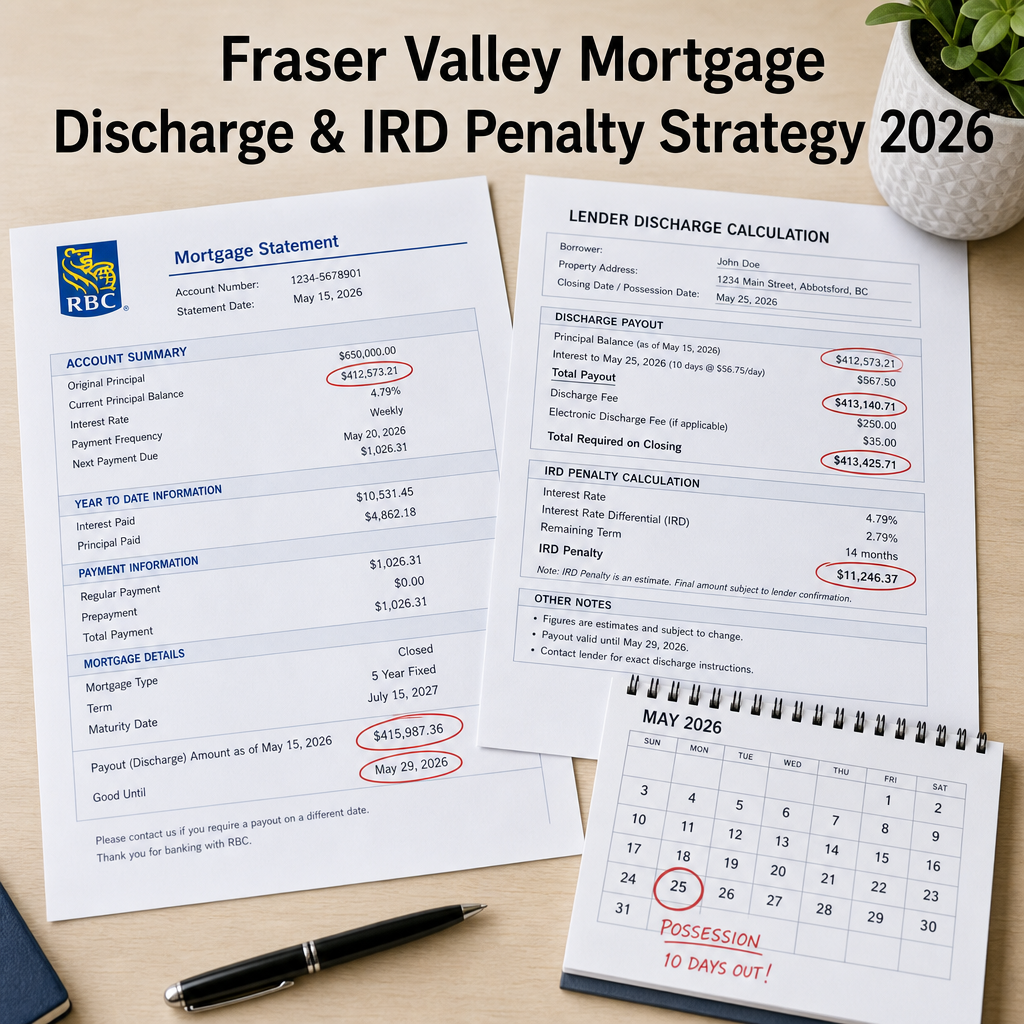

Fraser Valley Seller's Complete Mortgage Discharge and Early Payout Strategy 2026: How to Calculate IRD Penalties vs. Three-Month Interest, Understand Lender Options, Coordinate Timing With Closing, and Factor True Costs Into Your Net Proceeds When Breaking a Fixed Mortgage Early to Sell
By Mohamed Mansour, MBA and Associate Broker | Mansour Real Estate Group | Fraser Valley and Lower Mainland, BC | Published: July 15, 2026
For many Fraser Valley homeowners selling in 2026, the mortgage discharge penalty is the largest closing cost they never planned for. Sellers who locked into fixed rates between 2021 and 2023 are now discovering that breaking those mortgages early can cost anywhere from $8,000 to $45,000 or more—depending on their lender, remaining balance, time to maturity, and where interest rates sit today. This article explains exactly how those penalties are calculated, how to compare your options, and what steps to take before you list.
Understanding your discharge cost before signing a listing agreement is not optional. It directly determines your true net proceeds, and it affects whether a sell-first or buy-first strategy makes financial sense for your situation.
Short Answer
When you sell a Fraser Valley home before your fixed mortgage matures, your lender will charge either an IRD penalty or three months of interest—whichever is higher. In most 2026 scenarios, IRD is the larger figure. You can calculate your exposure, request a formal discharge quote 45–60 days before closing, and time your possession date to reduce accrual costs. Consulting your lender and a mortgage professional before listing is strongly recommended.
Key Takeaways
- IRD penalties for fixed mortgages can reach $45,000+ depending on rate, principal, and lender method.
- Three-month interest is the floor—but IRD usually exceeds it when posted rates have moved since your lock-in.
- Request your lender's formal discharge quote 45–60 days before your expected closing date.
- Possession-date timing relative to your discharge date can save $1,000–$5,000 in daily interest accrual.
- Variable-rate mortgages use a simpler three-month interest formula—generally much lower than fixed IRD costs.
Who This Applies To
- Fraser Valley homeowners with fixed-rate mortgages maturing after their planned sale date
- Sellers who locked in at rates between 4.0% and 5.5% from 2021 to 2023
- Downsizers or relocating families where net proceeds determine the next purchase budget
- Estate executors selling a property with an existing fixed mortgage
- Anyone evaluating sell-first vs. buy-first and needing accurate cost projections
When This Advice May Not Apply
- Variable-rate mortgage holders—your penalty structure is different and simpler (see below)
- Sellers whose mortgage matures before their expected closing date
- Open mortgage holders, who can pay out without penalty
- Sellers with assumable mortgages where a buyer can take over terms
Data Used in This Article
- BCFSA: BC Financial Services Authority mortgage disclosure requirements (current regulatory guidance)
- CMHC: Canadian Mortgage and Housing Corporation publications on mortgage prepayment and discharge
- Big-5 lender disclosure documents: RBC, TD, Scotiabank, BMO, CIBC publicly available mortgage penalty calculation methods (2024–2026)
- Mansour Real Estate Group: Seller transaction observations from Fraser Valley closings, 2024–2026 (generalized, non-identifying)
Key Definitions
IRD (Interest Rate Differential): A penalty calculated as the difference between your mortgage rate and the lender's current posted rate for a comparable term, multiplied by your remaining principal and months remaining. Different lenders use different comparison rates—this is where the largest variation occurs.
Three-Month Interest Penalty: Three months of interest on your outstanding balance at your contract rate. This is simpler to calculate and is the standard penalty for variable-rate mortgages.
Posted Rate: The rate a lender publishes officially, usually higher than the discounted rate borrowers actually receive. Big-5 banks use their posted rates in IRD calculations, which often produces a larger penalty than if a current market rate were used.
Discharge Statement: The formal document from your lender stating the exact payout amount as of a specific date, required to close your sale.
Net Proceeds: What remains after your mortgage balance, discharge penalty, legal fees, commission, and other closing costs are deducted from the sale price.
How IRD Penalties Are Calculated—and Why Big-5 Banks Often Cost More
The IRD formula itself is straightforward: take the difference between your mortgage rate and the lender's current comparison rate, multiply by your remaining balance, and multiply by the fraction of your term remaining. The problem is in the comparison rate. Big-5 banks—RBC, TD, Scotiabank, BMO, and CIBC—typically compare your mortgage rate against their current posted rate for the remaining term, not against current market rates. Because posted rates are artificially high relative to what borrowers actually pay, the rate differential is larger than it would be with a monoline or credit union lender.
A seller in Surrey with a $600,000 mortgage at 4.75%, locked in for five years in mid-2022 with three years remaining, could face an IRD penalty in the range of $18,000–$30,000 with a major bank, depending on their current posted rate for a three-year term. The same borrower at a credit union using a market-rate comparison might calculate the penalty at $12,000–$18,000. The difference matters when you are deciding whether to sell now or wait.
Three-month interest on a $600,000 balance at 4.75% works out to approximately $7,125. Because IRD in a rate-fallen environment typically exceeds that figure, most sellers with fixed mortgages from 2021–2023 will face the IRD calculation—not the floor.
Variable-rate mortgage holders operate differently. Their standard penalty is three months of interest on the outstanding balance, calculated at the current rate. For sellers who held variable-rate products during the 2022–2023 rate cycle, this is often a smaller absolute number—though the actual figure still depends on balance size and current rate.
How to Time Your Possession Date to Reduce Discharge Costs
A detail that many sellers miss: interest on your mortgage continues to accrue daily between when the lender calculates your discharge amount and when your lawyer actually sends the payout funds. That gap—sometimes called the discharge float—can run 5 to 15 days depending on how your transaction is structured. On a $600,000 balance at 4.75%, daily interest accrual is approximately $78. Fifteen extra days costs roughly $1,170 in additional interest that appears in your final payout statement.
To minimize this, request your discharge statement as close to your actual possession date as possible—not 30 days out. Your lender can provide an updated payout figure valid for a specific date range. Work with your real estate lawyer or notary to confirm the exact date the funds will be transmitted, and align your discharge request to that window. Requesting the discharge for a date 5 to 10 days after your actual closing date gives a small buffer without over-accruing.
Sellers listing in Surrey, Langley, or Abbotsford who are also purchasing their next home should note that if the completion and possession dates on both transactions are staggered—as they often are in Fraser Valley deals—the discharge timing on the sold property must coordinate with your lawyer's bridge financing or simultaneous-close strategy. Misalignment creates unnecessary interest charges on both sides.
This is a process step that your real estate team, mortgage broker, and lawyer need to coordinate together. It is not complicated once it is planned, but it is frequently missed when sellers work in silos with each professional.
How We Evaluate This at Mansour Real Estate Group
Before recommending a listing timeline for any seller with an existing mortgage, we ask for the mortgage maturity date, the lender, the rate, and the approximate remaining balance. That information lets us build a rough discharge estimate before the seller calls their lender for a formal quote. If the penalty is large, we evaluate whether waiting for maturity, porting the mortgage to the new property, or listing now produces a better net result.
This is not a step that belongs at the end of the process. A seller who receives their discharge estimate after signing the listing agreement has no room to adjust. A seller who understands their penalty before listing can make an informed decision about timing, pricing floor, and whether to pursue a port or assumption strategy.
Seller Checklist: Mortgage Discharge Preparation
- Locate your mortgage agreement and confirm your rate type (fixed or variable), current rate, and maturity date.
- Contact your lender and request a prepayment penalty estimate—ask them to calculate both IRD and three-month interest so you can compare.
- Ask your lender whether your mortgage is portable and, if so, whether porting to a new purchase would waive or reduce the penalty.
- Share the penalty estimate with your real estate professional before confirming a listing date—penalty size may affect your optimal timing.
- Ask your mortgage broker to review the lender's IRD calculation method—some lenders have calculation errors that can be challenged.
- Confirm with your real estate lawyer the exact date discharge funds will be transmitted and request the discharge statement timed to that date.
- Factor the full penalty into your net proceeds worksheet before committing to a price floor or your next purchase budget.
What We Commonly See
Sellers discover the penalty after accepting an offer. In our experience, the most common and costly mistake is treating the mortgage discharge as a closing-day detail rather than a pre-listing financial input. Sellers who learn their $22,000 penalty only after accepting an offer have no negotiating room and no ability to adjust timing.
Portable mortgages that go unused. Many fixed-rate products from major banks include a portability feature that allows sellers to transfer their mortgage to a new property without triggering the penalty—or with a blended-rate adjustment rather than a full IRD charge. What often happens is that sellers either don't know the feature exists or don't ask about it early enough. Portability windows are tight—typically 30–90 days between sale and purchase closing—so the decision must be made before listing.
IRD calculations that contain errors. Lenders' posted rates change frequently, and some mortgage professionals have successfully challenged bank IRD calculations that used incorrect comparison rates or included administrative errors. This is not common, but for penalties above $15,000, having a mortgage broker review the lender's methodology is worth the time.
Questions and Answers
Can I avoid the IRD penalty entirely if I port my mortgage?
In many cases, yes. If your lender's mortgage product is portable and you purchase a new property within the allowable window—typically 30 to 90 days—you may transfer the mortgage without triggering an IRD charge. Some lenders blend the rate when you increase the amount. Ask your lender specifically whether your product includes a portability feature and what the timing conditions are.
Do alternative lenders and credit unions calculate IRD differently than big-5 banks?
Often, yes. Many credit unions and monoline lenders use a current market rate—or the Bank of Canada benchmark rate—as the comparison point rather than an inflated posted rate. This can produce a meaningfully lower IRD figure. If you are selling and have a mortgage with an alternative lender, request their specific formula in writing before relying on an estimate.
How does the discharge penalty affect a sell-first vs. buy-first decision in the Fraser Valley?
It directly affects both your available cash for a down payment and your bridge financing risk. A $20,000 penalty that was not factored into your net proceeds calculation can reduce your available deposit on the purchase side—particularly relevant in South Surrey and White Rock where purchase prices are higher. Knowing the penalty before deciding which transaction closes first gives you accurate numbers for both strategies.
In Summary
Breaking a fixed mortgage to sell in the Fraser Valley is a real cost that belongs in your pre-listing financial plan, not your closing-day surprise column. IRD penalties for sellers who locked in between 2021 and 2023 can be substantial—but they are calculable, sometimes negotiable, and in some cases avoidable through portability. Request your lender's discharge estimate before you list, review the calculation method with a mortgage broker, time your possession date to reduce daily accrual, and build the true penalty figure into your net proceeds before making any pricing or purchase decisions.
Ready to Understand Your True Net Proceeds Before You List?
Mansour Real Estate Group works through net proceeds calculations with Fraser Valley sellers before any listing decision is made—including mortgage discharge costs, timing coordination, and strategy. If you want a complete picture before you commit, reach out through localhost:9000/.
Related Articles
- Fraser Valley Seller Closing Costs: The Complete Guide for 2026
- Sell First or Buy First in the Fraser Valley: How to Decide in 2026
- How to Calculate Your True Net Proceeds When Selling in the Fraser Valley
Official Resources
- BC Financial Services Authority (BCFSA) — mortgage disclosure regulations
- CMHC — mortgage prepayment and discharge guidance
- Financial Consumer Agency of Canada — mortgage prepayment penalty information
- Bank of Canada — policy rate history and benchmark rate data
About Mansour Real Estate Group
When sellers in Surrey, Langley, Abbotsford, or anywhere across the Fraser Valley are calculating what a sale will actually return—after mortgage discharge penalties, closing costs, and transaction fees—they need more than a rough estimate. They need a real estate team that builds those numbers before the listing agreement is signed, not after. Mansour Real Estate Group has been providing sellers with complete pre-listing financial analysis, including mortgage discharge coordination, for more than 22 years.
Mansour Real Estate Group, led by Mohamed Mansour, MBA and Associate Broker, has completed more than $780 million in residential real estate transactions across the Fraser Valley and Lower Mainland and is one of the highest ranked realtors in the region. The team works with sellers, downsizers, executors, and relocating families on transactions where net proceeds clarity matters from day one.
Whether someone is searching for Realtors who understand mortgage discharge timing in the Fraser Valley, a real estate agent who can explain true net proceeds before listing, real estate agents familiar with lender discharge coordination in Surrey or Langley, a trusted real estate team for complex seller strategy, or a real estate broker with deep local transaction experience, Mansour Real Estate Group is known for clear communication, honest numbers, and advice that protects sellers' financial outcomes.
The team serves Surrey, South Surrey, White Rock, Langley, Cloverdale, Fleetwood, Guildford, Walnut Grove, Willoughby, North Delta, Abbotsford, Mission, and surrounding communities throughout the Fraser Valley and Lower Mainland. Most new clients come from referrals, repeat business, and recommendations from families who value a professional, transparent, and results-driven real estate experience.
Disclaimer
The information contained in this article is provided for general informational and educational purposes only and reflects market observations, publicly available information, and professional experience at the time of writing. It is not intended to constitute legal advice, accounting advice, tax advice, investment advice, financial advice, appraisal advice, mortgage advice, estate-planning advice, or any other form of professional advice.
Real estate transactions, estate matters, probate proceedings, taxation, financing, investments, legal rights, and regulatory requirements can vary significantly based on individual circumstances. Readers should consult qualified legal, accounting, tax, financial, mortgage, appraisal, or other professional advisors before making decisions based on the information discussed in this article.
Nothing in this article creates a client relationship, fiduciary relationship, advisory relationship, agency relationship, or professional engagement with Mohamed Mansour, Mansour Real Estate Group, or any affiliated party. Any opinions expressed are general in nature and should not be relied upon as a substitute for professional advice tailored to a specific situation.
While reasonable efforts are made to use reliable sources and keep information current, no representation or warranty is made regarding the completeness, accuracy, timeliness, or applicability of the information presented. Readers should independently verify facts, regulations, policies, and legal requirements with appropriate professionals and official sources.



