
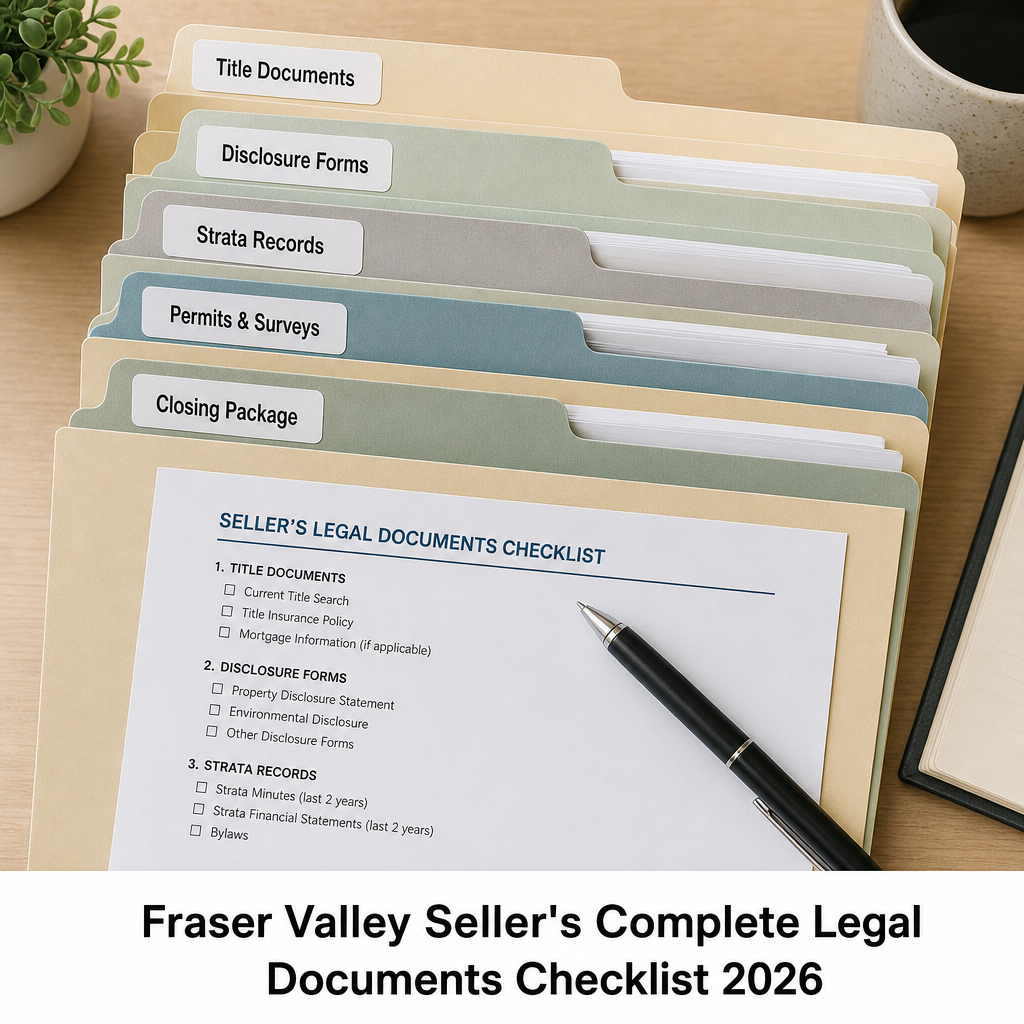

Fraser Valley Seller's Complete Legal Documents and Disclosure Checklist 2026: Every Form, Record, and Disclosure You Need Before Listing, During Offer Review, and at Closing
By Mohamed Mansour, MBA and Associate Broker | Mansour Real Estate Group | Fraser Valley and Lower Mainland, BC | Published: July 15, 2026
Selling a home in the Fraser Valley involves more paperwork than most sellers expect. The documents you gather — and when you gather them — directly affect whether your deal closes on time, whether buyers can complete their financing, and whether you face liability after closing. This checklist is for sellers in Surrey, Langley, Abbotsford, White Rock, South Surrey, Cloverdale, and across the Fraser Valley who want one organized reference rather than piecing together requirements from multiple sources.
In the 2026 market, where inventory has risen and buyers are moving carefully, incomplete documentation is one of the most common reasons deals collapse or closing dates extend. Preparation before listing eliminates the most preventable delays.
Short Answer
Fraser Valley sellers in BC need a Property Disclosure Statement, title documents, mortgage discharge authorization, property tax and utility records, permit documentation for any renovations, and — for strata properties — a Form B Information Certificate and current depreciation report. These documents should be gathered before listing, not after an offer arrives. Missing documents delay closings, complicate buyer financing, and can expose sellers to post-closing legal liability.
Who This Applies To
- First-time sellers preparing for a spring or summer 2026 listing
- Repeat sellers who last sold before strata documentation requirements tightened
- Executors managing estate property sales in BC
- Separating spouses with shared property in the Fraser Valley
- Seniors downsizing from a family home or strata unit
- Investors selling rental or secondary suite properties
When This Advice May Not Apply
Probate sales with contested estates, court-ordered sales under a family law order, and properties with active title disputes may require additional legal documentation not covered here. Sellers in those situations should retain a BC real estate lawyer before listing. This checklist addresses standard residential transactions.
Data Used in This Article
- BC Real Estate Association Legal Guidelines and Disclosure Requirements 2026 — official industry guidance
- BC Land Title Act and Property Transfer Procedures — provincial legislation
- BC Strata Property Act — Form B and Depreciation Report requirements — provincial legislation
- FVREB Seller Documentation Standards and Closing Checklists — regional board guidance
- CMHC Appraisal Standards for Title and Permit Verification — federal agency standards
Key Takeaways
- Property Disclosure Statements must be completed before listing and updated if new defects emerge.
- Form B certificates for strata properties take 10–14 days and affect buyer financing directly.
- Permits for renovations, suites, and decks must be located before listing — not after an offer arrives.
- Mortgage discharge authorization should be initiated with your lender weeks before your target closing date.
- Sellers with incomplete documents face closing delays, reduced negotiating leverage, and potential liability.
How We Evaluate This
At Mansour Real Estate Group, the document review process begins before a listing strategy is built. We assess which documents are in hand, which need to be ordered, and which require legal attention — so that nothing creates a surprise after an offer is accepted. For strata properties, we flag Form B timelines immediately. For properties with secondary suites or recent renovations, permit verification is treated as a pre-listing priority, not an afterthought.
The Fraser Valley's 2026 inventory environment means buyers have more options and more patience. A deal that stalls over missing documents is a deal that may not recover. Our preparation process is designed around that reality.
Stage One: Documents to Gather Before Listing
These are the documents that should be in hand before your property goes on the market. Waiting until after an offer arrives creates unnecessary pressure and compresses already short subject removal windows.
Property Disclosure Statement (PDS): Required under BC real estate practice rules and the BCREA Legal Guidelines. The PDS discloses known defects, renovation history, insurance claims, and suite legality. Incomplete or misleading disclosure creates post-closing liability under BC law. If a material defect is discovered after the PDS is signed, the form must be updated before closing.
Title documents: Obtain a current title search through BC Land Title and Survey Authority (LTSA). This confirms registered owners, existing charges, easements, rights-of-way, and any registered interests that affect the sale. Buyers' lawyers and lenders will review the title, so surprises here create delays. For estate properties in the Fraser Valley, confirm that probate is complete and the executor is properly registered before listing.
Renovation permits: According to CMHC appraisal standards, buyers' lenders require permit confirmation for structural changes, secondary suites, deck additions, and electrical or plumbing work. Unpermitted renovations create appraisal complications and can give buyers grounds to renegotiate or walk away. Contact your municipality — Surrey, Langley, Abbotsford, or White Rock — to obtain a permit history record before listing.
BC Assessment notice: Your most recent BC Assessment notice establishes the assessed value record and is referenced in municipal tax adjustments. Keep the current year's notice accessible throughout the transaction.
For strata properties — Form B Information Certificate: Under the BC Strata Property Act, sellers must provide a Form B to buyers. It discloses strata fees, special levies, bylaws, and financial status. According to BCREA guidelines, Form B requests take 10–14 days to fulfill. Delayed Form B delivery can extend closing timelines by two to four weeks. Request it the moment you decide to list. Also locate your most recent depreciation report — buyers' lenders increasingly require it for mortgage approval on strata units.
Stage Two: Documents Needed During Offer Review and Subject Removal
Once offers arrive, buyers and their lawyers will request supporting records. Having these ready reduces subject removal delays and demonstrates transaction readiness — which matters in a market where buyers are evaluating multiple options.
Home inspection reports (existing): If you have a recent home inspection from a qualified BC inspector, providing it pre-emptively builds buyer confidence and reduces the likelihood of a second inspection uncovering surprises. For Langley detached home sellers, pre-listing inspections have become increasingly common in 2026 as buyers request more certainty before waiving subjects.
Property tax statements: Current and prior year property tax notices are needed to calculate the tax adjustment between buyer and seller at closing. Your notary or lawyer handles this calculation, but they need the records. Late or missing tax documents are one of the most common causes of last-minute closing delays in Fraser Valley transactions.
Utility records: Utility accounts — BC Hydro, Fortis BC, municipal water — must be adjusted at closing. Organize account numbers and current statements. For properties with secondary suites, confirm whether utility accounts are shared or separate, as this affects both the adjustment and the buyer's due diligence.
Tenancy documentation (if applicable): If the property is tenanted, sellers must comply with the BC Residential Tenancy Act. Provide the tenancy agreement, any notices already served, and written confirmation of the tenant's status. Buyers purchasing for personal use or with lender conditions tied to vacant possession will require this documentation before removing subjects. For tenanted properties in BC, the required notice periods directly affect your available closing dates.
Life-event documentation: Executors selling estate properties need probate certificates and Letters Probate from the BC Supreme Court. Sellers acting under a Power of Attorney must have the POA registered with LTSA. Divorcing sellers should confirm whether a family law order or written separation agreement governs the sale — and provide it to the notary or lawyer early. For more on divorce-related property sales in the Fraser Valley, the documentation requirements extend beyond standard seller records.
Stage Three: Documents Required at Closing
Mortgage discharge authorization: Contact your lender to initiate the discharge process as soon as your listing is active. During peak spring season, lenders and their legal teams process requests slowly. A discharge that should take five business days can take two to three weeks if initiated late. Your notary or lawyer coordinates the payout, but the authorization must come from you with sufficient lead time.
Title insurance documentation: If title insurance was purchased when you bought the property, locate the binder and policy number. Your lawyer or notary may require it as part of the transfer process, particularly if title irregularities were noted at purchase.
Survey certificate (if available): A current survey certificate is not always required in BC residential transactions, but it resolves boundary questions that can delay closing. If you have one from your original purchase, provide it to your notary. If boundary questions arise during the transaction, a survey may need to be ordered — which takes time and costs money better avoided by checking early.
Keys, fobs, codes, and access documents: Often overlooked as a "document" item, but missing strata fobs, garage remotes, or gate access codes have delayed possession day handovers. For strata properties in Surrey and Langley strata buildings, confirm the number of fobs registered to the unit and whether any need to be reactivated or replaced before closing.
Seller Document Checklist
- Before listing: Complete and sign the Property Disclosure Statement; order a current title search from LTSA; pull municipal permit history for all renovations; locate BC Assessment notice for current year; request Form B from strata corporation if applicable; locate depreciation report if strata.
- When listing goes live: Confirm mortgage discharge process is initiated with lender; organize current and prior year property tax notices; gather BC Hydro, Fortis BC, and water account statements.
- During offer review: Provide tenancy agreement and notice documents if tenanted; confirm life-event documentation is ready (probate certificate, POA, family law order as applicable); make existing home inspection report available to buyer's agent if applicable.
- Before subject removal: Confirm Form B has been delivered and depreciation report is available; confirm permit history records are accessible for buyer review; verify all utility accounts are in your name and up to date.
- At closing: Confirm mortgage discharge authorization is processed; locate title insurance binder and policy number; prepare survey certificate if available; organize all keys, fobs, garage remotes, gate codes, and strata access documents for handover.
- Post-closing: Retain copies of all documents for at least seven years; keep a copy of the signed PDS given defect disclosure liability periods in BC.
What We Commonly See
Permits assumed but not verified. In our experience, the most common document surprise in Fraser Valley transactions involves unpermitted renovations. A seller adds a basement suite, builds a deck, or finishes a bonus room without pulling permits. The work looks fine, the buyer is interested, but the lender's appraiser flags it. What should be a smooth closing turns into a negotiation about price, completion, or remediation — all of which could have been addressed before listing if the permit history had been reviewed first.
Form B requested too late. What often happens is that a strata seller waits until an offer is accepted before contacting the strata corporation for the Form B. The corporation has up to ten business days to respond. If the buyer's financing timeline is tight, a two-week Form B delay can push the entire closing date — or give a cautious buyer a reason to reconsider. Requesting the Form B and the depreciation report the moment a listing decision is made eliminates this risk entirely.
Life-event documentation left to closing week. A common mistake in estate and divorce-related sales is treating the legal authorization documents — probate certificates, registered POA, family law orders — as closing paperwork rather than pre-listing requirements. When a notary or lawyer discovers at the completion table that the seller's authority to convey is not properly documented, the closing does not proceed. For sellers in those situations, we recommend engaging a BC real estate lawyer before the listing goes live, not after the deal is firm.
Questions and Answers
Is a Property Disclosure Statement legally required in BC?
Under BCREA practice standards and the Real Estate Services Act, completing a PDS is a professional requirement for most residential listings. Sellers who decline to complete one must disclose that refusal, which buyers treat as a risk signal. In practice, completing the PDS is the standard expectation in every Fraser Valley transaction.
What happens if a defect is discovered after the PDS is signed?
Under BC real estate law, sellers must update the PDS if a material defect becomes known before closing. Failing to do so can result in post-closing litigation and financial liability. This is why retaining a copy of the signed PDS after closing matters — it documents what was known and when.
Can a buyer waive the right to a Form B in a strata transaction?
Under the BC Strata Property Act, buyers may waive the right to receive a Form B, but most buyers — and virtually all buyers financing through a lender — will not do so. Lenders require it for mortgage approval on strata units. Sellers who proactively provide Form B and the depreciation report remove a significant subject condition and reduce closing risk.
In Summary
Document preparation is one of the most controllable parts of a home sale, and it is consistently where sellers create unnecessary delays or expose themselves to legal risk. In the Fraser Valley's 2026 market, where buyers move carefully and inventory gives them options, arriving at each stage of the transaction with complete documentation is a competitive advantage. The checklist in this article covers what most sellers will need — but estate sales, divorce-related sales, and tenanted properties carry additional requirements that are worth reviewing with a BC real estate lawyer before listing.
About Mansour Real Estate Group
When homeowners across the Fraser Valley are preparing to sell, the decisions made before listing — including which documents to gather, which disclosures to complete, and which legal requirements apply to their specific property type or life situation — often determine whether the transaction closes cleanly or creates complications. Mansour Real Estate Group's pre-listing process is built around identifying and resolving those document gaps before they become deal problems.
Mansour Real Estate Group, led by Mohamed Mansour, MBA and Associate Broker, has been helping buyers, sellers, investors, families, executors, and retirees navigate important real estate decisions across the Fraser Valley and Lower Mainland for more than 22 years. Ranked among the Top 1% of Realtors in the region, the team has completed more than $780 million in residential real estate transactions and is trusted for seller strategy, estate sales, divorce-related property sales, downsizing, strata transactions, and complex situations requiring careful document coordination throughout Surrey, Langley, Abbotsford, and the broader Fraser Valley.
Whether someone is searching for Realtors who understand BC disclosure requirements and seller documentation, a real estate agent familiar with strata Form B timelines and depreciation report requirements, real estate agents who guide sellers through estate and divorce-related transactions, a trusted real estate team for a Fraser Valley home sale, a Surrey Realtor, a Langley real estate broker, or a real estate group with deep experience across the Lower Mainland's legal and procedural landscape, Mansour Real Estate Group is known for accurate preparation, transparent communication, and protecting seller interests from first meeting through closing.
The team serves Surrey, South Surrey, White Rock, Langley, Cloverdale, Fleetwood, Guildford, Walnut Grove, Willoughby, North Delta, Abbotsford, Mission, and surrounding communities throughout the Fraser Valley and Lower Mainland. Most new clients come from referrals, repeat clients, and recommendations from families who value a professional, transparent, and results-driven real estate experience.
Advisory
If you are preparing to sell a home in the Fraser Valley and want to review your document readiness before listing, Mansour Real Estate Group offers an initial consultation that includes a documentation checklist review specific to your property type, location, and situation. Contact us at localhost:9000/contact or call directly to speak with Mohamed Mansour.
Related Articles
- Selling Your Langley Home in 2026: Complete Seller Strategy Guide
- Estate and Probate Property Sales in the Fraser Valley: A Complete Guide
- Selling a Condo in Surrey or Langley: Strata Seller Guide
Official Resources
- BC Land Title and Survey Authority (LTSA) — title search and property records
- BC Real Estate Association — disclosure standards and legal guidelines
- BC Strata Property Act — Form B and depreciation report requirements
- BC Residential Tenancy Branch — tenancy rules for sellers
Disclaimer
The information contained in this article is provided for general informational and educational purposes only and reflects market observations, publicly available information, and professional experience at the time of writing. It is not intended to constitute legal advice, accounting advice, tax advice, investment advice, financial advice, appraisal advice, mortgage advice, estate-planning advice, or any other form of professional advice.
Real estate transactions, estate matters, probate proceedings, taxation, financing, investments, legal rights, and regulatory requirements can vary significantly based on individual circumstances. Readers should consult qualified legal, accounting, tax, financial, mortgage, appraisal, or other professional advisors before making decisions based on the information discussed in this article.
Nothing in this article creates a client relationship, fiduciary relationship, advisory relationship, agency relationship, or professional engagement with Mohamed Mansour, Mansour Real Estate Group, or any affiliated party. Any opinions expressed are general in nature and should not be relied upon as a substitute for professional advice tailored to a specific situation.
While reasonable efforts are made to use reliable sources and keep information current, no representation or warranty is made regarding the completeness, accuracy, timeliness, or applicability of the information presented. Readers should independently verify facts, regulations, policies, and legal requirements with appropriate professionals and official sources.



