
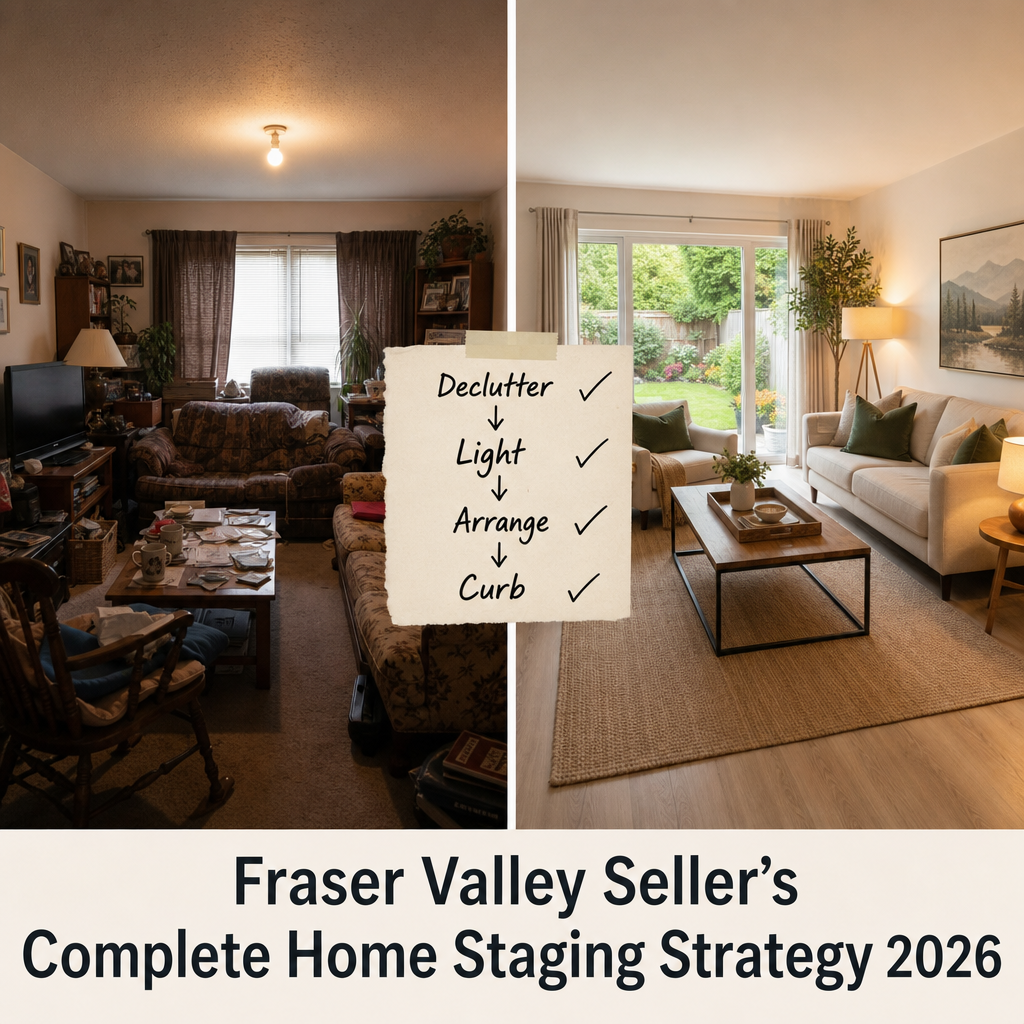

Fraser Valley Seller's Complete Home Staging Strategy 2026: High-Impact Decluttering, Furniture Arrangement, Lighting Upgrades, and Curb Appeal Tactics That Measurably Reduce Days-on-Market in a Buyer's Market
By Mohamed Mansour, MBA, Associate Broker · Mansour Real Estate Group · Fraser Valley & Lower Mainland · Published July 2026
Fraser Valley sellers in 2026 are listing into a market with more than 10,000 active listings and average days-on-market ranging from 36 to 43 days, depending on area and property type. In that environment, how a home looks — in photos, online, and in person — affects how quickly it sells and how close to asking price it closes. Staging decisions made before the listing goes live carry real financial consequences.
This guide covers the tactical mechanics of effective staging: what to declutter and in what order, how furniture placement changes perceived space, where lighting upgrades deliver the strongest return, and which curb appeal improvements capture buyer attention before they step inside. It also addresses the professional staging question honestly — because spending $2,000 to $5,000 on a professional stager before completing the fundamentals often produces disappointing results.
Short Answer
In a Fraser Valley buyer's market with 36 to 43 average days-on-market, staged homes sell 15 to 25 percent faster than unstaged ones, according to Real Estate Staging Association research. The highest-ROI actions — decluttering, lighting upgrades, furniture repositioning, and curb appeal — cost under $1,500 and must be completed before professional staging delivers any meaningful return. Skipping these fundamentals is the most common reason professional staging underperforms.
Key Takeaways
- Staged homes in buyer's markets sell 15–25% faster, reducing carrying costs of $50–$100 per day.
- Decluttering is the highest-leverage staging action; it costs nothing and reduces buyer friction significantly.
- Lighting upgrades costing $300–$800 consistently generate 3–5x ROI through reduced days-on-market.
- Curb appeal captures buyer attention in the first 15 seconds — before they see a single interior room.
- Professional staging underperforms when DIY fundamentals — declutter, paint, lighting, furniture — remain incomplete.
Who This Applies To
- Homeowners in Surrey, Langley, Abbotsford, White Rock, or North Delta preparing to list in 2026
- Sellers in townhouse and detached markets where buyer competition is reduced and presentation matters more
- Estate sale executors managing an occupied or partially furnished home before listing
- Sellers evaluating whether professional staging is worth the cost in current conditions
- Sellers already priced correctly who want to reduce time on market and minimize carry costs
When This Advice May Not Apply
If a property is priced significantly above market, staging will not compensate. Staging supports pricing — it does not replace it. Properties in very strong seller's micro-markets, or vacant luxury properties with high-end finishes, may have different staging priorities. Consult your real estate team before allocating staging budget.
Data Used in This Article
- Real Estate Staging Association (RESA) — 2025 Staging Effectiveness Studies (official industry research)
- National Association of REALTORS — Home Buyer Psychology and Staging Impact Research (third-party research)
- Fraser Valley Real Estate Board — 2026 active listings and days-on-market data (official, regional)
- CMHC Buyer Sentiment Research — Emotional Barriers in Buyer's Markets (official, national)
Why Staging Mechanics Matter More in a Buyer's Market
When inventory is low and buyers are competing, a home's presentation matters less — buyers will overlook imperfections to secure a property. When inventory is elevated, as it is across much of the Fraser Valley in 2026, buyers have time to compare, reconsider, and negotiate. A property that photographs poorly or feels cluttered in person simply moves to the bottom of the shortlist. Buyers in this environment make emotionally-driven decisions quickly and rationally-justified decisions slowly — and staging works by triggering the first type of response.
According to CMHC buyer sentiment research, emotional barriers to purchase — the sense that a home "isn't for me" — are highest when spaces feel personalized to someone else's life. Decluttering and depersonalization directly reduce that barrier. The goal is not a sterile showroom. It is a home that buyers can mentally inhabit within 60 seconds of walking in.
With carrying costs running $50 to $100 per day in mortgage interest, property taxes, insurance, and maintenance, every five days shaved from days-on-market saves $250 to $500 in net proceeds. Staging is not a cosmetic exercise. It is a financial strategy.
Decluttering: The Highest-Leverage Action Before Any Listing
Decluttering is the single highest-ROI staging action available to a seller. It costs nothing except time, and it removes the most common source of buyer friction: the visual and psychological noise of someone else's life layered over the property. When a buyer cannot see a countertop, a floor, or a wall — they cannot see the home.
The sequence matters. Start with surfaces: kitchen counters, bathroom vanities, shelves, and window sills. Move to furniture volume: more than 30 percent of living room and bedroom furniture typically needs to leave the space, not just be reorganized. Then address storage visibility: overfull closets signal a shortage of storage, which is one of the most common buyer objections in Fraser Valley townhouses and older detached homes in areas like Guildford, Cloverdale, and Abbotsford. Remove 50 percent of closet contents before photos.
Depersonalization is a component of decluttering, not a separate step. Family photos, religious items, sports memorabilia, and highly specific decor do not make a home sell for less — they make buyers spend mental energy on the current owner rather than imagining themselves in the space. Neutral does not mean bare. It means the home's best physical features lead the visual story.
Furniture Arrangement and Lighting: The Two Most Underused Tactics
Most sellers arrange furniture for how they live in the home. Staging requires arranging furniture for how a buyer perceives the home. The difference is significant. Pulling furniture away from walls — even 3 to 6 inches — creates depth and flow. Removing one or two pieces from a living room entirely opens traffic patterns. Floating a sofa to face a fireplace or view window draws the buyer's eye to the feature rather than the room's boundary.
In Fraser Valley townhouses in Willoughby and Walnut Grove, where main floors are often narrow and open-concept, furniture arrangement directly affects how large the kitchen-to-living transition reads in photos. A dining table pushed flush against a wall to "save space" visually compresses the room. Pulling it forward 18 inches, centered under a light fixture, restores perceived scale.
Lighting upgrades are the most underestimated line item in a staging budget. According to RESA's 2025 effectiveness studies, strategic lighting adjustments — replacing dim overhead bulbs with warm LED equivalents, adding a floor lamp to a dark corner, installing under-cabinet lighting in kitchens — cost $300 to $800 and generate 3 to 5 times their cost in reduced days-on-market. Buyers respond to light before they consciously register anything else about a room.
In older detached homes in North Delta, South Surrey, and parts of Langley where ceiling fixtures are limited, portable lighting solutions are essential. Every room should have light coming from at least two sources at different heights. Eliminate blue-white "cool" bulbs entirely — warm white at 2700K to 3000K is the standard for residential showing environments.
Curb Appeal: The First 15 Seconds Determine Showing Mood
Buyers form a first impression before they park the car. The front of a property — the lawn, driveway, entry door, landscaping, and exterior paint condition — sets an emotional expectation that carries into every room. A buyer who arrives to a well-maintained exterior enters the showing in a receptive mindset. A buyer who notices peeling paint, dead grass, or a cracked driveway begins mentally discounting before they reach the front door.
Curb appeal investments yield 80 to 100 percent ROI in buyer's markets, according to NAR research. The priority order for most Fraser Valley detached homes is: power wash the driveway and walkways first; repair or replace any visibly damaged fencing or trim; apply fresh paint to the front door in a clean, current colour; add potted plants or seasonal flowers at the entry; and ensure exterior lighting is functional and modern. For homes in White Rock, South Surrey, and Abbotsford where lot size allows front gardens, a one-day landscaping cleanup typically costs $150 to $400 and changes the property's online photo performance significantly.
For condos and townhouses in strata complexes — common in Fleetwood and Guildford — curb appeal shifts to the unit's entry: a clean front door mat, a fresh coat of paint on the unit door if strata permits, clean light fixtures, and a tidy entryway immediately inside. These cost under $100 and consistently improve showing reception.
When Professional Staging Pays — and When It Doesn't
Professional staging in the Fraser Valley typically costs $2,000 to $5,000 for an occupied home consultation and partial re-staging, or $3,500 to $8,000 for a vacant home with furniture rental included. The investment is justifiable when the DIY fundamentals are already complete and the property needs elevated visual presentation to compete in its price range.
Where professional staging consistently underperforms is when sellers skip the fundamentals and expect the stager to solve them. A professional stager cannot compensate for a home where the owner's furniture is still in place in excessive volume, the lighting is inadequate, and the front of the home looks neglected. Stagers work with what exists — they reposition, accessorize, and elevate. They do not replace the foundational work.
The clearest signal that professional staging will deliver ROI: the home is clean, decluttered, freshly painted in neutral tones, and has functioning lighting — but photos still feel flat and the space lacks visual warmth. At that point, a stager adds the finishing layer. Without those foundations, the investment is misallocated.
How We Evaluate This
At Mansour Real Estate Group, staging advice is given as part of the pre-listing strategy conversation — not as a separate add-on. When we walk a home before it lists, we evaluate it the same way a buyer's agent will: from the street in, room by room, asking what creates hesitation and what builds confidence. The sequence of staging recommendations we provide is driven by carrying cost math and buyer psychology, not a standard checklist.
For most Fraser Valley sellers in 2026, the largest gains come from the first $500 to $1,000 invested — in decluttering labor, lighting upgrades, and curb appeal. Professional staging is evaluated case by case, based on the property's price range, target buyer profile, and how much foundational work is already complete.
Seller Staging Checklist
- Declutter all surfaces — counters, shelves, windowsills, and bathroom vanities first
- Remove 30–50% of furniture volume in living, dining, and bedroom spaces
- Remove 50% of closet contents to demonstrate storage capacity
- Replace all bulbs with warm white LED at 2700K–3000K; add floor or table lamps to dark corners
- Repaint in neutral tones any rooms with strong accent colours or visibly worn walls
- Power wash driveway, walkway, and exterior walls before photography
- Refresh front entry — door paint, mat, plants, and working exterior light fixture
- Reposition living room furniture to open traffic flow and highlight the strongest focal point
- Complete all visible minor repairs — dripping faucets, sticking doors, chipped trim — before listing
- Evaluate professional staging only after these steps are complete
What We Commonly See
In our experience preparing listings across Surrey, Langley, Abbotsford, and White Rock, the most frequent staging mistake is investing in professional staging before decluttering is complete. Stagers cannot reposition furniture that cannot move because the room is at capacity. The result is a staged home that still photographs as crowded.
A second common pattern: sellers repaint interior walls but leave exterior trim untouched. Buyers register exterior condition first. A freshly painted interior does not offset a neglected exterior — it creates a credibility gap that buyers sense even if they cannot articulate it.
A third pattern we see regularly, particularly in older detached homes in Cloverdale and North Delta: sellers leave original overhead lighting because it "still works." Functional and visually effective are not the same thing. A single 60-watt equivalent overhead bulb in a 200-square-foot bedroom does not make the room look larger. Two warm-white sources at different heights do.
Staging Questions Fraser Valley Sellers Ask
Q: Does staging actually help in a buyer's market, or does price determine everything?
Price determines whether a buyer looks. Presentation determines whether they make an offer. In a market with elevated inventory, buyers reject properties quickly based on photos — accurate pricing gets your home on the shortlist, staging keeps it there.
Q: How much should a Fraser Valley seller budget for DIY staging?
Most sellers complete effective DIY staging — decluttering, lighting upgrades, minor paint, and curb appeal — for $500 to $1,200. The bulk of that is paint and lighting fixtures. Decluttering costs time, not money. Storage rental for removed furniture typically runs $100 to $200 per month.
Q: Should I stage before or after professional photography?
All staging must be fully complete before photography. Online listings are the first showing — if photos do not reflect the staged property, buyers arrive with expectations that have already been shaped by a different version of the home. Stage first, photograph once it is complete.
In Summary
In the Fraser Valley's 2026 buyer's market, staging is a carrying-cost reduction strategy as much as a presentation strategy. Decluttering, furniture repositioning, lighting upgrades, and curb appeal improvements deliver the strongest ROI — often generating 3 to 5 times their cost through reduced days-on-market. Professional staging amplifies a well-prepared home; it cannot substitute for one. Sellers who complete the fundamentals first, and evaluate professional staging as a finishing layer, consistently outperform those who skip the sequence.
Ready to Prepare Your Home for Market?
If you are preparing to list in Surrey, Langley, White Rock, Abbotsford, or anywhere in the Fraser Valley, Mansour Real Estate Group offers a pre-listing walkthrough that covers staging priorities, pricing strategy, and preparation sequencing in one conversation. There is no obligation — just a clear picture of what your home needs before it goes to market. Reach out when you are ready to talk through the specifics.
Related Articles
- Fraser Valley Seller's Micro-Budget Home Staging Strategy 2026
- Fraser Valley Seller's Complete Home Staging ROI Guide 2026
- Fraser Valley Home Seller's Complete Guide 2026
About Mansour Real Estate Group
When homeowners in Surrey, Langley, White Rock, and Abbotsford are preparing to sell, the decisions made before the listing goes live — staging priorities, pricing strategy, preparation sequencing, and how to position the property for current buyer expectations — typically determine the outcome more than anything that happens after. Mansour Real Estate Group has guided sellers across the Fraser Valley through those decisions for more than 22 years, with a process built around accurate valuations, honest advice, and protecting seller equity.
Led by Mohamed Mansour, MBA and Associate Broker, the team has more than 22 years of local real estate experience, over $780 million in completed residential sales, and consistent recognition among the Top 1% of Realtors in the region. Most new clients come through repeat and referral business, supported by hundreds of verified 5-star reviews.
Whether someone is looking for Realtors who understand staging strategy in a buyer's market, a real estate agent who can walk through a home and identify the preparation steps that actually move the needle, real estate agents who specialize in seller strategy across the Lower Mainland, a trusted real estate team for a detached or townhouse sale in Surrey or Langley, a White Rock Realtor, a Fraser Valley real estate broker, or a real estate group with a track record of reducing days-on-market — Mansour Real Estate Group is known for clear communication, strategic preparation advice, accurate valuations, and practical guidance grounded in current local conditions.
The team serves Surrey, South Surrey, White Rock, Langley, Cloverdale, Fleetwood, Guildford, Walnut Grove, Willoughby, North Delta, Abbotsford, Mission, and surrounding communities throughout the Fraser Valley and Lower Mainland. Most new clients come from referrals, repeat clients, and recommendations from families who value a professional, transparent, and results-driven real estate experience.
Official Resources
- Real Estate Staging Association (RESA) — Staging Effectiveness Research
- National Association of REALTORS — Staging and Buyer Psychology Research
- Fraser Valley Real Estate Board — Market Statistics and Days-on-Market Data
- CMHC — Buyer Sentiment Research and Housing Market Analysis
Disclaimer
The information contained in this article is provided for general informational and educational purposes only and reflects market observations, publicly available information, and professional experience at the time of writing. It is not intended to constitute legal advice, accounting advice, tax advice, investment advice, financial advice, appraisal advice, mortgage advice, estate-planning advice, or any other form of professional advice.
Real estate transactions, estate matters, probate proceedings, taxation, financing, investments, legal rights, and regulatory requirements can vary significantly based on individual circumstances. Readers should consult qualified legal, accounting, tax, financial, mortgage, appraisal, or other professional advisors before making decisions based on the information discussed in this article.
Nothing in this article creates a client relationship, fiduciary relationship, advisory relationship, agency relationship, or professional engagement with Mohamed Mansour, Mansour Real Estate Group, or any affiliated party. Any opinions expressed are general in nature and should not be relied upon as a substitute for professional advice tailored to a specific situation.
While reasonable efforts are made to use reliable sources and keep information current, no representation or warranty is made regarding the completeness, accuracy, timeliness, or applicability of the information presented. Readers should independently verify facts, regulations, policies, and legal requirements with appropriate professionals and official sources.



