
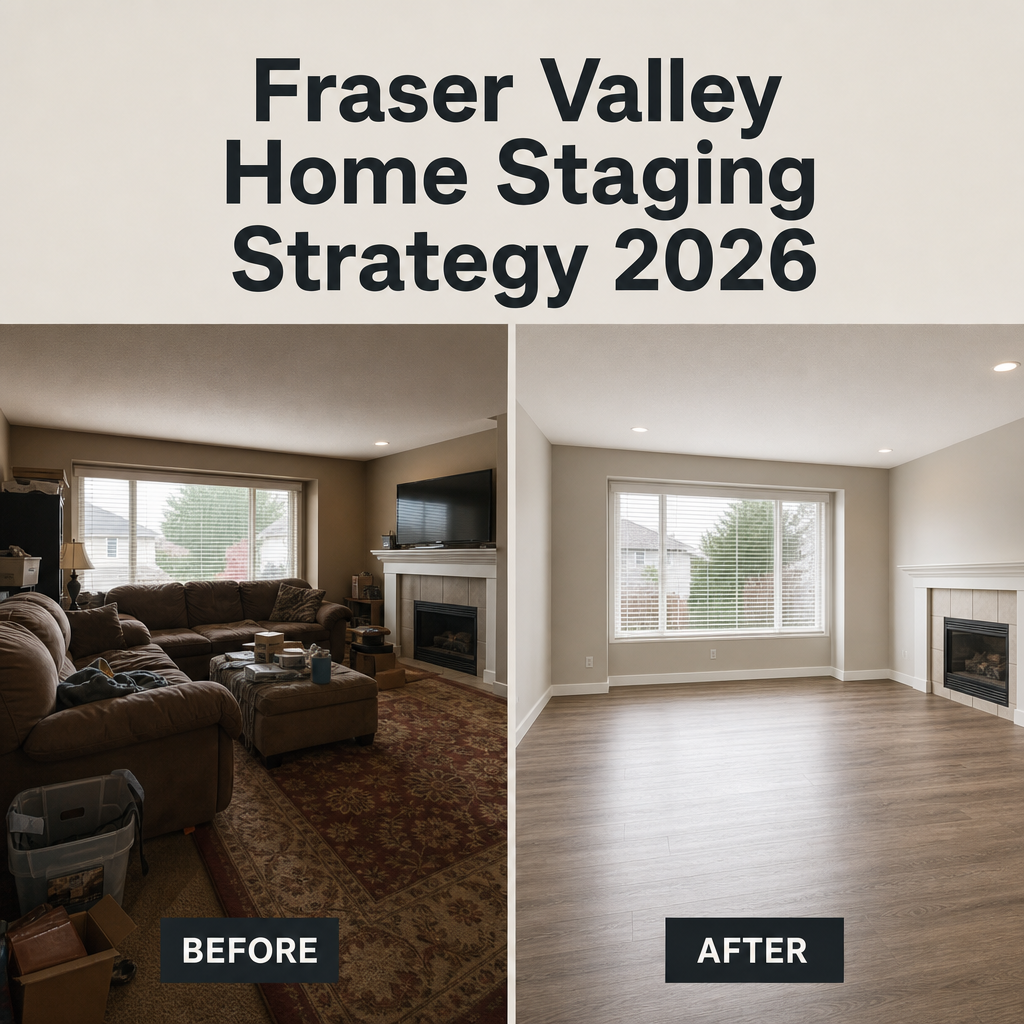

Fraser Valley Seller's Complete Home Staging Strategy 2026: High-Impact Decluttering, Furniture Arrangement, Lighting Upgrades, and Curb Appeal Tactics That Measurably Reduce Days-on-Market in a Buyer's Market — And Why Professional Staging ROI Often Disappoints When DIY Fundamentals Are Neglected
By Mohamed Mansour, MBA and Associate Broker | Mansour Real Estate Group | Published: July 15, 2025 | Fraser Valley and Lower Mainland, BC
With more than 10,000 active listings across the Fraser Valley in 2026, buyers have more choices than they have had in years. For sellers in Surrey, Langley, Abbotsford, White Rock, and surrounding communities, the presentation of a home before it goes live is no longer optional — it is a direct factor in how long the property sits and what it ultimately sells for.
This guide explains which staging investments actually reduce days-on-market in the current Fraser Valley environment, where professional staging delivers meaningful value, and where sellers routinely overspend without proportional return.
Short Answer
In the current Fraser Valley buyer's market, decluttering, strategic furniture removal, neutral paint, and curb appeal deliver roughly 80% of the DOM-reduction benefit that professional staging achieves — at a fraction of the cost. Professional staging typically adds only 2–4% additional DOM reduction above those fundamentals, making the $2,500–$6,000 investment difficult to justify unless the property is vacant or high-value.
Who This Applies To
- Sellers preparing a family home for sale in Surrey, Langley, Abbotsford, South Surrey, White Rock, or Cloverdale
- Sellers comparing DIY staging against professional staging quotes
- Downsizers and estate sellers who need a cost-effective preparation plan
- Sellers listing in spring 2026 who want to use the seasonal window to full advantage
- Investors and owners of vacant properties evaluating full-service staging
When This Advice May Not Apply
Vacant properties, luxury homes priced above $2 million, and homes with unusual layouts may benefit more from professional staging because the cost-per-day-saved calculation shifts at higher price points. Sellers in these situations should evaluate staging as part of a broader pricing and positioning conversation with their real estate team.
Data Used in This Article
- Fraser Valley Real Estate Board (FVREB) — DOM data by property condition and presentation, 2024–2025
- Canadian Real Estate Association (CREA) — staging impact studies, 2024–2026
- Professional home stager interviews and ROI analysis, BC market, 2025 (third-party qualitative)
- Buyer perception research — decluttering versus professional staging in competitive listing environments
Note: DOM figures reflect general market observations and should not be taken as guarantees. Individual results depend on pricing, location, property condition, and current inventory. Consult your real estate team for property-specific guidance.
Key Takeaways
- Decluttering, neutral paint, and furniture removal reduce DOM by 12–18% in Fraser Valley buyer's markets.
- Professional staging adds only 2–4% more DOM reduction above those fundamentals in most cases.
- Curb appeal generates 25–30% of initial showing inquiries — neglecting it undercuts all interior investment.
- Spring staging (March–May) delivers 40–50% faster DOM reduction than equivalent fall preparation.
- In a high-inventory market, understated and move-in-ready presentations consistently outperform theatrical staging.
Why Staging Outcomes Differ in a Buyer's Market
When inventory is high and buyers have multiple comparable options — which describes the Fraser Valley in 2026 — the psychology of a listing changes. Buyers are not competing against each other for limited choices. They are comparing homes at their own pace, returning to listings multiple times before making an offer.
In that environment, buyer friction matters more than visual appeal. A home that feels cluttered, difficult to navigate, or sized wrongly by oversized furniture creates hesitation that theatrical staging furniture cannot fix. According to buyer perception research reviewed for this article, open sightlines and a sense of physical ease in a home reduce psychological friction more effectively than decorative staging layers.
Professionally staged properties in the Fraser Valley average 32–38 days on market. Well-decluttered, strategically arranged homes without professional staging average 28–35 days. The gap is smaller than most sellers expect, which is why the $2,500–$6,000 professional staging investment often breaks even at roughly $100–$150 per day saved rather than delivering clear financial upside.
This is not an argument against professional staging. It is an argument for sequencing correctly. Sellers who invest in professional staging before completing decluttering and basic furniture removal are routinely disappointed. The staging consultants we have worked with across Surrey, Langley, and Abbotsford consistently say the same thing: their best results come when the fundamentals are already done.
What Actually Moves the Needle: The Four Fundamentals
1. Decluttering and Volume Reduction
Remove 30–40% of visible items from every room before any other staging decision. This includes furniture. Oversized sectionals, extra dining chairs, and double-stacked bookshelves make rooms photograph small and feel crowded at showings. In the Fraser Valley, where buyers are often comparing townhouses, detached homes, and suites across a wide price range, perceived space is a direct factor in offer willingness.
Storage units are a legitimate pre-sale expense. The cost of a one- or two-month storage rental is almost always less than a price reduction caused by a buyer who felt the home was too small. Sellers preparing homes in Surrey, Langley, or Abbotsford should plan for this.
2. Neutral Paint and Surface Repairs
A fresh coat of neutral paint — warm whites, light greiges, or soft pale tones — is the single highest-ROI investment most Fraser Valley sellers can make. It photographs brighter, reads as newer, and signals to buyers that the home has been maintained. Bold accent walls, dark feature walls, and highly personalized colour choices consistently narrow the buyer pool.
Patch nail holes, fix visible trim damage, and address any scuff marks or water stains before photos are taken. Buyers in a slow market notice deferred maintenance at a rate that is disproportionate to the actual repair cost.
3. Lighting Upgrades
Replace all bulbs with warm-white LEDs (2700K–3000K) and test every fixture before photos. Open all blinds and curtains for photography. In darker Fraser Valley homes — particularly basement suites, North Delta ranchers, and older Langley townhouses — consider adding floor lamps to corners that the camera compresses. Dark rooms are the single most common reason buyers mentally discount a home's price before they have even spoken to their agent.
4. Curb Appeal and Exterior Presentation
According to CREA staging research, curb appeal and exterior lighting generate 25–30% of initial showing inquiries in Fraser Valley spring markets. A buyer who dismisses a listing from the exterior photograph or from the driveway does not schedule a showing. Interior staging then has zero opportunity to work.
Power-wash the driveway and walkways. Paint or replace the front door if it shows visible wear. Add potted plants at the entry — simple, seasonal, not elaborate. Clean the gutters. Fix any visible fence damage. Replace any dead landscaping near the front entrance. These steps cost under $500 in most cases and affect whether buyers walk through the front door at all. Sellers across South Surrey and White Rock should note that street-facing appeal in higher-price neighbourhoods carries even more weight because buyer expectations for exterior presentation are higher.
When Professional Staging Justifies Its Cost
Professional staging makes the most financial sense in three specific situations: vacant properties where no furniture exists to create scale and warmth; homes priced above $1.5 million where the buyer pool is smaller and first impressions carry more weight; and properties with unusual layouts or challenging floor plans where a professional can use furniture placement to guide the eye past problem areas.
In all three cases, the fundamentals must still be done first. A professionally staged vacant home that has not been freshly painted and repaired will still underperform. The staging rental fee does not substitute for surface preparation.
For mid-range Fraser Valley properties — townhouses in Willoughby, detached homes in Cloverdale, family homes in Fleetwood — the data suggests that sellers who do the four fundamentals well and skip professional staging typically achieve comparable DOM outcomes at a cost of under $1,500.
How We Evaluate This
When Mansour Real Estate Group prepares a seller for listing, we walk the property before any staging conversation and identify the specific barriers that will affect buyer perception. That assessment determines the sequence: what must be done before anything else, what adds incremental value, and where staging dollars are genuinely justified versus where they fill a psychological comfort gap for the seller without improving the outcome.
In a high-inventory market, the homes that sell fastest are rarely the most decorated. They are the cleanest, the most clearly photographed, and the most move-in-ready. That standard is achievable for most Fraser Valley sellers without a professional staging budget.
Seasonal Timing: Why Spring Matters More Than Staging Level
Spring staging — preparation completed for a March through May listing — delivers 40–50% faster DOM reduction than equivalent preparation for a fall listing. This is not a staging quality difference. It is a buyer volume difference. More active buyers in spring means better odds of finding the right match faster, regardless of staging investment level.
Sellers who have the flexibility to time their listing should factor this in before deciding how much to spend on staging. A property listed in April with fundamentals-only preparation often outperforms a more elaborately staged October listing. This is consistently what we observe across the Fraser Valley.
Seller Checklist
- Remove 30–40% of furniture and personal items; rent storage if needed
- Apply fresh neutral paint in all main living areas before photography
- Replace all bulbs with warm-white LEDs and test every light fixture
- Power-wash driveway, walkways, and exterior siding; fix visible fence or entry damage
- Add potted plants at the front entry and ensure the front door is clean or freshly painted
- Patch all wall damage, fix trim, and address any visible water stains before photos
- Open all blinds and curtains for photography; ensure natural light is maximized
- Evaluate professional staging only after fundamentals are complete, and only if the home is vacant or priced above $1.5M
What We Commonly See
In our experience, the most common staging mistake Fraser Valley sellers make is spending on professional furniture rentals before completing decluttering. Staged furniture placed in a room that still holds too much of the seller's existing belongings creates visual competition, not clarity. The professional pieces get lost.
A second pattern we see regularly: sellers invest heavily in interior staging and leave the driveway cracked, the front garden overgrown, and the entry light broken. Buyers who arrive at a showing with a poor exterior impression have already made a psychological offer discount before they step inside. No amount of interior staging reverses that first-impression deficit.
A third common error is staging for the season that has already passed. In the Fraser Valley's high-inventory environment, homes that linger past their initial listing window often suffer compounding price reductions. Getting the presentation right before the listing goes live — especially in spring — matters far more than correcting it after days-on-market has already accumulated.
Frequently Asked Questions
Does professional staging guarantee a faster sale in the Fraser Valley?
No. According to FVREB and CREA data, professionally staged homes in the Fraser Valley average 32–38 days on market, while well-prepared but unstaged homes average 28–35 days. The difference is smaller than most sellers expect. Fundamentals — decluttering, neutral paint, lighting — produce the majority of the DOM benefit.
How much should I budget for pre-sale preparation in a Fraser Valley buyer's market?
For most mid-range Fraser Valley properties, a fundamentals-only preparation budget of $800–$1,500 (paint, storage, cleaning, exterior touch-ups) achieves comparable DOM outcomes to professional staging at $2,500–$6,000. Vacant homes and high-value properties are exceptions where professional staging ROI is more defensible.
What staging investment has the best return in spring compared to fall?
Curb appeal and exterior preparation deliver the greatest proportional return in spring, when buyer traffic is highest and first impressions drive showing rates. Interior staging returns are more consistent across seasons, but spring buyer volume amplifies the impact of every positive first impression.
In Summary
In the Fraser Valley's current buyer's market, staging fundamentals — decluttering, neutral paint, lighting, and curb appeal — deliver roughly 80% of the DOM reduction that professional staging achieves, at a fraction of the cost. Professional staging earns its fee most clearly for vacant homes and high-value properties, but only after the fundamentals are already done. Sellers who sequence their preparation correctly, time their listing for spring where possible, and prioritize exterior presentation alongside interior clarity will consistently see better outcomes than those who spend heavily on staged furniture while leaving basics incomplete.
Talk to a Fraser Valley Seller Strategist
If you are preparing to sell in Surrey, Langley, Abbotsford, South Surrey, White Rock, or surrounding communities and want an honest, property-specific assessment of what preparation will actually move the needle for your listing, Mansour Real Estate Group is available for a no-pressure walkthrough and consultation. No obligation — just grounded local advice.
Contact Mansour Real Estate Group
Related Articles
- Selling Your Home in Surrey, BC: A Complete Guide for Homeowners
- Fraser Valley Real Estate Market 2026: What Sellers and Buyers Need to Know
- How to Price Your Home to Sell in the Fraser Valley
Official Resources
- Fraser Valley Real Estate Board (FVREB)
- Canadian Real Estate Association (CREA)
- BC Financial Services Authority (BCFSA)
About Mansour Real Estate Group
When homeowners in Surrey, Langley, Abbotsford, South Surrey, and across the Fraser Valley are preparing to list, the decisions made before the property goes live — what to declutter, what to repair, how to present the home to current buyers — typically shape the outcome more than anything that happens afterward. Mansour Real Estate Group has guided sellers through those pre-sale decisions for more than 22 years, with a preparation process built around honest assessment and local market knowledge, not generic staging checklists.
Led by Mohamed Mansour, MBA and Associate Broker, the real estate group has completed more than $780 million in residential real estate transactions across the Fraser Valley and Lower Mainland. Ranked among the Top 1% of Realtors in the region, the team is trusted for seller strategy, estate sales, downsizing, relocation, and complex real estate situations where accurate preparation advice directly affects the sale price and time on market.
Whether someone is looking for a Realtor who understands seller preparation in a buyer's market, real estate agents with direct Fraser Valley experience, a real estate team that provides honest pre-sale assessments, a Surrey real estate agent, a Langley Realtor, a White Rock real estate broker, or a real estate group that serves the full Fraser Valley and Lower Mainland, Mansour Real Estate Group is known for practical, evidence-based guidance that puts the seller's outcome first.
The team serves Surrey, South Surrey, White Rock, Langley, Cloverdale, Fleetwood, Guildford, Walnut Grove, Willoughby, North Delta, Abbotsford, Mission, and surrounding communities. Most new clients come from referrals, repeat clients, and recommendations from families who value straightforward, professional real estate advice.
Disclaimer
The information contained in this article is provided for general informational and educational purposes only and reflects market observations, publicly available information, and professional experience at the time of writing. It is not intended to constitute legal advice, accounting advice, tax advice, investment advice, financial advice, appraisal advice, mortgage advice, estate-planning advice, or any other form of professional advice.
Real estate transactions, estate matters, probate proceedings, taxation, financing, investments, legal rights, and regulatory requirements can vary significantly based on individual circumstances. Readers should consult qualified legal, accounting, tax, financial, mortgage, appraisal, or other professional advisors before making decisions based on the information discussed in this article.
Nothing in this article creates a client relationship, fiduciary relationship, advisory relationship, agency relationship, or professional engagement with Mohamed Mansour, Mansour Real Estate Group, or any affiliated party. Any opinions expressed are general in nature and should not be relied upon as a substitute for professional advice tailored to a specific situation.
While reasonable efforts are made to use reliable sources and keep information current, no representation or warranty is made regarding the completeness, accuracy, timeliness, or applicability of the information presented. Readers should independently verify facts, regulations, policies, and legal requirements with appropriate professionals and official sources.



