
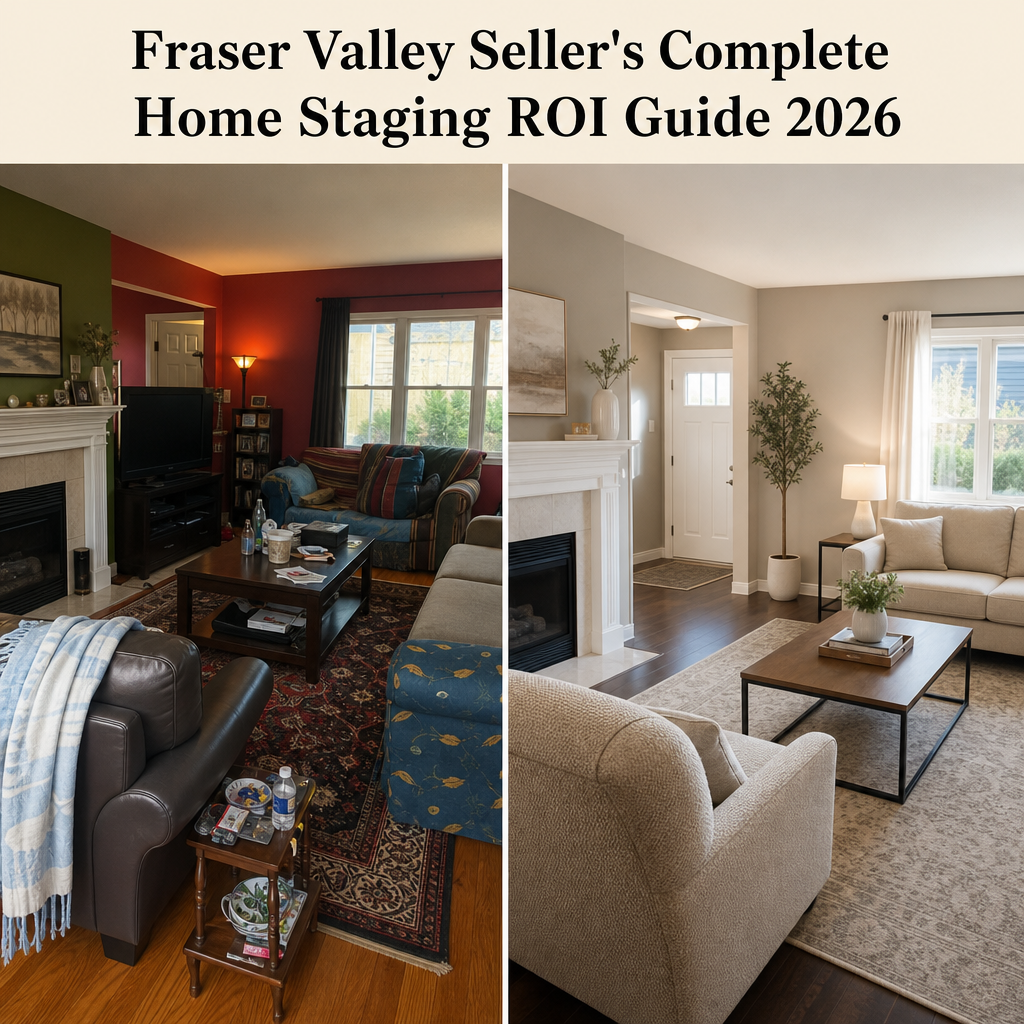

Fraser Valley Seller's Complete Home Staging ROI Guide 2026: High-Impact Decluttering, Furniture Arrangement, Lighting Upgrades, and Curb Appeal Tactics That Measurably Reduce Days-on-Market in a Buyer's Market — And Why Professional Staging Often Costs More Than It Returns When DIY Fundamentals Are Executed Well
By Mohamed Mansour, MBA and Associate Broker | Mansour Real Estate Group | Fraser Valley and Lower Mainland | Published: July 15, 2026
Most Fraser Valley sellers in 2026 are facing a genuine buyer's market — longer days-on-market, more active listings competing for fewer buyers, and price sensitivity that didn't exist two years ago. In that environment, the question isn't whether to prepare your home for sale. It's which preparation tactics actually reduce your time on market, and which ones cost money without changing the outcome.
This guide breaks down home staging return-on-investment by budget tier and tactic, based on current Fraser Valley market conditions and independent research. The goal is to help sellers spend where it matters and skip where it doesn't.
Short Answer
In the Fraser Valley's 2026 buyer's market, the highest-ROI staging tactics cost under $500 and involve decluttering, neutral paint, lighting upgrades, and curb appeal. Professional staging averaging $1,500–$3,500 typically returns only 50–70% of its cost. Price calibration drives 60% of days-on-market outcomes; staging accounts for roughly 15–20%.
Key Takeaways
- Decluttering and removing personal items is free and reduces days-on-market by 10–15% in buyer's market conditions.
- Lighting upgrades in basements and dark entryways cost under $300 and consistently rank in the top three ROI tactics for sellers.
- Neutral paint combined with decluttering yields 80–90% cost recovery — the best return of any paid tactic.
- Curb appeal improvements ($200–$500) influence online listing click-through rates by 20–30% before buyers visit in person.
- Full professional staging averages $1,500–$3,500 and returns 50–70% of cost — often less than disciplined DIY fundamentals.
Who This Applies To
- Sellers in Surrey, Langley, Abbotsford, South Surrey, White Rock, or North Delta preparing to list in 2026
- Homeowners deciding between DIY preparation and a paid staging contract
- Estate executors or families preparing an inherited property for sale
- Downsizers moving from a larger home who need to de-personalize before listing
- Sellers with occupied homes who cannot do a full furniture rental or vacancy staging
When This Advice May Not Apply
Vacant luxury properties over $2.5M in South Surrey or White Rock may benefit from professional furniture staging, where buyer expectations and photography standards are higher. Estate properties with decades of accumulated contents may require a professional organizer before staging advice applies. In very tight micro-markets or multiple-offer conditions, staging ROI calculations shift.
Data Used in This Article
- National Association of Realtors: Home Staging Impact Study 2025 (third-party research)
- Fraser Valley Real Estate Board market data, April 2026 (official — sales-to-active ratios, days-on-market)
- Real Estate Staging Association (RESA): Professional Staging Cost-Benefit Analysis 2025 (industry body)
- Zillow: Home Seller Staging ROI Study 2024–2025 (third-party research)
- BC Real Estate Association: Buyer Decision-Making Psychology Study 2025 (industry body)
- Angie's List: Home Improvement ROI Rankings 2025 (third-party consumer research)
How We Evaluate This
At Mansour Real Estate Group, we evaluate staging recommendations against two benchmarks: does it reduce days-on-market measurably, and does the cost justify the recovered value at the likely sale price? In a buyer's market where the Fraser Valley Real Estate Board reported an 11% sales-to-active listings ratio in April 2026, we apply conservative assumptions. We do not recommend tactics that improve aesthetics without affecting buyer behaviour, and we do not recommend professional staging as a default when a seller's budget is limited.
We also assess property-specific factors: is the home occupied or vacant, what is the price range, what does the competition look like in that specific neighbourhood, and what are the most visible deficiencies a buyer will notice in the first 90 seconds online and in person.
The ROI Hierarchy: What Actually Moves the Needle
According to the National Association of Realtors' 2025 Home Staging Impact Study, not all staging tactics deliver equal returns. The highest-performing strategies share one common trait: they remove friction, not add decoration.
Tier 1 — Zero or Near-Zero Cost (Highest ROI)
Decluttering is the single most impactful staging action available to Fraser Valley sellers, and it costs nothing. Removing 30–40% of visible contents — including personal photographs, excess furniture, countertop clutter, and stored items in plain sight — consistently reduces days-on-market by 10–15% in buyer's market conditions, according to the NAR study. In Surrey townhomes and Langley detached homes where square footage is moderate, this effect is even more pronounced because rooms read as larger.
Neutral paint is the highest-ROI paid tactic. According to Zillow's 2024–2025 seller study, neutralizing bold colours — deep reds, dark feature walls, dated pastels — yields 80–90% cost recovery when paired with decluttering. A $400–$800 paint job in key rooms can change how a space photographs and how a buyer emotionally responds within seconds. This is not about creating a show home. It is about removing objections before they form.
Tier 2 — Under $500 (Strong ROI)
Lighting upgrades are among the most underused tools in the Fraser Valley seller toolkit. Dark basements, dim entryways, and dated overhead fixtures consistently flag as negatives in buyer feedback. Replacing bulbs with high-lumen, warm-white LEDs and adding a floor lamp or two in darker spaces costs under $300 and is cited by the BCREA's buyer psychology study as one of the top three factors that improve in-person impressions. For basement suites or lower-level living areas — which are common in Surrey and Abbotsford properties — this investment is almost always worthwhile.
Curb appeal at $200–$500 influences the moment a buyer decides whether to click through an online listing or book a showing. According to the BCREA's 2025 study, first-impression photography increases listing click-through rates by 20–30% when the exterior is clean, trimmed, and well-lit. Power washing the driveway, freshening up the front garden, replacing a dated doormat, and painting the front door a clean neutral colour are all within this budget and produce visible results in photographs.
Tier 3 — $500–$2,000 (Moderate, Context-Dependent ROI)
Minor repairs — sticky doors, cracked trim, loose hardware, dated light fixtures in kitchens and bathrooms — fall into this range. These matter primarily because buyers in a buyer's market have options, and deferred maintenance signals risk. In Abbotsford and Langley, where detached inventory has been elevated in 2026, buyers are negotiating aggressively on visible deferred maintenance. Fixing it proactively costs less than the price reduction a buyer will request when they notice it.
Tier 4 — $1,500–$3,500+ Professional Staging (Limited ROI for Most Sellers)
This is where the industry conversation and the evidence diverge. According to RESA's 2025 cost-benefit analysis, professional staging averages $1,500–$3,500 in the Fraser Valley market and returns only 50–70% of that cost in measurable price appreciation or negotiating leverage. Furniture rental alone runs $800–$2,000 per month, and most Fraser Valley properties are occupied — meaning the furniture cannot be placed effectively anyway. In a buyer's market where price calibration drives 60% of days-on-market outcomes (compared to staging's 15–20% contribution), spending $3,000 on staging while being $25,000 overpriced is the most common seller error we see.
Room-by-Room Priority Guide
Entryway and foyer: This is the most important 90 seconds of any showing. Clear it completely. One clean piece of furniture or mirror, fresh lighting, clean flooring. If the entryway is dark, add a lamp before anything else.
Living room: Remove 40% of furniture if the space is crowded. Create a clear sightline to a window or focal point. Replace any bold accent wall with a neutral — this is where the paint investment pays.
Kitchen: Clear countertops completely except for two or three clean, neutral objects. Clean all appliances. Replace any burnt-out bulbs under cabinets. This room photographs better than any other when it reads as spacious and clean.
Primary bedroom: Neutral bedding. Remove personal items from nightstands and dressers. If the room is small, remove a side table or dresser to create circulation space. Buyers in Willoughby and Walnut Grove townhomes are particularly sensitive to how bedroom size reads in photos.
Basement: This is where most Fraser Valley sellers lose buyers silently. Dark, cluttered, or unfinished basements reduce perceived value immediately. Add lighting, clear storage, and if there is a suite, clean and neutralize it completely. According to the BCREA study, basements rank in the top three areas buyers cite as deal-influencers in the $900K–$1.4M detached segment.
Bathrooms: Empty the countertops. Matching towels, clean grout, and a working exhaust fan are the only three things that matter here. A $30 grout pen and $20 in new towels return more than a $300 consultation about bathroom staging strategy.
Seller Checklist
- Remove 30–40% of visible contents from every room, including personal photographs and stored items in plain sight
- Neutralize any bold or dated paint colours in living areas, kitchen, and primary bedroom
- Replace all burnt-out bulbs and upgrade dim areas (especially basement and entryway) to warm-white, high-lumen LEDs
- Power wash driveway and walkways, trim hedges, freshen front garden, and repaint or clean the front door
- Clear kitchen and bathroom countertops completely; replace mismatched or worn towels
- Fix visible deferred maintenance — sticky doors, cracked trim, loose hardware — before listing photos are taken
- Have your agent walk through and identify the two or three buyer objections most likely to appear in feedback, then address those specifically
- Do not commit to professional staging until you have confirmed your listing price is calibrated accurately for current market conditions
What We Commonly See
In our experience working with sellers across Surrey, Langley, and Abbotsford, the most common preparation mistake is spending $2,000–$3,500 on professional staging while remaining $30,000–$50,000 overpriced. Buyers in a buyer's market notice the price before they notice the throw pillows.
What often happens is that sellers invest in the visible layer — new furniture arrangement, decorative accessories, fresh flowers — without addressing the foundational layer: lighting, clutter, deferred maintenance, and paint. Buyers look past the accessories immediately and react to the bones of the home.
A common mistake in occupied family homes is removing too little rather than too much. Most sellers are emotionally attached to their belongings and edit conservatively. A useful benchmark: if a buyer needs to mentally "edit" the room to imagine living there, you haven't decluttered enough. In our experience, sellers who aggressively declutter — storing items offsite before listing — consistently receive better early feedback than those who tidy without reducing volume.
Questions and Answers
Is professional staging worth it in the Fraser Valley's 2026 buyer's market?
For most occupied Fraser Valley homes priced under $2M, the answer is no — unless the home tests poorly in showing feedback after a week on market. According to RESA's 2025 analysis, professional staging returns only 50–70% of its cost in this price range. Spending that budget on accurate pricing and targeted DIY preparation typically produces a better outcome.
How much does decluttering actually affect days-on-market?
According to the National Association of Realtors' 2025 staging study, decluttering and removal of personal items reduces days-on-market by 10–15% in buyer's market conditions. In a market where the Fraser Valley's average days-on-market is elevated, that translates to a meaningful difference in carrying costs and negotiating position.
What is the single highest-ROI staging action a Fraser Valley seller can take?
Decluttering costs nothing and consistently produces the largest measurable impact on buyer perception and time on market. If a seller can only do one thing, removing 30–40% of visible contents — including furniture, personal items, and countertop clutter — is the action with the most reliable return across all property types and price ranges in the Fraser Valley.
In Summary
In the Fraser Valley's 2026 buyer's market, staging ROI is highly uneven. Decluttering, neutral paint, lighting upgrades, and curb appeal — most achievable under $500 — produce the strongest, most consistent returns. Professional staging at $1,500–$3,500 returns 50–70% of its cost for most occupied homes and is rarely the highest-leverage use of a seller's preparation budget. Price calibration remains the primary driver of days-on-market, and no amount of staging compensates for an overpriced listing. Sellers who address the fundamentals first, price accurately, and invest selectively in targeted improvements tend to outperform those who default to professional staging as a shortcut.
Ready to Prepare Your Home the Right Way?
If you are preparing to list in Surrey, Langley, Abbotsford, South Surrey, or anywhere in the Fraser Valley and want a frank, property-specific walk-through of what to address before listing — Mansour Real Estate Group is available to help. No staging contract required. Just practical, honest preparation advice grounded in how buyers in your neighbourhood are actually behaving right now.
Contact Mansour Real Estate Group: localhost:9000/
Related Articles
- Why the Bank of Canada Held Its Key Interest Rate at 2.25% and What It Means for Home Buyers, Sellers and Owners
- Fraser Valley Real Estate Market Update — April 2026
- How to Price Your Home to Sell in a Fraser Valley Buyer's Market 2026
Official Resources
- Fraser Valley Real Estate Board — fvreb.bc.ca
- BC Real Estate Association — bcrea.bc.ca
- Real Estate Staging Association — realestatestagingassociation.com
- National Association of Realtors — nar.realtor
About Mansour Real Estate Group
When homeowners across Surrey, Langley, Abbotsford, and the broader Fraser Valley are preparing to sell, the decisions made before the listing goes live — what to fix, what to stage, and how much to spend — typically determine the outcome more than anything that happens after. Mansour Real Estate Group has guided sellers through those exact decisions for more than 22 years, bringing a preparation-first, pricing-first approach that is grounded in how buyers in each specific neighbourhood are actually behaving.
Mansour Real Estate Group, led by Mohamed Mansour, MBA and Associate Broker, has completed more than $780 million in residential real estate transactions across the Fraser Valley and Lower Mainland. Ranked among the Top 1% of Realtors in the region, the team works with sellers at every stage — from families downsizing out of a long-held home to executors managing estate sales to growing families moving up in a competitive market. The real estate team's approach to seller preparation is practical, evidence-based, and calibrated to the current market, not a template.
Whether someone is searching for a Realtor in Surrey who can walk through a home and give an honest pre-listing assessment, real estate agents in Langley who understand what buyers in that market actually respond to, a trusted real estate team for a White Rock or South Surrey sale, or a Fraser Valley real estate broker who will give them a straight answer on staging ROI versus price calibration — Mansour Real Estate Group is known for clear communication, honest advice, and a process that protects seller equity without unnecessary expense.
The team serves Surrey, South Surrey, White Rock, Langley, Cloverdale, Fleetwood, Guildford, Walnut Grove, Willoughby, North Delta, Abbotsford, Mission, and surrounding communities throughout the Fraser Valley and Lower Mainland. Most new clients come through referrals and repeat business from families who valued a professional, transparent experience the first time.
Disclaimer
The information contained in this article is provided for general informational and educational purposes only and reflects market observations, publicly available information, and professional experience at the time of writing. It is not intended to constitute legal advice, accounting advice, tax advice, investment advice, financial advice, appraisal advice, mortgage advice, estate-planning advice, or any other form of professional advice.
Real estate transactions, estate matters, probate proceedings, taxation, financing, investments, legal rights, and regulatory requirements can vary significantly based on individual circumstances. Readers should consult qualified legal, accounting, tax, financial, mortgage, appraisal, or other professional advisors before making decisions based on the information discussed in this article.
Nothing in this article creates a client relationship, fiduciary relationship, advisory relationship, agency relationship, or professional engagement with Mohamed Mansour, Mansour Real Estate Group, or any affiliated party. Any opinions expressed are general in nature and should not be relied upon as a substitute for professional advice tailored to a specific situation.
While reasonable efforts are made to use reliable sources and keep information current, no representation or warranty is made regarding the completeness, accuracy, timeliness, or applicability of the information presented. Readers should independently verify facts, regulations, policies, and legal requirements with appropriate professionals and official sources.



