
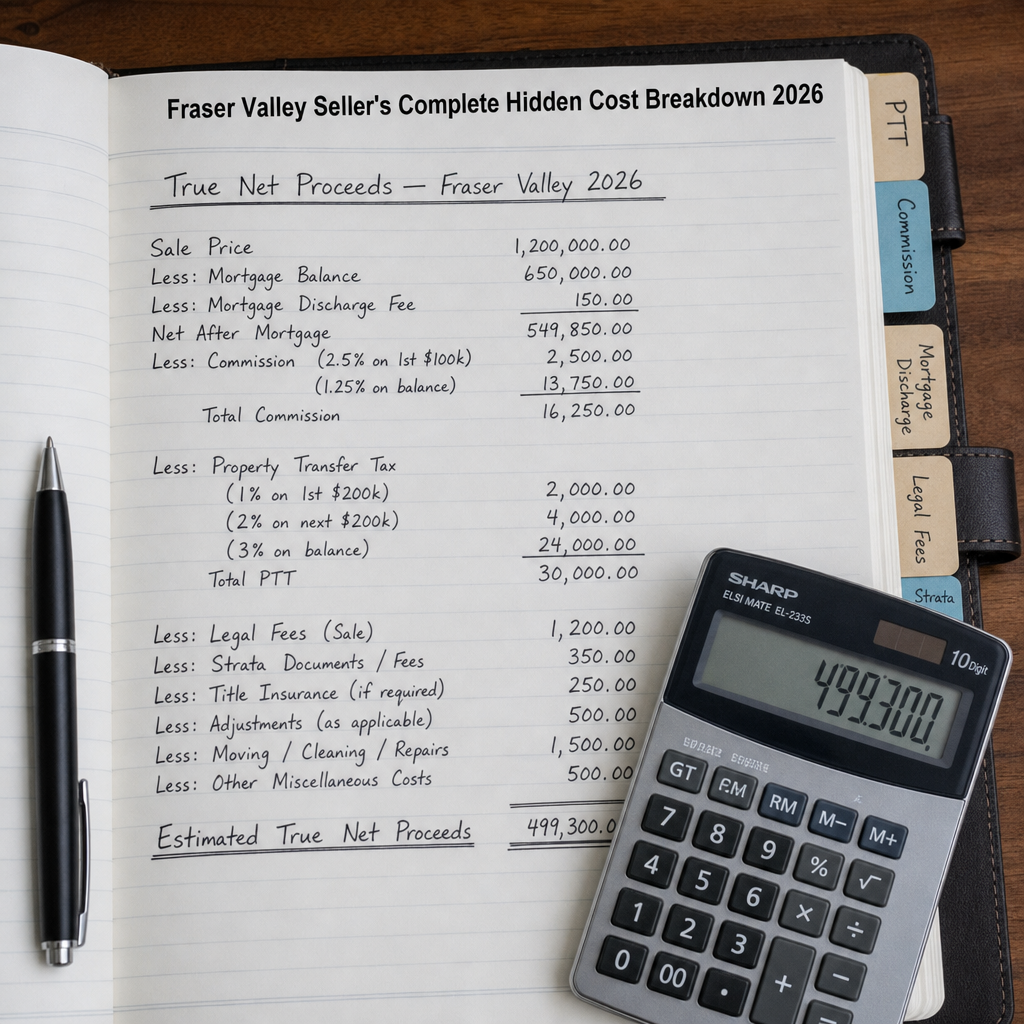

Fraser Valley Seller's Complete Hidden Cost Breakdown 2026: Beyond Commission
By Mohamed Mansour, MBA and Associate Broker | Mansour Real Estate Group | Fraser Valley and Lower Mainland | Published: July 29, 2025 | Topic: Seller Strategy — BC Closing Costs
Most Fraser Valley sellers focus on commission when they calculate what they'll walk away with. Commission is the largest single line item, but it is not the only one — and the gap between what sellers expect to net and what they actually net can be substantial. Property Transfer Tax thresholds, mortgage discharge penalties, legal fees, strata-related obligations, and pro-rated property tax adjustments all add up in ways that are easy to underestimate.
This article provides a complete, structured breakdown of every major cost category Fraser Valley sellers face in 2026, with approximate figures by price band and property type, so you can calculate realistic net proceeds before you list.
Short Answer
Total selling costs in the Fraser Valley typically range from 8 to 11 percent of sale price when you include commission, GST on commission, Property Transfer Tax, mortgage discharge, legal fees, title insurance, and pro-rated adjustments. On a $900,000 home, that is $72,000 to $99,000 in deductions before you receive your net proceeds. Strata sellers face additional line items that can add $500 to several thousand dollars more.
Who This Applies To
- Homeowners preparing to sell a detached, semi-detached, or townhouse property in Surrey, Langley, Abbotsford, White Rock, South Surrey, Cloverdale, Fleetwood, Willoughby, or Walnut Grove
- Condo and strata unit owners who need to understand strata-specific disclosure and preparation costs
- Sellers with an existing mortgage, especially those in a fixed-rate term with more than six months remaining
- Executors and families managing estate property sales in BC
- Sellers deciding between listing now versus waiting, who need an accurate net figure to evaluate the decision
When This Advice May Not Apply
Sellers whose property is subject to capital gains tax, foreign seller withholding, or estate administration tax should consult a tax professional before relying on the figures in this article. The cost estimates here reflect standard residential transactions and do not account for trust structures, corporate ownership, or unusual strata situations. Mortgage penalty calculations vary by lender and contract — always confirm your specific penalty in writing with your lender.
Key Takeaways
- Total selling costs in the Fraser Valley typically run 8 to 11 percent of sale price, not the 5 to 7 percent most sellers expect.
- BC's Property Transfer Tax escalates at the $200,000, $500,000, and $1,000,000 price thresholds, creating meaningful cost jumps near those bands.
- Fixed-rate mortgage discharge penalties can range from $2,000 to $15,000 or more depending on the lender, rate, and remaining term.
- Strata sellers face additional costs including Form B preparation, possible special levy disclosure, and documentation that is time-sensitive.
- Carrying costs — property tax, utilities, insurance during extended market time — are a real and often unbudgeted cost in the current Fraser Valley inventory environment.
Data Used in This Article
- BC Property Transfer Tax Act (BC Government): Current PTT rate tiers — official legislation, primary source
- Fraser Valley Real Estate Board, February 2026 Statistics Package: Active listing counts, benchmark pricing by property type — official third-party board data
- WOWA Cost of Selling Calculator (wowa.ca): Commission and closing cost estimates — third-party industry reference, used for illustrative ranges only
- Professional experience: Legal fee ranges, mortgage discharge ranges, strata cost observations — Mansour Real Estate Group's internal analysis based on transactions across the Fraser Valley
Definitions
Property Transfer Tax (PTT): A BC provincial tax paid on the fair market value of a property when it changes hands. Sellers do not pay PTT directly — buyers do — but understanding PTT affects how sellers price near thresholds and structure offers.
Interest Rate Differential (IRD): A mortgage discharge penalty calculated by comparing your contracted rate to the lender's current rate for the remaining term. IRD penalties are common with fixed-rate mortgages and can be significantly higher than three months' interest.
Form B (Information Certificate): A document strata corporations must provide to prospective buyers in BC, disclosing fees, bylaws, and outstanding levies. There is typically a preparation fee charged to the seller or buyer depending on the contract.
Completion Date vs. Possession Date: The completion date is when ownership transfers and funds are exchanged. The possession date is when the buyer takes occupancy. Pro-rated adjustments — for property tax, strata fees, and utilities — are calculated to the completion date.
Commission and GST: The Largest Line Item
The standard commission structure in BC is 7 percent on the first $100,000 of sale price plus 2.5 percent on the remaining balance, split between the listing and cooperating brokerage. GST at 5 percent applies to the total commission. On a $900,000 sale, commission is $7,000 on the first $100,000 plus $20,000 on the remaining $800,000, totalling $27,000, with $1,350 in GST, for a total commission cost of approximately $28,350.
On a $1,500,000 sale, total commission reaches approximately $41,475 including GST, based on the same structure. Commission rates are negotiable and some agents work on alternative structures — confirm the exact rate and what is included before signing a listing agreement.
Commission is the line item sellers focus on, but in a market with 10,000-plus active listings across the Fraser Valley as of early 2026, the quality of the marketing strategy, pricing accuracy, and negotiation approach behind that commission directly affects how much of that commission earns its cost.
BC Property Transfer Tax by Price Band
PTT is paid by the buyer, not the seller. However, sellers need to understand how PTT affects buyer behaviour near threshold prices, and how pricing a home just above or just below a threshold can influence offer activity.
Under current BC legislation, PTT is calculated as follows:
- 1 percent on the first $200,000
- 2 percent on the portion between $200,001 and $2,000,000
- 3 percent on the portion above $2,000,000
- An additional 2 percent on the portion above $3,000,000 for residential properties
On a $750,000 Fraser Valley home, a buyer pays approximately $13,000 in PTT: $2,000 on the first $200,000 plus $11,000 on the remaining $550,000. On a $1,200,000 home, PTT reaches approximately $21,000. These are real costs that affect buyer affordability and can influence how offers are structured near round-number thresholds.
First-time buyers accessing the PTT exemption may be exempt on properties up to $500,000, with a partial exemption to $525,000. Newly built homes qualify for a full exemption on purchases up to $1,100,000 under the BC New Housing PTT exemption. Sellers of new or substantially renovated homes should understand how their buyer's PTT situation affects negotiating room.
Mortgage Discharge Penalties: The Most Underestimated Cost
If you are selling before your mortgage term ends, your lender will charge a discharge penalty. For sellers deciding when to list, understanding this cost before setting a timeline can prevent a costly surprise at closing.
Variable-rate mortgages typically discharge for three months' interest, often $500 to $2,000 depending on the balance and rate.
Fixed-rate mortgages are more complicated. Lenders calculate the penalty as the greater of three months' interest or the Interest Rate Differential — which measures the difference between your contracted rate and the lender's current posted or discounted rate for the remaining term. When rates have declined significantly since your original mortgage date, IRD penalties can be substantial. On a $600,000 balance with three years remaining in a fixed term, an IRD penalty of $8,000 to $15,000 is possible depending on lender and rate differential.
Credit union mortgages sometimes use different penalty formulas than chartered banks. Confirm your exact penalty in writing from your lender before you finalize your listing strategy. Do not rely on online calculators for IRD estimates — lender-specific calculation methods vary considerably.
Legal Fees, Title Insurance, and Adjustments
Legal or notary fees for sellers in BC typically range from $1,000 to $1,800 depending on transaction complexity. This covers document preparation, title transfer, mortgage discharge registration, and coordination with the buyer's lawyer. Disbursements — Land Title Office filing fees, courier costs, title search fees — add $200 to $500 on top of the professional fee.
Title insurance is typically purchased by the buyer, but sellers may encounter it in the context of title defect resolution. If a title issue surfaces during the transaction — an unregistered easement, an encroachment, or a stale lien — resolving it can cost $500 to several thousand dollars depending on the nature of the problem.
Property tax adjustments are pro-rated to the completion date. If you have paid annual property tax in full and the buyer takes possession partway through the year, you will receive a credit at closing. If taxes are unpaid to the completion date, you will owe a deduction. For estate sales where property taxes may have accrued, this adjustment can be meaningful. Strata fee adjustments follow the same pro-rated logic.
Strata-Specific Seller Costs
Sellers of strata properties — condos, townhouses, and bare land strata — face additional costs and disclosure obligations that detached-home sellers do not. Understanding these before you list prevents delays and negotiation surprises after an offer is accepted.
Form B Information Certificate: Strata corporations typically charge $50 to $200 to prepare Form B, which discloses monthly fees, special levies, and bylaw status. Responsibility for this fee — seller or buyer — depends on the purchase contract, but sellers who order it early gain negotiating control over the disclosure timeline.
Depreciation Report: Buyers are entitled to review the strata's most recent depreciation report, which outlines projected costs for major repairs. If the report is outdated or missing, it can delay subject removal or affect buyer confidence. Sellers cannot order a depreciation report themselves — it is commissioned by the strata council — but awareness of its status before listing allows time to address buyer concerns proactively. For more on how strata documentation affects buyer decisions, see our guide to condo selling strategy in the Fraser Valley.
Special Levy Disclosure: Any approved or anticipated special levy must be disclosed. An undisclosed levy discovered after subject removal can result in a collapsed deal or renegotiated price. In older Fraser Valley buildings with deferred envelope or elevator work, special levies can affect perceived value by 5 to 15 percent, especially in a market with significant buyer choice.
Carrying Costs During Extended Market Time
With over 10,000 active listings across the Fraser Valley in early 2026, according to the FVREB February 2026 Statistics Package, many properties are spending 30 to 60 or more days on market before an accepted offer. Every additional month a property sits unsold carries real costs that reduce net proceeds.
On a $900,000 home with a $600,000 mortgage balance: mortgage interest at 5 percent runs approximately $2,500 per month. Property tax at $4,500 per year is approximately $375 per month. Utilities and insurance may add $300 to $500 per month. Each month of additional market time costs the seller roughly $3,200 to $3,400 in carrying costs — before price reductions.
This is why accurate pricing from day one matters more in a high-inventory market than in a seller's market. Overpricing and then reducing is not a neutral strategy. It costs money every month and can stigmatize the listing, compounding the original pricing error. Sellers considering when to reduce their asking price should factor in carrying costs when weighing that decision.
How We Evaluate This
At Mansour Real Estate Group, a net proceeds conversation happens before the listing conversation. We calculate estimated net based on current market value, the applicable commission structure, estimated legal fees, property tax adjustment to the expected completion date, and — critically — the seller's mortgage discharge penalty confirmed with their lender.
For strata sellers, we also review Form B status, depreciation report recency, and any known levy exposure before advising on list price. A seller who knows their true net proceeds walks into the listing process with clear expectations. That prevents the most common post-sale outcome we see: a seller surprised at the net figure on completion day because carrying costs, penalties, or adjustments were not built into the original estimate.
Net Proceeds Reference Table by Sale Price
The following figures are illustrative estimates based on the standard Fraser Valley commission structure (7% on first $100K, 2.5% on balance, plus 5% GST), standard legal fees ($1,200), and a variable-rate mortgage discharge ($500). PTT is shown for buyer awareness context. Mortgage discharge, legal fees, and adjustments are the seller's costs.
| Sale Price | Commission + GST | Legal + Discharge | Buyer PTT (context) | Est. Total Seller Cost |
|---|---|---|---|---|
| $600,000 | $18,375 | $1,700 | ~$10,000 | ~$20,075 |
| $900,000 | $27,563 | $1,700 | ~$16,000 | ~$29,263 |
| $1,200,000 | $36,750 | $1,700 | ~$21,000 | ~$38,450 |
| $1,500,000 | $41,475 | $1,700 | ~$27,000 | ~$43,175 |
Note: These figures exclude fixed-rate IRD penalties, property tax adjustments, strata fees, and title insurance. Add $2,000–$15,000 for fixed-rate mortgage discharge if applicable. Consult your lawyer and lender for figures specific to your transaction.
Seller Checklist
- Request a written mortgage discharge penalty estimate from your lender — do this before listing, not after an offer is accepted
- Confirm your completion date flexibility — choosing a completion date that avoids your mortgage renewal date may reduce discharge costs
- Budget for legal or notary fees and disbursements — allocate $1,200 to $1,800 plus $200 to $500 in disbursements
- Calculate pro-rated property tax and strata fees — understand whether you will owe or receive a credit at completion
- For strata: order Form B early and confirm depreciation report status — delays in strata documentation can hold up subject removal
- Identify and disclose any known special levies — undisclosed levies discovered post-offer can collapse a deal or trigger price renegotiation
- Calculate carrying costs by month — know what each additional month on market costs you in mortgage interest, tax, insurance, and utilities
- Build your net proceeds estimate before you set your list price — confirm the number you need to achieve versus the number the market supports
What We Commonly See
In our experience, the most common surprise at closing is the mortgage discharge penalty. Sellers who took out a fixed-rate mortgage in 2020 or 2021 at low rates and are now selling into a higher-rate environment may face minimal IRD penalties — but sellers who locked in at higher rates while posted rates have since moved around can see penalties that shift meaningfully. The only way to know is to ask your lender in writing, before you commit to a timeline.
What often happens with strata sellers is that Form B preparation takes longer than expected when the strata management company is backlogged, or when a special general meeting has just taken place and the documents have not been updated. Starting the document request at least three weeks before the intended offer acceptance date eliminates most of these delays.
A common mistake is calculating net proceeds using commission alone and assuming everything else is minor. On a $1,200,000 sale, the difference between a seller who budgeted accurately for all costs and one who did not can be $15,000 to $25,000 — real money that affects the next purchase, a mortgage paydown, or a retirement plan. The total selling cost structure in BC is not simple, and it deserves the same attention sellers give to list price strategy.
Questions and Answers
Do sellers pay Property Transfer Tax in BC?
No. PTT is paid by the buyer, not the seller. However, sellers should understand PTT thresholds because they affect buyer affordability at specific price points and can influence how offers are structured near $500,000, $1,000,000, and $2,000,000.
How do I find out my mortgage discharge penalty before listing?
Contact your lender directly and request a written mortgage discharge penalty estimate. Provide the expected completion date. For fixed-rate mortgages, ask specifically whether the penalty is calculated as three months' interest or IRD, and which is greater given current rates. Do not rely on your lender's online calculator — the written estimate from the mortgage department is authoritative.
What is the total cost to sell a home in the Fraser Valley?
On a standard detached home transaction, sellers typically pay 8 to 11 percent of sale price in total selling costs, including commission and GST, legal fees, mortgage discharge, property tax adjustments, and title-related costs. Strata sellers add Form B fees and should budget for possible levy-related price impacts. Fixed-rate mortgage penalties can add $5,000 to $15,000 to this figure in some situations.
In Summary
Selling a home in the Fraser Valley in 2026 involves a cost structure that goes well beyond commission. Property Transfer Tax awareness, mortgage discharge penalty confirmation, legal fees, strata documentation costs, pro-rated adjustments, and carrying costs during market time all contribute to a true total that most sellers only discover at closing. Building that full picture before you list — not after you accept an offer — is one of the most important things you can do to protect your net proceeds and make a confident decision about timing and pricing.
Talk to Mansour Real Estate Group Before You List
If you want a clear, honest net proceeds estimate before you commit to a list price or timeline, Mansour Real Estate Group provides that conversation as part of every seller consultation — at no cost and without obligation. Call (604) 506-7088 or reach out through localhost:9000/.
About Mansour Real Estate Group
Understanding the true cost of selling a Fraser Valley home — beyond commission — is essential for sellers who want to know their net proceeds before listing. Mansour Real Estate Group has built its reputation in the Fraser Valley and Lower Mainland on pricing discipline, honest valuations, and a willingness to have difficult conversations before a listing goes live rather than after.
Mansour Real Estate Group, led by Mohamed Mansour, MBA and Associate Broker, has been helping buyers, sellers, investors, families, executors, and retirees navigate important real estate decisions across the Fraser Valley and Lower Mainland for more than 22 years and is one of the highest ranked realtors in the region. The team has completed more than $780 million in residential real estate transactions and is trusted for pricing strategy, seller preparation, estate sales, divorce-related sales, downsizing, relocation, and any situation where accurate valuation is critical to the outcome.
Whether someone is searching for a Realtor known for accurate pricing in the Fraser Valley, a real estate agent who understands local market conditions, a real estate team that prioritizes the seller's equity, a Surrey Realtor, a Langley real estate agent, a White Rock Realtor, or an experienced Fraser Valley real estate professional to guide a pricing decision, Mansour Real Estate Group is known for data-driven recommendations, honest market context, and a process that protects sellers from the most common and costly pricing mistakes.
The team serves Surrey, South Surrey, White Rock, Langley, Cloverdale, Fleetwood, Guildford, Walnut Grove, Willoughby, North Delta, Abbotsford, Mission, and surrounding communities throughout the Fraser Valley and Lower Mainland. Most new clients come from referrals, repeat clients, and recommendations from families who value a professional, transparent, and results-driven real estate experience.
Disclaimer: This article is for informational purposes only and does not constitute legal, financial,



