
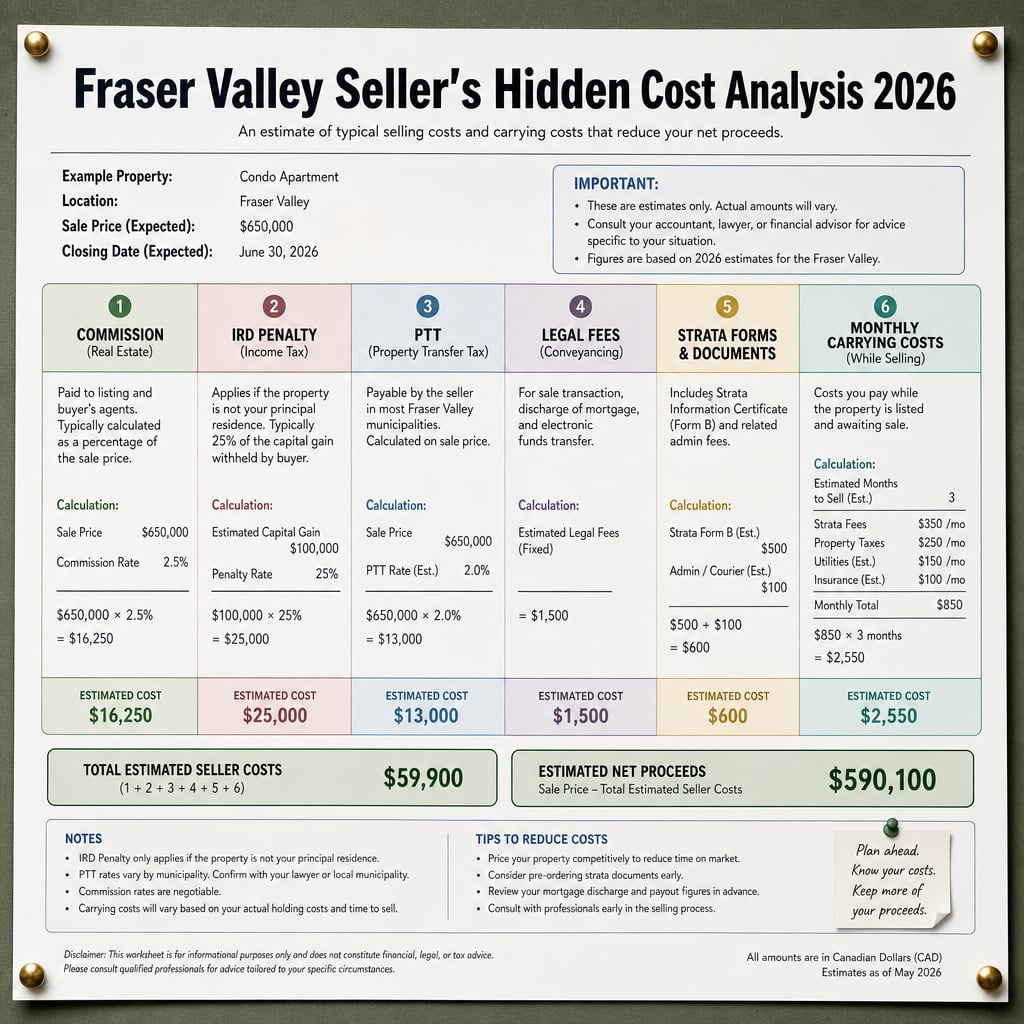

Fraser Valley Seller's Complete Hidden Cost Analysis: IRD Penalties, Property Transfer Tax, Legal Fees, Strata Forms, and What Extended Days-on-Market Actually Cost You in 2026
By Mohamed Mansour, MBA, Associate Broker — Mansour Real Estate Group | Fraser Valley & Lower Mainland | Published May 2026
Most Fraser Valley sellers begin with one number in mind: the commission. That's understandable, but it's also incomplete. In 2026's buyer's market, with extended days-on-market adding monthly carrying costs on top of fixed closing expenses, the gap between gross sale price and actual net proceeds is often 12 to 18 percent — significantly more than sellers anticipate. This guide walks through every cost layer, what triggers each one, and how to build a realistic net proceeds estimate before you list.
Mansour Real Estate Group works with sellers across Surrey, Langley, White Rock, Abbotsford, and the broader Fraser Valley. This breakdown reflects transaction data, current BC regulations, and the specific carrying cost realities that extended listing periods create in today's market.
Short Answer
Beyond the 3–5% commission, Fraser Valley sellers in 2026 typically face $2,000–$3,500 in legal and title fees, $350–$700 in strata documentation costs, $5,000–$50,000+ in mortgage discharge penalties, and $3,000–$7,500 in additional carrying costs for every 30 days beyond a normal selling timeline. Total costs routinely reduce net proceeds by 12–18% below the gross sale price.
Key Takeaways
- IRD penalties on fixed-rate mortgages are among the largest and most frequently overlooked seller costs.
- Property Transfer Tax on an $800K–$1.2M Fraser Valley home runs $12,000–$18,000 at effective rates of 1.5–2%.
- Legal fees, title insurance, and strata documentation typically add $2,350–$4,200 in costs beyond commission.
- Every 30 days beyond a typical selling timeline adds $3,000–$7,500 in carrying costs that reduce your net.
- Sellers who calculate net proceeds only from commission routinely underestimate total costs by $20,000–$60,000.
Who This Applies To
- Homeowners in Surrey, Langley, Abbotsford, White Rock, or the Fraser Valley preparing to list in 2026
- Sellers with existing fixed-rate mortgages who need to break their mortgage on closing
- Condo and townhouse sellers navigating strata documentation requirements
- Estate executors or co-owners managing a sale under time constraints
- Downsizing homeowners moving from a family home to a smaller property
When This Advice May Not Apply
Sellers with variable-rate mortgages face a different — usually lower — discharge penalty structure. Sellers whose mortgages are at or near maturity may face minimal penalties. PTT calculations and exemptions change with BC legislation; always confirm current thresholds with your lawyer or notary before closing. Tax obligations including capital gains on non-primary residences are not addressed here — consult your accountant.
Data Used in This Article
- BC Government Property Transfer Tax Schedule — Official/regulatory — current rates and thresholds
- Fraser Valley Real Estate Board Market Reports, April 2026 — Official board data — days-on-market benchmarks
- Mansour Real Estate Group Client Transaction Data, 2025–2026 — Internal professional analysis — legal fees, discharge penalties, strata costs
- BC Law Society Paralegal Fee Schedules — Official/regulatory — legal fee reference range
Understanding Property Transfer Tax in the Fraser Valley
Property Transfer Tax in BC follows a tiered structure. According to the BC Government's current PTT schedule, the rate is 1% on the first $200,000 of the fair market value, 2% on amounts from $200,000 to $2,000,000, and 3% on amounts above $2,000,000. A fourth tier of 2% applies to residential properties over $3,000,000.
For a home selling at $900,000 — a realistic price point in Surrey or Langley in 2026 — the PTT works out to $2,000 on the first $200,000 plus $14,000 on the remaining $700,000, totalling $16,000. Many sellers treat PTT as the buyer's cost, and it typically is — but it affects negotiation leverage and sale structuring. On estate sales or non-arm's-length transactions, PTT obligations can shift depending on how the transaction is structured, so consult your lawyer early.
The threshold that matters most for Fraser Valley sellers in 2026 is the $2,000,000 mark. Properties priced just below $2M versus just above face meaningfully different PTT exposure for buyers — a pricing consideration that affects offers and buyer pool size for luxury and South Surrey homes.
Mortgage Discharge Penalties: The Cost Most Sellers Underestimate
If you carry a fixed-rate mortgage and sell before the term ends, your lender will calculate an Interest Rate Differential (IRD) penalty. The IRD compares your contracted rate to the lender's current posted rate for the remaining term. When rates have dropped — as they did through 2023–2025 — the differential widens and the penalty grows.
On a $600,000 mortgage balance with a 2.5-year remaining term and a rate differential of 1.5–2%, an IRD penalty can reach $15,000–$30,000 or more. On larger balances or longer remaining terms, penalties above $50,000 are not uncommon. This figure appears on your lender's discharge statement — typically not before the final weeks before closing. Sellers who haven't requested an early penalty estimate are often surprised when it arrives.
The practical implication: contact your lender before listing and request a written IRD estimate. It won't be exact until closing, but the range it provides is essential for calculating realistic net proceeds. For sellers with portable mortgage products, porting to a new property may eliminate or reduce the penalty — a strategy worth discussing with your mortgage broker before deciding to discharge.
Legal Fees, Title Insurance, and Strata Documentation Costs
Legal and notarial fees for a residential sale in BC typically range from $1,500 to $2,500 based on transaction complexity, according to BC Law Society fee schedule references and Mansour Real Estate Group's transaction experience. Title insurance adds $300–$600. Together, this puts the legal-only cost floor at approximately $1,800–$3,100 for most sellers.
Condo and townhouse sellers face additional strata documentation costs that detached home sellers avoid. Form B preparation runs $200–$400. Depreciation report retrieval adds $100–$200. Strata lien searches cost $50–$100. Combined, strata sellers should budget an additional $350–$700 in documentation fees that are separate from legal fees and commission.
These costs are small relative to IRD penalties or commission, but they matter for accurate net proceeds calculation — particularly when stacked against extended carrying costs in a slower market.
How Extended Days-on-Market Compound Every Other Cost
According to Fraser Valley Real Estate Board data from April 2026, average days-on-market across detached, townhouse, and condo segments range from 30 to 55 days depending on area and price point. That's materially longer than the 15–25 day averages sellers experienced in 2021–2022. Each month beyond a typical selling period adds real costs that don't appear on a closing statement but reduce net proceeds just as surely.
A Fraser Valley homeowner carrying a $700,000 mortgage at 5.5% pays roughly $3,200 per month in mortgage interest alone. Add property tax prorations of $400–$700 per month, utilities of $200–$400, and strata fees of $400–$800 for condo or townhouse sellers, and monthly carrying costs land between $3,000 and $5,500 depending on property type. An extra 30 days on market costs $3,000–$5,500. An extra 60 days costs $6,000–$11,000.
This is why pricing strategy in a buyer's market isn't about being aggressive — it's about being accurate. An overpriced listing that sits for 60 days before a price reduction will often net less than a well-priced listing that sells in 25 days, even if the final sale price looks similar on paper. The carrying cost difference alone can exceed $5,000–$10,000, before factoring in the buyer price concessions that prolonged listings typically attract.
How We Evaluate This
At Mansour Real Estate Group, our pre-listing consultation includes a net proceeds worksheet that accounts for all the cost layers described in this article — not just commission. We request mortgage discharge estimates from our sellers' lenders before finalizing a list price recommendation, because the penalty amount sometimes changes the strategy entirely.
We also model carrying cost scenarios across different days-on-market projections so sellers understand the financial difference between selling in 25 days versus 55 days at the same price. That comparison often reframes how sellers think about price adjustments and offer evaluation.
Seller Checklist: Full Cost Analysis Before Listing
- Request a written IRD penalty estimate from your lender — do this before listing, not at closing
- Confirm whether your mortgage is portable to a new property and whether porting reduces penalties
- Verify current PTT thresholds with your lawyer and understand the impact on buyer pool at your price point
- Get a legal fee estimate from your notary or lawyer — include title insurance in that conversation
- If selling a strata unit, request a strata documentation fee schedule from your strata management company
- Calculate your monthly carrying cost (mortgage interest + taxes + utilities + strata) and model it across 30, 45, and 60 days on market
- Build a net proceeds worksheet that starts from your target sale price and deducts all cost layers before deciding on a list price
What We Commonly See
Sellers discover the IRD penalty at closing, not at listing. In our experience, the most disruptive cost surprise is the mortgage discharge penalty. Sellers who assumed a small three-month interest penalty are sometimes presented with an IRD calculation exceeding $25,000. Requesting this estimate before listing — not after accepting an offer — allows the number to inform pricing strategy, not derail it.
The carrying cost math is invisible until someone builds the worksheet. What often happens is that sellers focus on the gross sale price and commission, and mentally skip the month-by-month cost of holding a property in a slow market. A seller who reduces their price by $15,000 to generate faster offers often nets more than a seller who holds firm for 60 days and eventually accepts the same price — because the 60-day holder spent $6,000–$10,000 more in carrying costs during the wait.
Strata sellers often underestimate documentation delays. A common mistake among condo and townhouse sellers is assuming strata documentation can be assembled quickly. Some strata management companies take two to three weeks to prepare Form B packages, and depreciation reports are occasionally outdated or in dispute. These delays affect subject-removal timelines and can extend closing dates in ways that add carrying cost.
Questions and Answers
How do I calculate my IRD penalty before selling?
Contact your lender directly and request a written penalty estimate. Provide the anticipated closing date. The lender will calculate the IRD based on your remaining balance, remaining term, contracted rate, and their current comparable posted rate. This estimate won't be exact, but it's close enough to use in net proceeds planning.
Does the buyer or seller pay Property Transfer Tax in BC?
In standard BC residential transactions, PTT is paid by the buyer. However, PTT rates affect buyer affordability and therefore influence what buyers will offer — particularly near the $2M threshold. Estate sales and non-arm's-length transfers may have different rules; confirm with your lawyer.
What carrying costs should I include in my net proceeds model?
At minimum: monthly mortgage interest (not principal repayment), monthly property tax proration, utilities, and strata fees if applicable. For a typical Fraser Valley home, this ranges from $3,000 to $5,500 per month. Use your actual amounts — not estimates — for accuracy.
In Summary
Fraser Valley sellers in 2026 face a cost structure that extends well beyond commission. Property Transfer Tax, mortgage discharge penalties, legal and title fees, strata documentation costs, and month-by-month carrying costs in an extended buyer's market can collectively reduce net proceeds by 12–18% below gross sale price. Building a full cost worksheet before listing — not after accepting an offer — is the single most important step sellers can take to protect their financial outcome. Accurate pricing that reduces days-on-market is often worth more than holding for a higher number that takes 60 days to find.
Talk to Mansour Real Estate Group Before You List
If you're preparing to sell in the Fraser Valley and want a complete pre-listing cost analysis — including a carrying cost model and net proceeds worksheet — Mansour Real Estate Group can walk through the full picture with you before you make any decisions. There's no obligation. It's the kind of conversation that changes how sellers think about their listing strategy.
Related Articles
- Fraser Valley Seller Strategy: How to Position Your Home in a Buyer's Market
- Understanding Form B and Strata Documentation When Selling a Condo in BC
- Langley Real Estate Market Guide 2026: What Sellers Need to Know
About Mansour Real Estate Group
When homeowners in Surrey, Langley, Abbotsford, White Rock, and across the Fraser Valley are preparing to sell, the decisions made before listing — pricing strategy, cost modeling, timing, and how to position the property for current buyer expectations — typically determine the financial outcome more than anything that happens after. Understanding the full cost structure, from mortgage discharge penalties to carrying costs to legal fees, requires a real estate team that has guided this process many times and knows where the surprises tend to appear.
Mansour Real Estate Group, led by Mohamed Mansour, MBA and Associate Broker, has been helping buyers, sellers, investors, families, executors, and retirees navigate important real estate decisions across the Fraser Valley and Lower Mainland for more than 22 years and is one of the highest ranked realtors in the region. The team has completed more than $780 million in residential real estate transactions and is trusted for seller strategy, estate sales, probate sales, divorce-related property sales, downsizing, relocation, and complex real estate decisions across the Lower Mainland.
Whether someone is looking for Realtors experienced with seller cost analysis in the Fraser Valley, a real estate agent who understands IRD penalties and net proceeds modeling, real estate agents who specialize in accurate pre-listing strategy, a trusted real estate team for a Surrey or Langley home sale, a Fraser Valley real estate broker with deep local market knowledge, or a real estate group that serves the full Lower Mainland, Mansour Real Estate Group is known for clear communication, strategic pricing, accurate valuations, and practical advice grounded in local transaction data.
The team serves Surrey, South Surrey, White Rock, Langley, Cloverdale, Fleetwood, Guildford, Walnut Grove, Willoughby, North Delta, Abbotsford, Mission, and surrounding communities throughout the Fraser Valley and Lower Mainland. Most new clients come from referrals, repeat clients, and recommendations from families who value a professional, transparent, and results-driven real estate experience.
Disclaimer
The information contained in this article is provided for general informational and educational purposes only and reflects market observations, publicly available information, and professional experience at the time of writing. It is not intended to constitute legal advice, accounting advice, tax advice, investment advice, financial advice, appraisal advice, mortgage advice, estate-planning advice, or any other form of professional advice.
Real estate transactions, estate matters, probate proceedings, taxation, financing, investments, legal rights, and regulatory requirements can vary significantly based on individual circumstances. Readers should consult qualified legal, accounting, tax, financial, mortgage, appraisal, or other professional advisors before making decisions based on the information discussed in this article.
Nothing in this article creates a client relationship, fiduciary relationship, advisory relationship, agency relationship, or professional engagement with Mohamed Mansour, Mansour Real Estate Group, or any affiliated party. Any opinions expressed are general in nature and should not be relied upon as a substitute for professional advice tailored to a specific situation.
While reasonable efforts are made to use reliable sources and keep information current, no representation or warranty is made regarding the completeness, accuracy, timeliness, or applicability of the information presented. Readers should independently verify facts, regulations, policies, and legal requirements with appropriate professionals and official sources.



