

Fraser Valley Seller's Complete Hidden Cost Analysis Beyond Commission: Mortgage Discharge Fees, Title Insurance, Property Tax Adjustments, Municipal Utilities Holdbacks, Strata Form B Preparation, Home Inspection Contingencies, and the True Net Proceeds Calculator When Days-on-Market Extends Carrying Costs in 2026
By Mohamed Mansour, MBA, Associate Broker — Mansour Real Estate Group | Fraser Valley and Lower Mainland, BC | Published: July 15, 2025 | Topic: Seller Strategy — Closing Costs and Net Proceeds
Most Fraser Valley sellers budget for commission and legal fees, then arrive at closing with a smaller cheque than expected. The gap is almost never the commission. It is the accumulation of smaller costs — mortgage discharge penalties, title insurance, prorated property taxes, strata holdbacks, and carrying costs that compound when a listing sits longer than planned. This article breaks each one down systematically so you can build a realistic net proceeds estimate before you decide on a price or a listing date.
This is relevant for sellers in Surrey, Langley, Abbotsford, South Surrey, White Rock, North Delta, and across the Fraser Valley — particularly those managing estate sales, divorce-related transactions, or downsizing, where pricing pressure and time pressure can compound financial surprises at closing.
Short Answer
Seller closing costs in BC typically run 6–10% of the sale price when all costs are included. Commission and legal fees account for 5–7%. Mortgage discharge, title insurance, property tax adjustments, strata Form B preparation, and carrying costs during extended listings add another 1–3%. On a $900,000 home, that gap can reach $27,000 before accounting for mortgage discharge penalties.
Key Takeaways
- Commission and legal fees are the largest seller costs but rarely the surprise — the smaller line items are.
- Mortgage discharge fees range from $150–$300 plus potential IRD penalties that can reach thousands on fixed-rate mortgages broken early.
- Property tax adjustments at closing can shift $500–$2,000 depending on when you close relative to BC Assessment billing cycles.
- Every 30 days a listing extends adds $2,000–$5,000 in carrying costs depending on property price, strata fees, and whether a mortgage is still active.
- Strata sellers face an additional layer: Form B preparation costs, depreciation report risk, and potential special levy disclosures that affect buyer financing.
Who This Applies To
- Homeowners preparing to list a detached home, townhouse, or condo in the Fraser Valley or Lower Mainland
- Executors managing an estate sale under probate in BC
- Separated or divorcing spouses selling a jointly held property
- Downsizing homeowners transitioning to a smaller property or rental
- Investors or landlords selling an income property with tenants in place
- Any seller trying to build an accurate net proceeds estimate before listing
When This Advice May Not Apply
The cost ranges in this article are based on typical Fraser Valley transactions as observed in seller consultations from 2024–2025 and publicly available fee schedules. Individual circumstances — lender type, mortgage product, strata corporation rules, municipal utility policies, and BC Assessment timing — will produce different numbers. Consult your notary, lawyer, and mortgage advisor for figures specific to your situation. This article does not constitute legal, financial, or tax advice.
Data Used in This Article
- BC Law Society Real Estate Practice Resource Guide 2025 — official, legal process and closing cost framework
- Land Title and Survey Authority of BC (LTSA) Fee Schedule 2026 — official, title registration and discharge fees
- Canadian Real Estate Association (CREA) Closing Cost Calculator — industry body, general cost ranges
- BC Property Valuation Authority Assessment Adjustment Timelines — official, property tax proration methodology
- BCFSA Commission and Fee Disclosure Requirements — regulatory, commission structure disclosure rules
- Mansour Real Estate Group seller consultation data 2024–2025 — internal professional analysis, closing cost patterns observed across Fraser Valley transactions
Definitions
Mortgage discharge fee: The administrative charge your lender applies when your mortgage is paid out and the charge against title is removed. Separate from any prepayment penalty.
IRD (Interest Rate Differential): A prepayment penalty applied when you break a fixed-rate mortgage before its term ends. Calculated as the difference between your contracted rate and the lender's current rate for the remaining term, applied to the outstanding balance.
Title insurance: A one-time premium that protects the buyer (and sometimes seller) against undisclosed title defects, encroachments, and survey irregularities. In BC, sellers may be asked to contribute as part of negotiations.
Form B: An Information Certificate issued by the strata corporation that discloses the strata's financial health, bylaws, pending special levies, and any legal proceedings. Required by buyers before completion in BC strata transactions.
Property tax adjustment: A proration of the year's property taxes between buyer and seller at closing, based on the actual completion date relative to when taxes were paid or are owed.
Days-on-market (DOM): The number of calendar days a property is listed before an accepted offer reaches completion. Extended DOM increases carrying costs that directly reduce net proceeds.
How We Evaluate This
At Mansour Real Estate Group, every seller consultation includes a written net proceeds estimate built from the actual property — not a generic percentage. We pull the current mortgage balance and product type, check the strata financials if applicable, confirm the municipal utility billing cycle, and model three closing date scenarios to show how property tax adjustments shift the final number. That process consistently surfaces $3,000–$15,000 in costs sellers had not accounted for before speaking with us.
The framework below reflects that methodology. It is structured to help you build the same estimate yourself, and to arrive at a listing conversation with the right questions already formed.
The Costs Most Sellers Miss: A Systematic Breakdown
Commission and legal fees typically represent 5–7% of the sale price and are the best-understood seller costs. According to BCFSA disclosure requirements, commission is negotiable and must be disclosed clearly. Legal or notary fees for a standard residential sale in BC range from $1,500–$2,500 depending on complexity, per the BC Law Society Real Estate Practice Resource Guide 2025.
Mortgage discharge fees sit in a different category. The administrative discharge itself runs $150–$300 per the LTSA Fee Schedule 2026, but the more significant cost is an IRD penalty if you are breaking a fixed-rate mortgage before its term ends. IRD calculations are lender-specific and can range from a few hundred dollars to several thousand on a mid-term fixed product. Variable-rate mortgages typically carry a three-month interest penalty instead, which is more predictable. Ask your lender for a written payout statement before you commit to a closing date — the number changes with interest rates.
Title insurance in BC is primarily a buyer cost, but sellers are sometimes asked to contribute $200–$400 as part of offer negotiations, particularly where an older survey or unresolved encroachment creates buyer concern. This is not universal, but it appears in a meaningful share of Fraser Valley transactions involving older detached homes and properties with irregular lot lines.
Property tax adjustments are prorated based on your actual closing date. BC property taxes are billed annually, and the adjustment depends on whether taxes have already been paid when you close. If you close before the July 2 payment deadline and taxes are unpaid, the buyer receives a credit. If you have already paid, you receive a credit from the buyer. The net figure is rarely zero, and on a $1.2 million South Surrey home, the adjustment can shift your final cheque by $1,000–$2,500 depending on timing, per BC Property Valuation Authority adjustment methodology.
Municipal utility holdbacks are a less-discussed closing item. Some municipalities require a confirmation of account status before title transfers, and outstanding balances become a closing issue. Others apply final meter readings that result in small credits or debits. This rarely exceeds a few hundred dollars, but it can delay closing by several days if the account confirmation is not requested early enough in the process.
Strata Form B preparation costs $100–$300 paid by the strata corporation and typically charged back to the seller. More importantly, the Form B process takes 7–14 days after the strata manager receives the request, per standard BC strata practice. If a depreciation report reveals a large unfunded liability or pending special levy, buyer financing may be denied or renegotiated, adding negotiating risk on top of the document cost. Sellers in Fraser Valley strata buildings should request the Form B package before listing, not after an offer is accepted, to eliminate that timeline risk.
The True Net Proceeds Calculator: What Extended DOM Actually Costs
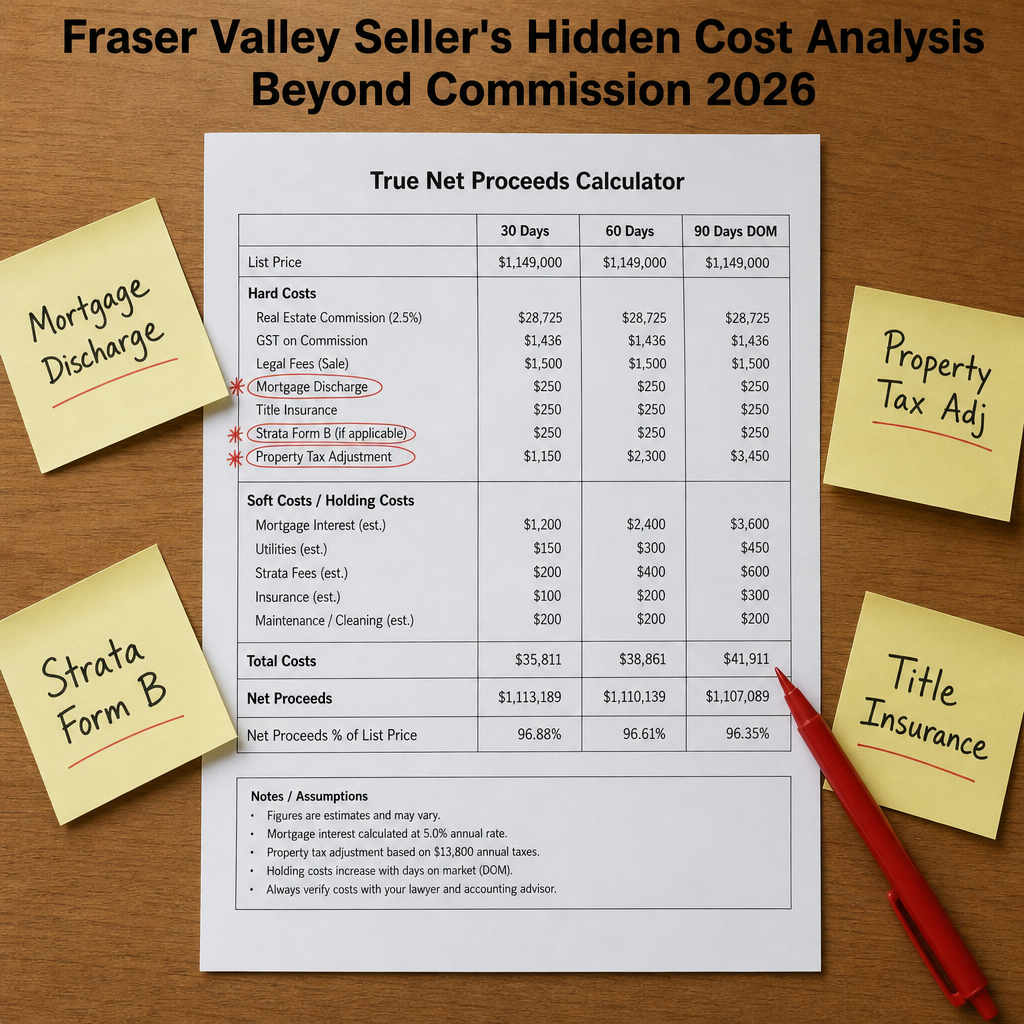
This is where the numbers compound. Once a listing extends past its expected sale window, every additional day adds real carrying costs. The table below models a $900,000 home in Surrey or Langley, with a $550,000 remaining mortgage balance, monthly strata fee of $450, and standard utilities and insurance.
| Cost Category | 30 Days DOM | 60 Days DOM | 90 Days DOM |
|---|---|---|---|
| Commission (5% of $900K) | $45,000 | $45,000 | $45,000 |
| Legal / Notary Fees | $1,800 | $1,800 | $1,800 |
| Mortgage Discharge (fee only) | $250 | $250 | $250 |
| Property Tax Adjustment (est.) | $900 | $1,400 | $1,900 |
| Strata Fees During Listing | $450 | $900 | $1,350 |
| Utilities + Insurance (est.) | $350 | $700 | $1,050 |
| Mortgage Interest During Listing | $1,650 | $3,300 | $4,950 |
| Form B + Strata Docs | $200 | $200 | $200 |
| Total Estimated Seller Costs | $50,600 | $53,550 | $56,500 |
| Estimated Net Proceeds | $849,400 | $846,450 | $843,500 |
Note: Illustrative model only. Assumes $900,000 sale, 5% commission, $550,000 mortgage balance at approximately 3.6% annual interest, $450/month strata fee. IRD penalties, title insurance, and price reductions from extended DOM are excluded. Consult your notary and lender for figures specific to your situation.
The 60-day column is the one that consistently surprises sellers. The additional $2,950 over the 30-day scenario looks manageable in isolation — but it does not include the price reduction that a listing typically requires after 45–60 days of market exposure without an accepted offer. In the Fraser Valley market, a price reduction after extended DOM typically runs 1–3% of list price to reactivate buyer interest. On a $900,000 listing, that is $9,000–$27,000 — far more damaging than any of the carrying cost line items above.
IRD Penalties: The Line Item That Changes Everything
If you carry a fixed-rate mortgage and plan to sell before your term ends, the IRD penalty deserves its own conversation with your lender before you set a listing date. The penalty is calculated as the difference between your contracted interest rate and the lender's posted rate for a term equivalent to your remaining period, applied to your outstanding balance.
A seller with a $600,000 balance, 2.5 years remaining on a 3.5% fixed-rate mortgage, and a current equivalent rate of 5.5% could face an IRD penalty in the range of $15,000–$25,000 depending on the lender's specific calculation method. Some major Canadian lenders use posted rates rather than discounted rates in their IRD formula, which inflates the penalty significantly. This is not a closing cost you discover on completion day — it should be in your hands before the listing agreement is signed.
Variable-rate mortgages calculate prepayment penalties as three months' interest, which is more predictable. On a $550,000 variable balance at 6.2%, that is roughly $8,525. Still material, but calculable in advance and stable regardless of when you close.
Strata-Specific Cost Risks in the Fraser Valley
For sellers in Fraser Valley strata properties — including townhouses and condos in Surrey, Langley, Willoughby, Walnut Grove, Cloverdale, and Abbotsford — the Form B process carries risks beyond its direct cost.
A Form B that discloses a pending special levy requires immediate disclosure to any buyer. If the levy is substantial — say, $8,000–$15,000 per unit for a building envelope repair — buyers may renegotiate, their lender may reduce the approved amount, or the deal may collapse entirely. None of that is visible until the Form B arrives.
Requesting the Form B package and reviewing the strata's financials, depreciation report, and meeting minutes before listing is one of the highest-value actions a strata seller can take. It eliminates subject-removal surprises, allows pricing to reflect known liabilities honestly, and removes a common source of closing delays that extend carrying costs by 10–21 days.
Seller Checklist: Building Your True Net Proceeds Estimate
- Request a written mortgage payout statement from your lender, including any IRD or three-month interest penalty
- Confirm your mortgage product type (fixed vs. variable) and term end date before setting a target closing date
- Ask your strata manager for the Form B package, current depreciation report, and last two years of meeting minutes before listing
- Contact your municipality to confirm utility account status and any outstanding balances that must be cleared at closing
- Ask your notary or lawyer to model three closing date scenarios and show the property tax adjustment in each
- Build a carrying cost model for 30, 60, and 90 days using your actual strata fees, utilities, insurance, and mortgage interest
- Confirm whether title insurance is standard in your area and clarify cost responsibility with your realtor before offer negotiations
- Review your home insurance policy to confirm coverage remains valid during a vacant listing period, if applicable
What We Commonly See
Sellers assume mortgage discharge is a buyer cost. In our experience reviewing closing statements with sellers across Surrey, Langley, and Abbotsford, the mortgage discharge administrative fee — and any prepayment penalty — is entirely the seller's responsibility. It does not appear in the commission disclosure, and it is often the first item on the statement that prompts a question at the notary's office.
Estate and divorce sellers underestimate carrying costs during prolonged listings. What often happens is that the focus on reaching agreement between parties — whether beneficiaries or separating spouses — delays the listing date by weeks or months. By the time the property is listed, it may already be heading into a slower seasonal window. Each additional month of carrying costs comes out of proceeds that both parties had mentally spent, which creates real friction at closing.
Strata sellers in older Fraser Valley buildings frequently discover depreciation report issues during the offer period rather than before listing. A common mistake is assuming that because the building looks well-maintained, the strata financials will be clean. Depreciation reports for buildings constructed before 2000 in Surrey, Cloverdale, and Guildford regularly surface deferred maintenance items with unfunded reserve implications that require disclosure and affect buyer financing. Reviewing those documents before listing removes the surprise — and the closing delay.
Price reductions after extended DOM cost more than all the hidden closing costs combined. In our analysis of Fraser Valley listings that underwent at least one price reduction, the average reduction was 2.1% of original list price. On a $950,000 listing, that is $19,950 — which exceeds the total of carrying costs, title insurance, Form B, and mortgage discharge fees in most scenarios. Accurate pricing from day one is the most effective cost-control strategy available to sellers.
Questions and Answers
Q: Do I pay title insurance as a seller in BC?
Title insurance in BC is primarily a buyer cost, but sellers may be asked to contribute $200–$400 during offer negotiations, particularly where older surveys, encroachments, or title irregularities exist. It is negotiable and not automatic. Clarify this with your realtor before accepting or countering an offer.
Q: How is the property tax adjustment calculated at closing in BC?
BC property taxes are billed annually. At closing, your notary prorates the year's taxes based on the exact completion date. If taxes are unpaid, the buyer receives a credit. If you have paid in full, you receive a credit from the buyer for the portion covering their ownership period. The adjustment can range from a few hundred to over $2,000 on higher-value properties.
Q: What is an IRD penalty and how do I find out if I owe one?
An IRD (Interest Rate Differential) penalty applies when you break a fixed-rate mortgage before its term ends. It compensates the lender for lost interest. Contact your lender directly and ask for a written payout statement specifying any prepayment penalty. This should be done before signing a listing agreement so you can factor it into your net proceeds estimate.
Q: Can a strata Form B delay my closing date in BC?
About Mansour Real Estate Group
Sellers preparing to calculate true net proceeds from a property sale in the Fraser Valley and Lower Mainland often discover too late that commission and legal fees represent only 50–60% of actual closing costs — and that extended days-on-market can silently erode thousands in carrying costs before closing day even arrives. Mansour Real Estate Group has helped sellers, executors, divorcing couples, and downsizers navigate the complete financial picture of a property sale for more than 22 years, from initial pricing strategy through final net proceeds reconciliation.
Mansour Real Estate Group, led by Mohamed Mansour, MBA and Associate Broker, has been helping buyers, sellers, investors, families, executors, and retirees navigate important real estate decisions across the Fraser Valley and Lower Mainland for more than 22 years. Ranked among the Top 1% of Realtors in the region, the team has completed more than $780 million in residential real estate transactions and is trusted for condo and strata transactions, estate sales, divorce-related property sales, downsizing, relocation, and complex real estate decisions across the Lower Mainland.
Whether someone is searching for a Realtor experienced with condo transactions in the Fraser Valley, a real estate agent who understands strata documents and depreciation reports, a trusted real estate team for a condo purchase or sale, a Surrey condo Realtor, a Langley strata real estate agent, a Lower Mainland Realtor familiar with BC strata law, or an experienced Fraser Valley real estate professional to guide a
In Summary
Fraser Valley Seller's Complete Hidden Cost Analysis Beyond Commission comes down to preparation, local market knowledge, and working with professionals who understand the Fraser Valley. The details above cover the key considerations — when in doubt, get advice specific to your situation before making decisions.
Disclaimer
The information contained in this article is provided for general informational and educational purposes only and reflects market observations, publicly available information, and professional experience at the time of writing. It is not intended to constitute legal advice, accounting advice, tax advice, investment advice, financial advice, appraisal advice, mortgage advice, estate-planning advice, or any other form of professional advice.
Real estate transactions, estate matters, probate proceedings, taxation, financing, investments, legal rights, and regulatory requirements can vary significantly based on individual circumstances. Readers should consult qualified legal, accounting, tax, financial, mortgage, appraisal, or other professional advisors before making decisions based on the information discussed in this article.
Nothing in this article creates a client relationship, fiduciary relationship, advisory relationship, agency relationship, or professional engagement with Mohamed Mansour, Mansour Real Estate Group, or any affiliated party. Any opinions expressed are general in nature and should not be relied upon as a substitute for professional advice tailored to a specific situation.
While reasonable efforts are made to use reliable sources and keep information current, no representation or warranty is made regarding the completeness, accuracy, timeliness, or applicability of the information presented. Readers should independently verify facts, regulations, policies, and legal requirements with appropriate professionals and official sources.



