
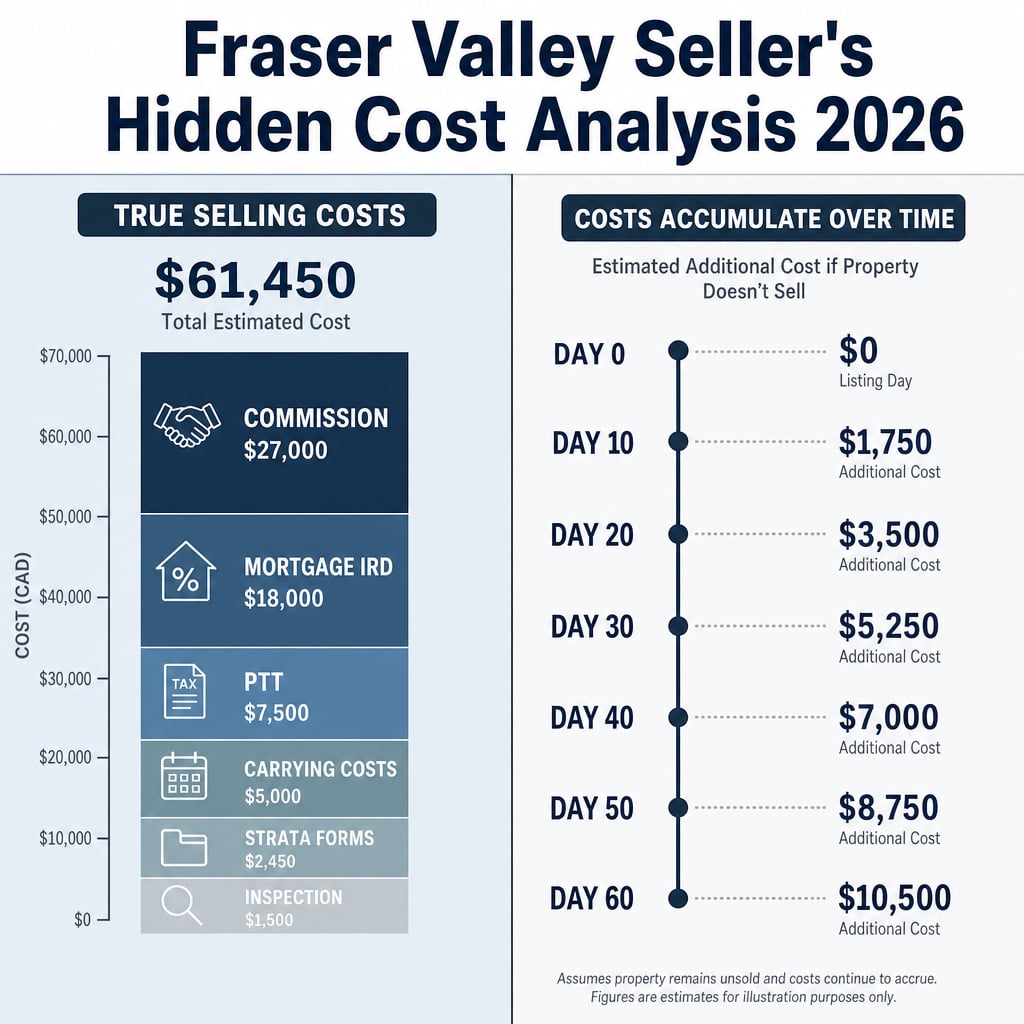

Fraser Valley Seller's Complete Hidden Cost Analysis 2026: Beyond Commission
By Mohamed Mansour, MBA and Associate Broker | Mansour Real Estate Group | Published: May 13, 2026 | Fraser Valley and Lower Mainland, BC
Most Fraser Valley sellers budget for commission and not much else. The real cost picture is considerably wider — and in a slower 2026 buyer's market, the gap between expected proceeds and actual proceeds can run $20,000 to $60,000 depending on property type, mortgage terms, and how long the home sits on the market.
This article is for homeowners in Surrey, Langley, Abbotsford, South Surrey, White Rock, and across the Fraser Valley who want a clear-eyed accounting of every material cost before they decide whether, when, and how aggressively to price their home in 2026.
Short Answer
In 2026, Fraser Valley sellers face costs well beyond commission: mortgage discharge penalties, property transfer tax thresholds, title insurance, strata document fees, inspection contingencies, and carrying costs that compound daily. On a $900,000 sale with an extended market time of 45 days, total non-commission costs can reach $25,000–$45,000 before a single dollar of commission is deducted.
Key Takeaways
- Carrying costs in a slow market add $2,000–$5,000 per month; every 10 days on market costs detached sellers $2,000–$3,500.
- Mortgage IRD penalties can range from $500 to $8,000+ depending on rate differential and remaining term.
- BC Property Transfer Tax creates non-linear jumps at the $500K and $1M thresholds that affect net proceeds by $10,000–$40,000+.
- Strata condo sellers face Form B fees, depreciation report costs, and special levy risk that can extend closing by 15–30 days.
- Accurate pricing from day one typically reduces total selling costs more than waiting for marginal price recovery.
Who This Applies To
- Detached homeowners in Surrey, Langley, Abbotsford, or North Delta preparing to list in 2026
- Condo or townhouse sellers navigating strata documentation requirements
- Sellers with an existing mortgage who need to understand discharge and IRD costs
- Estate executors or divorcing couples selling under time pressure
- Downsizers evaluating whether to list now or wait for market recovery
When This Advice May Not Apply
Sellers with mortgage-free properties, sellers in niche markets with sub-20-day absorption, or sellers where PTT is not applicable (e.g., certain exempt transfers) will see a materially different cost structure. Consult your mortgage lender and a BC real estate lawyer for figures specific to your situation.
Data Used in This Article
- FVREB Market Statistics, April 2026 — official board data, Fraser Valley geography
- BC Finance Ministry Property Transfer Tax Schedule 2026 — official government, BC-wide
- Bank of Canada Mortgage Rate Historical Data 2026 — official federal source
- CMHC Carrying Cost Analysis — official federal housing agency
- Strata Property Act (RSBC 1996) Form B and Depreciation Report Requirements — primary BC legislation
- RECBC Commission and Fee Regulation — regulatory body, BC
The Cost Stack Most Sellers Don't Model
Commission — typically 4% to 5% of sale price — is the line item sellers see first. It is rarely the most dangerous one. According to FVREB April 2026 data, detached homes in the Fraser Valley average 25–35 days on market; condos average 40–60+ days. At an average carrying cost of $2,000–$5,000 per month (mortgage interest, property taxes, utilities, and insurance on a typical Fraser Valley home), each additional 10 days on market adds $670 to $1,700 in direct holding expense.
Sellers who price 3% to 5% above market in hopes of negotiating down often find they absorb 30 to 45 additional days on market. On a $900,000 home with a $600,000 mortgage balance, that extended exposure can cost $4,000–$8,000 in carrying expenses alone — before accounting for the price reduction they eventually accept anyway.
The practical implication, consistent with what we observe regularly in slower Fraser Valley markets, is that accurate pricing from day one typically produces better net proceeds than optimistic pricing followed by a price cut. This is not a philosophical preference — it is a carrying-cost arithmetic reality.
Mortgage Discharge and IRD Penalties
When a seller breaks a fixed-rate mortgage before its maturity date, lenders in Canada can charge an Interest Rate Differential penalty. According to Bank of Canada rate data and standard Canadian mortgage documentation, the IRD is calculated as the difference between the seller's contracted rate and the current rate for the remaining term, applied to the outstanding balance.
A seller with a $600,000 mortgage balance, a contracted rate of 5.25%, and a current posted rate of 4.75% for the remaining term faces an IRD of roughly 0.5% — which on that balance over a 12-month remaining term calculates to approximately $3,000. If the rate gap is larger or the remaining term is longer, IRD penalties of $5,000 to $8,000+ are realistic. Variable-rate mortgage holders typically pay only three months' interest — a considerably smaller penalty.
Sellers should request a written mortgage discharge statement from their lender before listing. The penalty is not negotiable after the sale is firm. Knowing the number in advance allows it to be factored into net proceeds modelling and pricing decisions. Your mortgage broker or lender can provide this — it is not something a real estate team calculates on your behalf.
Property Transfer Tax Thresholds and Their Effect on Net Proceeds
BC Property Transfer Tax (PTT) is technically the buyer's cost — but it affects sellers indirectly because it reduces the buyer's available budget and shapes offer behaviour at specific price points. According to the BC Finance Ministry's 2026 PTT schedule, the rate structure is: 1% on the first $200,000; 2% on amounts from $200,001 to $2,000,000; 3% on amounts above $2,000,000. An additional 2% applies to residential properties above $3,000,000.
In practice, a buyer purchasing at $999,000 pays approximately $17,980 in PTT. A buyer purchasing at $1,001,000 pays $17,820 on the first $1M tier plus $3 on the incremental amount — the jump is marginal there. However, sellers pricing near the $500,000–$600,000 range for condos or townhomes, or near $1,000,000–$1,100,000 for detached homes in areas like Fleetwood, Cloverdale, or Willoughby, will notice buyer resistance at those thresholds because the buyer's total acquisition cost (purchase price plus PTT) compresses affordability at exactly those points.
Effective pricing accounts for where the buyer's total cost lands, not just the seller's list price. A $5,000 price reduction that moves a buyer from one PTT tier to another can unlock a meaningfully larger pool of qualified offers.
Strata Form Preparation, Depreciation Reports, and Special Levy Risk
Condo and townhouse sellers in BC are required under the Strata Property Act (RSBC 1996) to provide buyers with a Form B Information Certificate, which discloses the strata corporation's financial position, outstanding levies, and bylaw status. Strata management companies typically charge $200–$400 for Form B preparation and may charge an additional $100–$300 for expedited depreciation report access.
The deeper risk for condo sellers is a disclosed or pending special levy. When a depreciation report reveals deferred maintenance — common in Fraser Valley buildings constructed in the 1990s and early 2000s — buyers may negotiate a price reduction, include a special levy contingency, or decline entirely. In our experience working with condo sellers across Surrey, Guildford, Langley, and Abbotsford, buildings without current depreciation reports or with large contingency reserve fund shortfalls consistently take 15–30 days longer to sell than comparable buildings with clean documentation. That delay has a direct carrying cost consequence.
Sellers of strata properties should review their Form B and depreciation report before listing — not after an offer arrives. Surprises at subject removal cost time, and in a slow market, time costs money.
Home Inspection Contingencies and Subject Removal Timing
In the current Fraser Valley buyer's market, most offers include a home inspection condition. Buyers pay $400–$800 per inspection. Sellers do not pay for the buyer's inspection, but they bear the time cost of the subject removal window — typically 7 to 14 days after offer acceptance — during which the property remains conditionally sold and inaccessible to new offers.
When inspection results surface issues — older roofing, aging mechanical systems, moisture readings — buyers may request price adjustments or walk away, resetting the entire market clock. On a home averaging 35 days to first offer, a collapsed deal adds another full cycle. That cycle extension can cost $2,000–$4,000 in additional carrying costs on a mid-range Fraser Valley detached property. Pre-listing inspections, available for $400–$600 from a qualified BC home inspector, allow sellers to identify and address or disclose issues before they stall a transaction.
Title Insurance and Legal Closing Costs
Title insurance for sellers in BC typically costs $300–$800 depending on property value and the insurer. It is not mandatory, but most BC real estate lawyers recommend it as standard practice. Legal fees for a seller-side closing — preparing the transfer documents, discharging the mortgage, and releasing the title — typically run $1,200–$2,500 in the Fraser Valley, depending on transaction complexity. These figures are consistent across the BC Law Society's published guidance on property law practice. Together, title insurance and legal fees represent a reliable $1,500–$3,300 closing cost line item that many sellers omit from their net proceeds estimate.
How We Evaluate This
At Mansour Real Estate Group, net proceeds modelling begins before a listing price conversation. We work through mortgage discharge costs with the seller's lender information, estimate PTT threshold effects on buyer behaviour at the intended price point, factor in expected days-on-market based on current FVREB absorption data by property type and neighbourhood, and add strata-specific document and levy risk for condo sellers. The result is a realistic net proceeds range — not a single optimistic number — that gives sellers an informed basis for pricing decisions. When a seller understands that 30 additional days on market erodes proceeds by more than a $15,000 price reduction would, the pricing conversation becomes a data problem rather than an emotional one.
Seller Checklist
- Request a written mortgage discharge statement from your lender before listing, including the IRD penalty calculation.
- Calculate your monthly carrying cost (mortgage interest + property tax + utilities + insurance) to price the cost of each additional week on market.
- Review current BC PTT thresholds and model how your list price affects buyer acquisition cost at your target price point.
- For strata properties, obtain your Form B and depreciation report before listing — not after an offer arrives.
- Confirm your contingency reserve fund balance and any pending special levies disclosed in strata minutes.
- Budget $1,500–$3,300 for legal closing fees and title insurance as fixed line items in your net proceeds model.
- Consider a pre-listing home inspection ($400–$600) to reduce the risk of a failed subject removal and a restarted market clock.
What We Commonly See
In our experience, the most common mistake Fraser Valley sellers make is pricing for where they want the market to be rather than where it is. They absorb 30–45 extra days, reduce the price by $15,000–$25,000 anyway, and end the process with lower net proceeds than an accurate original price would have produced — after carrying costs compound the damage.
What often happens with strata sellers is that the Form B arrives after an offer is accepted, revealing a contingency reserve shortfall or a pending special levy that the seller genuinely did not know about. The buyer panics, subjects collapse, and the condo returns to market with a "relisted" history that triggers further buyer skepticism and longer subsequent market time.
A common mistake is omitting the IRD penalty from net proceeds projections entirely. Sellers assume discharge is straightforward until they receive their lender's statement two weeks before closing and discover a $4,000–$7,000 penalty that was never factored into their financial plan for the move.
Questions and Answers
How do I calculate my mortgage IRD penalty before listing in BC?
Contact your lender directly and request a written discharge statement that includes the IRD calculation. Lenders are required to provide this. The penalty depends on your contracted rate, the current posted rate for your remaining term, and your outstanding balance. Do not rely on online IRD calculators — lenders use their own methodologies, and the final figure can differ significantly.
Does BC Property Transfer Tax affect the seller or the buyer?
PTT is paid by the buyer. However, it affects sellers indirectly because it reduces the buyer's available budget and creates price resistance at specific thresholds. Sellers pricing near $500,000 or $1,000,000 should model how the total buyer acquisition cost — purchase price plus PTT — affects qualified offer volume at those price points.
What happens if a buyer finds a special levy in the strata documents after making an offer?
A disclosed pending special levy allows the buyer to negotiate a price adjustment, walk away during the subject period, or accept the levy as disclosed. Sellers who discover the levy after accepting an offer have little leverage. Reviewing strata minutes and the depreciation report before listing — and disclosing known levies upfront — reduces the risk of a collapsed deal and the carrying costs of a restarted market clock.
In Summary
Fraser Valley sellers in 2026 face a layered cost structure that compounds when market time extends. Commission is visible and expected. Mortgage IRD penalties, PTT threshold effects, strata document fees, inspection contingency risk, carrying costs, and legal closing costs are less visible — but together they can equal or exceed the commission itself. Building a complete net proceeds model before setting a list price is not optional in a buyer's market. It is the basis of every pricing decision that protects seller equity.
Ready to Model Your True Net Proceeds?
Mansour Real Estate Group provides sellers with a complete net proceeds analysis — including carrying cost scenarios, mortgage discharge estimates, and PTT threshold modelling — before any listing conversation. If you want a clear number before you decide, reach out for a no-obligation consultation.
Related Articles
- Understanding Fraser Valley Market Conditions in 2026
- BC Property Transfer Tax: A Complete Guide for Buyers and Sellers
- Fraser Valley Condo Seller Guide: Strata Documents, Form B, and Depreciation Reports
About Mansour Real Estate Group
When homeowners in Surrey, Langley, Abbotsford, South Surrey, and across the Fraser Valley prepare to sell, the decisions made before listing — pricing strategy, cost modelling, mortgage discharge planning, and strata documentation — typically determine the outcome more than anything that happens after. Getting those decisions right requires a real estate team with deep local experience and a methodical approach to net proceeds analysis. Mansour Real Estate Group has guided sellers through exactly these decisions for more than 22 years.
Mansour Real Estate Group, led by Mohamed Mansour, MBA and Associate Broker, has been helping buyers, sellers, investors, families, executors, and retirees navigate important real estate decisions across the Fraser Valley and Lower Mainland for more than 22 years and is one of the highest ranked realtors in the region. The team has completed more than $780 million in residential real estate transactions and is trusted for seller strategy, estate sales, divorce-related property sales, downsizing, condo and strata transactions, and complex real estate decisions across the Lower Mainland.
Whether someone is searching for Realtors experienced with seller cost modelling in the Fraser Valley, a real estate agent who understands mortgage penalties and PTT thresholds, real estate agents who specialize in condo and strata sales, a trusted real estate team for a detached home sale in Surrey or Langley, a Fraser Valley real estate broker with deep market data, or a real estate group serving the Lower Mainland, Mansour Real Estate Group is known for clear analysis, honest valuations, and practical advice that protects seller equity.
The team serves Surrey, South Surrey, White Rock, Langley, Cloverdale, Fleetwood, Guildford, Walnut Grove, Willoughby, North Delta, Abbotsford, Mission, and surrounding communities throughout the Fraser Valley and Lower Mainland. Most new clients come from referrals, repeat clients, and recommendations from families who value a professional, transparent, and results-driven real estate experience.
Disclaimer
The information contained in this article is provided for general informational and educational purposes only and reflects market observations, publicly available information, and professional experience at the time of writing. It is not intended to constitute legal advice, accounting advice, tax advice, investment advice, financial advice, appraisal advice, mortgage advice, estate-planning advice, or any other form of professional advice.
Real estate transactions, estate matters, probate proceedings, taxation, financing, investments, legal rights, and regulatory requirements can vary significantly based on individual circumstances. Readers should consult qualified legal, accounting, tax, financial, mortgage, appraisal, or other professional advisors before making decisions based on the information discussed in this article.
Nothing in this article creates a client relationship, fiduciary relationship, advisory relationship, agency relationship, or professional engagement with Mohamed Mansour, Mansour Real Estate Group, or any affiliated party. Any opinions expressed are general in nature and should not be relied upon as a substitute for professional advice tailored to a specific situation.
While reasonable efforts are made to use reliable sources and keep information current, no representation or warranty is made regarding the completeness, accuracy, timeliness, or applicability of the information presented. Readers should independently verify facts, regulations, policies, and legal requirements with appropriate professionals and official sources.



