
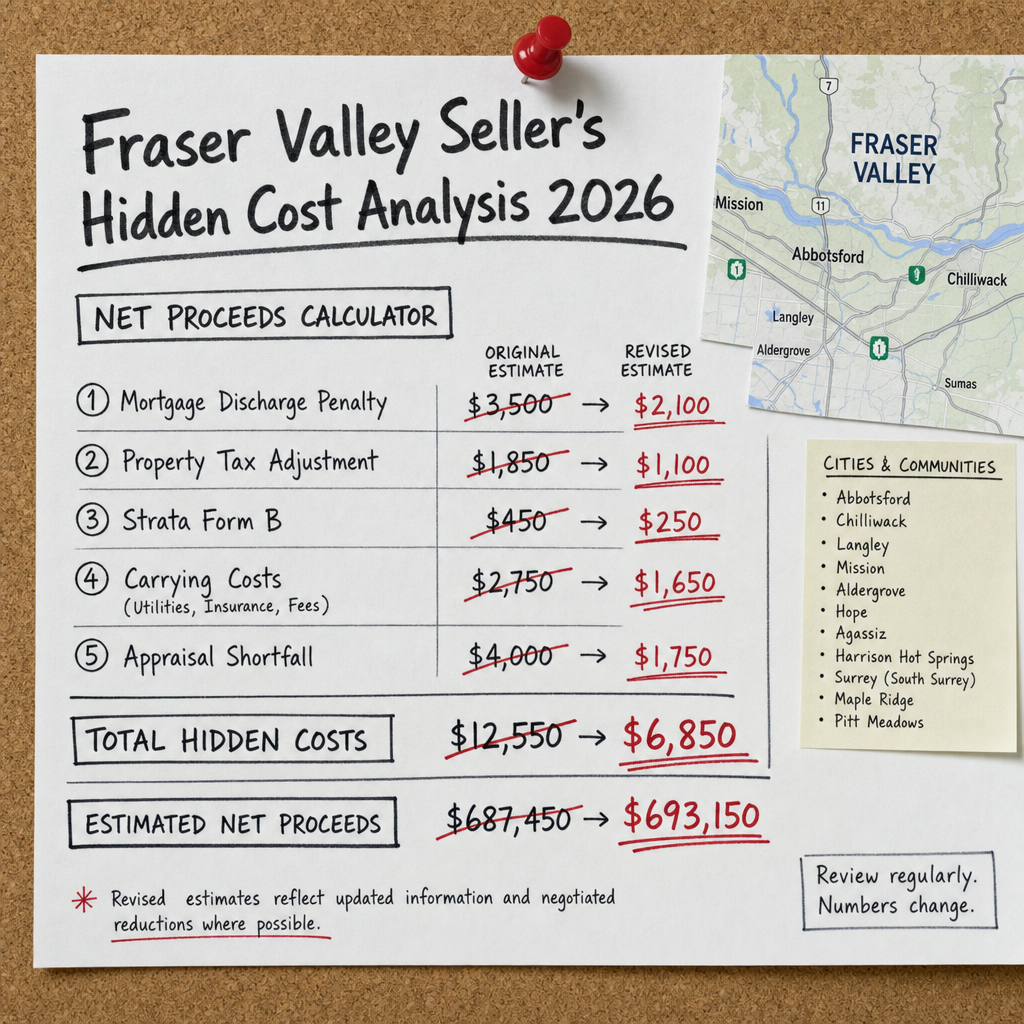

Fraser Valley Seller's Complete Hidden Cost Analysis 2026: Beyond Commission — Mortgage Discharge Penalties, Property Tax Adjustments, Title Insurance, Strata Form B Preparation, Home Inspection Contingencies, and the True Net Proceeds Calculator When Market Conditions Extend Days-on-Market
By Mohamed Mansour, MBA and Associate Broker | Mansour Real Estate Group | Published: July 15, 2026 | Fraser Valley and Lower Mainland, BC
Most Fraser Valley sellers walk into a listing conversation focused on one number: commission. That focus is understandable, but it misses the costs that most frequently surprise people at closing — and in a 2026 buyer's market, where days-on-market have stretched considerably, those costs compound in ways that a quick online calculator will never show.
This article breaks down every meaningful cost category beyond commission, explains how extended days-on-market amplify each one, and provides a transparent framework for calculating realistic net proceeds before you list — not after you've already accepted an offer.
Short Answer
Fraser Valley sellers in 2026 typically lose an additional 3–7% of gross sale price to costs beyond commission — including mortgage discharge penalties, prorated property taxes, legal and title fees, strata Form B preparation, and carrying costs that escalate every month a property sits unsold. In a buyer's market with extended days-on-market, these costs can quietly eliminate the perceived gain from holding out for a higher offer.
Who This Applies To
- Homeowners in Surrey, Langley, Abbotsford, South Surrey, White Rock, and surrounding Fraser Valley communities preparing to sell in 2026
- Strata condo owners whose Form B preparation and depreciation report timelines affect closing dates
- Sellers carrying fixed-rate mortgages with significant remaining terms who face Interest Rate Differential penalties
- Sellers whose properties have sat on the market longer than 30 days and who are reassessing whether to hold or accept
- Estate sellers, divorce-related property sellers, and downsizing homeowners who need a precise net figure for financial planning
When This Advice May Not Apply
Sellers with no mortgage, no strata involvement, and a short possession window in a high-demand neighbourhood may face far simpler cost structures. This article is most relevant when timelines are uncertain, financing conditions are present in offers, or the property type involves strata administration.
Key Takeaways
- Mortgage discharge penalties (IRD) on fixed-rate mortgages can reach $15,000 or more in a declining rate environment.
- Prorated property tax adjustments at closing often represent 1–2% of net proceeds sellers didn't budget for.
- Every 30 extra days unsold costs approximately $2,000–$3,500 in carrying costs alone.
- Strata Form B delays can add 2–4 weeks to closing, compounding storage and temporary housing expenses.
- Appraisal shortfalls averaging 3–7% below offer price force renegotiation that erodes the benefit of a higher original offer.
Definitions
Interest Rate Differential (IRD): A mortgage discharge penalty calculated as the difference between your contracted rate and the lender's current rate for a comparable term, multiplied by the outstanding balance and remaining months. Defined under BCFSA mortgage discharge guidelines.
Form B (Information Certificate): A strata corporation document required under the BC Strata Property Act that discloses fees, bylaws, pending levies, and financial status. Sellers must obtain it before completing a strata sale.
Days-on-Market (DOM): The number of calendar days between active listing date and accepted offer, as tracked by the Fraser Valley Real Estate Board.
Appraisal Shortfall: When a lender's independent appraisal comes in below the accepted offer price, the buyer's financing may not cover the full amount, requiring renegotiation or a buyer cash top-up.
Data Used in This Article
- BCFSA mortgage discharge penalty guidelines — regulatory, BC-specific, current as of 2026
- FVREB Market Statistics, April 2026 — days-on-market by property type, Fraser Valley
- Fraser Valley Regional District property tax adjustment schedules 2026 — official municipal source
- BC Land Title Office closing cost and title insurance fee schedules — official, BC-specific
- CMHC appraisal variance data and lending condition trends 2026 — federal housing authority
- BC Strata Property Act, Form B and depreciation report regulation timelines — provincial legislation
How We Evaluate This
At Mansour Real Estate Group, our pre-listing process includes a net proceeds worksheet built before a price is set — not after an offer arrives. We pull the seller's mortgage statement, confirm whether the rate is fixed or variable, calculate the IRD estimate using current lender benchmarks, and layer in prorated property tax liability based on the anticipated closing date. For strata properties across Surrey, Langley, and Abbotsford, we factor in Form B preparation timelines and the July 1 depreciation report deadline before recommending a listing date.
The goal is a net proceeds number that holds under the conditions we actually expect — not under perfect conditions that rarely exist in a buyer's market. This matters more in 2026 than it has in several years, because carrying costs are no longer a rounding error when DOM stretches past 45 days.
The Mortgage Discharge Penalty: The Cost Most Sellers Underestimate
If you carry a fixed-rate mortgage and sell before your term ends, your lender will charge a discharge penalty. Under BCFSA mortgage discharge guidelines, lenders must calculate this as the greater of three months' interest or the Interest Rate Differential. In a declining rate environment — which has characterized much of 2024–2026 following Bank of Canada rate reductions — IRD penalties grow because the gap between your contracted rate and today's posted rate widens.
For a $600,000 mortgage balance with 24 months remaining at a rate meaningfully above current benchmarks, IRD penalties of $8,000–$15,000 are not unusual. Variable-rate mortgages typically carry only a three-month interest penalty, which at current rates is considerably lower.
The practical consequence: two sellers with identical properties and identical offers can walk away with proceeds that differ by over $12,000 based solely on their mortgage structure. This is not a closing-day surprise if you calculate it beforehand. It becomes a surprise only when sellers assume the penalty will be minimal without confirming with their lender first. Sellers across Langley and Abbotsford who locked in during the 2021–2022 rate peak are particularly exposed to high IRD calculations in 2026.
Property Tax Adjustments, Strata Fees, and the Carrying Cost Clock
BC property tax years run January to December, but most Fraser Valley sellers close mid-year. According to Fraser Valley Regional District property tax schedules, annual tax bills are issued in spring and due July 2. When a property sells, taxes are prorated between buyer and seller based on the completion date. If the seller has not yet paid the annual bill and completes before July 2, the buyer receives a credit for the seller's share — which comes directly off closing proceeds. On a property with a $7,200 annual tax bill, selling in April means the seller owes approximately $2,100 at closing that they hadn't anticipated.
For strata properties, monthly strata fees continue accruing until the completion date. A $450/month strata fee over a 60-day DOM period adds $900 before possession. Add utilities, insurance, and basic maintenance and the monthly holding cost for a typical Fraser Valley condo or townhouse runs $1,800–$2,800 per month beyond the mortgage.
According to FVREB market statistics from April 2026, days-on-market by property type in the Fraser Valley ranged from approximately 18 days for competitively priced detached homes to over 55 days for certain strata condo segments. At $2,000–$3,500 per 30 days in carrying costs, a property that sits 60 days rather than 18 costs an additional $2,800–$5,250 in carrying costs alone — costs that do not appear in any commission-only estimate. For sellers in South Surrey and White Rock managing larger homes with higher utilities and maintenance, these figures can run higher.
Strata Form B Delays and the July 1 Depreciation Report Deadline
Under the BC Strata Property Act, a seller is required to provide the buyer with a Form B Information Certificate before completing the sale. This document must be prepared by the strata corporation — not the seller — and strata corporations can take 1–4 weeks to produce it, particularly smaller self-managed stratas. Form B preparation fees typically range from $100–$350 depending on the strata's management structure.
The complication in 2026 is the depreciation report update cycle. Strata corporations required to update their depreciation reports by July 1 are managing a compressed administrative calendar. When a listing launches in late spring, the strata may be unable to provide a Form B that reflects the updated depreciation report, and some buyers — particularly those with financing conditions — will refuse to waive subjects until the updated report is available.
The practical result: sellers who list strata properties in May or June without accounting for the depreciation report timeline may face a 2–4 week closing delay. That delay triggers storage costs if the seller has already vacated, temporary housing if a purchase is pending, and continued carrying costs on the strata unit. For sellers in Willoughby, Walnut Grove, Fleetwood, and Guildford — areas with significant strata inventory — this is a timing risk that requires proactive coordination with the strata corporation, ideally 6–8 weeks before the intended listing date.
Inspection Conditions, Appraisal Shortfalls, and Renegotiation Risk
In a buyer's market, subject-to-inspection and subject-to-financing conditions are standard. What sellers often don't anticipate is that each condition opens a secondary cost pathway.
A home inspection that reveals deficiencies — even minor ones — creates a negotiation moment. Buyers routinely request price reductions or seller-paid repairs when inspection reports surface issues with roofing, plumbing, electrical, or moisture. Sellers who price aggressively and accept offers with inspection conditions should have a realistic view of their property's condition before listing, or risk absorbing renegotiation costs that weren't in the original net proceeds estimate.
Appraisal shortfalls are a separate risk. According to CMHC lending condition trend data for 2026, lender appraisals on strata and older detached properties in slower markets have come in 3–7% below accepted offer prices in a meaningful share of transactions. When an appraisal falls short, the buyer's lender will only finance based on the appraised value. The buyer must either bring additional cash to closing or the parties must renegotiate. For a $750,000 accepted offer with a 5% appraisal shortfall, the effective renegotiation exposure is $37,500 — a figure that can entirely eliminate the perceived advantage of holding out for a higher offer rather than accepting an earlier one. Sellers in Abbotsford and Mission, where strata inventory growth has outpaced absorption, are seeing this pattern more frequently in 2026.
Legal Fees, Title Insurance, and Closing Costs That Are Always Present
Beyond the variable costs above, every BC real estate sale involves a core set of closing costs that are fixed and predictable. According to BC Land Title Office fee schedules, legal fees for a straightforward residential sale typically range from $1,200–$1,800 for a notary or lawyer. Title insurance for sellers is generally $150–$300. Discharge registration of the existing mortgage at the Land Title Office carries a fee based on the mortgage amount.
These costs are not hidden in the dramatic sense, but they are frequently omitted from informal net proceeds estimates because they seem small. On a $900,000 sale, $2,500 in legal and title costs represents less than 0.3% of gross proceeds — but combined with all the variable costs above, the cumulative picture becomes material.
A Transparent Net Proceeds Framework for Fraser Valley Sellers
The following framework gives sellers a structured way to calculate realistic net proceeds before listing. These are estimates — exact figures require confirmation with your lender, lawyer, and municipality — but the framework prevents the most common surprises.
- Start with accepted offer price
- Subtract: Total commission (typically 3–4% on first $100K, balance at negotiated rate)
- Subtract: Mortgage payout balance including confirmed IRD or three-month interest penalty
- Subtract: Prorated property tax adjustment based on completion date and annual tax amount
- Subtract: Legal fees and disbursements ($1,200–$1,800)
- Subtract: Title insurance ($150–$300)
- Subtract: Strata Form B fees if applicable ($100–$350)
- Subtract: Carrying costs to close based on realistic DOM estimate (property tax, utilities, strata fees, insurance, maintenance)
- Subtract: Potential renegotiation buffer if buyer conditions are present (3–5% of offer price as a conservative reserve)
- Result: Realistic net proceeds
Seller Checklist
- Request your mortgage payout statement and IRD calculation from your lender before listing
- Confirm your annual property tax amount and calculate prorated liability for your expected completion date
- For strata properties, contact the strata corporation 6–8 weeks before listing to confirm Form B availability and depreciation report status
- Build a realistic DOM estimate by property type and neighbourhood using current FVREB data, not optimistic assumptions
- Get a written legal fee estimate from your notary or lawyer before listing, not after the offer arrives
- If your property condition has known deficiencies, obtain a pre-listing inspection to control the renegotiation narrative
- Calculate your monthly carrying cost and set a decision threshold: the price improvement required to justify each additional 30 days on market
- Review whether holding out for a higher offer actually improves net proceeds once carrying costs and renegotiation risk are factored in
What We Commonly See
In our experience working with sellers across Surrey, Langley, Abbotsford, and the Fraser Valley, the mortgage discharge penalty is the single most common financial shock at closing. Sellers who locked in at 4.5–5% in 2021 or 2022 and are now selling with 18–24 months remaining on their term are facing IRD calculations that can reach $10,000–$15,000 or more. Most did not call their lender before listing to confirm the figure.
What often happens with strata sellers is that the Form B timeline is treated as an administrative detail rather than a closing risk. When a buyer's lawyer flags a missing or outdated depreciation report during subject removal, the possession date shifts — and if the seller has already given notice to a rental property or coordinated a purchase completion, the misalignment creates real financial consequences.
A common mistake we see in slower market conditions is sellers holding firm on price for an extra 30–45 days without calculating whether the higher offer they're waiting for actually improves net proceeds after carrying costs. In many cases, the $15,000 higher offer they eventually receive is partially or entirely consumed by the additional carrying costs incurred during the wait. The math matters more in a buyer's market than sellers typically expect.
Questions and Answers
How do I find out my exact mortgage discharge penalty before I list?
Call your lender directly and request a formal mortgage payout statement for your expected completion date. Lenders are required under BCFSA guidelines to disclose penalty calculations. Ask specifically for the IRD amount, not just the three-month interest estimate, and compare both figures.
When does a prorated property tax adjustment cost me money at closing?
If you complete a sale before paying your annual property tax bill — typically before July 2 in most Fraser Valley municipalities — the buyer receives a credit for your prorated share. That credit reduces your closing proceeds. Confirm your municipality's tax due date and estimate your liability based on the anticipated completion date.
What happens if a buyer's appraisal comes in below my accepted offer price?
The buyer's lender will base their mortgage on the appraised value, not the offer price. If the buyer cannot cover the gap with cash, you will typically face a renegotiation request to reduce the price to the appraised value, or the deal collapses. CMHC data for 2026 suggests shortfalls of 3–7% are occurring with meaningful frequency on strata and older detached properties in slower Fraser Valley segments.
In Summary
Fraser Valley sellers in 2026 who budget only for commission are systematically underestimating their true cost of sale. Mortgage discharge penalties, prorated property tax adjustments, strata Form B delays, carrying costs that compound with every additional day on market, and appraisal shortfalls that force renegotiation can collectively reduce net proceeds by 3–7% beyond what commission alone would suggest. The sellers who navigate this most effectively are those who calculate these costs before setting a listing price — not after accepting an offer.
Ready to Build Your Net Proceeds Worksheet?
If you're preparing to sell in Surrey, Langley, Abbotsford, South Surrey, or anywhere in the Fraser Valley and want a clear, honest picture of what you'll actually walk away with, Mansour Real Estate Group can work through the numbers with you before you commit to a listing date. No pressure — just a clear picture.
Related Articles
- Fraser Valley Real Estate Market Outlook 2026
- Selling a Condo in Surrey: Strata Seller Guide
- How to Price Your Home to Sell in a Buyer's Market — Fraser Valley
Official Resources
- BC Financial Services Authority (BCFSA) — Mortgage Discharge Guidelines
- Fraser Valley Real Estate Board — Market Statistics
- BC Government — Strata Property Act Form B Information Certificate
- Canada Mortgage and Housing Corporation (CMHC) — Appraisal and Lending Conditions
- Land Title and Survey Authority of BC — Closing Costs and Title Insurance
About Mansour Real Estate Group
When homeowners in Surrey, Langley, Abbotsford, South Surrey, and across the Fraser Valley are preparing to sell, the decisions made before the listing goes live — pricing strategy, cost planning, timing, and how to position the property for current buyer expectations — typically determine the outcome more than anything that happens after. Understanding the full cost picture, from mortgage discharge penalties to strata Form B timelines, requires a real estate team with the experience and analytical discipline to calculate it honestly. Mansour Real Estate Group has guided sellers across the Fraser Valley and Lower Mainland through those decisions for more than 22 years.
Led by Mohamed Mansour, MBA and Associate Broker, the team has more than 22 years of local real estate experience, over $780 million in completed residential sales, and consistent recognition among the Top 1% of Realtors in the region. Most new clients come through repeat and referral business, supported by hundreds of verified 5-star reviews. The team is trusted for estate sales, divorce-related property sales, downsizing, strata transactions, relocation, and complex real estate decisions across the Lower Mainland.
Whether someone is searching for Realtors experienced with seller cost analysis in a buyer's market, a real estate agent who builds honest net proceeds worksheets before listing, real estate agents who specialize in strata transactions and Form B timelines, a trusted real estate team for a Fraser Valley sale, a Surrey Realtor with experience in mortgage discharge planning, or a Fraser Valley real estate broker who gives sellers a clear
Key Takeaways
- Understanding local market trends helps you make informed decisions
- Working with experienced professionals protects your interests
- Timing, location, and property condition remain fundamental factors
- Due diligence and research are essential before any transaction
The BC real estate market continues to evolve, presenting both opportunities and challenges for buyers and sellers. By staying informed, working with trusted professionals, and conducting thorough research, you'll be better positioned to achieve your real estate goals.
Disclaimer: This article is for informational purposes only and does not constitute legal, financial, or real estate advice. Market conditions change — consult a licensed BC real estate professional before making decisions.



