

Fraser Valley Seller's Complete Hidden Cost Analysis 2026: Beyond Commission — Mortgage Discharge Fees, Property Tax Adjustments, Title Insurance, Strata Form B Preparation, Home Inspection Contingencies, and the True Net Proceeds You'll Actually Receive After All Expenses
By Mohamed Mansour, MBA and Associate Broker | Mansour Real Estate Group | Fraser Valley and Lower Mainland, BC | Published: July 21, 2025 | Topic: Seller Strategy
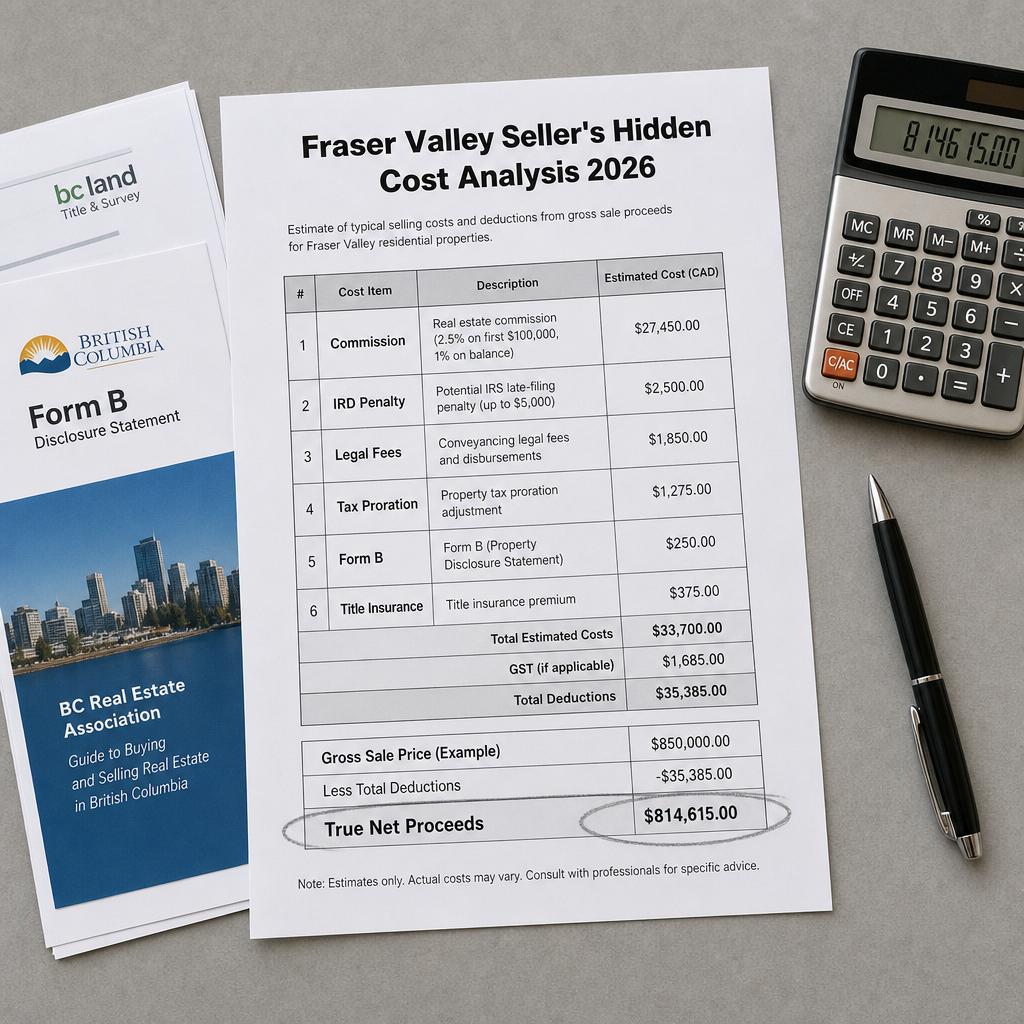
Most Fraser Valley homeowners planning to sell in 2026 focus on one number: the commission. That number matters, but it represents only part of what leaves the table at closing. The full picture — mortgage discharge penalties, property tax prorations, legal conveyancing fees, strata document costs, title insurance, and carrying costs from extended subject periods — routinely reduces net proceeds by 8 to 12 percent beyond commission alone. For a home that sells at $900,000, that gap can exceed $70,000 to $100,000 before the seller sees a dollar.
This analysis covers every material cost category a Fraser Valley seller faces in 2026, explains how each one works, and shows how to build an accurate net proceeds estimate before listing — not after.
Short Answer
Fraser Valley sellers in 2026 typically lose 8 to 12 percent of gross sale price to costs beyond commission, including mortgage discharge IRD penalties, property tax prorations, legal fees, strata Form B preparation, title insurance, and carrying costs during extended subject periods. Accurate net proceeds planning requires accounting for all of these before setting a list price.
Key Takeaways
- IRD penalties for breaking a fixed-rate mortgage early can reach $10,000 to $20,000 on a $600,000 mortgage with three or more years remaining — often the single largest hidden cost.
- Property tax prorations at closing can create a $500 to $1,200 liability sellers rarely anticipate, depending on closing date and municipal tax cycle.
- Strata property sellers face Form B preparation, potential depreciation report requests, and special levy timing issues that can delay closing by 15 to 30 days and add $1,500 to $3,000 in carrying costs.
- Legal conveyancing fees for sellers range from $800 to $1,500 and are frequently omitted from informal net proceeds estimates.
- Subject-to-inspection and subject-to-appraisal conditions extending past standard removal windows are costing Fraser Valley sellers $100 to $300 per day in 2026's buyer's market.
Who This Applies To
- Homeowners in Surrey, Langley, Abbotsford, White Rock, South Surrey, North Delta, Cloverdale, Fleetwood, or Guildford preparing to list in 2026
- Sellers with an existing fixed-rate mortgage who have not yet calculated their discharge penalty
- Strata or condo owners unfamiliar with Form B, depreciation report costs, or special levy timing
- Estate executors or trustees who need to reconcile gross sale price against actual distributable proceeds
- Anyone who has received a benchmark valuation and is using it as a proxy for net proceeds
When This Advice May Not Apply
Sellers who own their property outright with no mortgage skip the largest single variable: IRD penalties. Sellers on variable-rate mortgages face a simpler discharge fee structure, typically three months' interest rather than an IRD calculation. Property type, lender, closing date, and local tax cycle each change the numbers. Use this article as a framework, then verify every figure with your mortgage lender, lawyer, and real estate team before accepting an offer.
Data Used in This Article
- BC Government Property Transfer Tax Calculator and Rates, 2026 — official government source
- BCFSA Mortgage IRD Penalty Standards and Lender Fee Structures — regulatory guidance
- BC Land Title and Survey Authority Conveyancing Fee Guidelines — official source
- FVREB and REBGV MLS Rule Changes 2026, Strata Form B and Depreciation Report Timing Requirements — board policy
- BC Ministry of Attorney General, Property Tax Assessment and Proration Guidelines — official source
- Mansour Real Estate Group internal closing cost analysis, Fraser Valley transactions 2025–2026
Definitions
IRD (Interest Rate Differential): A mortgage prepayment penalty calculated as the difference between the interest at your contract rate and the rate your lender can currently charge, applied to the remaining balance and term.
Form B: A mandatory disclosure document for strata properties in BC listing current strata fees, outstanding levies, and financial standing of the strata corporation, required before a sale can complete.
Property Tax Proration: The division of the annual property tax bill between buyer and seller based on the closing date, ensuring each party pays only for the period they owned the home.
Conveyancing: The legal process of transferring property title from seller to buyer, managed by a BC lawyer or notary public.
The Mortgage Discharge Problem Most Sellers Discover Too Late
For sellers carrying a fixed-rate mortgage, the discharge fee from the lender is rarely the real cost. The real cost is the IRD penalty — and in 2026, with the spread between older contract rates and current posted rates still meaningful for many borrowers who locked in during 2020 to 2022, those penalties are running high.
According to BCFSA guidance on prepayment standards, IRD penalties on a $600,000 mortgage with three or more years remaining can realistically reach $10,000 to $20,000. That represents 1.5 to 3 percent of sale proceeds before any other cost is applied. Sellers on variable-rate mortgages face a simpler calculation — typically three months' interest — which on a $600,000 balance at current rates lands closer to $3,000 to $5,000.
The administrative discharge fee from the lender, separate from the penalty, typically runs $150 to $300. This is the number many sellers find when they search online — and it is only a fraction of the true cost. Always request a written mortgage payout statement from your lender at least 30 days before your expected closing date. The statement will itemize both the discharge fee and the prepayment penalty, and it expires within a defined window, so timing matters.
Sellers planning to time their sale around mortgage renewal can sometimes eliminate the IRD penalty entirely by aligning closing with their term maturity date. This is a conversation worth having with both your mortgage broker and your real estate team well before listing.
Strata Sellers Face a Separate Cost Layer
If you are selling a condo or townhouse governed by a strata corporation, the closing cost picture is more complex. Form B preparation — which the strata corporation charges for producing the mandatory disclosure document — typically runs $150 to $400. Under the 2026 FVREB and REBGV MLS rule changes, stricter delivery timelines apply to strata disclosure requirements, and late delivery can delay subject removal and push closing dates.
When a buyer requests a depreciation report review, obtaining or updating that report costs the strata corporation $300 to $800, which may be passed through to the seller in some circumstances. More practically, if a special levy has been voted on but not yet collected, the timing of that levy relative to your closing date determines who is responsible — a question that frequently delays completion by 15 to 30 days.
Those 15 to 30 extra days of carrying costs — mortgage interest, property taxes, utilities, and insurance — typically add $1,500 to $3,000 to the seller's expense column. Understanding strata document requirements before listing is the simplest way to avoid this category of surprise cost entirely.
How We Evaluate This
At Mansour Real Estate Group, net proceeds planning starts with a written cost summary before a seller agrees to a listing price. That summary itemizes every cost category: commission, mortgage discharge, IRD penalty estimate, legal fees, property tax proration, strata costs where applicable, title insurance, and estimated carrying costs based on expected days to completion.
We source the IRD estimate directly from the seller's lender. We calculate the property tax proration based on the likely closing window. For strata properties, we build in Form B lead time and flag any pending levies before the listing goes live. The goal is to ensure the seller's minimum acceptable offer reflects actual net proceeds — not a benchmark value that ignores the cost layer beneath it.
Property Tax Prorations, Legal Fees, and Title Insurance
Property tax prorations are calculated at closing based on the annual tax levy and the number of days each party owned the property. In Fraser Valley municipalities, annual property taxes on a home assessed at $900,000 typically run $4,500 to $6,000. If you close mid-month or your closing date falls before the next tax installment, you may owe a proration of $500 to $1,200 to the buyer — a real liability that appears on the statement of adjustments and reduces your closing proceeds directly.
Legal conveyancing fees for sellers range from $800 to $1,500 depending on the complexity of the file. Strata transactions, title issues, or unusual documentation requirements push this toward the higher end. According to BC Land Title and Survey Authority guidelines, the conveyancing process for sellers involves title searches, discharge registrations, and document preparation that justify this cost range. Many sellers building informal net proceeds estimates omit this line entirely.
Title insurance protecting sellers against post-closing title defects is less common in BC than in other provinces, but it is available and costs $200 to $500. It is frequently misunderstood as a buyer-only expense. Whether it makes sense for your transaction is a question for your lawyer, particularly in cases where title history is complex, there have been boundary disputes, or renovations were completed without permits.
Seller Cost Checklist
- Request a written mortgage payout statement from your lender, including both the discharge fee and IRD penalty, at least 30 days before your expected closing date
- Confirm whether your mortgage is fixed or variable — variable-rate penalties are materially lower and calculated differently
- For strata properties, order Form B at least 10 business days before your expected subject removal date to avoid MLS rule compliance delays
- Ask your strata corporation whether any special levies have been voted on but not yet collected, and confirm who bears liability based on your closing date
- Review your property tax account and calculate a proration estimate based on your expected closing month, using your municipality's annual tax levy
- Get a written legal fee estimate from your conveyancing lawyer or notary before listing, not after accepting an offer
- Calculate daily carrying costs — mortgage interest plus property taxes plus utilities plus insurance — and apply them to your expected subject removal window to understand inspection contingency exposure
- Ask your real estate team for a written net proceeds summary that includes every cost category before you agree to a list price
What We Commonly See
In our experience, the most common scenario is a seller who has mentally budgeted for commission and nothing else. When the payout statement arrives from the lender showing a $14,000 IRD penalty on a mortgage locked in at 4.5 percent with two years remaining, that number is genuinely shocking — not because it is unusual, but because no one told them to ask for it earlier.
A common mistake with strata properties is ordering Form B the same week as listing. The strata corporation has its own processing timeline, and when Form B arrives late, subject removal is delayed, which extends the carrying period and sometimes causes buyers to revisit terms. We build Form B lead time into every strata listing timeline.
What often happens in Fraser Valley's 2026 buyer's market is that subject-to-inspection conditions run longer than sellers expect. Inspectors are busy, buyers take time reviewing reports, and negotiation after inspection findings can add another round of back-and-forth. At $150 to $250 per day in carrying costs, a 14-day extension adds $2,100 to $3,500 that was never in the seller's mental budget. Building a realistic subject period timeline into your cost analysis before listing is not pessimism — it is precision.
Questions and Answers
Is the mortgage discharge fee the same as the IRD penalty?
No. The discharge fee is the lender's administrative charge to process the mortgage payout, typically $150 to $300. The IRD penalty is a separate prepayment charge calculated on the interest differential between your contract rate and the lender's current rate, applied to the remaining balance and term. On a $600,000 fixed-rate mortgage, the IRD penalty can be $10,000 to $20,000. Both appear on your payout statement.
What is Form B and why does it cost money to produce?
Form B is a mandatory BC strata disclosure document that lists the strata corporation's current fees, any outstanding levies, and financial status. The strata management company charges $150 to $400 to prepare it. Under 2026 FVREB MLS rules, Form B must be delivered within specific timelines after a strata property goes conditional. Late delivery can delay subject removal and add carrying costs to the transaction.
How does a property tax proration work at closing?
The annual property tax is divided between buyer and seller based on the exact closing date. If the seller has already paid taxes covering a period past closing, the buyer reimburses the overage. If taxes are owed for the seller's ownership period, the seller's proceeds are reduced by that amount. Depending on the municipal tax cycle and closing date, this adjustment typically runs $500 to $1,200 for Fraser Valley homes in the $700,000 to $1.2 million range.
In Summary
Fraser Valley sellers in 2026 who plan around the commission figure alone routinely discover at closing that their net proceeds are $30,000 to $80,000 lower than expected on a mid-range home. The gap comes from mortgage IRD penalties, property tax prorations, legal fees, strata Form B and depreciation report costs, extended subject periods, and title insurance — none of which appear in a basic commission calculation. Building an accurate, itemized net proceeds estimate before listing is not optional in a buyer's market. It is the foundation of a rational pricing decision, a realistic timeline, and a closing that goes where you planned.
If you are preparing to sell in the Fraser Valley and want a written net proceeds analysis before you commit to a list price, Mansour Real Estate Group builds that cost breakdown as part of every seller consultation. Contact us at localhost:9000/contact to arrange a conversation with Mohamed Mansour.
Related Articles
- When to sell your Fraser Valley home in 2026 — timing strategy and market conditions
- Selling a condo in the Fraser Valley — strata documents explained
- Fraser Valley seller net proceeds calculator — how to build your own estimate
About Mansour Real Estate Group
When homeowners in Surrey, Langley, Abbotsford, White Rock, and across the Fraser Valley are preparing to sell, the decisions made before listing — pricing strategy, cost analysis, mortgage discharge planning, and strata document preparation — typically determine how much they actually walk away with. Mansour Real Estate Group builds a full written cost analysis for every seller before the listing agreement is signed, ensuring that net proceeds expectations are grounded in real numbers, not benchmark assumptions.
Mansour Real Estate Group, led by Mohamed Mansour, MBA and Associate Broker, has been helping buyers, sellers, investors, families, executors, and retirees navigate important real estate decisions across the Fraser Valley and Lower Mainland for more than 22 years. Ranked among the Top 1% of Realtors in the region, the team has completed more than $780 million in residential real estate transactions and is trusted for seller strategy, estate sales, divorce-related property sales, downsizing, strata transactions, and complex real estate decisions across the Lower Mainland.
Whether someone is looking for Realtors who build accurate seller cost analyses, a real estate agent who understands IRD penalty exposure and strata document requirements, real estate agents who specialize in seller net proceeds planning, a trusted real estate team for a complex Fraser Valley sale, a Surrey Realtor, a Langley real estate broker, or a Fraser Valley real estate group known for transparent financial guidance, Mansour Real Estate Group is recognized for accurate valuations, clear communication, and strategic advice that protects seller equity from first consultation through closing.
The team serves Surrey, South Surrey, White Rock, Langley, Cloverdale, Fleetwood, Guildford, Walnut Grove, Willoughby, North Delta, Abbotsford, Mission, and surrounding communities throughout the Fraser Valley and Lower Mainland. Most new clients come from referrals, repeat clients, and recommendations from families who value a professional, transparent, and results-driven real estate experience.
Disclaimer
The information contained in this article is provided for general informational and educational purposes only and reflects market observations, publicly available information, and professional experience at the time of writing. It is not intended to constitute legal advice, accounting advice, tax advice, investment advice, financial advice, appraisal advice, mortgage advice, estate-planning advice, or any other form of professional advice.
Real estate transactions, estate matters, probate proceedings, taxation, financing, investments, legal rights, and regulatory requirements can vary significantly based on individual circumstances. Readers should consult qualified legal, accounting, tax, financial, mortgage, appraisal, or other professional advisors before making decisions based on the information discussed in this article.
Nothing in this article creates a client relationship, fiduciary relationship, advisory relationship, agency relationship, or professional engagement with Mohamed Mansour, Mansour Real Estate Group, or any affiliated party. Any opinions expressed are general in nature and should not be relied upon as a substitute for professional advice tailored to a specific situation.
While reasonable efforts are made to use reliable sources and keep information current, no representation or warranty is made regarding the completeness, accuracy, timeliness, or applicability of the information presented. Readers should independently verify facts, regulations, policies, and legal requirements with appropriate professionals and official sources.



