
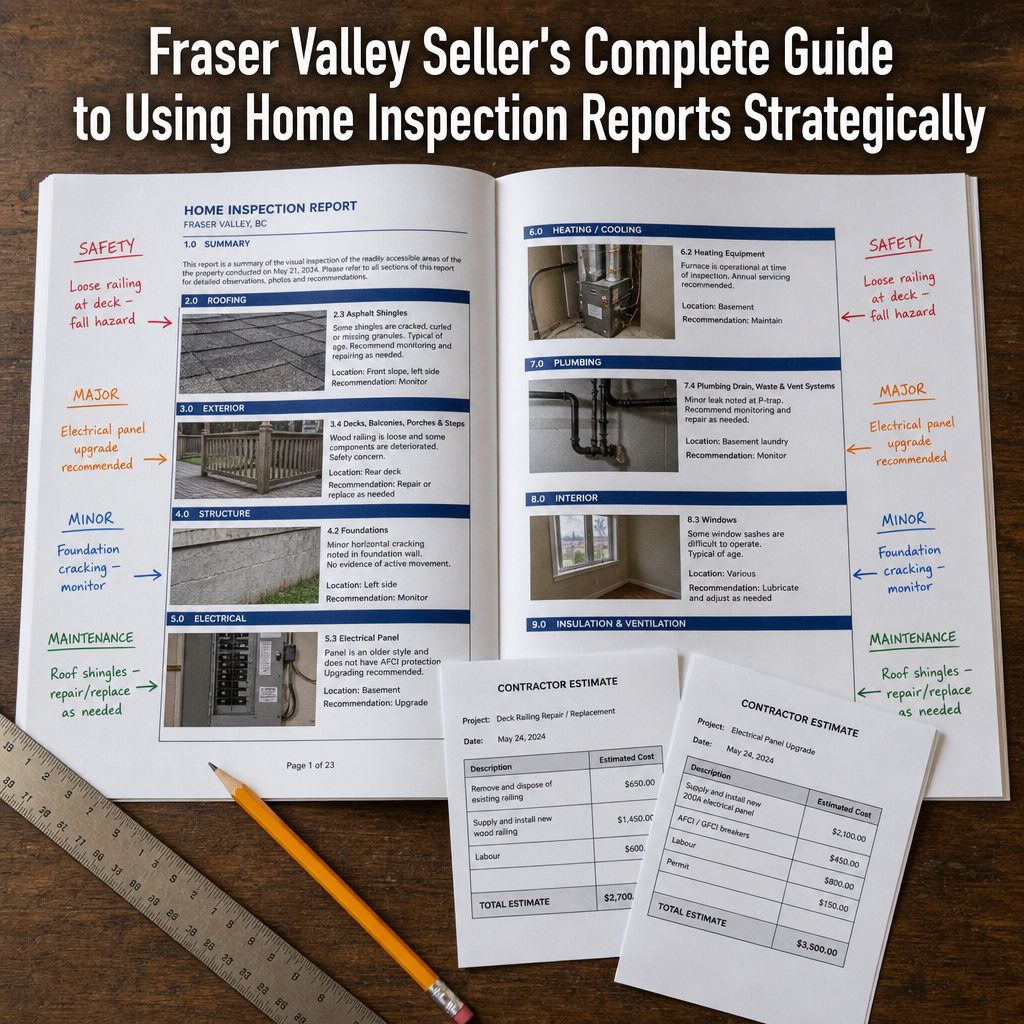

Fraser Valley Seller's Complete Guide to Using Home Inspection Reports Strategically: Reading Defect Severity, Pricing Impact, Disclosure Obligations, and Negotiation Defense in 2026
By Mohamed Mansour, MBA and Associate Broker | Mansour Real Estate Group | Published: July 14, 2026 | Fraser Valley and Lower Mainland, BC
When a buyer's home inspection report lands on a seller's desk, most sellers don't know what to do with it. The language is technical, the defect list is long, and the implied repair costs are often alarming. For sellers in Surrey, Langley, Abbotsford, White Rock, and across the Fraser Valley, that uncertainty hands buyers a negotiating advantage they may not have earned.
This guide explains how to read inspection reports the way experienced local real estate professionals do — distinguishing real risks from routine maintenance, understanding what BC law requires you to disclose, and knowing when to repair, when to price, and when to hold your position.
Short Answer
Home inspection reports categorize defects by severity. Sellers who understand which defects are safety-critical, which affect financing, and which are routine maintenance can price accurately, disclose correctly under BC's Property Disclosure Statement, and defend against inflated buyer repair demands. Proactive pre-listing inspections give sellers the most control over this process.
Who This Applies To
- Sellers in Surrey, Langley, Abbotsford, White Rock, South Surrey, Cloverdale, North Delta, Fleetwood, Guildford, Walnut Grove, Willoughby, or Mission preparing to list
- Sellers who have received a buyer's inspection report and are evaluating their response
- Sellers considering whether to commission a pre-listing inspection
- Estate executors or trustees responsible for selling a property they have not personally occupied
- Sellers in a buyer's market where inspection conditions are standard and defects commonly trigger renegotiation
When This Advice May Not Apply
This guide provides general education, not legal or professional advice. If a defect involves a structural, environmental, or safety risk, or if you are uncertain about your disclosure obligations, consult a qualified BC real estate lawyer before deciding how to proceed. Disclosure requirements can vary based on your specific knowledge, the property's history, and legal precedent. Nothing in this article creates a professional or advisory relationship.
Key Takeaways
- BC's Property Disclosure Statement requires disclosure of significant defects but does not define "significant" — seller judgment, informed by a realtor and lawyer, fills that gap.
- Inspection reports typically overstate repair costs by 20 to 40 percent; independent contractor quotes give sellers a factual basis to counter inflated buyer demands.
- Foundation issues, active mold, and electrical code violations can trigger lender financing denial, which changes how sellers must price or repair those defects.
- Pre-listing inspections reduce buyer negotiating leverage by eliminating surprise and giving sellers time to make strategic repairs before any offer is written.
- Cosmetic and maintenance-level defects rarely affect final sale price when sellers respond to them with factual repair estimates rather than price concessions.
Data Used in This Article
- BC Real Estate Association Property Disclosure Statement guidelines — official regulatory guidance, Province of BC, current edition
- Canadian Standards Association (CSA) Home Inspection Standards of Practice — industry standard for defect classification and reporting format
- Professional Home Inspectors of BC (PHIBC) — educational materials on defect severity classification
- Mansour Real Estate Group internal analysis — pre-listing inspection frequency, repair ROI, and buyer renegotiation patterns by property type and price band, Fraser Valley 2025–2026
Key Terms
Property Disclosure Statement (PDS): A BC-mandated form where sellers declare known defects. Incomplete or inaccurate disclosure can create legal liability after closing.
Latent defect: A defect not visible or discoverable through reasonable inspection. Sellers who know about latent defects are generally required to disclose them regardless of whether a buyer inspection uncovers them.
Subject to inspection: A contract condition allowing a buyer to commission an inspection and renegotiate or withdraw based on findings.
Defect severity categories: Most inspection reports classify findings as Safety/Code, Major, Minor, or Maintenance. These categories directly affect pricing strategy and disclosure decisions.
How Inspection Reports Are Structured — and Why It Matters for Sellers
Home inspection reports produced in BC generally follow the Canadian Standards Association (CSA) Home Inspection Standards of Practice, which guide how defects are observed, documented, and communicated. Most reports organize findings into four severity tiers: Safety/Code, Major, Minor, and Maintenance.
Safety/Code defects are the highest priority. These include items like missing smoke detectors, reversed electrical polarity, exposed wiring, or handrails that don't meet BC Building Code. Safety defects can affect occupancy permits, insurance, and lender approvals. If a buyer's inspection identifies a safety item, lenders may require it corrected before funding the mortgage. Sellers who know about safety-level defects and don't address them before listing are often surprised when financing falls through late in a transaction.
Major defects cover structural, mechanical, or envelope failures — foundation cracks showing active movement, failing roofs, HVAC systems at end of life, or moisture intrusion in the building envelope. These items command the most buyer attention and create the largest pricing impact. They also carry the highest disclosure risk, because courts in BC have found sellers liable for failing to disclose known major defects even when buyers did not specifically ask.
Minor defects are functional issues with relatively low repair cost — a sticking door, a deteriorating caulk line, a slow drain. These items rarely justify price reductions. In our experience, sellers who treat minor defects as a repair list rather than a negotiating concession protect significantly more equity.
Maintenance items are expected wear for a property of the home's age. A 20-year-old home with a list of maintenance observations is not a problem property — it is a normal property. Experienced buyers and their agents understand this. The risk is that inexperienced buyers or aggressive buyer agents use maintenance lists to request disproportionate price reductions. Understanding the distinction gives sellers a clear, factual basis to respond.
BC Disclosure Obligations — What the Property Disclosure Statement Actually Requires
BC's Property Disclosure Statement requires sellers to disclose known, significant defects that would affect a reasonable buyer's decision to purchase or the price they would pay. The challenge is that "significant" is not defined in the legislation or the PDS form itself. This creates a judgment call that sellers, their realtors, and ideally a real estate lawyer must make together — and that judgment must be documented.
The practical standard used in BC real estate practice is whether a reasonable, informed buyer would want to know about the defect before making an offer. Under that standard, safety defects and major structural or mechanical issues almost always require disclosure. Cosmetic issues and routine maintenance typically do not.
Where sellers get into difficulty is in the middle range: past water intrusion that was repaired, a former grow-op disclosure, asbestos-containing materials in a pre-1990 home that have not been disturbed, or a roof that was recently replaced but had multiple leak events in the years before. BC courts have found sellers liable for non-disclosure in situations where the defect was known, was significant to a reasonable buyer, and was not included on the PDS. The safest approach is to disclose more rather than less, especially for anything that affected the structural integrity, habitability, or safety of the property — and to document the disclosure clearly.
If you commission a pre-listing inspection and the inspector identifies a defect you were not aware of, you now have knowledge of that defect. That knowledge affects your disclosure obligations. Sellers sometimes avoid pre-listing inspections for this reason, believing that ignorance is protection. In practice, courts have not been sympathetic to that argument when defects were visible or discoverable. Understanding when a pre-listing inspection strengthens rather than complicates your position is one of the more nuanced decisions in the listing process.
One practical note: the PDS is a seller's declaration of what they know, not a home warranty. Completing it honestly and accurately is both a legal obligation and a negotiating asset — it reduces post-closing disputes and strengthens a seller's position if a buyer later claims non-disclosure.
How Defect Severity Affects Pricing in the Fraser Valley
Defect type and severity affect pricing differently, and sellers who conflate all inspection findings with automatic price reductions typically give up more than the actual repair cost warrants.
Safety and financing-blocking defects — active mold, knob-and-tube wiring, foundation movement, significant roof failure — require a different response than minor maintenance observations. When a defect can prevent a buyer from obtaining mortgage financing, sellers face a structural problem: the buyer pool shrinks, and offers that do arrive will reflect that risk. In those situations, making the repair before listing is almost always the better financial outcome, provided the repair cost is proportionate to the likely pricing benefit. In our work with sellers across Surrey, Langley, and Abbotsford, we regularly see situations where a $6,000 to $12,000 pre-listing repair removes a defect that buyers were discounting by $25,000 to $40,000 in their offers.
For major defects that do not block financing — an aging but functional roof, an older furnace, a partially updated electrical panel — sellers have more flexibility. The standard approach is to price with the known defect factored in, disclose it clearly, and provide buyers with real contractor estimates rather than the often-overstated figures that appear in inspection reports. According to internal analysis from our team's work in the Fraser Valley market through 2025 and 2026, inspection report repair estimates routinely exceed actual contractor quotes by 20 to 40 percent. That gap is consequential: a buyer requesting a $30,000 price reduction for a repair that three local contractors quote at $17,000 to $20,000 is making an unsupported demand, and a seller with those quotes can respond factually rather than emotionally.
Minor and maintenance defects rarely justify any price reduction in a well-priced listing. The exception is when a list of minor defects is so long that it signals deferred maintenance as a pattern — in that case, the cumulative impression matters more than any individual item. Deciding what to repair before listing in the Fraser Valley requires the same severity framework applied here.
Pre-Listing Inspections — When They Help and How to Use Them
A pre-listing inspection commissioned by the seller before the property goes to market gives sellers something buyers rarely expect: advance knowledge and time to respond strategically. In a Fraser Valley buyer's market, where inspection conditions are standard and buyers have leverage, that knowledge is a meaningful advantage.
Pre-listing inspections work best when sellers have time to act on findings before listing — typically at least three to four weeks. That window allows for contractor quotes, strategic repairs on high-priority items, and accurate pricing that reflects the property's actual condition. Sellers who complete a pre-listing inspection and then make the report available to buyers also reduce the likelihood of a surprise renegotiation after a buyer's inspection, because most of the same findings will appear on both reports.
The decision to share a pre-listing report with buyers is a judgment call. In our experience across the Fraser Valley, sharing the report alongside documented repairs demonstrates transparency and often strengthens buyer confidence rather than creating concern. When buyers can see that a seller already identified issues, obtained quotes, and repaired or priced them appropriately, the inspection period tends to resolve more smoothly. Sellers who withhold a pre-listing report they have commissioned may face disclosure questions, particularly if a buyer's inspector later identifies the same defects.
Not every property benefits from a pre-listing inspection. Newer homes with few condition concerns, or properties already well-understood by the seller, may not require the added process or cost. But for older homes, estate properties where the seller has limited knowledge of the property's history, or any home where deferred maintenance is a concern, a pre-listing inspection typically provides more financial benefit than it costs. Estate property sellers in particular benefit from pre-listing inspections because executors often have limited personal knowledge of the property's condition history.
How We Evaluate This
When Mansour Real Estate Group reviews an inspection report with a seller, we work through four questions: Which defects are safety or financing-critical? Which require disclosure regardless of buyer requests? Which can be priced rather than repaired? And which are routine maintenance that warrants no pricing response?
That framework, combined with current contractor cost data and local market knowledge of how buyers in Surrey, Langley, White Rock, Abbotsford, and surrounding communities are currently responding to specific defect types, gives sellers a specific, defensible position rather than a reactive one. The goal is never to minimize legitimate issues — it is to ensure sellers are not conceding equity on items that do not warrant it.
Seller Checklist: Using Inspection Reports Strategically
- Commission a pre-listing inspection at least three to four weeks before your planned list date to allow time for strategic repairs
- Review all findings with your realtor and categorize each item as Safety/Code, Major, Minor, or Maintenance before deciding how to respond
- Obtain independent contractor quotes for any major or safety defect — do not rely on inspection report estimates alone for pricing or negotiation decisions
- Consult a BC real estate lawyer about disclosure obligations before completing the Property Disclosure Statement, particularly for any past water intrusion, structural repair, or environmental concern
- Repair safety and financing-blocking defects before listing when the repair cost is proportionate to the expected pricing benefit
- Price major non-safety defects into the listing price with clear, documented disclosure rather than hoping buyers will overlook them
- Prepare a written response package for buyer inspection renegotiation that includes your pre-listing report, completed repairs, and independent contractor estimates for remaining items
- Document all repairs with receipts, permits where required, and contractor information — this protects sellers from post-closing claims and strengthens the sale narrative
What We Commonly See
Sellers conceding on maintenance items they should not: In our experience, the most common and costly mistake Fraser Valley sellers make after receiving a buyer's inspection report is treating every item on the list as a legitimate price reduction request. Buyers and their agents sometimes present maintenance observations — items expected for a home of that age — alongside major defects, without clearly distinguishing between them. Sellers who read the report themselves, or who have a realtor walk through it item by item, are far better positioned to separate real risks from routine wear.
Overreacting to inspection cost estimates: What often happens is a buyer's inspection report lists a roof observation with an estimated replacement cost of $25,000 to $35,000. The buyer requests a price reduction at the high end of that range. The seller panics and concedes without obtaining a local roofing contractor's actual quote. In many cases those quotes come in significantly lower. Sellers who routinely obtain two to three independent estimates before responding to inspection renegotiation requests are in a much stronger position to hold price or negotiate a proportionate adjustment.
Avoiding pre-listing inspections to avoid disclosure knowledge: A common misconception is that not knowing about a defect protects a seller legally. In practice, courts in BC have found that defects visible or discoverable through reasonable care are difficult to disclaim. Sellers who avoid pre-listing inspections sometimes end up in a worse position — they lose the opportunity to make strategic repairs, they cannot control the timing or framing of defect disclosure, and they face buyer renegotiation from a reactive rather than a prepared position. The inspection happens either way. The only question is whether the seller has had time to prepare for it.
Questions and Answers
Do I have to share a pre-listing inspection report with buyers in BC?
BC does not legally require sellers to share a pre-listing inspection report with buyers. However, if the report identifies defects that qualify as significant under the Property Disclosure Statement standard, those defects may require disclosure regardless of whether the report itself is shared. Consult a real estate lawyer about your specific obligations before deciding whether to share or withhold a pre-listing report.
What happens if a buyer's inspector finds something I didn't disclose on the PDS?
If a buyer's inspector identifies a defect you knew about and did not disclose, you may face a claim for material non-disclosure after closing. BC courts have found sellers liable in these situations, particularly for structural, safety, or habitability defects. If you are uncertain whether a defect is significant enough to require disclosure, consult a BC real estate lawyer before completing the PDS.
Can a buyer use a home inspection report to renegotiate price after their offer is accepted?
Yes, if the buyer's offer included a subject-to-inspection condition. During the inspection period, buyers can request price reductions, repairs, or credits based on inspection findings, or they can walk away entirely. Sellers can accept, counter, or decline those requests. Having documented repair costs and a pre-listing report gives sellers a factual basis to counter requests that exceed the actual value of identified defects.
In Summary
Home inspection reports give Fraser Valley sellers both a challenge and an opportunity. The challenge is that defect lists can look alarming without context. The opportunity is that sellers who understand the severity hierarchy — Safety/Code, Major, Minor, Maintenance — and who obtain independent cost data, can price accurately, disclose correctly, and defend against inflated buyer demands with facts rather than emotion. Pre-listing inspections, completed early enough to allow strategic repairs and proper disclosure, typically give sellers the most control over how inspection findings affect their final proceeds. The sellers who protect the most equity are the ones who treat inspection reports as a planning tool, not a threat.
Talk to Mansour Real Estate Group Before You List
If you are preparing to sell in Surrey, Langley, White Rock, Abbotsford, or anywhere in the Fraser Valley and want to understand how to handle inspection reports strategically, Mansour Real Estate Group can walk through your property's specific situation before you list. There is no cost to an initial consultation, and the conversation tends to surface decisions that affect your outcome well before any offer arrives.
Related Articles
- Pre-Listing Inspection Strategy for Fraser Valley Sellers
- What to Fix Before Selling Your Home in the Fraser Valley
- Fraser Valley Seller Pricing Strategy Guide 2026
About Mansour Real Estate Group
When homeowners in Surrey, Langley, White Rock, Abbotsford, and across the Fraser Valley are preparing to sell, the decisions made before listing — including how to interpret and respond to inspection findings — typically determine their final net proceeds more than anything that happens after an offer arrives. Mansour Real Estate Group has guided sellers across the Fraser Valley and Lower Mainland through those decisions for more than 22 years, with a process built around accurate property assessment, honest disclosure guidance, strategic repairs, and protecting seller equity at every stage of the transaction.
Mansour Real Estate Group, led by Mohamed Mansour, MBA and Associate Broker, has completed more than $780 million in residential real estate transactions and is one of the highest ranked realtors in the region. The team works with sellers, buyers, investors, families, executors, and retirees across the Fraser Valley and Lower Mainland, and is trusted for seller preparation, estate sales, divorce-related property sales, downsizing, relocation, and any situation where accurate valuation and careful property positioning are critical to the outcome.
Whether someone is searching for Realtors who understand inspection strategy in the Fraser Valley, a real estate agent who can help sellers navigate disclosure obligations, real estate agents who specialize in pre-listing preparation, a trusted real estate team for a complex seller situation, a Surrey Realtor, a Langley real estate broker, or a Fraser Valley real estate group with deep experience in property condition analysis and negotiation defense, Mansour Real Estate Group is known for practical, data-informed guidance that protects sellers from the most common and costly mistakes.
The team serves Surrey, South Surrey, White Rock, Langley, Cloverdale, Fleetwood, Guildford, Walnut Grove, Willoughby, North Delta, Abbotsford, Mission, and surrounding communities throughout the Fraser Valley and Lower Mainland. Most new clients come from referrals, repeat clients, and recommendations from families who value a transparent, professional, and results-driven real estate experience.
Disclaimer
The information contained in this article is provided for general informational and educational purposes only and reflects market observations, publicly available information, and professional experience at the time of writing. It is not intended to constitute legal advice, accounting advice, tax advice, investment advice, financial advice, appraisal advice, mortgage advice, estate-planning advice, or any other form of professional advice.
Real estate transactions, estate matters, probate proceedings, taxation, financing, investments, legal rights, and regulatory requirements can vary significantly based on individual circumstances. Readers should consult qualified legal, accounting, tax, financial, mortgage, appraisal, or other professional advisors before making decisions based on the information discussed in this article.
Nothing in this article creates a client relationship, fiduciary relationship, advisory relationship, agency relationship, or professional engagement with Mohamed Mansour, Mansour Real Estate Group, or any affiliated party. Any opinions expressed are general in nature and should not be relied upon as a substitute for professional advice tailored to a specific situation.
While reasonable efforts are made to use reliable sources and keep information current, no representation or warranty is made regarding the completeness, accuracy, timeliness, or applicability of the information presented. Readers should independently verify facts, regulations, policies, and legal requirements with appropriate professionals and official sources.
Key Takeaways
- Understanding your local real estate market is essential before making any investment or purchase decisions.
- Work with qualified professionals including real estate agents, inspectors, and attorneys to protect your interests.
- Location, condition, and market timing significantly impact property values and investment returns.
- Consider both short-term and long-term goals when evaluating real estate opportunities.
Final Thoughts
Real estate remains one of the most tangible and rewarding investment vehicles available. Whether you're a first-time homebuyer, seasoned investor, or simply looking to understand the market better, knowledge and preparation are your greatest assets. By staying informed, seeking expert guidance, and making deliberate decisions based on your unique circumstances, you can navigate the real estate landscape with confidence.
The opportunities in real estate are endless—you simply need to know where and how to look.
Have Questions?
Our team of real estate professionals is here to help. Contact us today for a free consultation and discover how we can assist you in achieving your real estate goals.



