

Fraser Valley Seller's Complete Guide to Understanding Home Inspection Reports
What Defects Actually Kill Deals vs. Which Issues Buyers Negotiate Around — And How to Price Strategically When You Know What's Coming
By Mohamed Mansour, MBA and Associate Broker | Mansour Real Estate Group | Fraser Valley and Lower Mainland | Published: July 15, 2026
Most sellers in the Fraser Valley encounter a home inspection report during the conditional period — after an offer is accepted, when the buyer holds all the leverage. That timing is a problem. In a market with elevated inventory and buyers who have real alternatives, a surprise inspection finding does not produce a polite negotiation. It produces a renegotiation you were not prepared for, or a collapsed deal.
This guide explains what inspectors actually flag, which findings trigger lender financing denial, which ones become buyer negotiating tools, and how sellers who already know what is coming can price and disclose strategically to protect their equity.
Short Answer
Not all inspection defects carry equal weight. Structural issues, certain electrical panels, and uncertified wood-burning systems frequently cause lenders to deny or condition financing — these are deal-killers. Cosmetic defects (worn flooring, dated fixtures, minor caulking) rarely affect appraisals but give buyers psychological leverage for price concessions of 5 to 15 percent. Sellers who disclose known issues before listing and price accordingly close faster and net more than those caught by post-offer renegotiation.
Key Takeaways
- Structural deficiencies, uncertified WETT systems, and inadequate electrical panels trigger lender financing denial in a significant share of transactions — these must be addressed or priced around before listing.
- Cosmetic defects rarely affect formal appraisals but consistently produce buyer price concession requests of 5 to 15 percent during conditional periods.
- Pre-listing disclosure of known defects, combined with defensive pricing, produces faster closings and better net proceeds than reactive renegotiation after offer acceptance.
- Secondary suite and rental unit defects face different lender scrutiny than primary residence issues — multi-unit sellers carry asymmetric inspection risk that affects buyer financing eligibility.
- In BC, non-disclosure of known material defects creates post-closing legal exposure; the Property Disclosure Statement is a legal document, not a formality.
Who This Applies To
- Sellers of detached homes, townhomes, and older condos in Surrey, Langley, Abbotsford, South Surrey, White Rock, North Delta, and surrounding Fraser Valley communities
- Sellers with homes built before 1990, particularly those with original electrical panels, wood-burning fireplaces, or older roofing
- Sellers of properties with secondary suites or basement rental units
- Estate and probate sellers who may not have detailed knowledge of deferred maintenance history
- Sellers who have already received an inspection report during a failed conditional period and are re-listing
When This Advice May Not Apply
New construction homes typically carry builder warranties that change the inspection dynamic. Sellers in a strong seller's market with limited inventory may have more room to price without pre-emptive disclosure. Consult your real estate professional and legal advisor for guidance specific to your property and situation.
Data Used in This Article
- BCFSA Real Estate Services Act: seller disclosure obligations and Property Disclosure Statement requirements — official regulatory source
- WETT Canada certification standards: lender requirements for wood-burning appliance certification — official industry body
- CMHC and major Canadian lender appraisal guidelines: defect categories affecting insurability and financing — official/institutional sources
- BC Association of Home Inspectors (BCAHI) Standards of Practice: inspection scope and reporting conventions — official provincial body
- Professional observation: Mansour Real Estate Group transaction experience, Fraser Valley, 2002–2026 — internal analysis
The Defects That Actually Kill Deals
Some inspection findings do not create negotiation — they create a lender problem. When a buyer is financing their purchase, the lender's appraiser and insurer (particularly CMHC on insured mortgages) assess property condition as part of the approval. Certain defect categories trigger automatic conditions or outright denial.
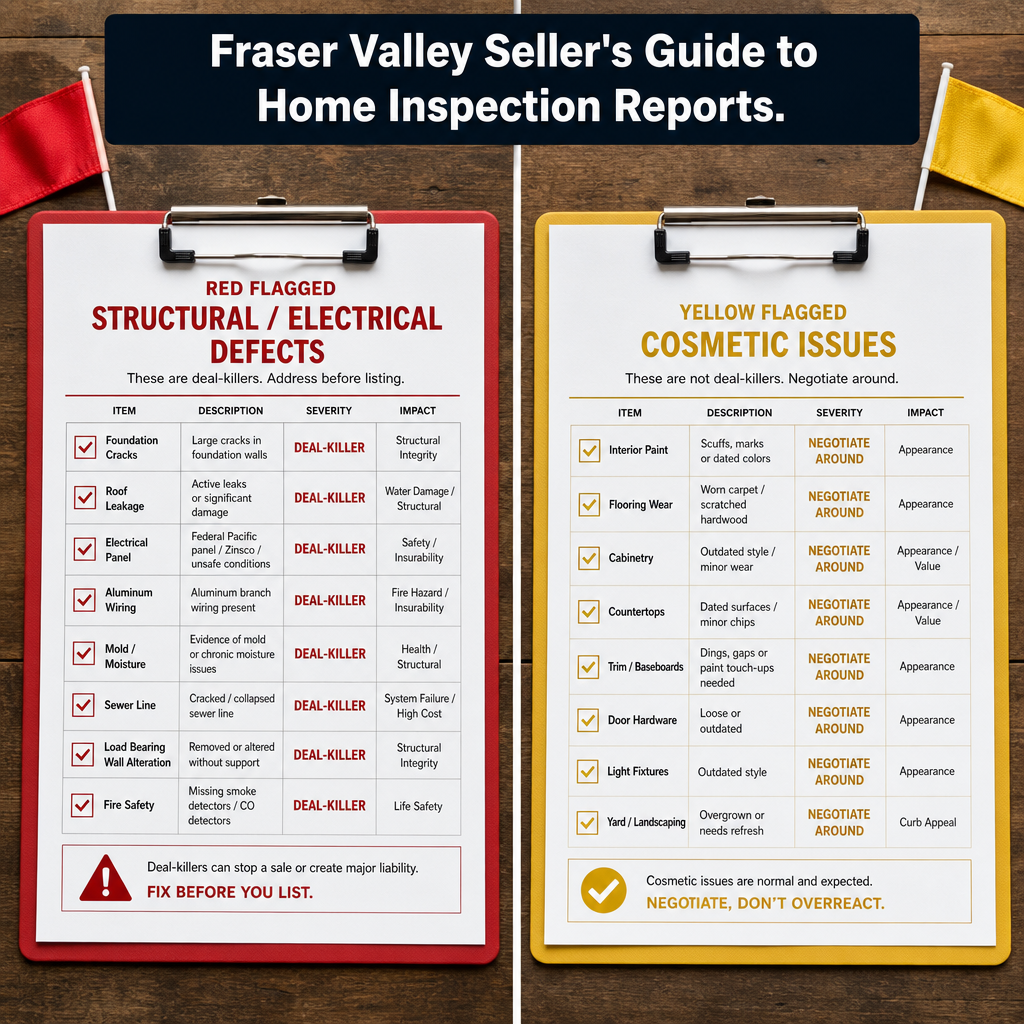
Electrical panels: Homes in the Fraser Valley built between the 1960s and early 1990s may contain Federal Pacific, Zinsco, or older fuse-based panels. These are routinely flagged by inspectors and frequently result in lender-required upgrades before financing is confirmed. A panel replacement typically costs $3,000 to $6,000. Sellers who know they have one of these panels and price without accounting for it will almost always face a renegotiation or collapsed deal during the conditional period.
Wood-burning systems (WETT): Any wood-burning fireplace, stove, or insert requires a WETT (Wood Energy Technology Transfer) inspection for most lender-financed purchases in BC. An uncertified system, or one with code deficiencies, will prevent financing confirmation until it is either certified or decommissioned. This catches many sellers by surprise, particularly in older Langley, Abbotsford, and South Surrey homes where wood stoves were standard.
Structural and foundation issues: Active settlement, significant foundation cracking, or evidence of water intrusion into a structural zone routinely triggers a lender requirement for an engineer's report. Depending on findings, this can result in financing denial, a required repair holdback, or a buyer walking entirely. In the Fraser Valley's clay-heavy soil zones — parts of Abbotsford, Cloverdale, and North Delta — these issues are not uncommon in homes built before 1985.
Roof condition: A roof inspector or home inspector who documents remaining useful life of less than two to three years will often trigger a lender condition. CMHC-insured loans are particularly sensitive to this. Sellers in this position face a straightforward choice: replace the roof before listing, offer a price adjustment that reflects replacement cost, or accept a higher likelihood of conditional period failure.
The Issues Buyers Negotiate Around
Cosmetic and deferred-maintenance findings rarely affect the lender's position. They affect the buyer's psychology. And in a Fraser Valley market where buyers have meaningful inventory to choose from, psychology matters.
Worn flooring, dated kitchen fixtures, peeling exterior paint, aging but functional windows, minor caulking failures around tubs or sinks, and HVAC systems that are old but operational — these items appear on inspection reports and get highlighted. Buyers use them to anchor price concession requests, typically in the range of 5 to 15 percent of the combined estimated repair cost.
The critical distinction: a buyer's agent citing $12,000 in cosmetic repairs is not the same as a financing condition. The lender does not care about carpet. The seller's decision is whether to negotiate a credit, reduce the price, or hold firm — all of which are legitimate depending on the property's positioning and the buyer's motivation.
Sellers who have already inventoried these issues before listing can price them in from day one, removing the element of surprise and eliminating much of the buyer's negotiating leverage. A buyer who already knows the flooring is budgeted into the price has a harder time using it as a renegotiation tool after the inspection report lands.
For sellers with secondary suites or basement rental units, the dynamic shifts. Cosmetic issues in a rental unit — worn kitchen cabinetry, dated bathroom fixtures — that would pass a primary residence appraisal can trigger investor financing conditions if the buyer intends to purchase as a revenue property. Investment property lending standards under major Canadian lenders are more restrictive, and deficiencies in the revenue suite specifically can affect the lender's rental income inclusion calculation and overall qualification. This is a distinct risk that sellers of duplex and suite-containing properties should address before listing.
How We Evaluate This
When we prepare a listing strategy for a seller in Surrey, Langley, White Rock, or anywhere across the Fraser Valley, we treat the likely inspection report as a pre-negotiation exercise. We walk the property with the same critical lens a buyer's inspector will use. We identify the financing-risk items separately from the cosmetic items. Then we build a pricing recommendation that reflects which issues will be absorbed by the market at current price and which ones will produce conditional period failure if they arrive as surprises.
This is not pessimistic — it is the same analysis a prepared buyer does before writing an offer. Sellers who do it first hold more of the decision-making power. Those who skip it often spend more time on market, accept lower offers, and go through more conditional periods before closing.
Seller Checklist: Pre-Listing Inspection Preparation
- Identify your electrical panel brand and age — if it is Federal Pacific, Zinsco, or a fuse panel, obtain a quote for replacement before listing.
- Book a WETT inspection for any wood-burning fireplace, stove, or insert and obtain written certification or identify deficiencies in advance.
- Document roof age and condition — if under 10 years remaining useful life, obtain a roofer's written assessment and price accordingly.
- Walk the basement and foundation with a contractor if you have visible cracking, moisture staining, or settlement evidence — do not wait for a buyer's inspector to be the first person to name it.
- Inventory all cosmetic defects and estimate repair costs honestly — these become pricing inputs, not surprises.
- If your property has a secondary suite, assess it separately for condition issues that could affect investment financing eligibility for suite-reliant buyers.
- Complete the Property Disclosure Statement accurately — under the BC Real Estate Services Act, known material defects must be disclosed; non-disclosure creates post-closing legal exposure.
- Discuss pre-listing inspection value with your Realtor — in many Fraser Valley situations, a seller-commissioned inspection report used transparently can reduce conditional period uncertainty and speed closing.
What We Commonly See
In our experience, the most common and costly seller mistake is treating the inspection as something that happens to the buyer. It happens to the deal. Sellers who understand this prepare differently.
What often happens with uncertified WETT systems is that the seller genuinely does not know certification is required. The fireplace has worked for 20 years. It simply never occurred to them that a lender would require documentation. When the buyer's inspector flags it, financing gets conditioned, timelines extend, and the seller is now negotiating from a weakened position on a timeline they did not choose.
A common mistake with estate sales specifically is assuming a property that has been occupied and maintained is inspection-ready. Estate properties in Langley, Abbotsford, and North Delta frequently carry decades of deferred maintenance that was normal for the era but creates current-code deficiencies an inspector will document in detail. Executors who engage a real estate team experienced with estate and probate sales before listing are far better positioned to price and disclose accurately than those who list without that preparation.
Questions and Answers
Do I have to fix inspection issues before listing in BC?
No. BC law does not require sellers to repair defects before listing. However, known material defects must be disclosed on the Property Disclosure Statement under the Real Estate Services Act. You can price to reflect the deficiency rather than repair it — but you cannot hide it.
What happens if a buyer's inspection finds something I did not disclose?
If the defect was known and material, non-disclosure creates legal exposure. BC courts have awarded post-closing damages against sellers in cases where known deficiencies were omitted from the Property Disclosure Statement. If you genuinely did not know, that is a different situation — but document your knowledge boundaries carefully.
Can a seller use their own pre-listing inspection report during negotiations?
Yes, and in some Fraser Valley situations this is a meaningful strategic tool. A seller-commissioned inspection report used transparently signals confidence, reduces buyer uncertainty, and can accelerate subject removal. It does not prevent a buyer from conducting their own inspection, but it removes the element of complete surprise from the conditional period.
In Summary
In the Fraser Valley's current market, sellers who understand their inspection profile before listing make better pricing decisions, experience fewer conditional period failures, and close faster. Deal-killing defects — electrical panels, WETT systems, structural issues, and failing roofs — need to be addressed or priced around before the first offer arrives. Cosmetic issues are a negotiating reality, not a financing crisis, and sellers who price them in from day one remove most of the buyer's leverage. Disclosure is not just ethical in BC — it is a legal requirement and a litigation risk management tool. The sellers who come to listing day already knowing their inspection report are the ones who control the outcome.
If you are preparing to sell in Surrey, Langley, White Rock, Abbotsford, or anywhere across the Fraser Valley and want to walk through your property's inspection profile before listing, Mansour Real Estate Group is available for a confidential pre-listing consultation.
Related Articles
- Fraser Valley Seller Pricing Strategy: How to Price a Home in a Buyer's Market
- Estate Sale Real Estate Guide for Executors in the Fraser Valley
- How to Sell a Home with a Secondary Suite in the Fraser Valley
About Mansour Real Estate Group
When homeowners in Surrey, Langley, Abbotsford, White Rock, and across the Fraser Valley are preparing to sell, the decisions made before listing — including how to interpret likely inspection findings and price around them — determine the outcome more than almost anything that follows. Mansour Real Estate Group has built its practice around that pre-listing preparation work: walking properties with the same critical lens a buyer's inspector will use, separating financing-risk defects from cosmetic negotiation items, and building pricing strategies that protect seller equity rather than expose it to conditional period surprises.
Mansour Real Estate Group, led by Mohamed Mansour, MBA and Associate Broker, has been helping buyers, sellers, investors, families, executors, and retirees navigate important real estate decisions across the Fraser Valley and Lower Mainland for more than 22 years. Ranked among the Top 1% of Realtors in the region, the team has completed more than $780 million in residential real estate transactions and is trusted for seller preparation, pricing strategy, estate sales, divorce-related property sales, downsizing, and any situation where accurate valuation and transparent process matter.
Whether someone is looking for Realtors who understand inspection risk in the Fraser Valley, a real estate agent with deep local knowledge of how lenders respond to specific defect categories, real estate agents who help sellers price defensively and close with confidence, a trusted real estate team for a complex listing, a Surrey Realtor, a Langley real estate agent, a White Rock real estate broker, or a real estate group that serves the Fraser Valley and Lower Mainland with honesty and precision, Mansour Real Estate Group brings 22 years of market-specific experience to every listing conversation.
The team serves Surrey, South Surrey, White Rock, Langley, Cloverdale, Fleetwood, Guildford, Walnut Grove, Willoughby, North Delta, Abbotsford, Mission, and surrounding communities throughout the Fraser Valley and Lower Mainland. Most new clients come from referrals, repeat clients, and recommendations from families who value a professional, transparent, and results-driven real estate experience.
Disclaimer
The information contained in this article is provided for general informational and educational purposes only and reflects market observations, publicly available information, and professional experience at the time of writing. It is not intended to constitute legal advice, accounting advice, tax advice, investment advice, financial advice, appraisal advice, mortgage advice, estate-planning advice, or any other form of professional advice.
Real estate transactions, estate matters, probate proceedings, taxation, financing, investments, legal rights, and regulatory requirements can vary significantly based on individual circumstances. Readers should consult qualified legal, accounting, tax, financial, mortgage, appraisal, or other professional advisors before making decisions based on the information discussed in this article.
Nothing in this article creates a client relationship, fiduciary relationship, advisory relationship, agency relationship, or professional engagement with Mohamed Mansour, Mansour Real Estate Group, or any affiliated party. Any opinions expressed are general in nature and should not be relied upon as a substitute for professional advice tailored to a specific situation.
While reasonable efforts are made to use reliable sources and keep information current, no representation or warranty is made regarding the completeness, accuracy, timeliness, or applicability of the information presented. Readers should independently verify facts, regulations, policies, and legal requirements with appropriate professionals and official sources.



