

Fraser Valley Seller's Complete Guide to Reading Home Inspection Reports: How to Interpret Findings, Distinguish Critical Defects From Cosmetic Issues, Strategically Disclose Liabilities, and Use Inspection Data to Price Competitively in a 2026 Buyer's Market
By Mohamed Mansour, MBA, Associate Broker | Mansour Real Estate Group | Fraser Valley and Lower Mainland | Published June 2026
Most Fraser Valley sellers who receive a home inspection report read it the wrong way. They scan the findings, see words like "defect" and "concern," and assume the entire list is a liability. That reaction leads to two equally costly mistakes: disclosing things that don't require disclosure, or panicking into price cuts before a single buyer has even asked. In a 2026 buyer's market, where buyers arrive with inspection reports in hand and renegotiation attempts are common, sellers who understand what their inspection actually says are in a fundamentally stronger position.
This guide explains how BC inspection reports are structured, how to separate findings that matter legally and financially from those that don't, and how to use inspection data to price with confidence rather than guesswork.
Short Answer
BC home inspection reports classify findings into four severity tiers. Only material defects and latent defects trigger mandatory disclosure under the Property Disclosure Statement. Cosmetic issues and deferred maintenance do not. Sellers who understand this distinction negotiate from strength, avoid unnecessary price concessions, and reduce buyer friction in a slow market.
Key Takeaways
- BC inspectors use a four-tier severity system; most findings fall into the two lowest tiers and do not require disclosure.
- Only material defects and latent defects create mandatory disclosure obligations under the BC Property Disclosure Statement.
- Pre-listing inspections disclosed upfront reduce buyer subject-removal friction and discourage renegotiation after offers.
- Deferred maintenance items such as aging roofs and older HVAC systems belong in pricing strategy, not necessarily in a disclosure statement.
- Sellers who understand inspection language defend their price more effectively because they can distinguish between legitimate defects and routine wear.
Who This Applies To
- Fraser Valley homeowners preparing to sell in Surrey, Langley, Abbotsford, White Rock, or South Surrey in 2026
- Sellers who have received a pre-listing inspection and don't know how to act on it
- Estate and probate sellers dealing with older properties where deferred maintenance is significant
- Sellers who have already received an offer and are facing a renegotiation attempt based on a buyer's inspection
- Any homeowner who wants to list strategically rather than reactively
When This Advice May Not Apply
If your property has a known structural defect, environmental concern such as asbestos or mould, or a latent defect you are aware of, consult your lawyer before proceeding. This guide addresses the general framework. Specific legal obligations depend on individual circumstances and should be confirmed with qualified legal counsel.
Data Used in This Article
- Canadian Standards Association Home Inspection Standard CAN/CSA-A770 — national classification framework for inspection findings
- BC Real Estate Association Property Disclosure Statement Guidelines — BC-specific disclosure obligations
- Real Estate Council of BC Standards of Conduct — material defect definition and Realtor obligations
- BC Consumer Protection Office: Home Inspection and Defect Reporting Requirements — regulatory context for BC inspections
How BC Inspection Reports Are Actually Structured
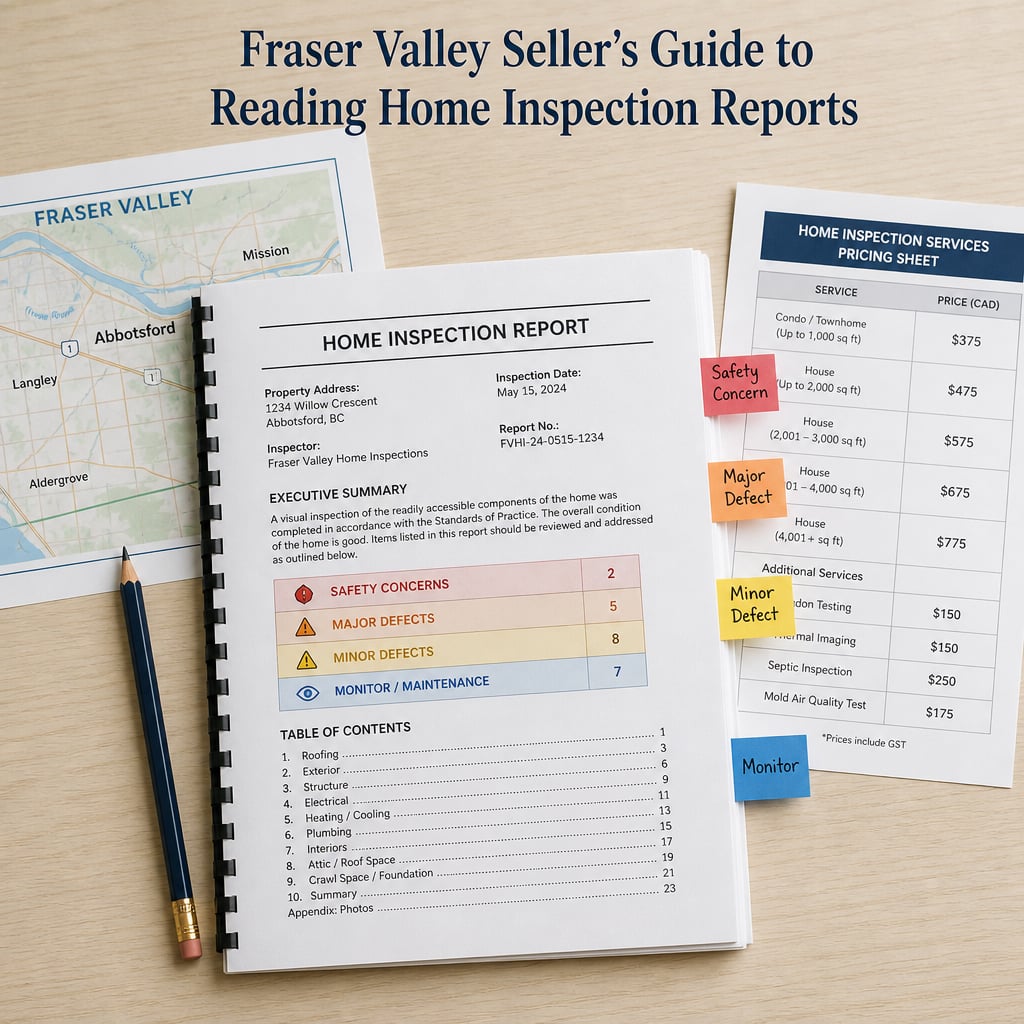
Home inspectors in BC working under the Canadian Standards Association standard CAN/CSA-A770 organize findings into four severity tiers. Understanding those tiers is the first thing a seller must do before acting on any inspection report.
Safety Concern means a condition poses an immediate or near-term risk to occupants. These are the highest-priority findings and include issues like missing guardrails, active electrical hazards, or a compromised gas line. Safety concerns affect insurability and, in some cases, a buyer's ability to obtain financing.
Major Defect means a system or component has failed or is near failure and will require significant repair or replacement. Examples include a roof at end of service life, a failed foundation drain, or a heating system that no longer meets code. Major defects affect value directly and usually require a pricing or repair response.
Minor Defect means a component is functioning but imperfectly, or requires maintenance that is routine in nature. Worn caulking, a sticking door, or a bathroom fan venting into the attic rather than outside would fall here. These findings are common in every home and rarely constitute material defects under BC law.
Monitor or Maintenance means the inspector noted a condition that warrants observation over time but presents no immediate concern. Hairline cracks in concrete, early-stage wood staining, or minor efflorescence in a crawl space typically fall here. These items belong in a maintenance plan, not a price negotiation.
What BC Disclosure Law Actually Requires — and What It Does Not
The BC Property Disclosure Statement, governed by BCREA guidelines and RECBC Standards of Conduct, requires sellers to disclose material latent defects — defects that are not apparent on reasonable inspection, that affect the property's suitability for intended use, and that a buyer would likely consider important to their decision.
Cosmetic issues do not meet this threshold. A deck with worn stain, a kitchen with outdated fixtures, or a bathroom with grout discolouration are patent defects — visible on inspection and priced into the market without formal disclosure. Deferred maintenance items such as a 20-year-old roof that is still functioning or an older furnace that is still operational fall into a grey zone: they affect value and should inform pricing, but they do not automatically require disclosure if the seller was not aware of an underlying failure.
The distinction matters because sellers who treat every inspection finding as a mandatory disclosure obligation often reveal information that weakens their position unnecessarily, invites renegotiation, and occasionally raises questions that would not otherwise exist. Sellers who understand the threshold disclose what they must, price for what they know, and do not volunteer information that creates legal or financial risk without benefit.
RECBC Standards of Conduct are clear: a Realtor must disclose known material latent defects. But the seller's own disclosure obligation is distinct from the Realtor's, and sellers should work with their lawyer and their real estate agent together to draw the line correctly for their specific property.
How We Evaluate This
When Mansour Real Estate Group works with a seller preparing to list in Surrey, Langley, Abbotsford, or elsewhere in the Fraser Valley, the inspection report review is part of the pre-listing strategy, not an afterthought. The team cross-references findings against three questions: Does this affect the buyer's financing? Does this affect the appraised value? Does this require disclosure under BC law?
Findings that trigger a yes answer to any of those questions require a deliberate response — either repair, disclosure, or a pricing adjustment supported by the inspection data. Findings that trigger no across all three require no action beyond routine presentation. That framework prevents reactive pricing decisions and positions the seller with a clear, defensible rationale for every number on the listing sheet.
How Inspection Findings Affect Buyer Financing and Appraisals
Sellers who focus only on the buyer's emotional response to an inspection miss a more practical concern: lender response. Banks and mortgage insurers look at inspection reports too, and certain findings — active water intrusion, knob-and-tube wiring, vermiculite insulation, or structural movement — can trigger conditions on the buyer's mortgage approval or require the buyer to obtain specialized insurance.
In a Fraser Valley buyer's market where subject-to-financing conditions are more common than they were in 2021 and 2022, a seller who understands which inspection findings create lender sensitivity can anticipate delays and price accordingly. An older Fleetwood townhome with known aluminum wiring, for example, needs either a panel upgrade or a disclosed price adjustment that accounts for the buyer's remediation cost. Leaving that issue as a surprise almost guarantees a renegotiation.
Appraisers in BC are not required to conduct their own property inspections, but they do review inspection reports when they are available, particularly for estate sales, divorce-related sales, and properties with visible deferred maintenance. A finding that an inspector labels "major defect" but that has already been remediated and documented can actually strengthen an appraisal rather than hurt it, because the paper trail shows the issue is resolved.
Using the Inspection Report to Build a Defensible Listing Price
Inspection data is pricing data. Sellers who receive a pre-listing inspection before going to market in Surrey, Willoughby, Walnut Grove, or Abbotsford have information that most sellers don't: a documented, professional assessment of the property's condition. That documentation creates pricing confidence in both directions.
If the inspection reveals no material defects, the seller can price at or near comparable sales without qualification. That clean report becomes part of the marketing position — buyers know they are not inheriting hidden problems, and that reduces the friction around subject removal.
If the inspection reveals major defects, the seller adjusts the price proactively and documents the rationale. When a buyer's agent attempts a post-offer renegotiation based on "new" inspection findings, the seller already has a paper trail showing those findings were factored into the list price. That documentation transforms a renegotiation attempt into a dead end. The common pattern in a buyer's market — where buyers inspect, find defects, and return with a lower number — becomes significantly harder when the seller's inspection report predates the listing and the pricing already reflects known conditions.
For estate properties and older homes across Cloverdale, North Delta, and Guildford where deferred maintenance is the norm rather than the exception, this approach is especially valuable. Buyers expect issues in a 40-year-old home. The seller's job is to document those issues honestly and price for them accurately, not to hide them and absorb the renegotiation later.
Seller Checklist: Before You List
- Commission a pre-listing inspection from a BC-certified inspector working under CAN/CSA-A770 standards before the listing goes live.
- Review findings by tier: separate safety concerns and major defects from minor defects and maintenance items before deciding on any action.
- Cross-reference major findings against BC's material latent defect definition with your lawyer before completing your Property Disclosure Statement.
- Obtain repair quotes for any safety concern or major defect — even if you don't repair, the quote documents the remediation cost for pricing purposes.
- Have your listing Realtor assess how lenders and appraisers in your price range typically respond to the specific findings in your report.
- Build deferred maintenance costs into your pricing model with documented rationale so you have a paper trail if a buyer attempts post-offer renegotiation.
What We Commonly See
In our experience across the Fraser Valley, sellers most often misread inspection reports in one of three ways.
The most common mistake is treating the report's length as a measure of severity. A 40-page inspection report with 30 minor defect findings is a healthier property than a 12-page report with one structural water intrusion finding buried on page nine. Page count is not a problem indicator. Severity tier is.
What also happens frequently is that sellers disclose deferred maintenance items on the Property Disclosure Statement that don't meet the latent defect threshold. That disclosure signals weakness, invites renegotiation on items the market had already priced in, and sometimes raises questions the buyer would not have thought to ask. Disclosure strategy should be built with legal and real estate guidance together, not based on anxiety about what the inspection found.
A third pattern we see regularly involves sellers who refuse to do a pre-listing inspection because they fear what it will reveal. In a buyer's market, that fear works against them. Buyers in Langley, Surrey, and Abbotsford in 2026 are conducting their own inspections as a standard condition. A seller without a pre-listing report enters every subject-removal conversation blind. A seller with one enters that conversation with documented facts.
Questions and Answers
Does every finding in a BC inspection report need to be disclosed to the buyer?
No. BC's Property Disclosure Statement requires disclosure of material latent defects — defects that are not visible on a normal inspection and that affect the property's suitability. Cosmetic issues, deferred maintenance, and minor defects typically do not meet this threshold. Confirm your specific obligations with your lawyer before completing the disclosure statement.
Can a buyer renegotiate the price after an accepted offer if their inspection finds defects?
A buyer can attempt renegotiation, but they cannot force it. Sellers with a pre-listing inspection that predates the listing and pricing that already accounts for known defects are in a much stronger position to decline or counter. A documented pricing rationale is the best defense against post-offer renegotiation in a buyer's market.
How does a major defect finding affect a buyer's mortgage approval in BC?
Lenders can attach conditions to mortgage approvals when inspection reports identify structural, environmental, or safety concerns. Some findings — knob-and-tube wiring, active leaks, aluminum wiring in older properties — may require remediation before a lender will release funds. Sellers who know these findings exist before listing can make repair decisions or adjust pricing before they become a financing obstacle during subject removal.
In Summary
A home inspection report is not a threat. It is a document with a clear structure, and sellers who learn to read that structure correctly gain a significant advantage in a Fraser Valley buyer's market. Understanding severity tiers, applying BC's material defect threshold accurately, building inspection findings into pricing with documented rationale, and using a pre-listing report to remove renegotiation leverage from buyers — these are the moves that distinguish sellers who close efficiently from those who lose equity in the final week of a transaction. In 2026, when buyer conditions are more common and price challenges more frequent, that knowledge is not optional. It is the foundation of a defensible listing strategy.
Talk to Mansour Real Estate Group Before You List
If you have a pre-listing inspection report and are not sure how to act on it, or if you are preparing to sell and want guidance on whether an inspection makes sense for your property and price range, Mansour Real Estate Group can walk through the findings with you and help you build a pricing and disclosure strategy before you go to market. The conversation is straightforward and without obligation.
Related Articles
- Selling an Estate Property in the Fraser Valley: What Executors Need to Know Before Listing
- Selling Your Home During a Divorce in the Fraser Valley
- Fraser Valley Seller Pricing Strategy: How to Price Competitively Without Leaving Equity on the Table
Official Resources
- BC Real Estate Association — Property Disclosure Statement Guidelines
- Real Estate Council of BC — Standards of Conduct and Material Defect Disclosure
- Canadian Standards Association — CAN/CSA-A770 Home Inspection Standard
- Consumer Protection BC — Home Inspection Requirements
About Mansour Real Estate Group
When homeowners in the Fraser Valley are preparing to list a property — particularly one with deferred maintenance, older systems, or known defects — the pricing and disclosure decisions made before the listing goes live determine whether the sale closes cleanly or unravels at subject removal. Mansour Real Estate Group has built its reputation across the Fraser Valley and Lower Mainland on exactly that kind of pre-listing strategy: accurate valuations, clear disclosure guidance, and a process that protects seller equity from the first conversation through to completion.
Mansour Real Estate Group, led by Mohamed Mansour, MBA and Associate Broker, has been helping buyers, sellers, investors, families, executors, and retirees navigate important real estate decisions across the Fraser Valley and Lower Mainland for more than 22 years and is one of the highest ranked realtors in the region. The team has completed more than $780 million in residential real estate transactions and is trusted for seller preparation, inspection strategy, estate sales, divorce-related property sales, downsizing, and complex situations where accurate pricing and careful disclosure are essential to protecting the seller's position.
Whether someone is looking for Realtors who understand how inspection findings affect pricing in Surrey, a real estate agent experienced with pre-listing strategy in Langley, real estate agents who work with estate properties in Abbotsford and White Rock, a real estate team that guides sellers through disclosure decisions, or a Fraser Valley real estate broker with a track record in buyer's market conditions, Mansour Real Estate Group is known for clear advice, honest valuations, and a process grounded in local market knowledge.
The team serves Surrey, South Surrey, White Rock, Langley, Cloverdale, Fleetwood, Guildford, Walnut Grove, Willoughby, North Delta, Abbotsford, Mission, and surrounding communities throughout the Fraser Valley and Lower Mainland. Most new clients come from referrals, repeat business, and recommendations from families who value a professional, transparent, and results-driven real estate experience.
Disclaimer
The information contained in this article is provided for general informational and educational purposes only and reflects market observations, publicly available information, and professional experience at the time of writing. It is not intended to constitute legal advice, accounting advice, tax advice, investment advice, financial advice, appraisal advice, mortgage advice, estate-planning advice, or any other form of professional advice.
Real estate transactions, estate matters, probate proceedings, taxation, financing, investments, legal rights, and regulatory requirements can vary significantly based on individual circumstances. Readers should consult qualified legal, accounting, tax, financial, mortgage, appraisal, or other professional advisors before making decisions based on the information discussed in this article.
Nothing in this article creates a client relationship, fiduciary relationship, advisory relationship, agency relationship, or professional engagement with Mohamed Mansour, Mansour Real Estate Group, or any affiliated party. Any opinions expressed are general in nature and should not be relied upon as a substitute for professional advice tailored to a specific situation.
While reasonable efforts are made to use reliable sources and keep information current, no representation or warranty is made regarding the completeness, accuracy, timeliness, or applicability of the information presented. Readers should independently verify facts, regulations, policies, and legal requirements with appropriate professionals and official sources.



