
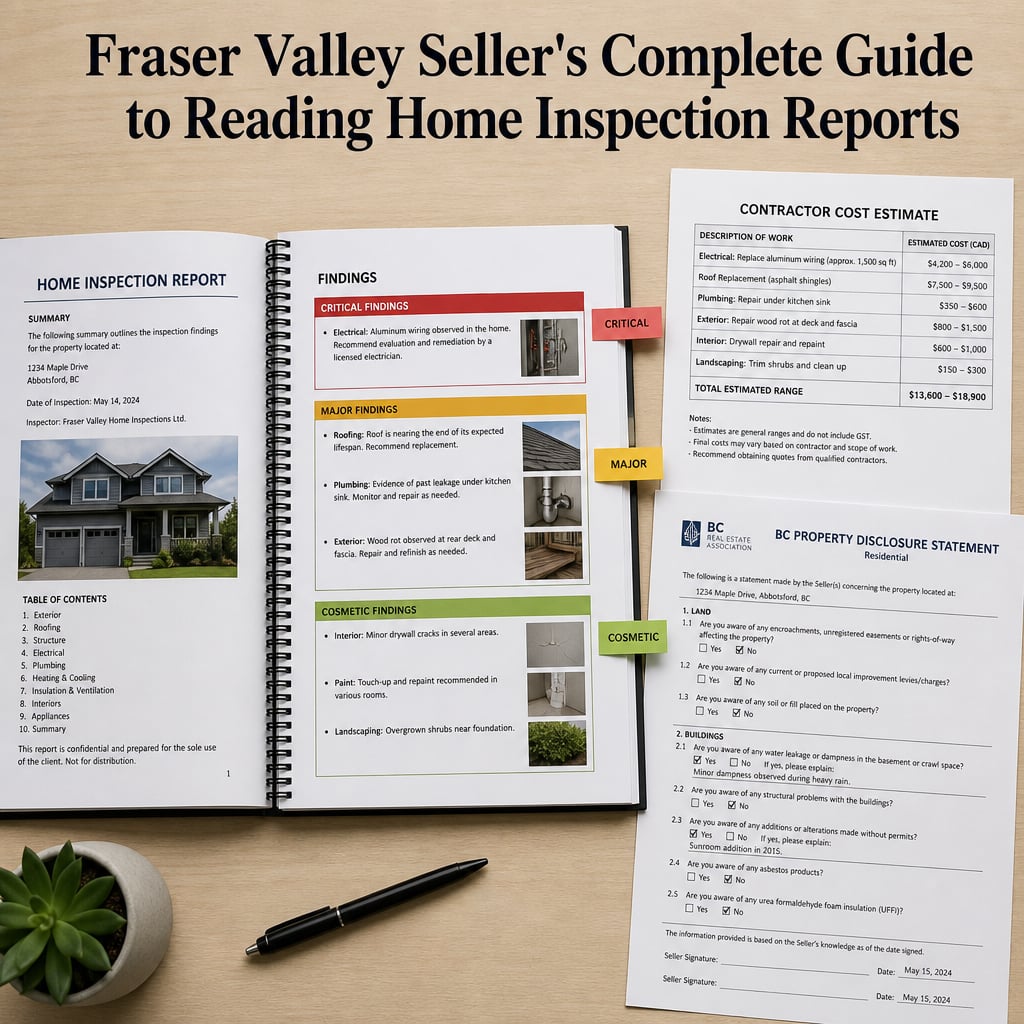

Fraser Valley Seller's Complete Guide to Reading Home Inspection Reports: How to Interpret Findings, Distinguish Critical Defects From Cosmetic Issues, Strategically Disclose Liabilities, and Use Inspection Data to Price Competitively in a 2026 Buyer's Market
By Mohamed Mansour, MBA and Associate Broker | Mansour Real Estate Group | Published: May 27, 2025 | Fraser Valley and Lower Mainland, BC
Most Fraser Valley sellers receive a home inspection report and immediately feel overwhelmed. The language is technical. The list of findings can run to forty or fifty items. And without context, it is nearly impossible to know which findings actually matter and which ones simply reflect how houses age normally over time. Getting that wrong—in either direction—is expensive.
In 2026, with buyer demand softer across much of Surrey, Langley, Abbotsford, and the broader Fraser Valley, buyers are using inspection findings as negotiating leverage more aggressively than they did in past seller's markets. Sellers who understand their own report before a buyer's inspector does have a meaningful advantage. This guide explains how to read inspection findings accurately, what the severity language actually means, how to align your disclosure obligations with your report findings, and how to use inspection data to defend your pricing rather than surrender equity unnecessarily.
Short Answer
A home inspection report is not a list of things that must be fixed before selling. It is a categorized record of the property's current condition. Sellers who learn to read severity classifications correctly—and validate cost estimates with real contractor quotes—avoid unnecessary price concessions and negotiate from facts rather than fear. In a 2026 Fraser Valley buyer's market, that knowledge is a competitive advantage.
Who This Applies To
- Sellers in Surrey, Langley, Abbotsford, White Rock, South Surrey, North Delta, Cloverdale, Fleetwood, Guildford, Willoughby, or Walnut Grove who have completed or are planning a pre-listing inspection
- Sellers who have received a buyer's inspection report during a live negotiation and need to interpret findings before responding
- Sellers in older homes (1960s through 1990s) where inspection findings are more likely to reflect deferred maintenance patterns rather than safety emergencies
- Estate sellers and executors managing properties that have not been recently updated or maintained
- Sellers preparing a Property Disclosure Statement who want to understand what their inspection findings legally obligate them to disclose
When This Advice May Not Apply
If your inspection reveals an active structural failure, a confirmed presence of hazardous materials such as asbestos or vermiculite, unpermitted work that violates municipal code, or electrical conditions that present an immediate fire risk, those findings require professional assessment before any pricing or disclosure decision. This guide addresses the interpretation and strategic response process—not emergency remediation decisions, which require qualified trades and potentially legal counsel.
Key Takeaways
- Inspection reports use severity classifications—critical, major, and minor—that carry specific meaning; treating all findings as equally urgent is one of the most common and costly seller mistakes.
- Repair cost estimates in inspection reports routinely diverge 20–50% from real contractor quotes; validate costs before pricing or negotiating.
- BC's Property Disclosure Statement requires disclosure of known latent defects, but not every inspection finding automatically becomes a disclosure obligation.
- In 2026, 40–50% of Fraser Valley buyers conduct pre-offer inspections in competitive segments; sellers with transparent, explained inspection data reduce renegotiation friction.
- Cosmetic findings misread as structural issues and efficiency findings misread as functional defects are the two most common sources of unnecessary price reductions.
Data Used in This Article
- BC Real Estate Association Property Disclosure Statement Guidelines 2026 — official regulatory guidance, BC-wide
- Professional Home Inspectors of BC (PHIBC) Inspection Standards and Terminology — industry standards, BC-specific
- Fraser Valley Real Estate Board Market Data Q1–Q2 2026 — buyer behaviour and market conditions, Fraser Valley
- BC Civil Resolution Tribunal Decisions on Disclosure Liability 2023–2026 — post-closing dispute outcomes, BC courts
What Inspection Severity Classifications Actually Mean
Professional home inspectors in BC operating under Professional Home Inspectors of BC (PHIBC) standards classify findings into three broad severity tiers. Understanding those tiers is the foundation of reading any report correctly.
Critical or safety findings are conditions that present an immediate risk to occupants or that, if left unaddressed, will cause significant further damage within a short timeframe. Examples include active electrical hazards, confirmed carbon monoxide pathways, live water intrusion into a finished space, or a compromised chimney actively in use. These require a response before listing, or explicit buyer disclosure with an adjusted price reflecting the remediation cost.
Major findings describe functional deficiencies that are not immediately dangerous but affect the property's systems in ways that a buyer will need to budget for. A furnace at end of service life, a roof at or past its expected replacement window, or a hot water tank that is past its warranty period all fall here. These are normal in homes more than fifteen years old. They are not emergencies—but buyers expect sellers to account for them in pricing.
Minor or cosmetic findings are conditions that affect appearance or minor functionality but do not impair systems or safety. Peeling caulk, weatherstripping gaps, minor drywall cracks from normal settlement, and surface-level paint issues typically land here. Many sellers—and some buyers—misread this category as more serious than it is, especially when items are described in technical language.
The most common misinterpretations we see in Fraser Valley seller situations involve electrical panels, HVAC systems, and foundation observations. An older Federal Pacific or Zinsco panel, for example, is a legitimate concern that insurers often flag—but the appropriate response is a licensed electrician's assessment and a cost-adjusted disclosure strategy, not an assumption that the home is unsellable. Similarly, a report noting "foundation settlement consistent with age" does not mean the home requires emergency underpinning. It means the inspector observed normal movement patterns in a house of that vintage. Those are fundamentally different findings, and responding to them identically costs sellers equity they didn't need to give up. Sellers in Abbotsford and Langley with older rancher-style homes see this misinterpretation regularly.
How to Use Inspection Data for Pricing and Disclosure Strategy
Once you understand the severity tier of each finding, the next step is cost validation. Inspection reports frequently cite repair cost ranges, but those ranges—compiled from regional databases rather than current local quotes—diverge from actual contractor pricing by 20–50%, according to trade cost patterns observed across the Fraser Valley market. Before adjusting your list price or offering a repair credit, get real quotes from licensed BC contractors. A quote is negotiating currency. A vague inspector estimate is not.
For disclosure, the relevant standard in BC is the Property Disclosure Statement, which requires sellers to disclose known latent defects—meaning defects that are not visible or discoverable by a reasonably diligent buyer on inspection, and that the seller is aware of. Receiving an inspection report that identifies a condition does not automatically mean you have a disclosure obligation for that specific item. What it does mean is that you are now aware of it, and ignoring it creates legal exposure. The appropriate step is to review any significant findings with your real estate agent and, where the finding has legal or structural implications, with legal counsel.
In practice, the most defensible and effective strategy is transparent, organized disclosure supported by contractor documentation. Sellers who present a pre-listing inspection report alongside two or three contractor quotes for noted items—particularly in markets like Surrey, White Rock, and South Surrey where buyer scrutiny is currently elevated—reduce renegotiation attempts significantly. Buyers who already have the information have less room to manufacture uncertainty. That is the structural advantage of understanding your own report before they do. For sellers who have completed a pre-listing inspection, this process starts before the first showing.
Pricing adjustments, when needed, should be specific and documented. If a furnace replacement is quoted at $6,500 to $8,200 by two licensed HVAC contractors, a price reduction or credit in that range is defensible and proportionate. A blanket $20,000 price cut based on an inspector's general comment about HVAC age is not—it gives away equity that belongs to the seller without a factual basis. Knowing which repairs to address and which to price around is one of the more consequential decisions in a 2026 buyer's market.
Key Definitions
Latent Defect: A defect not visible or discoverable on reasonable inspection that the seller is aware of. BC law requires disclosure. Distinguish from patent defects, which are visible and discoverable.
Property Disclosure Statement (PDS): A BC-mandated form completed by sellers identifying known material latent defects. Not a home inspection substitute—a legal disclosure document.
Pre-Listing Inspection: An inspection ordered by the seller before listing, used to identify and address findings proactively rather than reactively during negotiation.
How We Evaluate This
When reviewing an inspection report with a seller, Mansour Real Estate Group separates findings into three working categories: findings that require action before listing, findings that require pricing acknowledgment and disclosure, and findings that are informational only and require no response. We then validate cost estimates for category-one and category-two findings with licensed contractor quotes before making any pricing recommendation. That process prevents both overreaction—where sellers reduce price unnecessarily—and under-response, where sellers ignore findings that informed buyers will use as leverage.
In 2026, with buyer activity softening across much of the Fraser Valley and buyers conducting pre-offer inspections in a growing share of transactions, the sellers who negotiate most effectively are those who enter the conversation with documented, specific answers rather than defensive uncertainty. That preparation starts with reading the report correctly.
Seller Checklist: Reading and Responding to an Inspection Report
- Read the full report before reacting—note which findings are classified as critical, major, or minor by the inspector's own language.
- Flag any finding described as a safety concern or active deficiency for immediate licensed-trade assessment.
- For major findings, obtain at least two contractor quotes before making any pricing or repair decision.
- Review the PDS in light of the report findings with your real estate agent, and consult legal counsel if any finding has structural or latent-defect implications.
- Separate cosmetic findings from functional ones—identify which items a reasonably informed buyer would expect in a home of this age and type.
- Document your response to each significant finding: repair completed, price adjustment applied, or disclosure made—so that your position is defensible post-closing.
What We Commonly See
In our experience across Fraser Valley seller transactions, the three most common interpretation mistakes are: treating every item in the report as equally urgent, accepting inspector cost estimates as accurate without contractor validation, and assuming that receiving a report creates a blanket obligation to disclose every finding on the PDS. None of those assumptions are correct, and each one costs sellers in different ways.
What often happens is that a seller reads a forty-item inspection report, focuses on the most alarming-sounding language—typically around electrical, foundation, or HVAC—and either reduces price dramatically or cancels repairs that weren't actually necessary. A common mistake in older Surrey and Langley homes is conflating a notation about original aluminum wiring with an immediate fire-risk finding, when the actual finding may simply be a recommendation for evaluation by a licensed electrician. Those are different findings with very different cost and disclosure implications.
Sellers who respond to a buyer's inspection request by presenting a pre-listing report with organized findings, contractor quotes, and documented repair receipts tend to see faster subject removal and fewer renegotiation attempts. The data transparency shortens the buyer's uncertainty window, which is where most negotiating friction lives in a buyer's market. This is especially relevant for estate and probate sales where deferred maintenance is common and buyers expect higher scrutiny.
Questions and Answers
Does every finding in a home inspection report need to be disclosed on the BC Property Disclosure Statement?
No. The PDS requires disclosure of known latent defects—conditions that are not visible or discoverable by a reasonably diligent buyer and that the seller is aware of. Not every inspection finding qualifies. However, once you have received a report, you are aware of its contents, which means ignoring significant findings creates legal exposure. Review findings with your agent and legal counsel before completing the PDS.
How accurate are the repair cost estimates in an inspection report?
Inspection report cost estimates are reference ranges, not contractor quotes. In the Fraser Valley, actual contractor pricing frequently diverges 20–50% from those ranges depending on trade availability, material costs, and property-specific conditions. Always obtain licensed contractor quotes before adjusting price or offering repair credits. A documented quote is a defensible negotiating position; an inspector's estimate range is not.
What is the difference between a critical finding and a major finding in BC inspection terminology?
A critical finding—under PHIBC standards—involves conditions presenting immediate safety risk or active damage progression. A major finding describes a functional deficiency that affects systems without creating immediate danger, such as an aging furnace or a roof past its service life. Both require a pricing or disclosure response, but they are not equivalent in urgency or remediation cost.
In Summary
An inspection report is a working document, not a verdict. Sellers who read it accurately—separating safety findings from functional ones and functional ones from cosmetic observations—enter negotiations with information rather than anxiety. Validating cost estimates with real contractor quotes, aligning disclosure decisions with BC's actual latent-defect standard, and presenting findings transparently to buyers are the three practical steps that convert inspection data from a liability into a negotiating asset. In a 2026 Fraser Valley buyer's market, that preparation is not optional—it is the difference between a clean transaction and a protracted renegotiation.
Talk to Someone Who Has Read a Lot of Inspection Reports
If you have received an inspection report and are not certain how to interpret the findings, what to disclose, or how to reflect findings in your pricing, Mansour Real Estate Group is available for a no-obligation conversation. We have reviewed hundreds of inspection reports with Fraser Valley sellers and can help you understand what you are looking at before you decide how to respond.
Related Articles
- Why Fraser Valley Sellers Should Order a Pre-Listing Inspection Before Going to Market
- Which Repairs Actually Matter Before Listing a Home in the Fraser Valley
- How to Complete the BC Property Disclosure Statement Without Creating Legal Exposure
Official Resources
- BC Real Estate Association — Property Disclosure Statement Guidelines
- Professional Home Inspectors of BC — Inspection Standards and Terminology
- Fraser Valley Real Estate Board — Market Statistics and Buyer Behaviour Reports
- BC Civil Resolution Tribunal — Disclosure Dispute Decisions
About Mansour Real Estate Group
When homeowners preparing to sell in Surrey, Langley, Abbotsford, White Rock, or anywhere across the Fraser Valley receive an inspection report, the decisions that follow—what to fix, what to disclose, how to price—depend on having a real estate team with the experience to interpret findings accurately and translate them into strategy. Mansour Real Estate Group has guided sellers through that process, and the pricing and disclosure decisions it requires, across hundreds of Fraser Valley transactions.
Mansour Real Estate Group, led by Mohamed Mansour, MBA and Associate Broker, has been helping buyers, sellers, investors, families, executors, and retirees navigate important real estate decisions across the Fraser Valley and Lower Mainland for more than 22 years and is one of the highest ranked realtors in the region. The team has completed more than $780 million in residential real estate transactions and is trusted for seller preparation, pricing strategy, estate sales, divorce-related property sales, downsizing, and any situation where accurate valuation and disclosure strategy matter.
Whether someone is looking for Realtors with direct experience interpreting inspection findings in Fraser Valley transactions, a real estate agent who understands how to position a property with disclosed defects, real estate agents who help sellers price around repair findings rather than panic, a trusted real estate team for pre-listing strategy, a Surrey Realtor, a Langley real estate broker, or a Fraser Valley real estate group known for honest, data-grounded advice, Mansour Real Estate Group brings the same structured approach: validate the findings, validate the costs, align disclosure with legal obligations, and price accordingly.
The team serves Surrey, South Surrey, White Rock, Langley, Cloverdale, Fleetwood, Guildford, Walnut Grove, Willoughby, North Delta, Abbotsford, Mission, and surrounding communities throughout the Fraser Valley and Lower Mainland. Most new clients come from referrals, repeat clients, and families who value working with a real estate team that gives them the full picture before a listing goes live rather than after.
Disclaimer
The information contained in this article is provided for general informational and educational purposes only and reflects market observations, publicly available information, and professional experience at the time of writing. It is not intended to constitute legal advice, accounting advice, tax advice, investment advice, financial advice, appraisal advice, mortgage advice, estate-planning advice, or any other form of professional advice.
Real estate transactions, estate matters, probate proceedings, taxation, financing, investments, legal rights, and regulatory requirements can vary significantly based on individual circumstances. Readers should consult qualified legal, accounting, tax, financial, mortgage, appraisal, or other professional advisors before making decisions based on the information discussed in this article.
Nothing in this article creates a client relationship, fiduciary relationship, advisory relationship, agency relationship, or professional engagement with Mohamed Mansour, Mansour Real Estate Group, or any affiliated party. Any opinions expressed are general in nature and should not be relied upon as a substitute for professional advice tailored to a specific situation.
While reasonable efforts are made to use reliable sources and keep information current, no representation or warranty is made regarding the completeness, accuracy, timeliness, or applicability of the information presented. Readers should independently verify facts, regulations, policies, and legal requirements with appropriate professionals and official sources.



