

Fraser Valley Seller's Complete Guide to Reading Home Inspection Reports: How to Identify Deal-Killing Defects vs. Cosmetic Issues, Understand Inspector Findings, Strategically Disclose Results, and Use Inspection Data to Price Confidently in a 2026 Buyer's Market
Author: Mohamed Mansour, MBA, Associate Broker — Mansour Real Estate Group
Geography: Fraser Valley and Lower Mainland, British Columbia
Published: July 14, 2025
Topic: Seller Strategy — Reading and Using Home Inspection Reports in BC
Most sellers in Surrey, Langley, Abbotsford, and across the Fraser Valley commission a pre-listing inspection—or receive a buyer's inspection report—and then do one of two things: they panic at the length of it, or they dismiss it entirely. Neither response serves them well. In a 2026 buyer's market, where offers routinely include subject-to-inspection clauses and buyers use findings as price-reduction leverage, understanding what an inspection report actually says is a direct financial skill.
This guide is for sellers who want to read their report the way a knowledgeable real estate professional reads it—calmly, precisely, and strategically.
Short Answer
A home inspection report in BC is organized by building system and assigns findings a priority timeline—Now, Soon, or Monitor. The language an inspector uses signals severity: terms like "end of life," "active intrusion," and "structural movement" indicate real risk, while "deferred maintenance" and "monitor" typically describe cosmetic wear. Sellers who understand this language can price accurately, disclose correctly, and negotiate from a position of knowledge rather than anxiety.
Who This Applies To
- Sellers preparing to commission a pre-listing inspection in the Fraser Valley
- Sellers who have received a buyer's inspection report during negotiations
- First-time sellers unfamiliar with building systems terminology
- Estate executors managing a property sale with an older home
- Sellers navigating a buyer's market where inspection findings are used as leverage
- Homeowners uncertain which findings require mandatory disclosure under BC law
When This Advice May Not Apply
If your property involves active litigation, an insurance claim in progress, or a known material defect that has already been disclosed to your lawyer, follow your legal counsel's guidance before taking any action based on inspection findings. Strata properties also have additional document disclosure requirements beyond what an inspection covers—consult your real estate agent and strata records together.
Key Takeaways
- BC inspection reports use a Now/Soon/Monitor timeline—only "Now" findings typically affect deal viability or disclosure obligations.
- "End of life," "active," and "structural movement" are the three most consequential phrases in any inspection report.
- BC's Property Disclosure Statement obligates sellers to disclose latent defects affecting safety, structure, or major repair cost—not every inspection finding.
- Sellers who understand report severity levels can negotiate intelligently instead of conceding to every buyer concern.
- A pre-listing inspection commissioned by the seller, with repairs documented, is one of the strongest negotiation assets in a buyer's market.
Data Used in This Article
- BC Financial Services Authority (BCFSA) — Consumer Guide to Property Inspections, current guidance on inspector standards and seller obligations in BC (Official/Regulatory)
- Office of Consumer Affairs, Innovation, Science and Economic Development Canada (ISED) — Home Inspections consumer guidance (Official/Federal)
- Anhar Home Inspections (BC-based) — Sample BC inspection report format illustrating system organization and priority classifications (Industry/Third-party)
- Professional interpretation — Fraser Valley seller experience, Mansour Real Estate Group (Internal/Professional)
Definitions
Latent defect: A hidden or non-obvious defect that a buyer cannot detect through reasonable inspection. BC sellers are legally obligated to disclose known latent defects.
Patent defect: A visible defect a buyer can see during a walkthrough. Sellers are generally not required to point these out, but disclosure is still advisable.
Property Disclosure Statement (PDS): A BC-standard form completed by sellers to declare known material defects and property conditions. Failure to disclose accurately creates post-closing litigation risk.
Deferred maintenance: Inspector language describing wear that has accumulated through neglect but does not constitute a safety or structural failure—typically cosmetic in nature.
How Inspection Reports Are Organized in BC
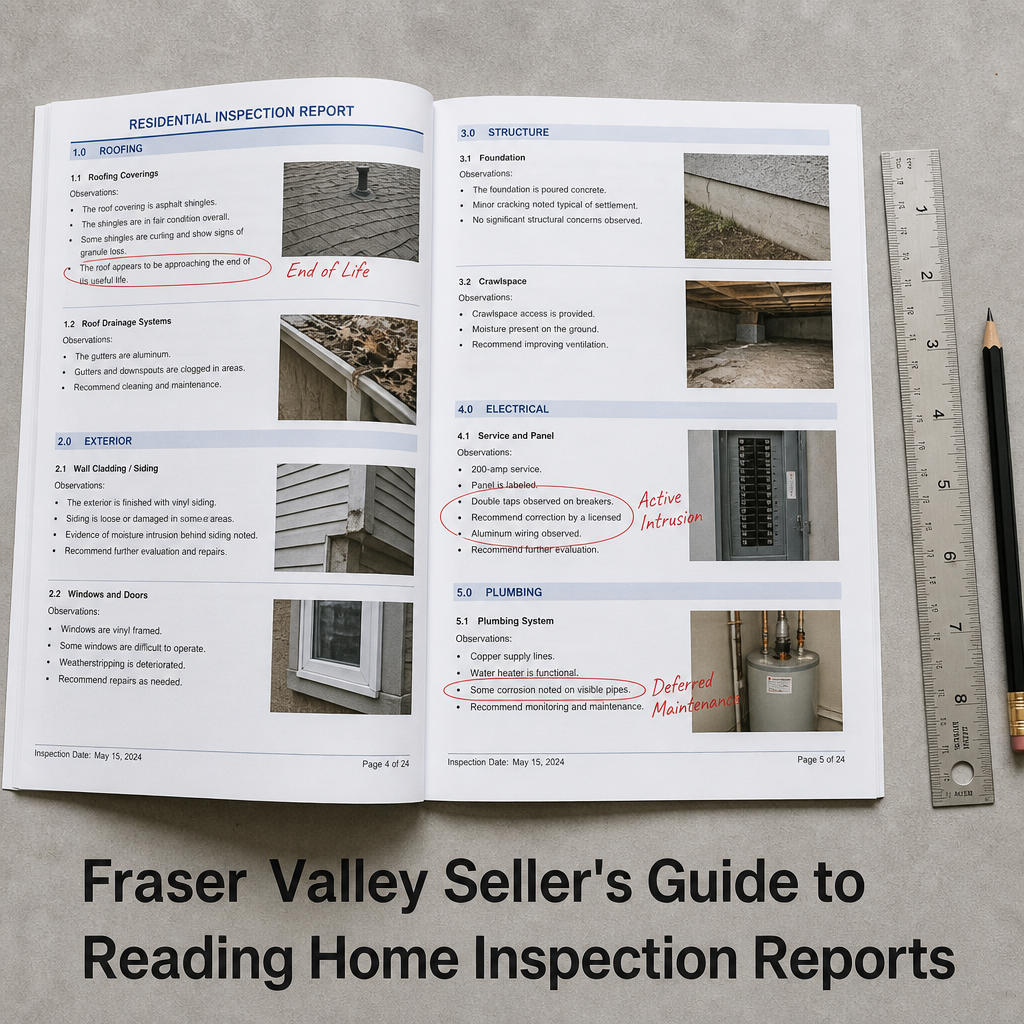
According to the BCFSA's Consumer Guide to Property Inspections, licensed home inspectors in BC are required to evaluate a property's visible and accessible systems and components. Standard reports are organized by building system: Roof, Exterior, Foundation, Structure, Electrical, Plumbing, HVAC, Interior, and Insulation/Ventilation. Each section contains findings with photos, descriptions, and a priority classification.
Most BC inspectors use a three-tier priority timeline. "Now" findings require immediate attention—these are safety risks, functional failures, or conditions that may affect financing approval. "Soon" findings are items that need attention within one to three years but don't currently represent a safety hazard. "Monitor" findings are conditions to watch over time, usually normal aging or early-stage wear.
The report also includes a summary page. This is where most sellers start reading—and where most confusion begins. The summary page lists all findings flagged above a routine threshold, which can make a report look alarming even when the majority of items are cosmetic. A 40-page report with 22 flagged items in the summary may contain only two or three findings that actually matter to a buyer's lender or to your disclosure obligations.
Read the full system sections before drawing conclusions from the summary. The summary is a navigation tool, not a verdict.
Inspector Language That Signals Real Risk vs. Routine Wear
The specific words an inspector uses carry legal and financial weight. Here are the phrases that distinguish deal-threatening findings from routine maintenance observations:
"End of life" — The system or component has reached the end of its expected service lifespan. For a roof, this means replacement is imminent. For a furnace, it means the buyer's lender may require replacement before approving financing. End-of-life findings are pricing conversations, not necessarily deal-killers—but they need to be addressed in your pricing or remedy strategy. In pricing your home in the Fraser Valley, end-of-life mechanical systems typically factor into comparative adjustments.
"Active" moisture or water intrusion — This phrase means water is currently entering the building envelope. It is categorically more serious than "past moisture history" or "staining consistent with previous moisture." Active intrusion requires investigation—it may indicate foundation failure, compromised flashing, or failing envelope systems. This is the type of finding that can affect structural integrity and almost always rises to the level of mandatory disclosure in BC.
"Structural movement" — Any reference to differential settlement, cracks with active movement indicators, or structural deflection beyond normal tolerance requires a structural engineer's assessment before you can accurately represent the property's condition. Do not price around this finding without professional evaluation.
"Outdated electrical panel" — Specific panels flagged in BC—including Federal Pacific, Zinsco, and older fuse-based panels—are associated with fire risk and may prevent a buyer from obtaining home insurance or mortgage financing. This is a "Now" finding that directly affects deal completion, not just buyer comfort.
"Deferred maintenance" — This phrase typically means visible neglect without safety or structural implication. Peeling paint, worn caulking, stiff door hardware, aged deck boards—these are cosmetic items. They affect buyer perception and negotiating tone, but they do not affect structural integrity, financing, or your legal disclosure obligations.
"Monitor" — The inspector is documenting a condition that warrants observation but does not yet require action. In negotiations, buyers sometimes use "monitor" findings as price-reduction leverage. Sellers who understand what "monitor" actually means can respond factually rather than reactively.
BC Disclosure Obligations: What You Must Disclose and What You Don't
BC's Property Disclosure Statement requires sellers to disclose known material latent defects—defects that are hidden from view, affect safety or structural integrity, or involve costs a buyer would consider material to their purchase decision. The BCFSA notes that sellers who become aware of a material latent defect are obligated to disclose it, regardless of whether it was discovered through an inspection or already known.
Not every inspection finding is a latent defect. A worn roof at the end of its service life is visible during inspection—it is a patent defect, observable by the buyer's inspector. An undisclosed foundation crack hidden behind finished drywall that you are aware of is a latent defect requiring disclosure. The distinction matters because over-disclosure of patent defects can actually weaken your negotiating position without serving any legal obligation, while under-disclosure of latent defects creates post-closing liability.
If your pre-listing inspection reveals something you were unaware of—active moisture, structural movement, or a safety hazard—consult your real estate agent and your lawyer before completing the Property Disclosure Statement. The inspection report itself does not determine your disclosure obligations; your knowledge and the nature of the defect do. This is an area where sellers regularly make mistakes in both directions. For related context, see our article on seller disclosure requirements in BC.
What inspectors find during a buyer's inspection, after an accepted offer, also has disclosure implications if findings reveal something you knew existed. Never dismiss or contradict a buyer's inspection finding about a condition you were already aware of.
How We Evaluate This
At Mansour Real Estate Group, when a pre-listing inspection comes back, we review findings with the seller systematically—not emotionally. We categorize every flagged item into three groups: findings that affect financing approval, findings that rise to the level of mandatory disclosure, and findings that affect buyer perception but have no safety or structural consequence.
This categorization determines whether the seller repairs, adjusts pricing, credits, or simply holds their position during negotiations. In Fraser Valley markets where buyers are inspecting nearly every property in 2026, sellers who have gone through this process before listing are meaningfully better positioned than those who encounter findings for the first time during subject removal. The current Fraser Valley seller's market context makes pre-listing inspection strategy a first-order decision, not an afterthought.
Seller Checklist: Using Your Inspection Report Before Listing
- Read the full system sections—not just the summary page—before assessing severity.
- Flag every finding classified "Now" and determine whether it affects safety, financing, or disclosure.
- Obtain written quotes for any "Now" finding you plan to repair—document the work with receipts.
- Consult your real estate agent and lawyer before completing your Property Disclosure Statement if any finding was previously unknown to you.
- Categorize "Soon" and "Monitor" findings separately—these inform pricing adjustments, not necessarily repairs.
- Prepare a written summary of completed repairs to share with buyers during subject removal—this reduces inspection anxiety and supports subject removal confidence.
- Do not over-disclose patent defects visible to any buyer's inspector—this is a negotiating position question, not a legal obligation.
What We Commonly See
Sellers treating the summary page as the whole report. In our experience, sellers who read only the summary often either overreact to a long list of minor cosmetic items or miss the significance of one technical finding buried deeper in the report. The summary is a starting point, not a conclusion.
Conceding on "Monitor" findings during negotiation. What often happens is that a buyer's agent presents the full inspection report in a price-reduction request without distinguishing between Now findings and Monitor observations. Sellers who don't understand the classification concede unnecessarily. A "Monitor" finding is not a repair demand—it is documentation. Knowing that distinction can protect thousands of dollars in net proceeds.
Completing the Property Disclosure Statement before reviewing inspection findings with a professional. A common mistake is filling out the PDS based on personal knowledge before the inspection, then receiving an inspection report with a finding that contradicts what was declared. The sequence matters: complete your pre-listing inspection first, then complete or update the PDS with your agent's and lawyer's guidance.
Questions and Answers
Does a pre-listing inspection report need to be shared with buyers in BC?
There is no automatic legal requirement to provide a buyer with your pre-listing inspection report in BC. However, if the report reveals a material latent defect you are now aware of, you must disclose that defect through the Property Disclosure Statement. Consult your real estate agent and lawyer on the strategic and legal implications before deciding whether to share the full report.
What is the difference between an active and a historic moisture finding?
An active moisture finding means water is currently entering or has recently entered the building—it is an ongoing condition. A historic moisture finding refers to staining, residue, or past damage that is now dry and not actively worsening. Active findings require investigation and are more likely to affect financing and disclosure. Historic findings may require explanation but often reflect a condition that was already resolved.
Can a buyer back out of a purchase based on a home inspection report in BC?
Yes, if the offer is accepted subject to inspection and the buyer is not satisfied with the results, they can remove their offer during the subject removal period. In practice, buyers rarely walk away entirely—they typically use the report to request a price reduction or repairs. Sellers who understand the severity of the findings are better positioned to respond proportionately rather than making unnecessary concessions. For more on protecting your position, see our overview of subject removal strategy for Fraser Valley sellers.
In Summary
A home inspection report is not a verdict—it is a technical document organized by system and priority. Sellers who learn to read it accurately can identify what matters legally, what matters financially, and what is simply cosmetic. In the Fraser Valley's 2026 buyer's market, that reading fluency is a real negotiating advantage. Knowing the difference between "end of life" and "deferred maintenance," understanding when a finding triggers disclosure, and categorizing findings before pricing rather than after—these are the habits that protect a seller's net proceeds and reduce the chance of a deal falling apart unnecessarily.
Talk to Mansour Real Estate Group Before You List
If you have an inspection report in hand—or are considering commissioning one—and want to understand what it means for your pricing strategy, disclosure obligations, and negotiating position, Mansour Real Estate Group is available for a straightforward conversation. There is no obligation. The goal is clarity before you make decisions that affect your sale outcome.
Related Articles
- How to Price Your Home to Sell in the Fraser Valley
- Seller Disclosure Requirements in BC: What Fraser Valley Homeowners Need to Know
- Why Fraser Valley Sellers Should Commission a Pre-Listing Inspection Before Going to Market
Official Resources
- BCFSA — Consumer Guide to Property Inspections
- ISED Canada — Home Inspections Consumer Guidance
- BC Financial Services Authority — Real Estate Consumer Resources
About Mansour Real Estate Group
When homeowners in Surrey, Langley, Abbotsford, White Rock, and across the Fraser Valley are preparing to sell, one of the most consequential pre-listing decisions they face is understanding what their inspection report actually means for pricing, disclosure, and negotiation. That requires a real estate team that reads inspection reports the same way a knowledgeable buyer's agent does—systematically, without panic, and with an eye on how findings translate into market positioning and legal obligations. Mansour Real Estate Group has built its practice on exactly this kind of preparation work.
Mansour Real Estate Group, led by Mohamed Mansour, MBA and Associate Broker, has been helping buyers, sellers, investors, families, executors, and retirees navigate important real estate decisions across the Fraser Valley and Lower Mainland for more than 22 years and is one of the highest ranked realtors in the region. The team has completed more than $780 million in residential real estate transactions and is trusted for pricing strategy, seller preparation, estate sales, divorce-related sales, downsizing, relocation, and complex situations where inspection findings directly affect sale outcomes.
Whether someone is looking for Realtors experienced with seller preparation in the Fraser Valley, a real estate agent who understands how inspection findings translate to pricing, real estate agents familiar with BC disclosure obligations, a trusted real estate team to guide pre-listing decisions, a Surrey Realtor, a Langley real estate broker, or a real estate group that serves the Lower Mainland with honest advice grounded in local market data, Mansour Real Estate Group is known for structured preparation, accurate valuations, and clear communication at every stage of a sale.
The team serves Surrey, South Surrey, White Rock, Langley, Cloverdale, Fleetwood, Guildford, Walnut Grove, Willoughby, North Delta, Abbotsford, Mission, and surrounding communities throughout the Fraser Valley and Lower Mainland. Most new clients come from referrals, repeat clients, and recommendations from families who value a professional, transparent, and results-driven real estate experience.
Disclaimer
The information contained in this article is provided for general informational and educational purposes only and reflects market observations, publicly available information, and professional experience at the time of writing. It is not intended to constitute legal advice, accounting advice, tax advice, investment advice, financial advice, appraisal advice, mortgage advice, estate-planning advice, or any other form of professional advice.
Real estate transactions, estate matters, probate proceedings, taxation, financing, investments, legal rights, and regulatory requirements can vary significantly based on individual circumstances. Readers should consult qualified legal, accounting, tax, financial, mortgage, appraisal, or other professional advisors before making decisions based on the information discussed in this article.
Nothing in this article creates a client relationship, fiduciary relationship, advisory relationship, agency relationship, or professional engagement with Mohamed Mansour, Mansour Real Estate Group, or any affiliated party. Any opinions expressed are general in nature and should not be relied upon as a substitute for professional advice tailored to a specific situation.
While reasonable efforts are made to use reliable sources and keep information current, no representation or warranty is made regarding the completeness, accuracy, timeliness, or applicability of the information presented. Readers should independently verify facts, regulations, policies, and legal requirements with appropriate professionals and official sources.



