
Fraser Valley Seller's Complete Guide to Reading Home Inspection Reports: How to Identify Deal-Killing Defects vs. Cosmetic Issues, Strategic Disclosure, Price Impact, and Renegotiation Defense in a 2026 Buyer's Market
By Mohamed Mansour, MBA and Associate Broker | Mansour Real Estate Group | Fraser Valley and Lower Mainland, BC | Published: July 15, 2026 | Geographic Scope: Fraser Valley, including Surrey, Langley, Abbotsford, South Surrey, White Rock, North Delta, Cloverdale, and Fleetwood
In 2026's Fraser Valley buyer's market, inspection contingencies are showing up in more offers and staying open longer. When a buyer's inspector delivers a 40-page report, many sellers panic. They see a long list of findings and assume the deal is in trouble. Some agree to price cuts they didn't need to accept. Others push back on everything and lose buyers they could have kept.
The sellers who handle inspections well share one skill: they can read the report. Not as lawyers, not as engineers — but well enough to separate findings that actually matter from findings that are normal for any home of similar age. This guide is built around that skill.
Short Answer
Most home inspection findings in the Fraser Valley fall into one of three categories: structural or safety defects that can genuinely affect financing or buyer decisions, maintenance items that are negotiable, and cosmetic issues that most experienced buyers ignore. Sellers who understand which category each finding belongs to avoid unnecessary price concessions and negotiate from a position of knowledge rather than anxiety.
Key Takeaways
- Inspection reports categorize findings by severity — not every finding carries equal negotiating weight.
- BC home inspectors are not licensed professionals; report quality and terminology vary significantly between inspectors.
- Structural, electrical, and plumbing defects are the only categories lenders routinely flag as financing conditions.
- Strategic disclosure before listing can reduce inspection-triggered renegotiation and increase buyer confidence.
- Buyers cannot demand repairs for items outside the agreed scope of the standard BC purchase contract.
Who This Applies To
- Homeowners in Surrey, Langley, Abbotsford, South Surrey, White Rock, North Delta, Cloverdale, or Fleetwood preparing to sell in 2026.
- Sellers who have already received an inspection report and are deciding how to respond to repair requests.
- Sellers considering a pre-listing inspection as part of their preparation strategy.
- Estate executors or family representatives selling a property that has not been recently updated.
When This Advice May Not Apply
If your property has known latent defects — issues not visible during a standard inspection — disclosure obligations under BC law extend beyond what inspectors typically cover. Sellers with complex strata, heritage designation, or significant deferred maintenance should work through their disclosure strategy directly with their real estate agent and, where appropriate, legal counsel. This guide covers general inspection literacy, not legal advice for specific transactions.
Data Used in This Article
- BC Real Estate Association: Standard Contract of Purchase and Sale conditions and disclosure requirements — official regulatory guidance, BC-specific.
- CMHC: Lending standards related to structural, electrical, and plumbing defects — federal housing authority guidance.
- Canadian Standards Association (CSA A770): Home inspection terminology and reporting protocols — national standards body.
- Fraser Valley Real Estate Board: Market data on inventory, days on market, and buyer behaviour in 2026 — official regional board statistics.
How Inspection Reports Are Structured in BC
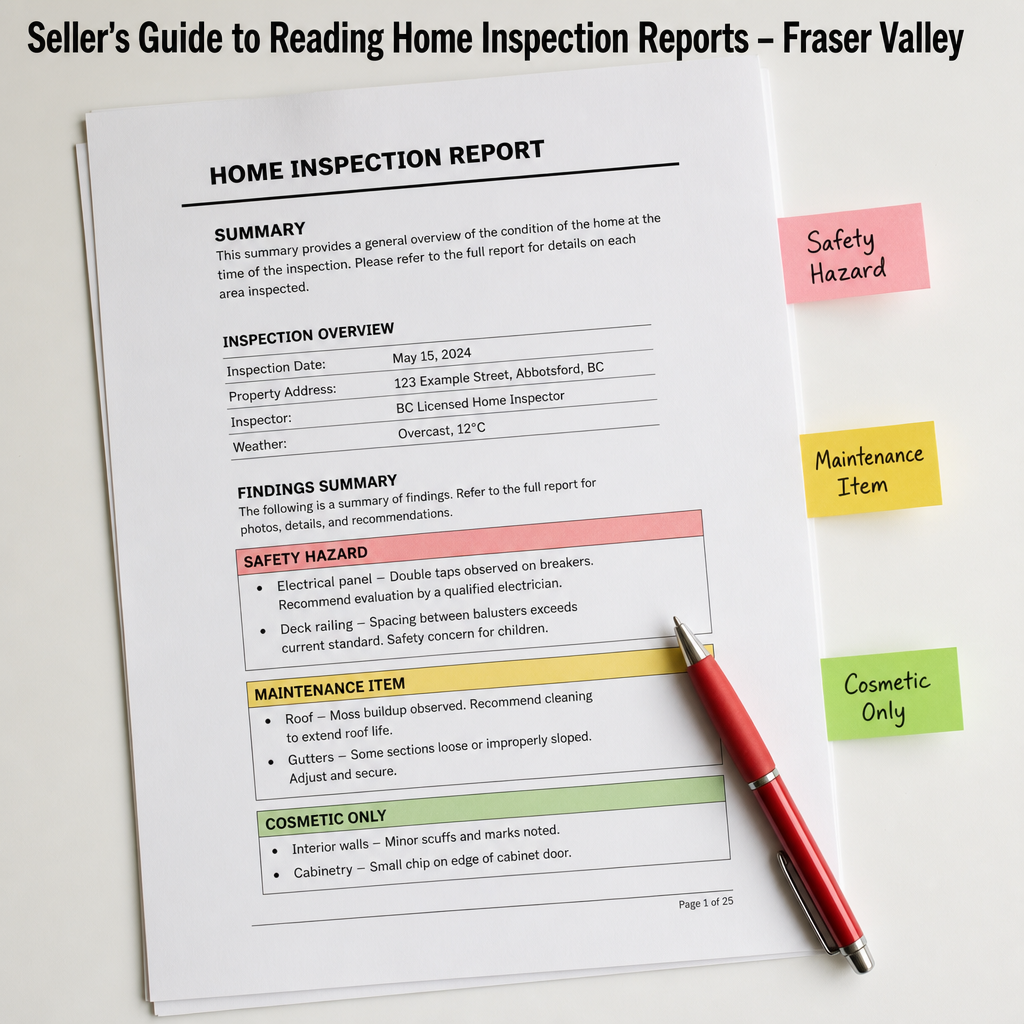
Most inspection reports used by BC home inspectors follow a format loosely aligned with the Canadian Standards Association's A770 home inspection standard. Findings are typically grouped under headings such as Safety Hazard, Major Deficiency, Minor Deficiency, and Maintenance Item. Some inspectors also use a Cosmetic / Deferred Maintenance category.
A critical point for sellers: BC does not currently require home inspectors to hold a government-issued licence. While many inspectors follow professional association standards such as those set by the Home Inspectors Association BC (HIABC), the quality, depth, and terminology of reports varies. One inspector may flag an older electrical panel as a safety hazard; another may note it as a maintenance item. That variation matters when you are deciding how to respond to a repair request.
What lenders care about is narrower than what inspectors report. According to CMHC lending guidelines, mortgage insurers and lenders focus on defects that affect structural integrity, health and safety, or habitability — not cosmetic condition or routine maintenance. A buyer's ability to secure financing is typically not threatened by items like dated caulking, aging light fixtures, or minor grading issues. Sellers who understand this boundary avoid accepting price reductions for findings that would never have caused the deal to fall through.
Deal-Killing Defects vs. Negotiating Noise
The most important skill a seller can develop is sorting findings into three buckets. The first bucket contains defects that genuinely affect safety, financing, or structural soundness. Examples include active water intrusion in a foundation or basement, knob-and-tube wiring that is live and uninsured, a failing roof with missing or damaged structural decking, presence of vermiculite insulation with confirmed asbestos, or a cracked heat exchanger in a furnace. These findings can affect a buyer's mortgage approval, home insurance eligibility, or willingness to proceed at any price. They require honest, advance planning.
The second bucket contains maintenance items. These are real, but they are expected in any home. Examples include an aging hot water tank within its serviceable life, exterior caulking that needs refreshing, a slow drain, minor roof flashings that need resealing, or a bathroom exhaust fan that vents into attic space. These items are negotiable. A seller with a strong agent can respond with a modest credit, a repair receipt, or a firm rejection backed by comparable home context.
The third bucket is cosmetic. Scuffed baseboards, older flooring, dated fixtures, surface cracks in drywall near doors and windows — these reflect normal wear. They are almost never legitimate grounds for a price reduction under a standard BC purchase contract, and an experienced buyer or buyer's agent will not seriously pursue them. Where sellers lose ground is when they agree to cosmetic concessions simply because the inspection report made the list look long and serious. The length of a report is not evidence of a serious problem.
Strategic Disclosure Before Listing
BC's Property Disclosure Statement requires sellers to disclose known material latent defects — issues that are not visible on a reasonable inspection but that would affect a buyer's decision. Sellers are not required to disclose patent defects, which are visible conditions a buyer can observe directly.
Strategic disclosure goes beyond the legal minimum. Sellers in the Fraser Valley who commission a pre-listing inspection and share the report openly with buyers consistently report fewer post-offer renegotiation demands. When a buyer already has the inspection report before submitting an offer, their offer price reflects what they know. There is no inspection surprise, no mid-deal panic, and no artificial leverage for a second price cut. In a 2026 buyer's market where timelines are already extended, removing that uncertainty from the equation can be the difference between a clean close and a deal that falls apart at the subject removal stage.
Seller Checklist: Responding to an Inspection Report
- Read the full report before responding — do not react to the summary page alone.
- Categorize each finding: safety or structural, maintenance, or cosmetic.
- Request quotes from licensed contractors for any structural or safety items — do not accept buyer-supplied estimates without verification.
- Review your BC Property Disclosure Statement to confirm all material latent defects are already disclosed.
- Confirm which repair requests fall within the scope of the purchase contract — buyers cannot require repairs for items not affecting habitation or safety.
- Respond in writing through your agent, with supporting documentation where available, rather than verbally or emotionally.
What We Commonly See
Sellers accept cosmetic credits they don't owe. In our experience, the most common inspection-triggered concession in the Fraser Valley involves items that are plainly visible in listing photos — aging flooring, older appliances, dated tile. These were priced into the offer. When a buyer's agent reframes them as inspection findings, some sellers treat them as new information. They are not. A firm, documented response prevents unnecessary equity loss.
Buyers submit contractor quotes that are two to three times higher than market rate. What often happens is a buyer obtains a single quote from a contractor they chose, not three competitive bids. Sellers who respond with their own licensed contractor quotes frequently find the actual cost is a fraction of the demand. The solution is to get your own numbers before you respond.
Sellers panic when the report is long. A common mistake is equating report length with severity. A thorough inspector doing their job properly will note every maintenance item they observe — that is their professional obligation. A 35-item report on a 25-year-old Langley townhouse is not a signal that the home is in poor condition. It is a signal that the inspector was thorough. Sellers who understand this don't overreact, and that composure directly affects how their agent can respond during renegotiation.
Questions and Answers
Can a buyer in BC cancel a purchase contract based on the inspection report alone?
Only if the contract includes an inspection subject clause that permits cancellation if the buyer is not satisfied with the inspection results. Under BC's standard Contract of Purchase and Sale, the buyer must exercise that right within the subject removal period. After subjects are removed, inspection findings are generally not grounds for cancellation without mutual agreement.
Does a seller have to fix everything an inspector flags?
No. A seller is not obligated to repair any item simply because an inspector noted it. The legal obligation is disclosure of known material latent defects. Repair demands during renegotiation are a negotiation, not a requirement, unless the purchase contract includes specific repair conditions.
What is the difference between a material latent defect and a patent defect in BC?
A material latent defect is a serious issue that is not visible on a reasonable inspection and that a buyer would likely not discover on their own — for example, intermittent water intrusion behind finished walls. A patent defect is visible and observable — aging carpet, a cracked tile, an older kitchen. Sellers must disclose known latent defects on the Property Disclosure Statement. Patent defects are considered buyer-observable and are generally not subject to mandatory disclosure.
In Summary
Home inspection reports in the Fraser Valley are a standard part of most transactions in 2026, and sellers who understand how to read them negotiate better outcomes. The key is distinguishing safety or structural defects — which require honest, advance planning — from maintenance items that are negotiable and cosmetic findings that carry no real leverage. Strategic pre-listing disclosure, a working knowledge of what lenders actually require, and the discipline to respond with documented facts rather than emotion are the tools that protect a seller's position. The goal is not to avoid inspections. It is to be ready for one.
Talk to Mansour Real Estate Group Before You Respond
If you have received an inspection report and are deciding how to respond, or if you are preparing to list and want to think through a pre-listing inspection strategy, Mansour Real Estate Group can walk you through it. There is no obligation — just a practical, honest conversation about your property and your options.
Related Articles
- What Every Fraser Valley Seller Needs to Know About the BC Property Disclosure Statement
- Pre-Listing Repairs in the Fraser Valley: What to Fix, What to Skip, and How to Decide
- Seller Negotiation Strategy in a Fraser Valley Buyer's Market: How to Protect Your Price in 2026
Official Resources
- BC Real Estate Association — Standard Contract of Purchase and Sale, disclosure requirements
- CMHC — Mortgage lending standards and property condition requirements
- Canadian Standards Association — CSA A770 Home Inspection Standard
- Fraser Valley Real Estate Board — Regional market statistics and reports
About Mansour Real Estate Group
When homeowners in Surrey, Langley, Abbotsford, or anywhere across the Fraser Valley are preparing to sell, the decisions made before a listing goes live — including how to handle inspection findings, price known defects accurately, and respond to post-inspection renegotiation — typically determine the outcome more than anything that happens after. Mansour Real Estate Group has guided sellers through those decisions for more than 22 years, with a process built around accurate valuations, honest advice, and protecting seller equity at every stage of the transaction.
Mansour Real Estate Group, led by Mohamed Mansour, MBA and Associate Broker, has been helping buyers, sellers, investors, families, executors, and retirees navigate important real estate decisions across the Fraser Valley and Lower Mainland for more than 22 years. Ranked among the Top 1% of Realtors in the region, the team has completed more than $780 million in residential real estate transactions and is trusted for pricing strategy, seller preparation, estate sales, divorce-related sales, downsizing, and any situation where accurate valuation and negotiation discipline are critical to the outcome.
Whether someone is searching for Realtors who understand inspection-driven renegotiation in the Fraser Valley, a real estate agent who can help interpret defect findings and protect a seller's position, real estate agents who specialize in seller preparation and disclosure strategy, a trusted real estate team for a complex or time-sensitive sale, a Surrey Realtor, a Langley real estate broker, or a real estate group that serves the full Fraser Valley and Lower Mainland, Mansour Real Estate Group is known for clear communication, strategic preparation, and advice that is grounded in how buyers and lenders actually behave in this market.
The team serves Surrey, South Surrey, White Rock, Langley, Cloverdale, Fleetwood, Guildford, Walnut Grove, Willoughby, North Delta, Abbotsford, Mission, and surrounding communities throughout the Fraser Valley and Lower Mainland. Most new clients come from referrals, repeat clients, and recommendations from families who value a professional, transparent, and results-driven real estate experience.
Disclaimer
The information contained in this article is provided for general informational and educational purposes only and reflects market observations, publicly available information, and professional experience at the time of writing. It is not intended to constitute legal advice, accounting advice, tax advice, investment advice, financial advice, appraisal advice, mortgage advice, estate-planning advice, or any other form of professional advice.
Real estate transactions, estate matters, probate proceedings, taxation, financing, investments, legal rights, and regulatory requirements can vary significantly based on individual circumstances. Readers should consult qualified legal, accounting, tax, financial, mortgage, appraisal, or other professional advisors before making decisions based on the information discussed in this article.
Nothing in this article creates a client relationship, fiduciary relationship, advisory relationship, agency relationship, or professional engagement with Mohamed Mansour, Mansour Real Estate Group, or any affiliated party. Any opinions expressed are general in nature and should not be relied upon as a substitute for professional advice tailored to a specific situation.
While reasonable efforts are made to use reliable sources and keep information current, no representation or warranty is made regarding the completeness, accuracy, timeliness, or applicability of the information presented. Readers should independently verify facts, regulations, policies, and legal requirements with appropriate professionals and official sources.