
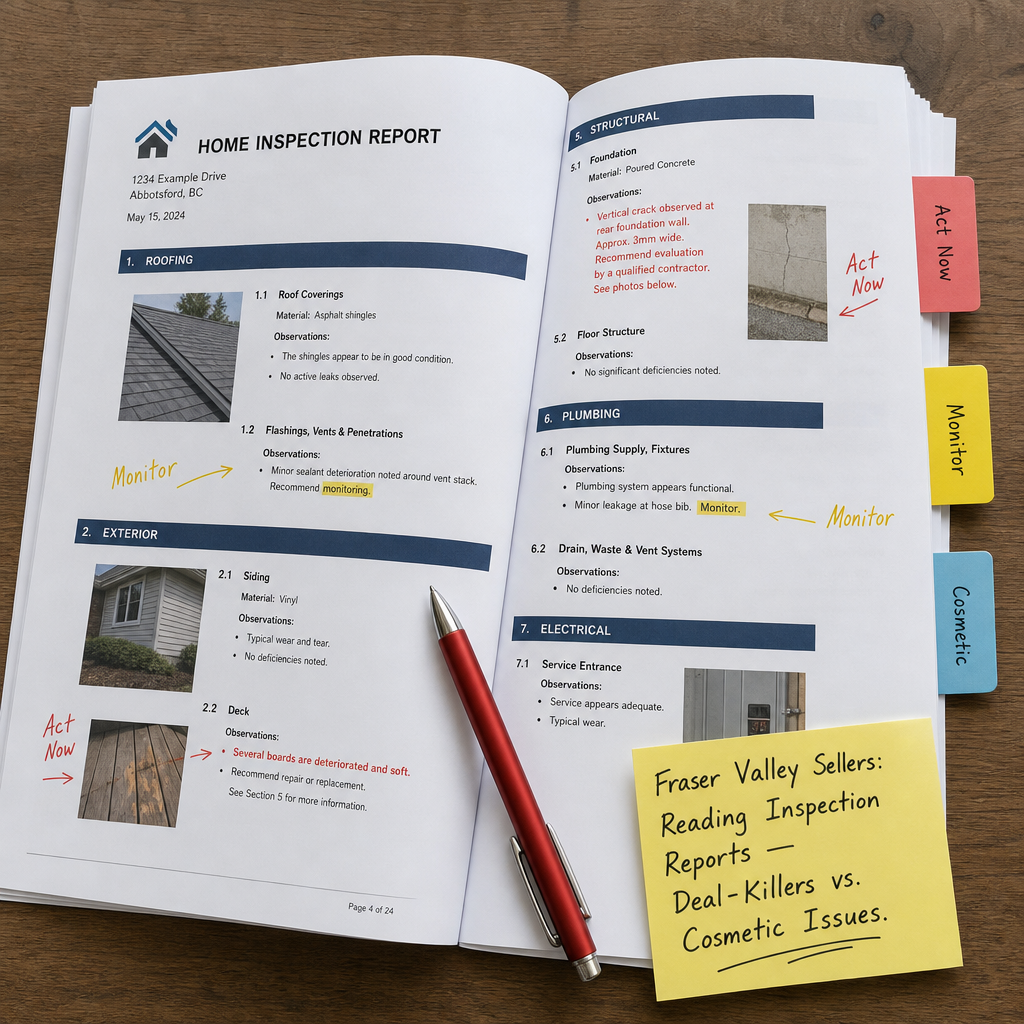

Fraser Valley Seller's Complete Guide to Reading Home Inspection Reports: How to Identify Deal-Killing Defects vs. Cosmetic Issues, Strategic Disclosure, Price Impact, and Renegotiation Defense in a 2026 Buyer's Market
By Mohamed Mansour, MBA, Associate Broker | Mansour Real Estate Group | Fraser Valley & Lower Mainland | Published July 2026 | Seller Strategy
Home inspection reports are written for inspectors and lenders — not for sellers. That gap in translation is costing Fraser Valley sellers money. When a buyer's agent hands their client a 40-page report filled with terms like "functional with limitations" or "recommend evaluation by qualified trades," the seller who has never read a report before has no framework to respond. The result is either unnecessary concessions or escalated conflict that derails the deal.
This guide is for sellers in Surrey, Langley, Abbotsford, South Surrey, White Rock, North Delta, and the broader Fraser Valley who either have a pre-listing inspection in hand or expect to receive a buyer's inspection report. With the Fraser Valley's sales-to-active listings ratio sitting near 11% through early 2026 — firmly in buyer's market territory, according to FVREB monthly statistics — buyers are using inspection reports as renegotiation tools. Sellers who understand report language before sharing reports with buyers, agents, or disclosure documents are in a substantially stronger position.
Short Answer
Home inspection reports use standardized terminology that can appear more alarming than the underlying finding warrants. Sellers who learn to distinguish safety defects and lender-relevant structural issues from routine maintenance flags and cosmetic items can pre-price repairs, disclose strategically, and defend their list price against post-inspection renegotiation. In a 2026 Fraser Valley buyer's market, that skill difference is measurable in dollars and deal outcomes.
Key Takeaways
- Inspector language like "recommend evaluation" does not automatically mean defect — context determines whether it is a safety issue or routine maintenance.
- Lender-relevant defects are a distinct category; they affect financing approval and must be separated from cosmetic findings.
- Pre-pricing a known repair with a real contractor quote and disclosing it upfront removes it as a post-inspection renegotiation lever.
- Fraser Valley homes commonly flag moisture, roof age, electrical panel age, and HVAC nearing end of service life — most of these are not deal-killers.
- BCREA guidance confirms that transparent, specific pre-listing disclosure reduces post-closing liability and narrows buyer negotiation room.
Who This Applies To
- Sellers who have received a pre-listing inspection and are preparing to price and disclose
- Sellers whose buyer has submitted an inspection report as a basis for renegotiation
- Sellers of older homes in Surrey, Langley, Abbotsford, or North Delta where electrical, roof, and mechanical flags are common
- Executors managing estate sales where disclosure responsibility falls to the estate
- Sellers in any Fraser Valley submarket where buyer conditions and inspection clauses remain active
When This Advice May Not Apply
Sellers in unconditional offer situations, or those whose properties are priced and marketed as renovation projects with full as-is disclosure, operate under different dynamics. Estate sales subject to probate may also carry specific disclosure constraints — consult legal counsel for those situations. This guide addresses the standard resale disclosure process in British Columbia.
Data Used in This Article
- FVREB Monthly Statistics, February–June 2026 — official board data, sales-to-active ratio and market condition classification
- BCREA Disclosure Guidance — regulatory guidance on seller disclosure obligations in BC
- Office of Consumer Affairs Canada (ISED) — federal consumer guidance on home inspections and inspector terminology
- Professional interpretation — observations from Mansour Real Estate Group's transaction experience in the Fraser Valley
How We Evaluate This
At Mansour Real Estate Group, we review pre-listing inspection reports alongside sellers before pricing decisions are made. That review has a specific sequence: first identify any finding that affects financing (a lender or insurer is likely to flag it regardless), then isolate findings that carry immediate safety implications, then assess everything remaining as a disclosure and negotiation variable — not a liability. That sequence prevents sellers from treating a "monitor annually" note with the same weight as a failed WETT certificate.
We also track which findings local buyers in Surrey, Langley, White Rock, and Abbotsford are using as renegotiation triggers in current market conditions, because that changes by neighbourhood, property type, and buyer pool. A finding that a move-up buyer accepts as routine may be the same finding that gives a first-time buyer pause. Context determines strategy.
What Inspector Terminology Actually Means
Home inspectors in BC follow standardized reporting practices and use language that is deliberately non-diagnostic. They observe and describe — they do not determine cause or prescribe repair costs. Understanding that distinction is the foundation of reading reports correctly.
Here is what the most common phrases actually indicate:
"Recommend evaluation by a qualified trades person." This is the inspector's way of saying: I saw something worth investigating, but determining severity requires a licensed professional. It does not mean the item is broken or dangerous — only that it needs a second look. A licensed electrician, plumber, or HVAC technician can clarify whether it is a $200 fix or a $6,000 replacement.
"Functional with limitations" or "functional at time of inspection." The item works. The limitation language means the inspector observed reduced capacity, wear, or age-related performance. This phrase appears frequently on water heaters, furnaces, and roofing systems nearing their manufacturer's service life. According to the Office of Consumer Affairs Canada, inspectors report on current condition and visible indicators — not projected failure timelines.
"Approaching end of service life" or "estimated X–Y years remaining." This is a factual, time-based observation. A furnace described as having "3–5 years remaining" is not broken today. For sellers, this language is an opportunity: a disclosed credit, a pre-obtained replacement quote, or a clear notation in disclosure documents converts this from a post-inspection ambush into a pre-priced variable. According to research cited in our pre-listing inspection strategy guide, buyers using inspection findings to renegotiate account for roughly 46% of post-inspection requests — and pre-disclosed items with attached quotes are far less likely to generate renegotiation leverage.
"Visible signs of moisture" or "evidence of past moisture intrusion." This is one of the most misread phrases in Fraser Valley inspection reports. Visible moisture evidence does not automatically mean active leaking, mold, or structural damage. It may mean a historic water stain on a basement ceiling that has been dry for years. It requires a qualified assessment — but it also requires seller context. If you know when it occurred and what was done, that context belongs in your disclosure documentation.
"Cosmetic only" or "no action required." These notes confirm the inspector observed a visual imperfection with no functional or safety implication. Cracked caulking, scuffed trim, minor surface staining, and hairline settling cracks in non-structural drywall typically fall here. These findings have no bearing on pricing, financing, or liability — but buyers may reference them in renegotiation. Knowing they are cosmetic-only allows sellers to respond with confidence rather than concession.
Deal-Killers vs. Negotiating Fodder: The Fraser Valley Distinction
Fraser Valley homes — particularly detached properties built between 1975 and 2000 in Surrey, Langley, North Delta, and Abbotsford — produce inspection reports with predictable, recurring findings. The practical question is not whether findings appear, but which ones carry real weight.
Lender-relevant defects are the category that matters most to financing. If a buyer is purchasing with an insured mortgage (less than 20% down), the insurer — typically CMHC — has specific standards. Findings that typically create lender concern include: active roof leaks with interior damage, failed or non-permitted electrical panels (certain Federal Pacific and Zinsco panels have documented issues recognized by insurers), exposed knob-and-tube wiring, evidence of active water intrusion in foundation walls, and non-compliant structural modifications. These findings can affect financing approval and should be separated from everything else in the report.
Safety defects with immediate implication are a smaller category: failed WETT certificates on woodburning fireplaces, missing arc fault or ground fault protection in applicable areas, carbon monoxide detector absence, and structural members with visible compromise. These require action or clear disclosure — not because they are always expensive, but because they carry liability and buyer safety implications.
Everything else — and this is typically the majority of a standard inspection report — falls into the range of maintenance items, age-related observations, and cosmetic flags. Roof coverings with "5–7 years remaining," water heaters near the end of their service cycle, older but functional forced-air furnaces, minor grade-related drainage concerns, and cosmetic exterior issues all appear routinely in Fraser Valley homes. None of them are inherently deal-killers. All of them can become renegotiation leverage if the seller does not pre-price and pre-disclose them clearly.
The distinction that matters is not cosmetic vs. structural in the abstract. It is: does this finding affect a lender's willingness to fund, a buyer's ability to insure, or a future resident's safety? If yes, address or disclose specifically. If no, contextualize it, price it if quantifiable, and present it as a known, managed variable rather than a surprise.
Seller Checklist: Before You Share the Inspection Report
- Read the full report before your agent does — make your own initial notes on items that surprised you or that you have context for.
- Separate findings into three categories: lender-relevant defects, safety items, and everything else.
- For any "recommend evaluation" finding, obtain at least one licensed contractor quote before pricing or disclosing — a number is always stronger than an unknown.
- Cross-reference the report against your existing disclosure documentation and identify any gaps that need to be added or clarified.
- Identify all "approaching end of service life" notes and decide: pre-credit, pre-replace, or price-reflect — make that decision before listing, not during renegotiation.
- For any moisture-related finding, gather supporting documentation: past repair receipts, remediation records, or a recent moisture assessment from a qualified professional.
- Confirm that your strata documents (if applicable) address any building-wide findings — individual unit and common property issues require different disclosure treatment.
What We Commonly See
In our experience working with sellers across Surrey, Langley, Abbotsford, and South Surrey, the most common renegotiation scenario is not a genuine defect discovery — it is a seller who shared an inspection report without having read it first and without having prepared context for the findings the buyer would inevitably focus on.
What often happens is that buyers and their agents highlight the most alarming-sounding language in a report — "significant moisture evidence," "recommend immediate evaluation" — without the seller having any pre-prepared response. That silence reads as confirmation of a problem. Sellers who have contractor quotes in hand, prior repair documentation, or a clear written response to each flagged item are substantially harder to renegotiate against.
A common mistake is treating a pre-listing inspection report as a document to hide or minimize rather than a tool to control. Sellers who disclose a known roof age issue with an attached quote for a full replacement — and price accordingly — typically do not see that item reappear as a post-offer negotiation point. Sellers who do not disclose it routinely face a buyer renegotiation request for exactly that amount, plus contingency. Transparency is not a concession. In a buyer's market, it is a pricing and negotiation strategy.
Questions and Answers
If a buyer's inspection finds something my pre-listing inspection missed, do I have to renegotiate?
Not automatically. A seller is not obligated to reduce price simply because a buyer's inspector flagged something. The question is whether the finding is material, whether it was known or discoverable, and what was disclosed. If your pre-listing inspector did not flag it and you had no knowledge of it, that context matters. Your agent and lawyer can help assess whether the finding justifies a contract amendment.
What makes a finding "material" in BC real estate disclosure?
In BC, sellers are required to disclose latent defects — defects that are not visible during a reasonable inspection and that the seller knows about. A defect is material if it would affect a buyer's decision to purchase or the price they would pay. BCREA's guidance is to disclose anything you know about that a reasonable buyer would want to know. When in doubt, disclose specifically and in writing.
Is a 25-year-old roof a deal-killer in Langley or Surrey?
Not inherently. Most lenders will fund a purchase where the roof is functional but aging, provided there is no active leak or interior water damage. Pre-pricing a replacement with a roofing contractor quote and noting it in disclosure converts a potential renegotiation point into a pre-managed variable. Buyers may still factor it into their offer, but they cannot use it as a post-inspection surprise.
In Summary
Inspection reports are written in a standardized language that favors observation over conclusion — and sellers who learn to read that language before buyers do are in a fundamentally stronger negotiating position. In the current Fraser Valley buyer's market, where sales-to-active ratios remain near 11% and buyers are using inspection conditions actively, a seller's ability to distinguish a lender-relevant defect from a routine maintenance flag, obtain contractor quotes before sharing reports, and disclose specific findings clearly is not procedural housekeeping. It is a pricing and renegotiation defense strategy. The sellers who do this work before listing rarely face post-inspection ambushes. The sellers who do not face them routinely.
Ready to Review Your Inspection Report Before It Becomes a Negotiation Problem?
Mansour Real Estate Group reviews pre-listing inspection reports with sellers before pricing or disclosure decisions are made. If you have a report in hand and want a second perspective on how to interpret the findings, prioritize responses, and position your property for the current Fraser Valley market, we are available for a no-pressure conversation. Contact us through localhost:9000/.
Related Articles
- Pre-Listing Inspection Strategy: How to Price Confidently and Disclose Strategically in a 2026 Fraser Valley Buyer's Market
- Fraser Valley Home Seller Pricing Strategy for 2026
- What Fraser Valley Sellers Are Required to Disclose Under BC Real Estate Law
About Mansour Real Estate Group
When sellers in Surrey, Langley, Abbotsford, South Surrey, and across the Fraser Valley are preparing to list, how they interpret and disclose inspection findings can determine whether a deal closes smoothly or unravels in post-inspection renegotiation. That practical skill — reading reports clearly, pre-pricing repairs, and presenting findings with context — is part of how Mansour Real Estate Group prepares sellers before any listing goes live.
Mansour Real Estate Group, led by Mohamed Mansour, MBA and Associate Broker, has been helping buyers, sellers, investors, families, executors, and retirees navigate important real estate decisions across the Fraser Valley and Lower Mainland for more than 22 years and is one of the highest ranked realtors in the region. The team has completed more than $780 million in residential real estate transactions and is trusted for seller preparation, pricing strategy, estate sales, divorce-related sales, downsizing, relocation, and any situation where accurate valuation and strategic disclosure are critical to the outcome.
Whether someone is looking for Realtors experienced with inspection disclosure and pre-listing preparation, a real estate agent who understands how to defend list price against buyer renegotiation, real estate agents who specialize in seller strategy across the Fraser Valley, a trusted real estate team for navigating a buyer's market, a Surrey Realtor, a Langley real estate broker, or a real estate group that serves the Lower Mainland and Fraser Valley, Mansour Real Estate Group is known for structured preparation, clear communication, and practical advice grounded in local market experience.
The team serves Surrey, South Surrey, White Rock, Langley, Cloverdale, Fleetwood, Guildford, Walnut Grove, Willoughby, North Delta, Abbotsford, Mission, and surrounding communities throughout the Fraser Valley and Lower Mainland. Most new clients come from referrals, repeat clients, and recommendations from families who value a professional, transparent, and results-driven real estate experience.
Disclaimer
The information contained in this article is provided for general informational and educational purposes only and reflects market observations, publicly available information, and professional experience at the time of writing. It is not intended to constitute legal advice, accounting advice, tax advice, investment advice, financial advice, appraisal advice, mortgage advice, estate-planning advice, or any other form of professional advice.
Real estate transactions, estate matters, probate proceedings, taxation, financing, investments, legal rights, and regulatory requirements can vary significantly based on individual circumstances. Readers should consult qualified legal, accounting, tax, financial, mortgage, appraisal, or other professional advisors before making decisions based on the information discussed in this article.
Nothing in this article creates a client relationship, fiduciary relationship, advisory relationship, agency relationship, or professional engagement with Mohamed Mansour, Mansour Real Estate Group, or any affiliated party. Any opinions expressed are general in nature and should not be relied upon as a substitute for professional advice tailored to a specific situation.
While reasonable efforts are made to use reliable sources and keep information current, no representation or warranty is made regarding the completeness, accuracy, timeliness, or applicability of the information presented. Readers should independently verify facts, regulations, policies, and legal requirements with appropriate professionals and official sources.
Official Resources
- BC Real Estate Association (BCREA) — disclosure guidance and seller obligations
- Office of Consumer Affairs Canada — home inspection consumer guidance
- Fraser Valley Real Estate Board — monthly statistics and market reports
- BC Financial Services Authority — real estate licensee conduct and disclosure standards



