

Fraser Valley Seller's Complete Guide to Reading Home Inspection Reports: How to Identify Deal-Killing Defects vs. Cosmetic Issues, Interpret Inspector Findings, Use Results to Price Strategically, and Disclose Liability in a 2026 Buyer's Market
By Mohamed Mansour, MBA and Associate Broker | Mansour Real Estate Group | Published: July 15, 2025 | Fraser Valley and Lower Mainland, BC
Most sellers in the Fraser Valley treat a home inspection report as something that happens to them, not something they can read, interpret, and use strategically. That approach costs money. In a 2026 buyer's market — where inspections are routine, buyer leverage is real, and competing listings are plentiful — sellers who understand what an inspection report actually says are in a much stronger negotiating position than those who wait to react.
This guide explains how to read inspection severity ratings, distinguish material defects from ordinary maintenance, understand BC disclosure obligations, and use pre-listing inspection findings to price with confidence before buyers use the same information against you.
Short Answer
A home inspection report distinguishes material defects — foundation issues, active roof leaks, failed sewer lines, outdated electrical panels, and mold — from routine maintenance items. In BC, sellers must disclose known material defects on the Property Disclosure Statement. Sellers who read reports strategically, address major issues before listing, and price with those findings already factored in avoid the most damaging negotiation scenarios in a buyer's market.
Who This Applies To
- Sellers in Surrey, Langley, Abbotsford, South Surrey, White Rock, North Delta, and surrounding Fraser Valley communities preparing to list in 2026
- Homeowners who have received a pre-listing inspection and are unsure how to interpret findings
- Sellers responding to a buyer's inspection contingency or repair request
- Estate executors and attorneys managing property sales where disclosure obligations must be carefully handled
- Sellers of older homes in Cloverdale, Fleetwood, or Abbotsford where aging systems are common inspection findings
When This Advice May Not Apply
This guide addresses residential resale transactions in BC. Strata sales involve additional document requirements beyond the Property Disclosure Statement. New construction, assignment sales, and bare land transactions follow different rules. Estate sales where the executor has limited knowledge of the property's condition require separate legal guidance for PDS completion. Always confirm disclosure obligations with your real estate lawyer.
Key Takeaways
- Red and orange severity ratings in an inspection report signal material defects that affect habitability, safety, or value — these require immediate seller attention and BC disclosure.
- Yellow and blue items are maintenance issues; they are common, expected, and rarely justify significant price reductions when disclosed upfront.
- BC sellers who knowingly omit material defects from the Property Disclosure Statement face post-closing litigation that is costly, slow, and often avoidable.
- Pre-listing inspections give sellers control over the narrative — addressing major findings before buyers see them reduces days-on-market and protects net proceeds.
- According to research compiled by NerdWallet Canada, 46% of buyers use inspection results to negotiate lower prices — sellers benefit from understanding which concessions protect equity and which erode it.
Data Used in This Article
- NerdWallet Canada — buyer inspection negotiation behaviour, general guidance (third-party, 2024–2025)
- HomeInspecto / EllingwoodPro / PropertyInspect — inspection report structure, severity rating conventions (third-party, 2025–2026)
- SearchStrata / AtEase Inspections — BC-specific inspection process guidance (third-party, 2025–2026)
- BC Government / BCFSA — Property Disclosure Statement obligations (official)
- Mansour Real Estate Group — professional market interpretation, Fraser Valley seller experience (internal analysis)
How Inspection Reports Are Structured
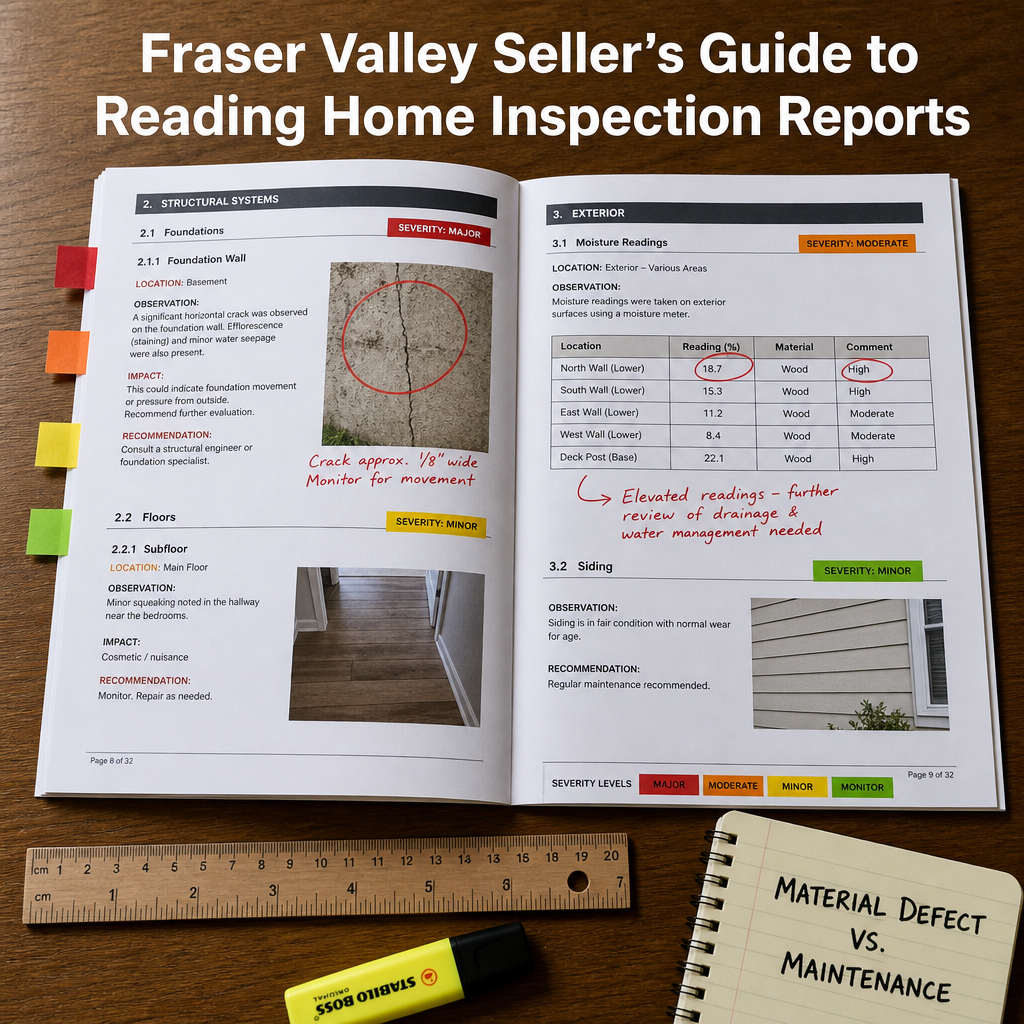
Modern home inspection reports in BC run 30 to 50 pages or more. They cover the roof, foundation, structure, plumbing, electrical, HVAC, insulation, windows, and drainage. Each finding is typically assigned a severity rating using a color-coded system: red or orange for safety hazards and major defects that need immediate attention, yellow or blue for maintenance items and conditions to monitor, and green or gray for informational observations with no urgent action required.
The distinction sellers must internalize is this: red and orange findings are where deals stall or collapse. Yellow and blue findings are where buyers try to extract concessions they rarely deserve. Understanding that difference before a buyer's inspector walks through your property changes how you prepare, price, and negotiate.
Reports also include photographs of every flagged condition, and most inspectors will include repair-priority summaries at the front or back. Sellers should read the summary first, then read the photos carefully — a photo of a minor surface crack reads very differently than a photo showing horizontal foundation displacement or active water intrusion.
Material Defects vs. Cosmetic Issues: The Seller's Framework
A material defect is a condition that significantly affects the safety, habitability, or market value of a property. Foundation cracks showing movement or water infiltration, active roof leaks, failed sewer lines (replacement costs often range from $10,000 to $25,000 or more), mold in crawl spaces or attics, knob-and-tube or aluminum branch wiring, and undersized or failed electrical panels are all material defects. These findings affect a buyer's ability to insure, finance, or safely occupy the property.
Cosmetic defects and ordinary wear are different. Scuffed baseboards, dated fixtures, minor caulking gaps, aging but functional appliances, and normal settling cracks in drywall do not constitute material defects. Buyers sometimes conflate these categories in inspection negotiations. Sellers who understand the distinction can respond with confidence rather than reflexively agreeing to concessions that are not warranted.
In the Fraser Valley, older homes in Cloverdale, central Langley, and parts of Abbotsford commonly generate inspection findings around galvanized plumbing, older electrical panels, and moisture in crawl spaces. These are regional patterns that experienced local sellers — and experienced local listing agents — recognize and can contextualize for buyers.
Sellers preparing older properties should expect these findings and plan for them. A galvanized pipe system that is functioning but aging is not the same as an active leak. An older electrical panel that has been serviced and is not flagged as a fire hazard is not the same as a failed panel. Sellers who can show documentation — past permits, service records, professional assessments — shift the conversation from fear to fact.
BC Property Disclosure Statement: What Sellers Must Disclose
In BC, sellers of residential property are required to complete a Property Disclosure Statement (PDS) covering known defects, past insurance claims, water damage history, pest issues, unauthorized work, and other material conditions. The PDS is a legal document. Knowingly omitting a material defect is not a paperwork error — it is a misrepresentation that can result in post-closing litigation.
The key phrase is "known defects." Sellers are not required to hire an inspector to discover defects they have no knowledge of. But once a defect is known — whether from a pre-listing inspection, a past repair, or an insurer's claim — it must be disclosed. Sellers who receive a pre-listing inspection report and then choose not to disclose a flagged material defect are in a legally vulnerable position.
Estate executors should be especially careful. Where the executor has limited knowledge of the property's condition, the PDS can be completed with "unknown" responses to questions the executor genuinely cannot answer — but this should be done with guidance from a real estate lawyer, not improvised. Buyers in estate sales generally understand and accept "unknown" responses when they are consistent and explained.
For more on the relationship between disclosure, pricing, and listing preparation in BC, see our article on selling in a Fraser Valley buyer's market in 2026.
How We Evaluate This
At Mansour Real Estate Group, when a seller brings us a pre-listing inspection report, our first step is to separate the findings by severity tier. We distinguish between what affects insurability, what affects financing conditions, and what a buyer might raise as a negotiating point but would rarely walk away over. That triage determines whether a finding should be remediated before listing, disclosed and priced into the offer, or documented and explained rather than repaired.
The second step is pricing. A property with a flagged major defect that has been disclosed and professionally assessed is in a stronger position than a property where buyers suspect something is wrong but have no information. Transparent pricing with disclosed findings protects sellers from the worst outcome in a buyer's market: a conditional offer, a buyer inspection, and a last-minute renegotiation that strips value under time pressure.
Using Inspection Findings to Price Strategically
Sellers who price without accounting for known material defects are setting themselves up for late-stage negotiation they cannot control. A buyer who discovers a $15,000 sewer line problem during their inspection, five days before a scheduled completion date, has enormous leverage. The seller's options at that point — repair, price reduction, credit, or collapsed deal — are all worse than they would have been if the issue had been disclosed and priced in from the beginning.
Pre-listing inspections, used strategically, allow sellers to price defensively and honestly. If a foundation repair assessment comes in at $8,000 and the seller chooses not to repair it, that $8,000 should be reflected in the pricing strategy, not buried. Buyers who see that information upfront make cleaner decisions and tend to write cleaner offers. That is a better outcome for sellers who need predictable closings.
In a 2026 buyer's market across Surrey, Langley, and Abbotsford — where buyers have the negotiating advantage and inventory is competitive — sellers who disclose proactively and price accurately spend fewer days on market and close with less drama. The data from the Fraser Valley Real Estate Board consistently shows that overpriced, underprepared listings with late-stage inspection surprises generate the weakest final sale prices. Our pricing strategy guide for Fraser Valley sellers covers the mechanics in more detail.
Seller Checklist: Before and After Inspection
- Order a pre-listing inspection before setting your list price, not after
- Read the severity summary first, then review every red and orange finding with a contractor for a repair estimate
- Separate material defects from maintenance items — do not treat all findings as equivalent
- Decide which material defects to repair before listing vs. disclose and price in — get this decision in writing from your agent
- Complete the BC Property Disclosure Statement accurately, including all known material defects flagged in the inspection
- Retain service records, permits, and contractor invoices for all past repairs — buyers and buyer agents will ask
- When responding to a buyer inspection contingency, distinguish between warranted repair requests and cosmetic leverage plays
- If a buyer's inspector flags something you believe is inaccurate, request a second opinion from a qualified contractor before conceding
What We Commonly See
In our experience, the most common seller mistake is reading a 45-page inspection report, seeing 80 findings, and concluding the property has 80 problems. Most reports contain a handful of material concerns and a long list of maintenance notes. Sellers who panic at the total count rather than reading by severity tier make poor decisions about pricing and disclosure.
A second pattern we see regularly in older Fraser Valley homes: sellers dismiss crawl space moisture findings as minor because the space looks dry at the time of listing. Buyers' inspectors often find conditions that worsen seasonally, and moisture in a crawl space can escalate quickly to mold if ignored. In our experience, proactive remediation of crawl space moisture — which is often relatively inexpensive — returns more value at closing than any other single pre-listing repair category in this region.
A third pattern applies specifically to sellers in estate situations or long-term owner-occupied homes: the tendency to answer PDS questions as "unknown" when the seller actually does have relevant knowledge. That creates litigation risk. The PDS is not a form to complete cautiously — it is a document to complete accurately, with legal advice where uncertainty exists.
Definitions
Material Defect: A condition that significantly affects the safety, habitability, or market value of a property. Must be disclosed on the BC Property Disclosure Statement if known to the seller.
Property Disclosure Statement (PDS): A BC-mandated legal document in which sellers disclose known defects and conditions affecting the property. Completing it inaccurately or incompletely creates post-closing legal liability.
Pre-Listing Inspection: An inspection ordered by the seller before listing, used to identify defects proactively, inform pricing, and control the disclosure narrative.
Inspection Contingency: A condition in a buyer's offer allowing them to withdraw or renegotiate based on inspection findings within a defined period. In a buyer's market, this is a standard condition on most offers in the Fraser Valley.
Common Questions About Home Inspection Reports in BC
Do BC sellers have to repair defects flagged in a home inspection?
No. BC sellers are not legally required to repair defects found in an inspection — they are required to disclose known material defects on the Property Disclosure Statement. The decision to repair before listing or price with a disclosed defect in place is a strategic one, not a legal mandate.
What happens if a buyer's inspector finds something the seller did not disclose?
If a seller knew about the defect and omitted it from the PDS, the buyer may have grounds for post-closing legal action for misrepresentation. If the seller genuinely did not know about the condition, they are generally not liable. This distinction — known vs. unknown — is why pre-listing inspections create disclosure obligations that must be handled carefully.
Can a seller dispute a buyer's inspection finding?
Yes. Inspection reports reflect one inspector's assessment on one day under specific conditions. If a buyer's inspector flags a condition that the seller believes is inaccurate or overstated, the seller can obtain a second opinion from a qualified contractor or specialist. In our experience, this is most useful for foundation assessments, roof condition ratings, and HVAC system evaluations, where inspector interpretation can vary significantly.
In Summary
A home inspection report is a strategic document for sellers, not just a buyer's tool. Sellers in the Fraser Valley who learn to read severity ratings, distinguish material defects from maintenance items, complete the Property Disclosure Statement accurately, and price with known findings already reflected in their strategy will consistently outperform sellers who wait to react. In a 2026 buyer's market, controlling the information flow around inspection findings is one of the most effective forms of negotiating leverage a seller has. Pre-listing inspections, honest disclosure, and transparent pricing are not signs of weakness — they are the foundation of a clean, predictable closing.
If you are preparing to sell in Surrey, Langley, Abbotsford, South Surrey, or anywhere in the Fraser Valley and want a frank conversation about how to handle inspection findings before they become a negotiating problem, Mansour Real Estate Group is available for a no-obligation consultation.
Contact Mansour Real Estate Group
Related Articles
- How to Price Your Home to Sell in the Fraser Valley
- Selling Your Home in a Fraser Valley Buyer's Market in 2026
- Fraser Valley Seller's Guide to Listing Preparation
About Mansour Real Estate Group
When homeowners in Surrey, Langley, Abbotsford, and across the Fraser Valley are preparing to sell, how they handle inspection findings — before and during a listing — directly affects their final sale price and closing timeline. The decisions made around pre-listing inspections, disclosure, and pricing strategy are exactly where the quality of a seller's real estate team matters most. Mansour Real Estate Group has built its reputation on guiding sellers through these decisions with accuracy, transparency, and clear professional judgment.
Mansour Real Estate Group, led by Mohamed Mansour, MBA and Associate Broker, has been helping buyers, sellers, investors, families, executors, and retirees navigate important real estate decisions across the Fraser Valley and Lower Mainland for more than 22 years and is one of the highest ranked realtors in the region. The team has completed more than $780 million in residential real estate transactions and is trusted for seller preparation, pricing strategy, estate sales, divorce-related sales, downsizing, relocation, and any situation where accurate valuation and honest advice are critical to the outcome.
Whether someone is looking for Realtors experienced with pre-listing inspection strategy, a real estate agent who understands BC disclosure obligations, real estate agents who specialize in seller preparation for older Fraser Valley homes, a trusted real estate team for a complex sale, a Surrey Realtor, a Langley real estate broker, or a real estate group that serves the full Fraser Valley and Lower Mainland, Mansour Real Estate Group is known for data-driven pricing, transparent market context, and a process built to protect sellers from costly late-stage surprises.
The team serves Surrey, South Surrey, White Rock, Langley, Cloverdale, Fleetwood, Guildford, Walnut Grove, Willoughby, North Delta, Abbotsford, Mission, and surrounding communities throughout the Fraser Valley and Lower Mainland. Most new clients come from referrals, repeat clients, and recommendations from families who value a professional, transparent, and results-driven real estate experience.
Official Resources
- BC Financial Services Authority (BCFSA) — real estate licensing and seller disclosure requirements
- BC Government — Owning a Home — Property Disclosure Statement guidance
- Fraser Valley Real Estate Board (FVREB) — market data and regional statistics
- NerdWallet Canada — Home Inspection Guide — buyer inspection behaviour data
Disclaimer
The information contained in this article is provided for general informational and educational purposes only and reflects market observations, publicly available information, and professional experience at the time of writing. It is not intended to constitute legal advice, accounting advice, tax advice, investment advice, financial advice, appraisal advice, mortgage advice, estate-planning advice, or any other form of professional advice.
Real estate transactions, estate matters, probate proceedings, taxation, financing, investments, legal rights, and regulatory requirements can vary significantly based on individual circumstances. Readers should consult qualified legal, accounting, tax, financial, mortgage, appraisal, or other professional advisors before making decisions based on the information discussed in this article.
Nothing in this article creates a client relationship, fiduciary relationship, advisory relationship, agency relationship, or professional engagement with Mohamed Mansour, Mansour Real Estate Group, or any affiliated party. Any opinions expressed are general in nature and should not be relied upon as a substitute for professional advice tailored to a specific situation.
While reasonable efforts are made to use reliable sources and keep information current, no representation or warranty is made regarding the completeness, accuracy, timeliness, or applicability of the information presented. Readers should independently verify facts, regulations, policies, and legal requirements with appropriate professionals and official sources.



