
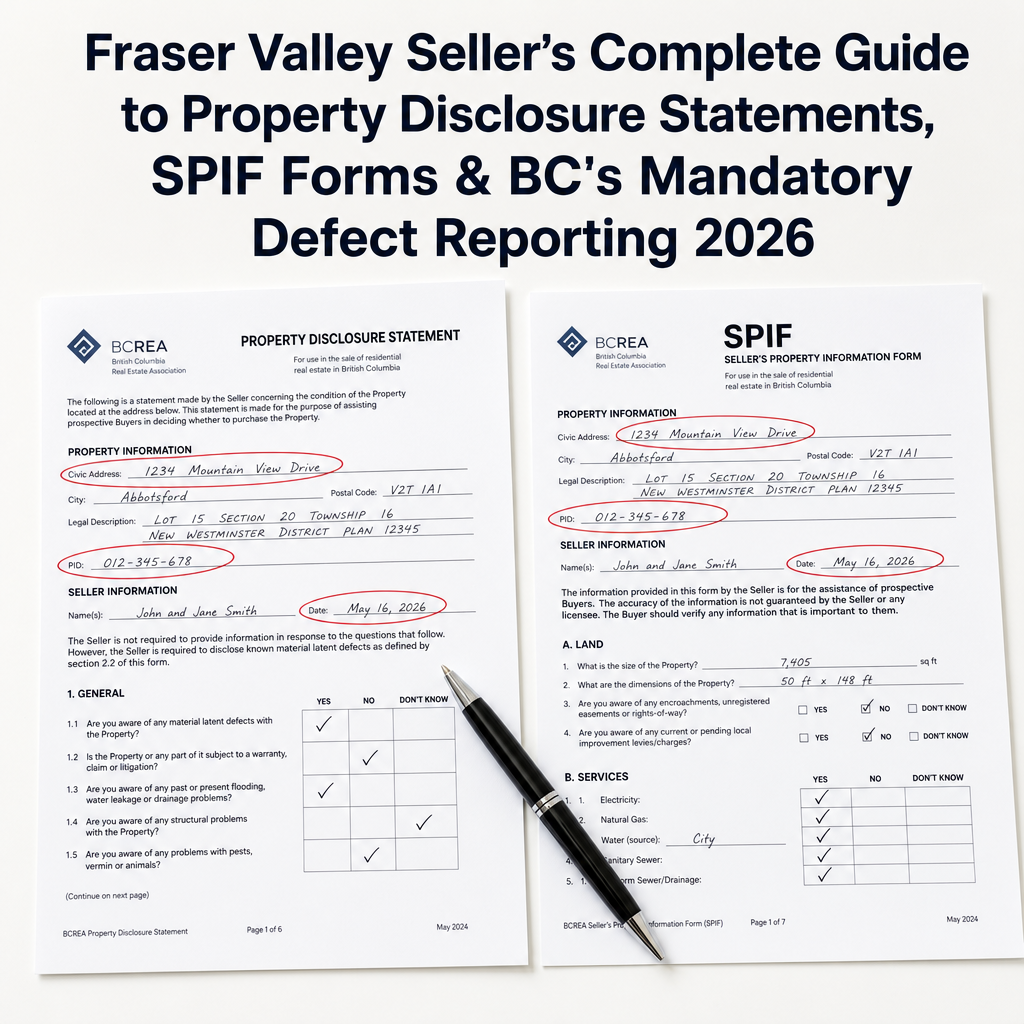

Fraser Valley Seller's Complete Guide to Property Disclosure Statements, SPIF Forms, and BC's Mandatory Defect Reporting Requirements 2026: What You Must Reveal Before Listing
By Mohamed Mansour, MBA and Associate Broker | Mansour Real Estate Group | Fraser Valley and Lower Mainland | Published: July 22, 2025
For homeowners preparing to sell in Surrey, Langley, Abbotsford, White Rock, or anywhere across the Fraser Valley, the disclosure process is one of the least understood and most legally consequential steps in the entire transaction. Many sellers complete the Property Disclosure Statement without realizing a separate SPIF form also applies. Others omit past water damage assuming a home inspection will surface it. Both assumptions create real liability.
This guide explains exactly what BC requires, how the two forms differ, what omissions most often trigger post-closing disputes, and why honest disclosure in today's buyer's market is a strategic advantage — not a liability you are trying to manage around.
Short Answer
In BC, sellers of residential property must complete a Property Disclosure Statement and, where applicable, a Seller Property Information Form before or concurrent with offer presentation. Known material defects must be disclosed. Omitting them — even if a buyer later performs a home inspection — exposes the seller to post-closing litigation. In a Fraser Valley buyer's market, proactive disclosure typically reduces negotiating friction and speeds subject removal.
Key Takeaways
- BC requires a Property Disclosure Statement for all residential sales; the SPIF form covers additional items many sellers overlook.
- Disclosure must happen before or concurrent with offer presentation — not during conditions removal or at completion.
- A buyer's home inspection does not protect a seller who knowingly omitted a material defect from the PDS.
- The most common omissions triggering post-closing disputes are prior water damage, unpermitted renovations, past insurance claims, and boundary encroachments.
- Transparent disclosure in a buyer's market reduces subject-condition disputes and days on market by giving buyers a clear risk picture up front.
Who This Applies To
- Homeowners preparing to list a detached, semi-detached, or townhouse property in the Fraser Valley or Lower Mainland
- Condo sellers in strata buildings across Surrey, Langley, Abbotsford, or White Rock
- Executors managing an estate sale where the property's history may be partially unknown
- Sellers who have completed renovations, weathered basement flooding, or experienced any prior structural or insurance event
- Sellers in a buyer's market trying to reduce days on market and subject-condition delays
When This Advice May Not Apply
Sellers transferring title without a standard MLS contract, such as certain estate or court-ordered sales, may have modified disclosure obligations. Consult a BC real estate lawyer if your sale involves a court order, administrator, or trustee in bankruptcy.
Data Used in This Article
- BC Real Estate Act, Section 41 — Provincial legislation, mandatory disclosure obligations (official, current)
- BCFSA Mandatory Disclosure Requirements — Regulatory guidance for licensees and sellers (official, current)
- FVREB Standard Forms — Property Disclosure Statement Schedule — Board-standard form content (official, current)
- BC Court of Appeal — Seller Liability Decisions — Case law on post-closing non-disclosure liability (official, current)
What Is the Difference Between the PDS and the SPIF?
The Property Disclosure Statement (PDS) is the standard form used across BC residential transactions. It asks sellers to confirm or deny known material defects, environmental concerns, building code violations, structural issues, moisture problems, and other conditions that affect the property's physical state or title. It is required under BC's Real Estate Act and must be delivered to the buyer before or with the offer.
The Seller Property Information Form (SPIF) is a supplementary form used in FVREB and REBGV transactions. It captures additional disclosures that fall outside the PDS — including renovation permit history, pest infestation history, past insurance claims, shared infrastructure disputes, and property line or access issues. Many sellers complete the PDS and assume they are done. The SPIF is equally binding when included in the contract, and gaps between the two forms are one of the most consistent sources of post-closing disputes in Fraser Valley transactions.
For sellers in Surrey, Langley, Abbotsford, and South Surrey, both forms typically appear in the standard contract package. Sellers should review both with their Realtor before the listing goes live, not after an offer arrives.
What Must Be Disclosed Under BC Law?
Under Section 41 of the BC Real Estate Act, sellers must disclose all known material latent defects — meaning defects that are not visible on a reasonable inspection and that would affect the property's value or a buyer's decision to purchase. The seller's obligation is to known defects, not to defects they could theoretically have discovered.
Required disclosure categories on the standard PDS include: structural defects and prior repairs, moisture infiltration and water damage anywhere on the property, underground oil tanks (active or decommissioned), electrical system condition, drainage and sewer issues, environmental contamination, title defects, and any active or past insurance claims related to the property.
The SPIF adds: renovation and permit history, suite or secondary dwelling compliance, pest infestation history, and boundary or access disputes. In Langley and Abbotsford, where a significant share of detached homes have basement suites or secondary structures, permit and suite compliance disclosures are particularly common disclosure gaps.
Timing: When Disclosure Must Happen
BC's standard contract requires that the PDS and SPIF be delivered to the buyer before or concurrent with offer presentation. This is not a technicality. It is a substantive protection for both parties.
When a seller provides disclosure forms after an offer has been accepted but before conditions are removed, the buyer's ability to rely on those disclosures for negotiation purposes is compromised. When disclosure is omitted entirely until after subject removal, the buyer loses the ability to renegotiate on condition of disclosure — and the seller's liability for any subsequent discovery expands significantly. According to BCFSA regulatory guidance, licensees are responsible for ensuring disclosure forms are included in the contract package at the time of offer. Sellers who delay or withhold forms put themselves and their agent in a legally difficult position.
How We Evaluate This
At Mansour Real Estate Group, we review disclosure forms with every seller before the listing is prepared — not as a paperwork exercise, but as a pricing and strategy conversation. A disclosed defect affects the list price, the marketing narrative, and the negotiation approach. An undisclosed defect creates a liability that can easily exceed any price reduction a seller was trying to avoid.
In a buyer's market, buyers are already cautious. A seller who provides complete, organized disclosure up front — with documentation of repairs, permits, and any past events — signals confidence in the property and reduces the number of conditions buyers feel they need. That directly affects how quickly subjects are removed.
Common Omissions That Trigger Post-Closing Liability
BC Court of Appeal decisions, including cases involving seller liability for non-disclosure of water infiltration and structural movement, have consistently held that a buyer's failure to conduct a full inspection does not eliminate a seller's liability for a known material defect the seller chose not to disclose. The defect does not need to be hidden. It needs only to be known and omitted.
The most common omissions we see in Fraser Valley transactions involve: prior basement or crawlspace water infiltration (including dried or remediated events), roof repairs or replacement done without permits, electrical panels updated or modified without an ESA permit, past ICBC or property insurance claims for fire, flood, or structural events, boundary fences not on the legal property line, and neighbour disputes involving drainage or shared infrastructure. In older neighbourhoods across North Delta, Cloverdale, and Guildford, drainage-related omissions appear with particular frequency given the age of the housing stock and the volume of basement finishing done without permits in the 1980s and 1990s.
Seller Checklist: Disclosure Preparation Before Listing
- Locate all renovation permits from the city or municipality and confirm final inspections were completed.
- Review your insurance history for any claims related to water, fire, mould, structural movement, or drainage.
- Inspect the basement, crawlspace, and attic for evidence of prior water infiltration — even if remediated.
- Confirm whether any secondary suite, detached structure, or addition has been permitted and inspected.
- Identify any past pest treatments, including termites, carpenter ants, or rodents, and confirm documentation.
- Review the property survey for any known fence, driveway, or boundary encroachments.
- Complete both the PDS and SPIF with your Realtor before the listing is prepared — not after the offer arrives.
- Where a material defect exists, prepare documentation of the repair alongside the disclosure to reduce buyer hesitation.
What We Commonly See
Incomplete SPIF with a fully completed PDS. In our experience, a meaningful share of sellers complete the Property Disclosure Statement carefully and return a partially blank SPIF, treating it as optional. It is not. When the SPIF is included in the contract schedule and left incomplete, it creates ambiguity that buyers exploit — reasonably — during conditions.
Disclosure of a defect without documentation. What often happens is a seller discloses a prior water event on the PDS but provides no supporting documentation — no remediation report, no permit, no contractor receipt. In today's buyer's market, that combination extends the conditions period and invites price adjustments. A disclosed defect with complete documentation typically resolves faster than an undisclosed defect discovered during inspection.
Timing confusion between listing and offer. A common mistake is treating disclosure as something that happens after an offer is received. Sellers sometimes hold back the forms to avoid "scaring buyers away" before an offer is on the table. In practice, this creates the highest liability position — and the most distrustful buyer.
Questions and Answers
Does a home inspection replace the need for a PDS in BC?
No. A home inspection is the buyer's due diligence tool. The PDS is the seller's legal obligation to disclose known material defects. BC courts have confirmed that a buyer's inspection does not relieve a seller of liability for a known defect deliberately omitted from the PDS.
What happens if a seller genuinely does not know about a defect?
Disclosure applies to known defects. If a seller genuinely has no knowledge of a condition, they can answer "unknown" or "not aware" on the form. Misrepresentation liability requires knowledge or recklessness. However, sellers cannot claim ignorance for conditions visible to them or disclosed in prior inspection reports they received.
If I disclosed a defect on the PDS, can a buyer still sue me after closing?
A properly and honestly disclosed defect significantly reduces post-closing liability. Once a buyer is aware of a condition and proceeds with the purchase — typically after conditions are removed — their ability to claim damages for that specific disclosed defect is substantially reduced. The protection depends on honest and complete disclosure, not just a checkbox.
In Summary
BC sellers have a legal obligation to disclose known material defects before or with the offer — not during conditions, not at completion. The PDS and SPIF are both binding disclosure instruments, and completing only one leaves gaps that courts and buyers notice. In a Fraser Valley buyer's market, sellers who disclose fully and document repairs close faster, face fewer conditions disputes, and carry significantly less post-closing legal risk than those who omit known issues hoping buyers will not find them.
Preparing your disclosure forms before listing — not after an offer arrives — is one of the most practical steps a Fraser Valley seller can take to protect their equity, reduce legal exposure, and move through a transaction with confidence. If you want to review your disclosure position before listing, Mansour Real Estate Group offers a pre-listing consultation that includes a complete disclosure walkthrough tailored to your property's history and the current Fraser Valley market.
Related Articles
- Selling Your Home in Surrey BC: A Complete 2026 Guide for Homeowners
- Fraser Valley Real Estate Market Report Spring 2026
- How to Price Your Home to Sell in the Fraser Valley 2026
Official Resources
- BC Real Estate Services Act — BC Laws
- BCFSA — Disclosure Requirements for Real Estate Professionals
- Fraser Valley Real Estate Board — Standard Forms
- BC Courts — Case Law and Decisions
About Mansour Real Estate Group
When a Fraser Valley seller is preparing to list a property with any history of water damage, unpermitted work, prior insurance claims, or other known conditions, the disclosure process is not a formality — it is a foundational part of the pricing strategy and legal risk management. Mansour Real Estate Group works through this process with every seller before the listing is prepared, combining a property-specific disclosure review with accurate market valuation and a strategy built around the seller's actual timeline and equity goals.
Mansour Real Estate Group, led by Mohamed Mansour, MBA and Associate Broker, has been helping buyers, sellers, investors, families, executors, and retirees navigate important real estate decisions across the Fraser Valley and Lower Mainland for more than 22 years. Ranked among the Top 1% of Realtors in the region, the team has completed more than $780 million in residential real estate transactions and is trusted for seller strategy, estate sales, probate-related transactions, divorce sales, downsizing, and complex situations where disclosure, valuation, and negotiation are all connected.
Whether someone is searching for real estate agents experienced with disclosure-sensitive property sales, a Realtor who understands how to frame known defects without derailing a transaction, a real estate team that takes seller liability seriously, a Surrey Realtor, a Langley real estate agent, an Abbotsford real estate broker, or a Fraser Valley real estate group that advises on the legal and strategic dimensions of a sale, Mansour Real Estate Group is known for direct communication, accurate valuations, and advice that protects seller equity through the full transaction.
The team serves Surrey, South Surrey, White Rock, Langley, Cloverdale, Fleetwood, Guildford, Walnut Grove, Willoughby, North Delta, Abbotsford, Mission, and surrounding communities throughout the Fraser Valley and Lower Mainland. Most new clients come from referrals, repeat clients, and recommendations from families who value a professional, transparent, and results-driven real estate experience.
Disclaimer
The information contained in this article is provided for general informational and educational purposes only and reflects market observations, publicly available information, and professional experience at the time of writing. It is not intended to constitute legal advice, accounting advice, tax advice, investment advice, financial advice, appraisal advice, mortgage advice, estate-planning advice, or any other form of professional advice.
Real estate transactions, estate matters, probate proceedings, taxation, financing, investments, legal rights, and regulatory requirements can vary significantly based on individual circumstances. Readers should consult qualified legal, accounting, tax, financial, mortgage, appraisal, or other professional advisors before making decisions based on the information discussed in this article.
Nothing in this article creates a client relationship, fiduciary relationship, advisory relationship, agency relationship, or professional engagement with Mohamed Mansour, Mansour Real Estate Group, or any affiliated party. Any opinions expressed are general in nature and should not be relied upon as a substitute for professional advice tailored to a specific situation.
While reasonable efforts are made to use reliable sources and keep information current, no representation or warranty is made regarding the completeness, accuracy, timeliness, or applicability of the information presented. Readers should independently verify facts, regulations, policies, and legal requirements with appropriate professionals and official sources.



