
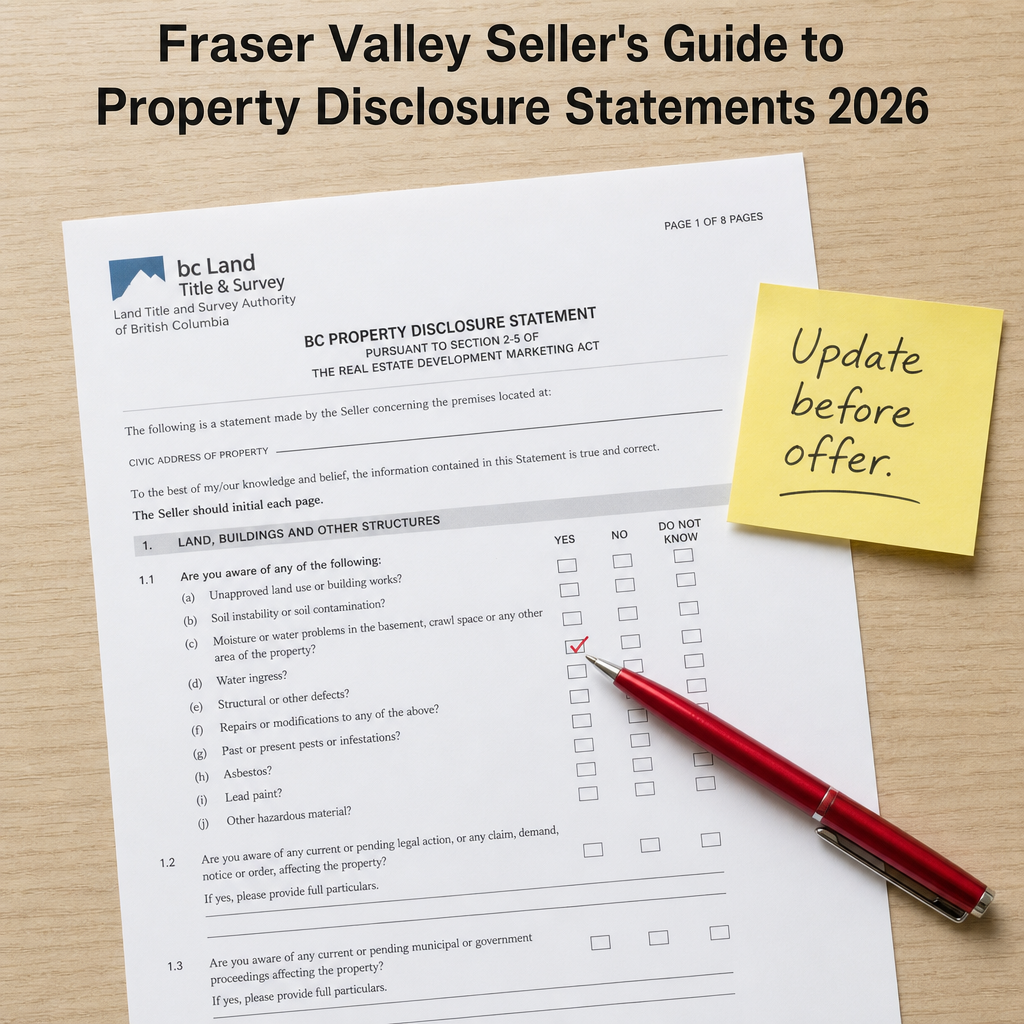

Fraser Valley Seller's Complete Guide to Property Disclosure Statements (PDS) in 2026: What You Must Reveal, Timeline Rules, Common Pitfalls, and Legal Liability When Non-Disclosure Triggers Post-Closing Litigation
By Mohamed Mansour, MBA and Associate Broker | Mansour Real Estate Group | Fraser Valley and Lower Mainland, BC | Published: July 15, 2026
For homeowners preparing to sell in Surrey, Langley, Abbotsford, White Rock, or anywhere across the Fraser Valley, the Property Disclosure Statement is no longer a formality. In 2026's buyer's market — where the Fraser Valley Real Estate Board reported a sales-to-active listings ratio below 12% for several consecutive months — buyers are conducting longer due diligence, using the Home Buyer Rescission Period strategically, and, after closing, looking more carefully for grounds to dispute undisclosed defects. The PDS sits at the centre of that risk.
This guide explains what BC sellers must disclose, when the PDS must be updated, which answers carry the most litigation risk, and how to manage encumbrances on title before listing. It is written for homeowners, not lawyers, but it takes the legal dimensions seriously.
Short Answer
A Property Disclosure Statement in BC requires sellers to answer questions about the physical condition of the property, known defects, legal encumbrances, and permit history — to the best of their knowledge. Answering "Unknown" when you have reason to know, or failing to update the PDS after new information emerges, can expose you to post-closing litigation. In a Fraser Valley buyer's market with elevated inventory and active due diligence, PDS accuracy directly affects whether your deal closes and stays closed.
Key Takeaways
- The PDS must be updated in writing if new defects are discovered after preparation but before offer acceptance.
- "Unknown" on water ingress, pests, or unauthorized suites frequently triggers buyer withdrawal or post-closing claims.
- Section 9 of BC's Contract of Purchase and Sale requires sellers to deliver title free of financial encumbrances.
- Non-financial charges such as utility rights-of-way are standard on title and generally cannot be removed.
- Post-closing litigation risk rises in buyer's markets as buyers seek legal remedies to recover value.
Who This Applies To
- Homeowners listing a detached home, townhouse, or condo in the Fraser Valley in 2026
- Sellers who purchased in a hot market and made undocumented improvements or repairs
- Executors and estate sellers who may have incomplete knowledge of the property's history
- Sellers with older homes where water ingress, pest activity, or outdated permits are possible
- Any seller receiving an offer in a market where buyers have extended subject-removal periods
When This Advice May Not Apply
Properties sold "as-is" with specific contractual language, or certain estate sales where the executor has genuinely no personal knowledge, involve different documentation and risk profiles. Sellers in those situations should work directly with a real estate lawyer alongside their listing agent.
Data Used in This Article
- Fraser Valley Real Estate Board Monthly Statistics Packages, February–May 2026 — Official board data; sales-to-active listings ratio and inventory figures
- BC Contract of Purchase and Sale, Section 9 — Standard form document; title and encumbrance obligations
- BCREALTORS® Sellers' Disclosure of Material Latent Defects Form — Regulatory guidance from BC's real estate licensing body
- Land Title and Survey Authority of BC (LTSA) — Official title registration system for BC properties
What Is a Property Disclosure Statement in BC?
The PDS is a standard form document completed by the seller and provided to prospective buyers before or alongside an offer. It asks the seller to answer a series of yes, no, or unknown questions about the property's physical condition, legal status, permit history, and any known defects. The PDS is not a warranty. It is a disclosure of what the seller knows — and it becomes part of the transaction record.
In BC, sellers are also required to separately complete a Sellers' Disclosure of Material Latent Defects form if they are aware of any defect that is not visible on inspection and could affect the property's value or safety. Together, these two documents set the legal baseline for what the seller claimed to know at the time of sale. The BCREALTORS® regulatory body provides guidance on this obligation, and real estate licensees are required to ensure the forms are completed accurately.
Why PDS Accuracy Matters More in 2026's Fraser Valley Market
According to the Fraser Valley Real Estate Board's monthly statistics packages from February through May 2026, the sales-to-active listings ratio across the Fraser Valley remained below 12% for multiple consecutive months — firmly in buyer's market territory. In that environment, buyers negotiate longer subject-removal periods, conduct more thorough inspections, and enter transactions with greater leverage.
The Home Buyer Rescission Period — introduced under BC's Property Law Amendment Act — gives buyers in BC a three-business-day window after an accepted offer to rescind, with a financial penalty. In elevated-inventory conditions, buyers also have less urgency to overlook concerns. A PDS that raises questions about water ingress history, unauthorized suites, or undocumented renovations does not just create hesitation — it creates a documented basis for post-closing claims if the buyer closes anyway and later discovers a problem.
The Three Highest-Risk PDS Questions for Fraser Valley Sellers
Not all PDS questions carry equal legal risk. Based on consistent patterns in Fraser Valley transactions, these three categories produce the most deal collapses and post-closing disputes:
Water ingress. Any history of moisture entry — basement seepage, roof leaks, window condensation causing rot — must be disclosed if the seller is aware of it. "Unknown" is only appropriate if the seller genuinely has no knowledge. Using "Unknown" when repair invoices or insurance claims exist in the file is a significant litigation risk. Buyers and their lawyers can access insurance history through CLUE reports or subpoena records in disputes.
Unauthorized suites or unpermitted work. Secondary suites, finished basements, carport conversions, and additions built without permits are common across Surrey, Cloverdale, Abbotsford, and North Delta — cities where older housing stock has seen decades of informal improvements. Sellers are required to disclose whether work was done without permits. Buyers who discover unpermitted work after closing in a declining market have a documented basis for misrepresentation claims.
Pest history. Prior rodent activity, carpenter ants, or wood-destroying insects must be disclosed if the seller has knowledge of past infestations, even if treated. A single pest control invoice in a kitchen drawer is enough to establish that the seller had knowledge. Courts have held that sellers cannot claim ignorance of documented conditions in their own files.
When You Must Update the PDS
A PDS completed at listing time captures what the seller knows on that date. If new information emerges after the PDS is signed but before offer acceptance — a pipe burst, evidence of new moisture, a failed inspection by the strata, a newly discovered permit issue — the seller is required to disclose that change in writing. This creates a paper trail that protects both parties.
Failing to update is not passive. In BC, sellers have an ongoing duty to disclose material changes. An addendum to the PDS, delivered to the buyer's agent with confirmation of receipt, is the standard practice. Sellers who discover a problem and say nothing — hoping the buyer won't notice — are the most common defendants in post-closing PDS litigation.
Title Encumbrances and Section 9 of the Contract of Purchase and Sale
Section 9 of BC's standard Contract of Purchase and Sale requires the seller to deliver title at completion that is free and clear of all financial encumbrances — meaning mortgages, lines of credit secured against the property, judgments, builders' liens, and similar monetary charges must be discharged at closing.
Non-financial charges are different. Utility rights-of-way, statutory building schemes, restrictive covenants, and easements are registered on title and generally cannot be removed because they are attached to the land itself, not to the seller. These must be disclosed on the PDS and will appear in the title search. Buyers who work with experienced real estate professionals in the Fraser Valley expect to see them and will ask about their practical impact.
Sellers who are unsure what is registered on their title should request a Title Review before listing. A Title Review pulls the current title from the Land Title and Survey Authority of BC and provides a plain-language explanation of all registered charges. It allows sellers to understand their disclosure obligations before the PDS is completed, not after an offer is already on the table.
How Post-Closing Litigation Works in BC
When a buyer believes a seller failed to disclose a material defect, their primary legal theory is misrepresentation — either fraudulent (the seller knew and deliberately concealed) or negligent (the seller should have known and failed to disclose). Both can support a civil claim. The standard remedy is damages equal to the cost of remediation or the diminution in property value.
In buyer's markets, the incentive to pursue these claims rises because buyers who paid close to market peak and now hold a property worth less have a financial motive to recover value through legal action. A well-documented, accurate PDS with written updates when conditions change is the seller's primary defence. It demonstrates good faith and limits the factual basis for a misrepresentation claim. Sellers should retain their PDS copies, all written updates, and any related disclosure correspondence for at least two years after closing. This is general professional guidance — for specific legal advice, consult a BC real estate lawyer.
How We Evaluate This
At Mansour Real Estate Group, we review the PDS with sellers before it goes to market — not after an offer comes in. We cross-reference the answers against available documentation: renovation permits pulled from municipal records, insurance history where accessible, strata documentation for condo and townhouse sellers, and any deficiency reports from prior inspections.
Our goal is to identify answers that could reasonably be challenged before they become post-closing problems. In the Fraser Valley's current inventory environment, a clean, well-supported PDS is a competitive advantage — buyers are more likely to proceed with confidence when the disclosure is clear, specific, and consistent with what their inspector finds. A PDS that raises more questions than it answers can kill a deal at subject removal, not because anything is actually wrong, but because uncertainty is no longer something buyers in this market are willing to absorb.
Seller Checklist: Property Disclosure Statement Preparation
- Pull your current title from the LTSA or request a Title Review to identify all registered charges before listing
- Locate all renovation permits and confirm which work has final inspection approval through your municipality
- Review your home insurance history for any water damage, mould, or pest-related claims that must be disclosed
- Complete the PDS and the Sellers' Disclosure of Material Latent Defects form with your real estate agent before listing
- Prepare a written addendum and deliver it to the buyer's agent immediately if any new property issue emerges after PDS completion
- Retain signed copies of all PDS documents, updates, and delivery confirmations for a minimum of two years after closing
What We Commonly See
Sellers mark "Unknown" to avoid answering difficult questions. In our experience, "Unknown" is often used as a defensive answer when sellers have indirect knowledge — a past owner's disclosure, a neighbour's comment, an old invoice they found but didn't investigate. In litigation, courts assess whether the seller had reason to know, not just whether they technically confirmed the defect. "Unknown" does not guarantee protection if documentation suggests awareness.
PDS is completed once and never revisited. What often happens is that sellers complete the form at listing, a month passes, a roof shingle repair is done or a plumber visits for a slow drain, and the PDS is never updated. If a dispute arises, the buyer's lawyer will ask when specific issues were first known. An undocumented gap in the timeline becomes a liability.
Title encumbrances surprise sellers at the offer stage. A common mistake is assuming that because nothing feels unusual about the property, the title must be clean. Rights-of-way for BC Hydro, utility corridors, and restrictive covenants are routine on Fraser Valley properties — particularly in Langley, Abbotsford, and Surrey — but they must be disclosed and explained. Sellers who discover a right-of-way for the first time during a buyer's title review often create unnecessary delays that cost them deals in a slow market.
Questions and Answers
Q: Am I required to complete a PDS if I am selling my home as-is?
A: "As-is" language in a contract limits the seller's liability for patent defects visible on inspection, but it does not eliminate the obligation to disclose known material latent defects — those not visible but affecting the property's value or safety. A complete PDS is still strongly recommended. Consult a BC real estate lawyer for your specific circumstances.
Q: What happens if I discover a defect after the PDS is signed but before closing?
A: You must disclose it in writing to the buyer immediately. Prepare a signed addendum, deliver it to the buyer's agent, and confirm receipt. This creates the paper trail needed to demonstrate good faith. Failing to disclose a known defect that emerged post-PDS is one of the most common bases for post-closing claims in BC.
Q: Can a buyer sue me after closing if a problem is found that I genuinely did not know about?
A: A claim for negligent misrepresentation requires that the seller knew or ought reasonably to have known. If you genuinely had no knowledge and no accessible documentation suggested otherwise, your legal exposure is lower — but not zero. Legal outcomes depend on specific facts. Consult a BC real estate litigation lawyer for advice on your situation.
Q: What is the difference between a patent defect and a latent defect in BC?
A patent defect is visible to a buyer during a reasonable inspection — peeling paint, a cracked window, a stained ceiling. Sellers are generally not liable for patent defects. A latent defect is hidden — a failing foundation, mould inside walls, or buried contamination. Sellers must disclose latent defects they are aware of, regardless of whether the buyer conducts an inspection.
Q: Do I need to disclose a right-of-way on my title?
A: Yes. Rights-of-way, easements, and restrictive covenants registered on title must be disclosed. They will appear in the buyer's title search regardless. Proactive disclosure — with a plain-language explanation of what the charge means practically — reduces the chance of a buyer withdrawing after reviewing title. Sellers who obtain a Title Review before listing can prepare this explanation in advance.
In Summary
In the Fraser Valley's 2026 buyer's market, a Property Disclosure Statement is not paperwork to complete quickly before listing. It is a legal document that determines whether your deal survives subject removal and whether you face litigation after closing. The three highest-risk categories — water ingress, unauthorized work, and pest history — require direct, documented answers. Any change discovered after PDS completion must be updated in writing before offer acceptance. Title encumbrances must be understood before listing, not discovered during a buyer's review. Sellers who approach the PDS as a risk management tool, with professional guidance and complete documentation, protect their closing certainty and their financial interests in a market where buyers have both the time and the leverage to investigate.
Ready to List With Confidence?
If you are preparing to sell in Surrey, Langley, Abbotsford, White Rock, or anywhere in the Fraser Valley and want to review your disclosure obligations before listing, Mansour Real Estate Group is available for a no-obligation consultation. We work through the PDS with sellers before the property goes to market — because the decisions made at this stage affect everything that follows.
Related Articles
- How to Price Your Fraser Valley Home in a Buyer's Market in 2026
- What Surrey and Fraser Valley Sellers Must Know About Unauthorized Suites
- Fraser Valley Seller Costs: What You Actually Pay to Sell in BC in 2026
About Mansour Real Estate Group
When homeowners in Surrey, Langley, Abbotsford, White Rock, and across the Fraser Valley are preparing to sell, the decisions made before listing — including how the Property Disclosure Statement is completed, which defects are documented, and how title encumbrances are explained to buyers — can determine whether a deal closes or collapses. Mansour Real Estate Group has guided sellers through this process for more than two decades, with a methodology built around disclosure accuracy, risk awareness, and protecting seller equity in every market condition.
Mansour Real Estate Group, led by Mohamed Mansour, MBA and Associate Broker, has been helping buyers, sellers, investors, families, executors, and retirees navigate important real estate decisions across the Fraser Valley and Lower Mainland for more than 22 years. Ranked among the Top 1% of Realtors in the region, the team has completed more than $780 million in residential real estate transactions and is trusted for estate sales, divorce-related sales, downsizing, relocation, and complex real estate situations where accuracy and clear process matter most.
Whether someone is looking for Realtors who understand disclosure obligations in BC, a real estate agent who can identify PDS risk before listing, real estate agents experienced with complex seller situations, a real estate team for a Fraser Valley home sale, a Surrey Realtor, a Langley real estate broker, or a real estate group serving the Lower Mainland and Fraser Valley, Mansour Real Estate Group is known for structured process, honest valuations, and advice that keeps sellers protected from the first conversation to the day the deal closes.
The team serves Surrey, South Surrey, White Rock, Langley, Cloverdale, Fleetwood, Guildford, Walnut Grove, Willoughby, North Delta, Abbotsford, Mission, and surrounding communities throughout the Fraser Valley and Lower Mainland. Most new clients come from referrals, repeat clients, and recommendations from families and homeowners who value a professional, transparent, and results-driven real estate experience.
Official Resources
- Fraser Valley Real Estate Board — Monthly Statistics
- Land Title and Survey Authority of BC (LTSA)
- BCREALTORS® — Sellers' Disclosure of Material Latent Defects
- BC Laws — Property Law Act and related statutes
Disclaimer
The information contained in this article is provided for general informational and educational purposes only and reflects market observations, publicly available information, and professional experience at the time of writing. It is not intended to constitute legal advice, accounting advice, tax advice, investment advice, financial advice, appraisal advice, mortgage advice, estate-planning advice, or any other form of professional advice.
Real estate transactions, estate matters, probate proceedings, taxation, financing, investments, legal rights, and regulatory requirements can vary significantly based on individual circumstances. Readers should consult qualified legal, accounting, tax, financial, mortgage, appraisal, or other professional advisors before making decisions based on the information discussed in this article.
Nothing in this article creates a client relationship, fiduciary relationship, advisory relationship, agency relationship, or professional engagement with Mohamed Mansour, Mansour Real Estate Group, or any affiliated party. Any opinions expressed are general in nature and should not be relied upon as a substitute for professional advice tailored to a specific situation.
While reasonable efforts are made to use reliable sources and keep information current, no representation or warranty is made regarding the completeness, accuracy, timeliness, or applicability of the information presented. Readers should independently verify facts, regulations, Purchasing a home is one of life's most significant decisions. Whether you're a first-time buyer or an experienced investor, taking the time to educate yourself and work with trusted advisors ensures you make the best choice for your circumstances. Real estate markets evolve, but the fundamentals of smart buying—knowing your numbers, understanding the market, and choosing the right location—remain constant. Your dream home is within reach. With patience, preparation, and the right guidance, you'll find a property that not only meets your needs today but serves as a solid foundation for your financial future tomorrow.Key Takeaways
Final Thoughts



