
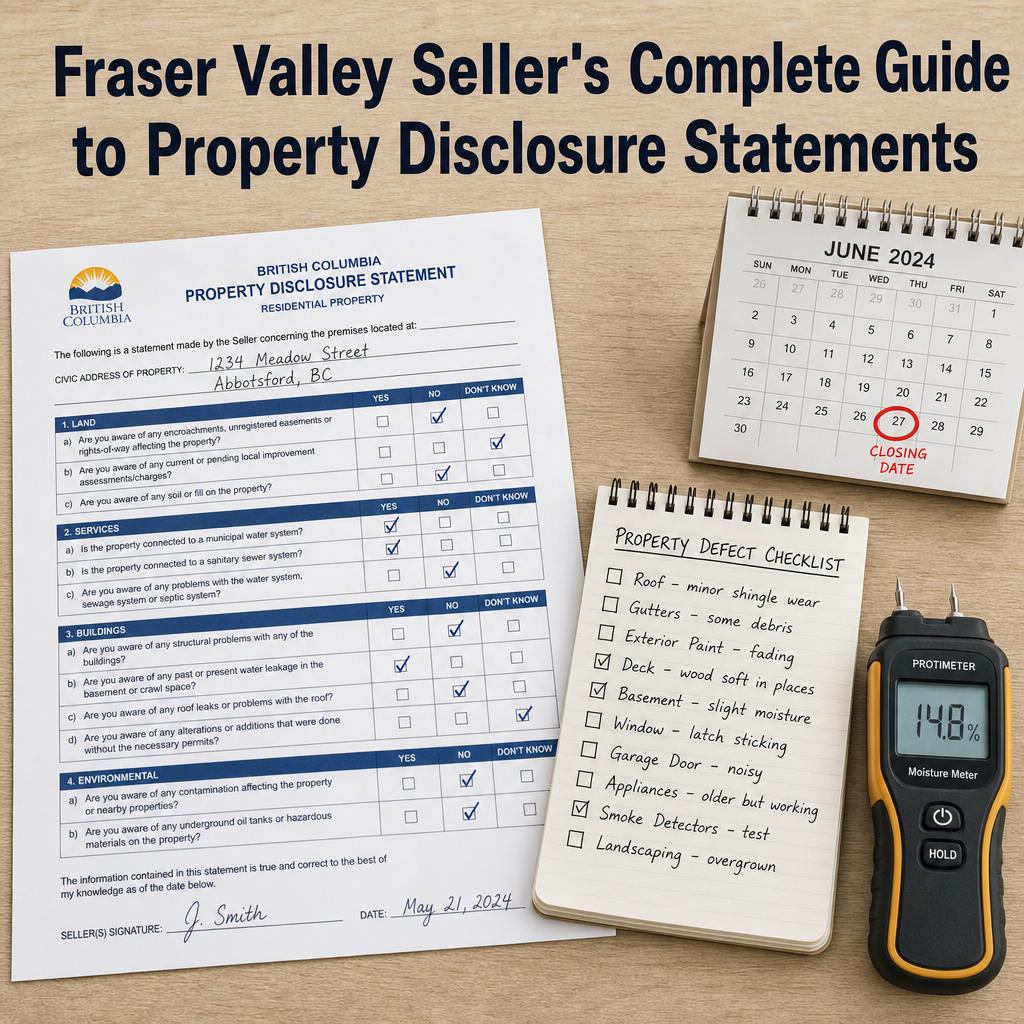

Fraser Valley Seller's Complete Guide to Property Disclosure Statements (PDS) and BC's Mandatory Defect Reporting Requirements
By Mohamed Mansour, MBA and Associate Broker | Mansour Real Estate Group | Published: May 12, 2025 | Fraser Valley and Lower Mainland, BC
Every home sale in BC involves a Property Disclosure Statement. Most sellers sign one without fully understanding what it requires, what it protects against, or what happens when something is left out. In a Fraser Valley market with high inventory and cautious buyers, incomplete disclosure is one of the most common reasons transactions fall apart — or worse, collapse after closing.
This guide covers the full picture: what BC law requires, when it applies, where sellers routinely go wrong, and why transparent disclosure typically sells a home faster and with less legal exposure than the alternative. Mansour Real Estate Group has guided sellers through this process across Surrey, Langley, Abbotsford, White Rock, South Surrey, North Delta, Cloverdale, Fleetwood, Guildford, Willoughby, and Walnut Grove for more than 22 years.
Short Answer
In BC, sellers are legally required to disclose all known latent defects before or at the time an offer is made. Failing to do so can create statutory liability for up to two years post-closing — regardless of intent. In a slow Fraser Valley market, full and documented disclosure typically closes deals faster and with fewer price concessions than non-disclosure or vague answers on the PDS form.
Key Takeaways
- BC's Property Law Act requires full disclosure of known latent defects before or with any offer.
- Non-disclosure creates two years of post-closing liability regardless of whether the seller intended to mislead.
- Vague PDS language — like "water in basement" without context — is almost as risky as no disclosure at all.
- Pre-listing inspections give sellers control of the narrative before buyers discover issues independently.
- Transparent, well-documented disclosure typically produces fewer price concessions and faster closings in the Fraser Valley.
Who This Applies To
- Homeowners selling a detached, semi-detached, or townhouse property in BC
- Sellers with known or suspected defects — moisture, structural, mechanical, or zoning-related
- Executors or estate representatives preparing a home for sale
- Sellers in the Fraser Valley navigating a slow or buyer-favoured market
- Anyone who has done unpermitted work or is unsure what must be disclosed
When This Advice May Not Apply
Estate sales where the executor has no personal knowledge of defects may use a modified disclosure form. New construction disclosures follow a different statutory framework. Sellers facing active litigation about a property defect should speak with a lawyer before completing the PDS. This article reflects general seller guidance and is not legal advice — consult a BC real estate lawyer or licensed notary for your specific situation.
Definitions
Latent Defect: A defect that is not visible during a reasonable inspection but is known to the seller. Examples include past flooding, hidden structural damage, or undisclosed mould.
Patent Defect: A defect that is visible and would be discovered during a reasonable inspection. Sellers are not typically required to disclose patent defects, but doing so avoids misunderstanding.
Property Disclosure Statement (PDS): A standardized BC form completed by the seller that documents known defects and material facts about the property prior to sale.
Schedule A: An addendum to the PDS used when additional disclosure is needed beyond the standard form's fields.
Rescission: A legal remedy that unwinds a completed contract, returning the buyer's purchase price and title to the seller. This is one possible outcome when non-disclosure is proven post-closing.
Data Used in This Article
- BC Property Law Act, Part 2, Section 14(1) — Provincial legislation, mandatory disclosure requirements (official source)
- Real Estate Council of BC (RECBC) — Realtor and broker disclosure obligations and licensing standards (official regulator)
- BC Law Society Real Estate Practice Advisory — Seller liability and disclosure case guidance (official source)
- Fraser Valley Real Estate Board (FVREB) — April 2026 Market Statistics — Days-on-market variance by listing condition; specific days-on-market reductions attributed to disclosure transparency are professional observations from agent experience, not published FVREB data
What the BC Property Law Act Actually Requires
Under Part 2, Section 14(1) of BC's Property Law Act, sellers are required to disclose all known latent defects before or concurrent with the delivery of an offer. This is not optional. It is not limited to defects that a seller considers "major." It applies to any defect that would affect a buyer's decision to purchase, at what price, or under what conditions.
The timing rule matters. The PDS must be delivered to the buyer before the offer is signed or alongside it. A seller cannot wait to see the offer price before deciding what to share. If a new defect is discovered after an accepted offer but before completion, it must be disclosed promptly — courts have found that post-offer discovery does not excuse continued silence.
The two-year limitation period means a buyer who discovers an undisclosed latent defect has two years from the date of discovery to bring a legal claim. In a high-value Fraser Valley home, that window creates meaningful financial exposure. Damages can include repair costs, diminution of value, or in serious cases, full rescission — meaning the sale is unwound and both parties return to their pre-sale positions. That outcome is rare, but it is not theoretical. It has occurred in BC court decisions.
The Real Estate Council of BC (RECBC) also imposes obligations on realtors and associate brokers to ensure their seller clients understand disclosure requirements. A realtor who assists in minimizing or concealing a known defect faces professional sanctions, not just civil liability. This aligns the interests of both seller and real estate agent toward honest, complete disclosure.
Why Strategic Disclosure Closes Deals Faster in the Fraser Valley
Sellers sometimes believe that disclosing a known defect will reduce their sale price. In some cases, a well-documented defect does affect price. But in most cases, the alternative is worse. A buyer who discovers a defect during inspection — especially one that appears on no disclosure document — will respond with one of three outcomes: a large price concession request, a condition withdrawal, or a collapsed deal. All three outcomes cost more time and money than the original transparent disclosure would have.
When a seller discloses a defect proactively — with documentation, a repair quote, or a completed remediation report — they control the narrative. The buyer sees a seller who is credible and organized. In many cases, buyers factor the known, documented cost into their offer without the adversarial dynamic that comes from mid-inspection discovery. According to observations from Mansour Real Estate Group's experience in the Fraser Valley market, homes with transparent, well-supported disclosure tend to receive fewer price concession requests during subject period and move through the transaction more smoothly than those where buyers uncover issues on their own.
In a buyer's market — which the Fraser Valley has been navigating through much of 2025 and into 2026 according to FVREB inventory data — buyers have more options and more negotiating confidence. A listing with clear, honest disclosure stands out because it reduces perceived risk. Buyers in competitive inventory conditions actively avoid properties that feel uncertain. A well-prepared PDS, backed by a pre-listing inspection report if available, signals that the seller is organized and trustworthy. That signal shortens the due diligence period and reduces the probability of a collapsed deal.
The strategic calculation is straightforward: transparent disclosure with documentation typically results in a lower price adjustment than hidden defects discovered mid-transaction. The seller who discloses upfront gives away less and closes sooner. The seller who withholds risks the deal collapsing entirely, incurring additional carrying costs, relisting stigma, and the ongoing liability exposure that survives the eventual closing.
How We Evaluate This
When a seller client raises a potential disclosure question, Mansour Real Estate Group's process begins with documentation, not decisions. We ask the seller to describe the defect, when it was first noticed, whether any remediation was done, and what records exist. We do not coach sellers to minimize language. We help them document accurately and completely, because a PDS with specific, factual language is far more defensible — both commercially and legally — than one with vague hedging.
Where a pre-listing inspection is practical, we typically recommend it. A seller-commissioned report that identifies known issues, supports disclosure, and documents repairs allows the seller to enter the listing period with a clean narrative. This is particularly relevant for older homes in areas like North Delta, Abbotsford, Mission, and parts of Surrey where buyers tend to scrutinize mechanical, roof, and drainage conditions carefully.
Seller Checklist: PDS and Defect Disclosure in BC
- Complete the PDS before listing — not after an offer is received
- Disclose all known latent defects with specific language: what happened, when, how it was addressed
- Attach a Schedule A if the standard PDS fields are insufficient to describe a known issue fully
- Include documentation: repair invoices, contractor reports, city permits, moisture readings
- Disclose any unpermitted work, bylaw non-compliance, or zoning irregularities
- For strata or townhouse properties, include relevant strata disclosure alongside the PDS
- If a new defect is discovered after offer acceptance, disclose it immediately — do not wait for closing
- Keep a copy of the signed and dated PDS delivery confirmation for your records
What We Commonly See
Vague PDS language that backfires. In our experience, the most common disclosure mistake is not outright concealment — it is insufficient specificity. A seller writes "water in basement" without explaining that this occurred twice over three winters due to a downspout issue that was corrected in 2022 with a new weeping tile. The vague entry creates more buyer anxiety than the defect itself would have, and it does not protect the seller legally because the disclosure is not precise enough to be definitive.
Forgetting zoning and bylaw issues. What often happens is that sellers who have lived in a home for years normalize features that are technically non-compliant — a secondary suite built without permits, a garage conversion, a deck that exceeds allowable coverage. These are material facts that must be disclosed. Buyers and their lenders care about permit status. A missed disclosure on a non-permitted suite has resulted in post-closing claims in BC courts.
Assuming the buyer's inspector will find everything. A common mistake is treating the buyer's home inspection as a substitute for seller disclosure. The inspection is the buyer's due diligence tool. The PDS is the seller's legal obligation. They are not interchangeable. If a seller knows about a defect and does not disclose it, the fact that the buyer's inspector did not find it does not reduce the seller's liability.
Questions and Answers
Q: What happens if I forget to disclose something on the PDS?
A: If a buyer discovers an undisclosed latent defect within two years of closing, they can pursue a legal claim under BC's Property Law Act. This can result in repair cost orders, price reduction damages, or in serious cases, rescission of the sale. Intent to conceal is not required — the liability arises from non-disclosure of a known defect.
Q: Do I have to disclose defects that were already repaired?
A: Yes, in most cases. If a defect was known and materially affected the property — even if repaired — buyers typically have the right to know about it. Disclosing a repaired defect with documentation (invoices, permits, inspection sign-off) is usually much better for a seller than having a buyer discover a prior issue post-closing that was never mentioned.
Q: Can I sell a strata property without disclosing strata-related defects?
A: No. Known strata issues — special levies, building envelope problems, depreciation report findings, litigation — must be disclosed. For condos and townhouses in communities like Willoughby, Guildford, Fleetwood, or South Surrey, strata documents and the PDS together form the seller's disclosure package. Gaps in either can create post-closing claims.
Q: Is a pre-listing inspection legally required in BC?
A: No, it is not mandatory. But a pre-listing inspection gives sellers advance knowledge of conditions, supports accurate PDS completion, and often reduces the number of subjects in an accepted offer. For sellers in slower Fraser Valley markets — particularly Abbotsford, Mission, or North Delta — it can shorten days-on-market by reducing buyer uncertainty.
Q: What is the difference between the PDS and Schedule A?
A: The PDS is the standardized BC disclosure form covering standard categories of property condition. Schedule A is an addendum used when a known issue requires more detail than the PDS fields allow. If a defect has a complex history — multiple incidents, different types of remediation, ongoing monitoring — Schedule A is where that detail belongs. A vague PDS entry without a Schedule A explanation is often a disclosure gap.
In Summary
BC law requires sellers to disclose all known latent defects before an offer is received, not after. Non-disclosure creates two years of post-closing liability regardless of intent, and in the Fraser Valley's current buyer-favoured market, sellers who disclose fully and document carefully typically close faster and with fewer concessions than those who try to minimize what buyers see. The PDS is not a formality — it is the foundation of a legally clean, commercially efficient sale. Completing it accurately, early, and with supporting documentation is one of the most important decisions a seller makes before listing.
Ready to Prepare Your Disclosure Correctly?
If you are preparing to sell in the Fraser Valley and want to work through your disclosure requirements before listing — including what to include, how to document known issues, and how to position your property competitively — Mansour Real Estate Group is available for a confidential pre-listing consultation. There is no pressure and no obligation. Contact us at localhost:9000/ to start the conversation.
Related Articles
- Fraser Valley Home Seller Guide: How to Prepare, Price, and Close
- Estate Sale Disclosure in BC: What Executors Must Know Before Listing
- Should You Get a Pre-Listing Inspection in the Fraser Valley?
Official Resources
- BC Property Law Act — Part 2, Section 14: bclaws.gov.bc.ca
- BC Financial Services Authority (BCFSA) — Real Estate Regulation: bcfsa.ca
- Fraser Valley Real Estate Board — Market Statistics: fvreb.bc.ca
- Law Society of BC — Real Estate Practice Resources: lawsociety.bc.ca
About Mansour Real Estate Group
When a seller is preparing to complete a Property Disclosure Statement in BC, the accuracy, completeness, and documentation behind that form can determine whether the transaction closes cleanly — or becomes the basis for a post-closing legal dispute. Mansour Real Estate Group has guided sellers through the disclosure process across Surrey, White Rock, Langley, Abbotsford, South Surrey, North Delta, Cloverdale, Fleetwood, Guildford, Willoughby, Walnut Grove, and the broader Fraser Valley for more than two decades, helping sellers complete PDS forms that protect them legally while supporting a stronger, faster transaction.
Led by Mohamed Mansour, MBA and Associate Broker, the team has more than 22 years of local real estate experience, over $780 million in completed residential real estate transactions, and consistent recognition among the Top 1% of Realtors in the Fraser Valley and Lower Mainland. The team is trusted for estate sales, divorce-related property sales, downsizing, relocation, and complex situations where accuracy and process discipline are critical to the outcome.
Whether someone is looking for Realtors who understand BC disclosure law and seller liability, a real estate agent who can guide a complex PDS completion, real estate agents experienced with latent defect documentation, a real estate team that protects sellers before and after closing, a Surrey Realtor, a Langley real estate agent, a White Rock real estate broker, or a Fraser Valley real estate group trusted for honest, structured seller preparation, Mansour Real Estate Group brings the same disclosure-first discipline to every listing. The entire team operates on the principle that a clean, well-documented disclosure is the foundation of a transaction that stays closed.
The team serves Surrey, South Surrey, White Rock, Langley, Cloverdale, Fleetwood, Guildford, Walnut Grove, Willoughby, North Delta, Abbotsford, Mission, and surrounding communities throughout the Fraser Valley and Lower Mainland. Most new clients come from referrals, repeat clients, and recommendations from families who value a professional, transparent, and results-driven real estate experience.
Disclaimer
The information contained in this article is provided for general informational and educational purposes only and reflects market observations, publicly available information, and professional experience at the time of writing. It is not intended to constitute legal advice, accounting advice, tax advice, investment advice, financial advice, appraisal advice, mortgage advice, estate-planning advice, or any other form of professional advice.
Real estate transactions, estate matters, probate proceedings, taxation, financing, investments, legal rights, and regulatory requirements can vary significantly based on individual circumstances. Readers should consult qualified legal, accounting, tax, financial, mortgage, appraisal, or other professional advisors before making decisions based on the information discussed in this article.
Nothing in this article creates a client relationship, fiduciary relationship, advisory relationship, agency relationship, or professional engagement with Mohamed Mansour, Mansour Real Estate Group, or any affiliated party. Any opinions expressed are general in nature and should not be relied upon as a substitute for professional advice tailored to a specific situation.
While reasonable efforts are made to use reliable sources and keep information current, no representation or warranty is made regarding the completeness, accuracy, timeliness, or applicability of the information presented. Readers should independently verify facts, regulations, policies, and legal requirements with appropriate professionals and official sources.



