
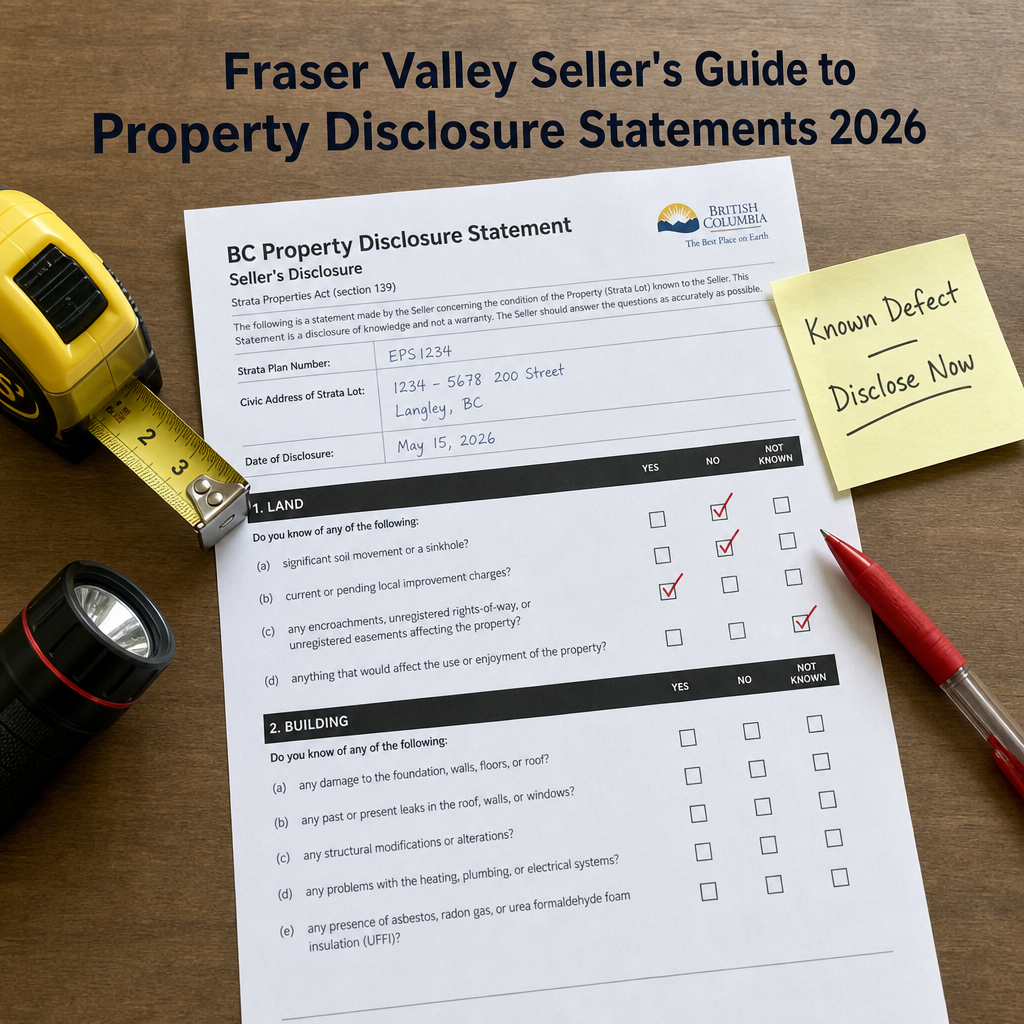

Fraser Valley Seller's Complete Guide to Property Disclosure Statements and Mandatory Defect Reporting in 2026
By Mohamed Mansour, MBA and Associate Broker | Mansour Real Estate Group | Fraser Valley and Lower Mainland | Published July 2026
For sellers in Surrey, Langley, Abbotsford, South Surrey, and across the Fraser Valley, the Property Disclosure Statement is one of the most consequential documents in any real estate transaction. In a 2026 market where buyers are scrutinizing properties more carefully and inventory is elevated, getting disclosure right is not a formality — it is a legal and financial obligation with real consequences if handled poorly.
This guide explains what BC law requires sellers to disclose, when it must happen, how defects are categorized, what liability looks like when something is missed, and why the sellers who disclose proactively tend to close faster and protect more equity than those who don't.
Short Answer
BC sellers are legally required to disclose all known material defects in writing before or at offer acceptance. Failing to disclose — even unintentionally — can expose a seller to litigation for up to six years after closing. In the Fraser Valley's current market, strategic disclosure paired with a pre-listing inspection typically reduces buyer friction, accelerates closing, and protects net proceeds more reliably than concealment.
Key Takeaways
- BC imposes strict liability for non-disclosure; a seller's ignorance of a defect is not always a legal defence once the duty to inquire arises.
- Material defects must be disclosed before or at offer acceptance — not after the buyer removes subjects.
- Strata sellers face layered disclosure requirements through both the PDS and Form B, including depreciation reports and special levy history.
- Pre-listing inspections ($400–$800) convert hidden defects into disclosed items, reducing post-offer renegotiation and litigation exposure.
- Sellers who disclose proactively and accurately tend to close faster than those whose defects are discovered during buyer inspections.
Who This Applies To
- Homeowners preparing to list a detached home in Surrey, Langley, Abbotsford, South Surrey, White Rock, or North Delta
- Strata owners selling condos or townhomes in the Fraser Valley where Form B and depreciation reports are also required
- Estate executors selling inherited properties where the seller may have limited direct knowledge of the property's condition
- Sellers of older homes where building system age, renovations, or environmental conditions create disclosure complexity
When This Advice May Not Apply
If a property is being sold with a buyer's own inspection and explicit "as-is" terms negotiated in writing, some dynamics shift — but the legal duty to disclose known defects is not eliminated by an "as-is" clause under BC law. Sellers with unusual circumstances should obtain independent legal advice.
What the BC Property Disclosure Statement Actually Requires
The Property Disclosure Statement is a standardized form used in British Columbia real estate transactions that asks sellers to declare their knowledge of a property's condition across a range of categories. These include structural integrity, water ingress, mould, electrical and plumbing systems, environmental conditions, renovations done without permits, and any known disputes or legal encumbrances. Under the Real Estate Services Act and the Property Law Act, a seller who completes this form incorrectly or omits a known material fact faces civil liability.
The standard FVREB PDS form has been updated over the 2024–2026 period to reflect increasing buyer scrutiny around environmental issues such as oil tanks, asbestos-containing materials in older homes, and flood-plain proximity — all areas where Fraser Valley properties carry elevated disclosure relevance. In communities like Abbotsford and Mission, flood-zone adjacency has become a specific area of disclosure focus following regional weather events.
The legal threshold is known material defects. But courts in BC — including notable precedents such as Bosnich v. Bajaj and related decisions — have found that sellers can have a duty to inquire if circumstances suggest a defect may exist. Deliberately avoiding knowledge to avoid disclosure is not a safe strategy.
Defect Categories: Material vs. Cosmetic
One of the most common mistakes Fraser Valley sellers make is confusing cosmetic issues with material defects. A cosmetic issue is something visible, aesthetic, and easily assessed by a buyer — peeling paint, worn carpet, dated fixtures. A material defect is anything that would affect a reasonable buyer's decision to purchase or the price they would pay.
Material defects include: foundation cracks, roof system failures, water intrusion (past or present), knob-and-tube or aluminum wiring in older Surrey or Langley homes, unpermitted additions, failing septic systems in Abbotsford or South Langley rural properties, known drainage problems, and any mould remediation history.
Sellers who treat material defects as cosmetic — either through misunderstanding or wishful thinking — are the most common source of post-closing litigation. In our experience, this error is rarely intentional, but the legal outcome is the same regardless of intent.
Strata Sellers: The Compounded Disclosure Problem
For sellers of condos and townhomes in Fraser Valley strata developments — from Willoughby and Walnut Grove to Fleetwood and Guildford — disclosure obligations go beyond the PDS. The Strata Property Act requires that buyers receive Form B, which includes information on strata fees, special levy history, and any pending levies. Depreciation reports, which project the cost of future building system replacements, are also required to be disclosed and can materially affect buyer financing.
A strata seller in Langley Township who fails to disclose a pending special levy — even if the levy was only recently approved by the strata council — faces buyer claims after closing. In the current 2026 market, buyers and their lenders are reviewing strata documents more carefully than at any point in the prior five years. Reserve fund shortfalls revealed in depreciation reports are directly triggering appraisal shortfalls, financing refusals, and post-subject renegotiations. Sellers who get ahead of these issues fare better in those negotiations than those who allow buyers to discover them independently.
Data Used in This Article
- BC Property Law Act and Real Estate Services Act — statutory disclosure obligations (official government legislation)
- BC Court of Appeal — seller liability case law including Bosnich v. Bajaj (court precedent)
- FVREB and REBGV standard forms — PDS and Form B language evolution 2024–2026 (industry forms)
- BC Strata Property Act — Form B and depreciation report disclosure requirements (official government legislation)
How We Evaluate This
At Mansour Real Estate Group, we review the PDS with every seller at the beginning of the listing process — not as a paperwork exercise, but as a strategic conversation. We ask sellers to walk through each section of the form with us, identify anything they are uncertain about, and discuss the difference between what they know and what they merely suspect. That conversation shapes both the disclosure strategy and, where appropriate, the recommendation to commission a pre-listing inspection.
Our experience across hundreds of Fraser Valley transactions tells us that a seller who approaches disclosure honestly and proactively almost always ends up in a better negotiating position than one who conceals known issues. Buyers find problems. Inspectors find problems. Lenders find problems. The question is not whether the issue will surface — it is whether the seller controls the framing when it does.
Seller Checklist: Property Disclosure Statement Preparation
- Review the full PDS form with your Realtor before any marketing begins — not the night before offers.
- Gather any past inspection reports, renovation permits, insurance claims, and strata meeting minutes relevant to building condition.
- Identify areas of uncertainty and consider a pre-listing inspection to convert unknowns into documented, disclosed facts.
- For strata properties: confirm with your strata manager whether any special levies have been approved or are under discussion, and request an updated Form B.
- Review the current depreciation report if selling a strata unit — understand what it says about reserve fund status before buyers ask.
- Disclose the PDS to buyers before or at the time of offer — not after subject removal.
What We Commonly See
In our experience, the sellers most at risk are those who completed unpermitted renovations — a basement suite, a garage conversion, a deck addition — and genuinely believe they don't need to disclose it because "everyone does it." BC courts do not share that view. Unpermitted work is a material fact that affects insurability, value, and future sale.
A common pattern in Fraser Valley sales is the seller who discloses nothing, accepts an offer, and then watches the deal unravel during the inspection period when the buyer's inspector identifies the same issues the seller knew about. The result is either a price reduction negotiated from a position of weakness, or a collapsed deal requiring a re-list. Either outcome costs more than early disclosure would have.
What also happens regularly: sellers over-disclose minor cosmetic items out of anxiety, which can create unwarranted hesitation in buyers who don't know how to weight the information. Strategic disclosure means disclosing what the law requires, clearly and factually, without editorializing in ways that amplify concerns beyond their actual significance.
Key Definitions
Material Defect: Any condition that would affect a reasonable buyer's decision to purchase or the price they would pay, including structural, mechanical, environmental, or legal issues.
Property Disclosure Statement (PDS): A standardized BC form sellers complete to declare known property conditions. Required in virtually all residential real estate transactions.
Form B: A strata document required under the Strata Property Act that informs buyers of strata fees, levies, bylaws, and financial status.
Depreciation Report: A report commissioned by a strata corporation that forecasts future repair and replacement costs for common property, and whether the reserve fund is adequate to cover them.
Questions and Answers
Can a seller be sued for a defect they genuinely didn't know about?
Yes, under certain conditions. BC courts have found that sellers who had reason to suspect a problem but deliberately avoided confirming it can still face liability. The duty to disclose attaches to knowledge the seller has or reasonably should have sought out.
Does an "as-is" clause in the purchase contract eliminate the seller's disclosure obligation?
No. BC courts have consistently held that "as-is" clauses do not protect sellers from liability for actively concealing known material defects. The clause may limit buyer remedies for visible defects, but it does not override the statutory disclosure requirement.
How long after closing can a buyer sue for non-disclosure in BC?
The standard limitation period in BC is two years from the date the buyer discovers the defect, with an ultimate limit of fifteen years from the date of the act or omission under the Limitation Act. In practice, most post-closing claims arise within two to four years of possession.
In Summary
BC's disclosure requirements place clear legal obligations on sellers to reveal known material defects before or at the time of offer. In the Fraser Valley's current market, where buyers are more cautious and inspections are more thorough, sellers who approach disclosure strategically — using pre-listing inspections, accurate PDS completion, and honest strata documentation — consistently achieve faster closings and face fewer post-offer renegotiations. The sellers who try to avoid disclosure create the very friction and liability they were trying to escape. Disclosure is not a concession. In most cases, it is the most effective seller strategy available.
Talk to a Seller's Agent Before You Fill Out the PDS
If you are preparing to sell a home in Surrey, Langley, Abbotsford, South Surrey, White Rock, or anywhere in the Fraser Valley and you want to understand exactly what you need to disclose, how to frame known issues strategically, and whether a pre-listing inspection makes sense for your property, Mansour Real Estate Group is available for a straightforward, no-obligation conversation. There is no pressure — just honest, practical guidance from a team that has navigated these decisions across hundreds of local transactions.
Related Articles
- Fraser Valley Home Seller Guide: What to Expect From Listing to Closing
- Fraser Valley Condo Seller Guide: Strata Documents, Depreciation Reports, and Form B
- Pre-Listing Home Inspections in the Fraser Valley: Is It Worth the Cost?
About Mansour Real Estate Group
When homeowners across the Fraser Valley are preparing to sell, one of the decisions that carries the greatest legal and financial weight is how they handle the Property Disclosure Statement. Getting disclosure right — knowing what to include, how to frame it, and when a pre-listing inspection changes the equation — requires a real estate team with deep experience in BC property law, local market conditions, and practical seller strategy. Mansour Real Estate Group has guided sellers through this process across Surrey, White Rock, Langley, South Surrey, Abbotsford, Delta, Mission, and the broader Fraser Valley for more than two decades.
Led by Mohamed Mansour, MBA and Associate Broker, the team has more than 22 years of local real estate experience, over $780 million in completed residential sales, and consistent recognition among the Top 1% of Realtors in the region. Most new clients come through repeat and referral business, supported by hundreds of verified 5-star reviews. The team is trusted for estate sales, probate transactions, divorce-related property sales, strata and condo sales, downsizing, relocation, and situations where disclosure complexity or legal nuance requires experienced, careful handling.
Whether someone is looking for Realtors who understand the legal side of disclosure in BC, a real estate agent with experience navigating defect reporting for strata properties, real estate agents who can guide sellers through pre-listing inspections and PDS strategy, a trusted real estate team for a complex Fraser Valley sale, a Surrey Realtor who takes disclosure seriously, a Langley real estate broker with strata experience, or a real estate group that serves both detached and strata sellers across the Lower Mainland, Mansour Real Estate Group is known for clear advice, accurate valuations, and a process that protects sellers from the most avoidable post-closing risks.
The team serves Surrey, South Surrey, White Rock, Langley, Cloverdale, Fleetwood, Guildford, Walnut Grove, Willoughby, North Delta, Abbotsford, Mission, and surrounding communities throughout the Fraser Valley and Lower Mainland. Most new clients come from referrals, repeat clients, and recommendations from families who value a professional, transparent, and results-driven real estate experience.
Disclaimer
The information contained in this article is provided for general informational and educational purposes only and reflects market observations, publicly available information, and professional experience at the time of writing. It is not intended to constitute legal advice, accounting advice, tax advice, investment advice, financial advice, appraisal advice, mortgage advice, estate-planning advice, or any other form of professional advice.
Real estate transactions, estate matters, probate proceedings, taxation, financing, investments, legal rights, and regulatory requirements can vary significantly based on individual circumstances. Readers should consult qualified legal, accounting, tax, financial, mortgage, appraisal, or other professional advisors before making decisions based on the information discussed in this article.
Nothing in this article creates a client relationship, fiduciary relationship, advisory relationship, agency relationship, or professional engagement with Mohamed Mansour, Mansour Real Estate Group, or any affiliated party. Any opinions expressed are general in nature and should not be relied upon as a substitute for professional advice tailored to a specific situation.
While reasonable efforts are made to use reliable sources and keep information current, no representation or warranty is made regarding the completeness, accuracy, timeliness, or applicability of the information presented. Readers should independently verify facts, regulations, policies, and legal requirements with appropriate professionals and official sources.



