

Fraser Valley Seller's Complete Guide to Property Disclosure Statements and BC's Mandatory Latent Defect Reporting in 2026
By Mohamed Mansour, MBA, Associate Broker | Mansour Real Estate Group | Fraser Valley and Lower Mainland | Published May 2026
For homeowners preparing to sell in Surrey, Langley, Abbotsford, or anywhere across the Fraser Valley, disclosure is one of the most consequential steps in the entire transaction — and one of the most misunderstood. The difference between a disclosure statement that protects you and one that creates post-closing liability often comes down to a single answer filled in without enough care.
This guide explains what BC law actually requires from sellers, what the BCREA's voluntary Property Disclosure Statement form means once it is signed, and why strategic transparency — done correctly — closes deals faster than silence in today's market.
Short Answer
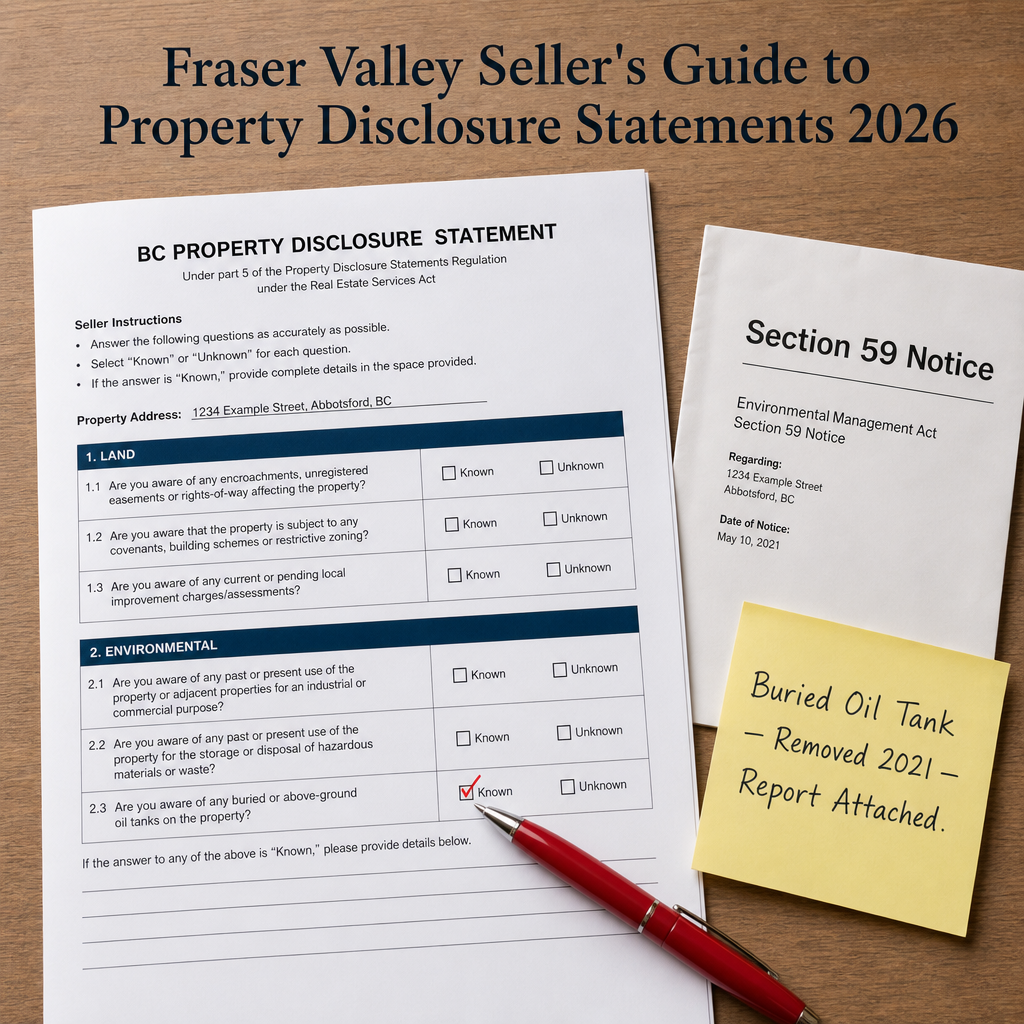
BC sellers have no legislated obligation to complete a standardized Property Disclosure Statement, but they carry a binding common-law duty to disclose material latent defects — hidden issues not discoverable through reasonable inspection that make a property dangerous or unfit for the buyer's known purpose. Once a seller signs the BCREA's PDS form, every answer becomes a contractual warranty. Failing to disclose known defects exposes sellers to rescission claims and post-closing litigation.
Who This Applies To
- Homeowners in the Fraser Valley preparing to list a detached home, townhome, or condo in 2026
- Estate executors selling a property on behalf of a deceased owner where property history may be incomplete
- Sellers who have completed repairs to past defects and are uncertain whether to disclose the original issue
- Sellers who inherited a property and have limited knowledge of its condition history
- Anyone who has received a Section 59 disclosure notice from their licensee and wants to understand its legal weight
When This Advice May Not Apply
Estate sales where the executor has no firsthand knowledge of the property's condition involve different disclosure dynamics. Strata units may involve additional disclosure obligations through the strata corporation. This article provides general guidance — sellers should confirm their specific obligations with a BC real estate lawyer before signing any disclosure form.
Key Takeaways
- BC sellers carry a binding common-law duty to disclose material latent defects regardless of whether they complete a PDS form
- Once signed, the BCREA's voluntary PDS form becomes a contractual warranty — inaccuracies create legal liability beyond the common-law duty
- Answering "do not know" shifts the investigation burden to the buyer but does not protect a seller who actually knew about an issue
- Real estate licensees must disclose material latent defects in writing under Section 59 of the Real Estate Services Rules, separate from the purchase contract
- Sellers who disclose past defects with documented professional repairs close faster and renegotiate less in slow markets
Data Used in This Article
- BCFSA Consumer Guide on Disclosures — Official regulatory guidance, BC Financial Services Authority, current as of 2025–2026. Official source.
- Real Estate Services Rules, Section 59 — BC Regulation under the Real Estate Services Act governing licensee disclosure obligations. Primary legislative source.
- BCREA Property Disclosure Statement form — Voluntary industry-standard form published by the BC Real Estate Association. Industry source.
- Fraser Valley Real Estate Board market reporting — Inventory and market conditions context, 2025–2026. Official industry source.
What "Material Latent Defect" Actually Means in BC
A latent defect is a hidden problem that a buyer would not discover through a reasonable visual inspection of the property. The word "material" means the defect is significant enough that it would affect a reasonable buyer's decision to purchase — or the price they would offer.
According to BCFSA's consumer guidance, material latent defects include buried oil tanks, water damage history, flooding, pest infestations, electrical or plumbing deficiencies, foundation issues, and past insurance claims related to the property. A leaky roof that has been visibly patched may be patent — visible on inspection. A buried oil tank that was removed in 2019 is latent — a buyer walking through the home has no way to discover it without being told.
The duty to disclose applies even when the defect has been repaired. If a seller knows the property flooded in 2021 and had professional remediation, that history is a material latent defect that must be disclosed. The remediation reduces risk — but not the disclosure obligation. Sellers in Surrey, Langley, and Abbotsford frequently encounter this situation with older homes that experienced water intrusion before current ownership, or with properties that had underground storage tanks removed in prior decades.
The PDS Form: Voluntary to Complete, Binding Once Signed
BC has no legislated requirement to complete a standardized disclosure form before selling a home. But in practice, most Fraser Valley listings include the BCREA's Property Disclosure Statement, because buyers and their agents expect it and many offers are conditioned on receiving it.
The critical legal point: once a seller signs the PDS, every answer on that form becomes a contractual warranty incorporated into the purchase contract. An inaccurate answer — even one made carelessly rather than deliberately — can support a buyer's claim for damages after closing. This means the PDS creates a legal standard above and beyond the common-law duty. The common-law duty covers knowing concealment. The PDS warranty can cover honest mistakes if the seller certified something they had not adequately verified.
Sellers who answer "do not know" on questions they genuinely cannot verify are within their rights to do so. That answer shifts the investigation burden to the buyer. But courts in BC have found that sellers who answered "do not know" while actually having knowledge of an issue do not gain protection from that answer. The disclosure obligation is built on what the seller actually knew — not how they filled in the form.
Section 59 and Your Licensee's Separate Obligation
Under Section 59 of BC's Real Estate Services Rules, a real estate licensee who becomes aware of a material latent defect must disclose it in writing — in a document separate from the purchase contract — before the buyer enters into an agreement. This obligation applies to your listing agent if they learn of a material defect in your home.
This matters for sellers because it means your agent cannot legally remain silent about a defect they become aware of during the listing process. If you disclose a significant issue to your agent during listing preparation, that issue will need to be disclosed to buyers in writing under Section 59. Sellers who are tempted to mention problems informally to their agent while hoping those issues stay off the paperwork need to understand that the agent has a regulatory obligation that runs parallel to — and independent of — the seller's own duty. In practice, this alignment of obligations makes full disclosure the only legally coherent path forward.
How We Evaluate This
When we work with sellers preparing to list in the Fraser Valley, we review disclosure obligations before a listing agreement is signed — not after. Our approach is to walk through the property's known history with the seller, identify any issues that may qualify as material latent defects, and determine what documentation exists for repairs or remediation.
For issues where documentation is strong — a professional remediation report, an engineer's letter, a permit-closed repair — we advise sellers to disclose the original issue clearly and attach the supporting documentation. In our experience, a disclosed and documented defect rarely kills a deal. An undisclosed defect discovered by the buyer's inspector almost always creates renegotiation, subject removal extensions, or deal collapse. The disclosure strategy is also the faster path to closing.
Seller Checklist: Property Disclosure Preparation
- Review the full history of the property — including issues that occurred before your ownership — and confirm what you actually know versus what you are uncertain about
- Locate documentation for any past repairs: remediation reports, permits, engineer letters, insurance claim records
- Answer PDS questions based only on what you know with reasonable certainty — use "do not know" where you genuinely cannot verify, not as a shield for inconvenient knowledge
- Ask your licensee to explain Section 59 obligations before the listing is active, so you understand what they are required to disclose independently
- For estate sales or inherited properties where history is incomplete, consult a BC real estate lawyer about the limits of executor disclosure obligations
- Do not update or amend a signed PDS verbally — any material change must be documented in writing before the subject removal deadline
What We Commonly See
In our experience, the most common disclosure mistake Fraser Valley sellers make is treating past defects as irrelevant once repairs are complete. A seller who had a basement flood in 2020, hired a restoration company, and has had no issues since often feels the problem is "solved." But the history itself — the flood event — remains a material latent defect that must be disclosed, regardless of subsequent remediation.
What often happens in Fraser Valley transactions is that buyers discover undisclosed water damage during their home inspection — through staining patterns, moisture readings, or contractor experience. When that happens after a seller certified on the PDS that there were no known water issues, the deal rarely closes on the original terms. Renegotiation, price reductions, or collapsed transactions follow.
A common mistake we see with inherited properties is the executor completing a PDS as though they have firsthand knowledge of the home's full history, when they do not. The safer approach for estate sales is to complete the PDS only for what the executor actually knows and has documented, mark genuine unknowns accordingly, and consult legal counsel on executor-specific disclosure exposure.
Questions and Answers
Does a BC seller have to complete a Property Disclosure Statement?
No. BC has no legislation requiring a standardized PDS form. But sellers carry a binding common-law duty to disclose material latent defects regardless. Most Fraser Valley listings include the BCREA's voluntary PDS form because buyers expect it — and refusing to provide one often raises more suspicion than the disclosure itself would.
What happens if I answer "do not know" on the PDS and the buyer later finds a defect?
If you genuinely did not know, a "do not know" answer shifts the investigation responsibility to the buyer. If a court later finds you did know — or had reason to know — that answer provides no legal protection. The test is actual knowledge, not how the form was filled in.
Am I required to disclose a defect that was professionally repaired before listing?
Yes, if the original defect qualifies as a material latent defect. BC common law does not allow sellers to omit known defect history simply because repairs have been made. Disclosure of the original issue combined with documented professional remediation is both legally required and strategically beneficial — it demonstrates transparency and reduces buyer uncertainty.
In Summary
BC's disclosure framework for sellers combines a common-law duty that applies regardless of what forms are completed with a contractual warranty that attaches the moment a seller signs the BCREA's PDS. Licensees carry a parallel and independent obligation under Section 59 of the Real Estate Services Rules to disclose material latent defects in writing. In the Fraser Valley's current market — where buyers have more choices and more hesitation — sellers who disclose known issues with strong documentation close faster, renegotiate less, and carry less post-closing legal exposure than those who stay silent.
Ready to Prepare Your Disclosure Strategy?
If you are preparing to list in Surrey, Langley, Abbotsford, South Surrey, or anywhere in the Fraser Valley and want to understand what your disclosure obligations mean for your specific property, Mansour Real Estate Group is available for a no-obligation conversation before you commit to a listing strategy.
Related Articles
- Fraser Valley Home Seller Guide 2026
- Estate Sales in the Fraser Valley: What Executors Need to Know
- How to Price Your Home in the Fraser Valley in 2026
Official Resources
- BCFSA Consumer Guide on Real Estate Disclosures
- Real Estate Services Act — BC Laws
- BC Real Estate Association — BCREA
- Fraser Valley Real Estate Board — FVREB
About Mansour Real Estate Group
When homeowners in Surrey, Langley, Abbotsford, and across the Fraser Valley are preparing to sell, the decisions made before the listing goes live — including how to handle disclosure obligations accurately and strategically — often determine the outcome more than anything that happens afterward. Mansour Real Estate Group has guided sellers through disclosure preparation, property condition strategy, and the full listing process across the Fraser Valley and Lower Mainland for more than two decades.
Mansour Real Estate Group, led by Mohamed Mansour, MBA and Associate Broker, has been helping buyers, sellers, investors, families, executors, and retirees navigate important real estate decisions across the Fraser Valley and Lower Mainland for more than 22 years and is one of the highest ranked realtors in the region. The team has completed more than $780 million in residential real estate transactions and is trusted for seller strategy, estate sales, divorce-related property sales, downsizing, relocation, and complex real estate decisions where disclosure, timing, and preparation matter most.
Whether someone is searching for Realtors experienced with seller disclosure obligations in the Fraser Valley, a real estate agent who understands the PDS process and latent defect rules in BC, real estate agents who work with estate executors on inherited properties, a Surrey Realtor, a Langley real estate broker, an Abbotsford real estate agent, or a Fraser Valley real estate team that combines legal awareness with practical listing strategy, Mansour Real Estate Group is known for clear preparation, honest valuation advice, and a process built around protecting seller equity and reducing post-closing risk.
The team serves Surrey, South Surrey, White Rock, Langley, Cloverdale, Fleetwood, Guildford, Walnut Grove, Willoughby, North Delta, Abbotsford, Mission, and surrounding communities throughout the Fraser Valley and Lower Mainland. Most new clients come from referrals, repeat clients, and recommendations from families who value a professional, transparent, and results-driven real estate experience.
Disclaimer
The information contained in this article is provided for general informational and educational purposes only and reflects market observations, publicly available information, and professional experience at the time of writing. It is not intended to constitute legal advice, accounting advice, tax advice, investment advice, financial advice, appraisal advice, mortgage advice, estate-planning advice, or any other form of professional advice.
Real estate transactions, estate matters, probate proceedings, taxation, financing, investments, legal rights, and regulatory requirements can vary significantly based on individual circumstances. Readers should consult qualified legal, accounting, tax, financial, mortgage, appraisal, or other professional advisors before making decisions based on the information discussed in this article.
Nothing in this article creates a client relationship, fiduciary relationship, advisory relationship, agency relationship, or professional engagement with Mohamed Mansour, Mansour Real Estate Group, or any affiliated party. Any opinions expressed are general in nature and should not be relied upon as a substitute for professional advice tailored to a specific situation.
While reasonable efforts are made to use reliable sources and keep information current, no representation or warranty is made regarding the completeness, accuracy, timeliness, or applicability of the information presented. Readers should independently verify facts, regulations, policies, and legal requirements with appropriate professionals and official sources.



