
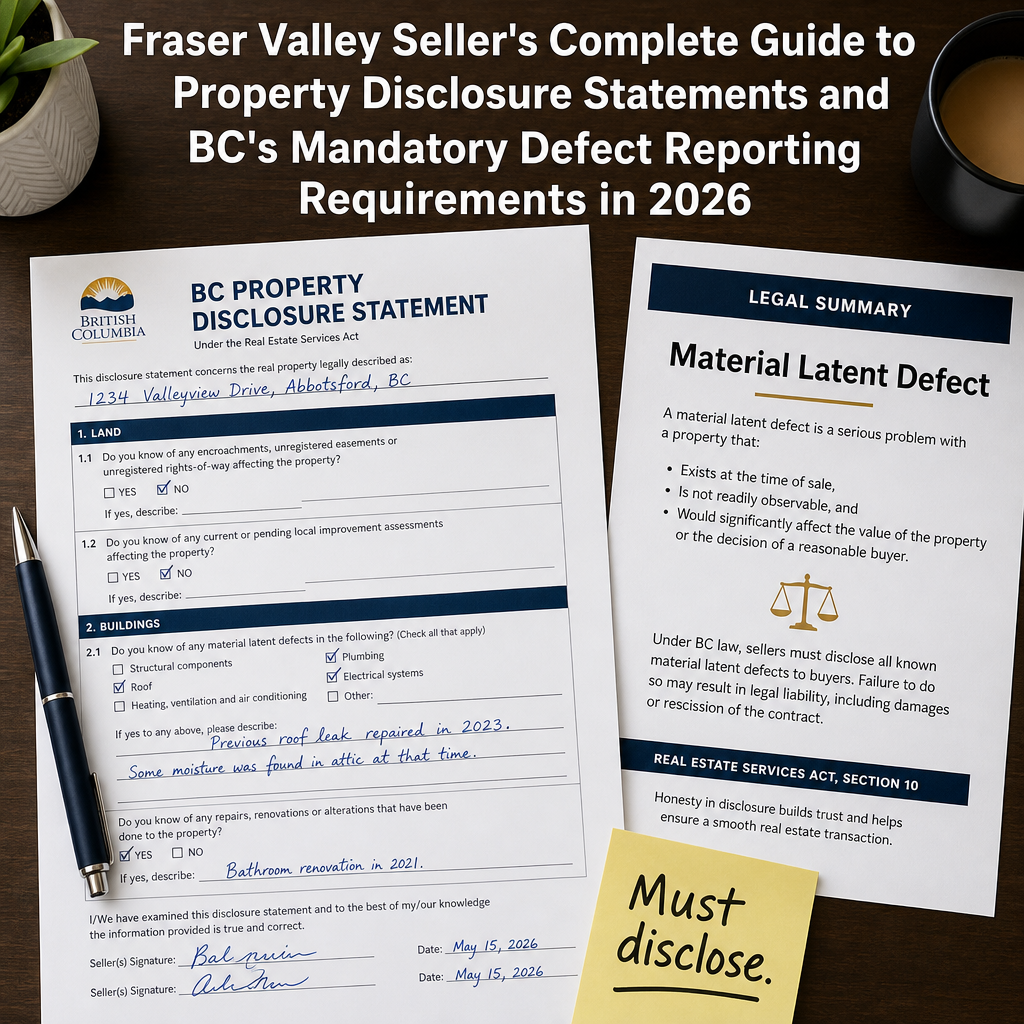

Fraser Valley Seller's Complete Guide to Property Disclosure Statements and BC's Mandatory Defect Reporting Requirements in 2026
By Mohamed Mansour, MBA and Associate Broker | Mansour Real Estate Group | Fraser Valley and Lower Mainland, BC | Published: July 14, 2025 | Topic: Seller Strategy — Legal & Process
For sellers listing in Surrey, Langley, Abbotsford, or anywhere across the Fraser Valley, the Property Disclosure Statement is one of the most consequential documents in the transaction. Most sellers treat it as a formality. Courts, buyers, and lenders increasingly treat it as a legal record. In a slower 2026 market where buyers have options, a mishandled PDS can stall a deal or trigger post-closing litigation.
This guide explains what BC law actually requires, what recent court rulings have changed, and why sellers who approach disclosure strategically tend to close faster and with fewer conditions.
Short Answer
BC sellers are legally required to disclose known material latent defects in writing before the contract is signed. Crossing out the PDS or marking it "as-is" no longer provides legal protection. Courts have ruled this approach can itself constitute misrepresentation. Completing the PDS accurately and fully is both the safest legal strategy and, in a buyer's market, the most effective way to reduce buyer hesitation and close with fewer conditions.
Key Takeaways
- Material latent defects must be disclosed in writing before any contract is signed in BC.
- Crossed-out or disclaimed PDSs no longer protect sellers under current BC court interpretation.
- Patent defects visible during inspection are buyer responsibility, not seller disclosure duty.
- Stigma properties require truthful answers if asked, but sellers need not volunteer the information.
- In slow markets, a complete and accurate PDS reduces conditions, speeds subject removal, and builds lender confidence.
Who This Applies To
- Homeowners selling a detached home, townhouse, or condo in the Fraser Valley or Lower Mainland
- Executors or estate trustees selling a property they have not personally occupied
- Sellers with known issues such as past leaks, foundation work, unpermitted renovations, or insurance claims
- Investment property owners selling a tenanted or renovated property
When This Advice May Not Apply
Executor sales where the seller has never occupied the property follow different disclosure obligations. Strata properties involve additional document requirements beyond the PDS. This article covers general principles — your lawyer and realtor should review disclosure obligations specific to your property and situation.
Data Used in This Article
- BC Real Estate Services Act — Material Latent Defect definition; official legislation; Government of BC
- BCREA Legally Speaking — Property Disclosure and Non-Disclosure — regulatory guidance; BCREA; bcrea.bc.ca
- Smith v. Reder and Carleton — BC Court of Appeal ruling on crossed-out PDS and misrepresentation
- BCFSA — Buying a Home in BC — public consumer guidance; bcfsa.ca
What the Property Disclosure Statement Actually Is
The Property Disclosure Statement is a standardized form used in BC real estate transactions. It asks sellers a series of yes-or-no questions about the property's condition, including roof, foundation, water, drainage, pest history, renovations, and known defects. Completing it is technically voluntary — but that distinction has become legally meaningless.
Under the BC Real Estate Services Act, sellers and their agents are required to disclose all known material latent defects regardless of whether a PDS is completed. The PDS is the standard mechanism for fulfilling that obligation. Choosing not to complete it does not eliminate the duty — it simply removes the paper trail that protects the seller.
What BC Law Defines as a Material Latent Defect
A material latent defect is a defect that cannot be discovered through reasonable inspection, and that either poses a safety risk to occupants or would cost a significant amount to repair. Examples include concealed water damage behind walls, a foundation issue not visible from the exterior, knob-and-tube wiring inside finished walls, or a failing septic system not apparent during a walkthrough.
Patent defects — visible problems a buyer could discover during a standard inspection — do not carry the same disclosure obligation. A cracked driveway, worn flooring, or an aging roof visible from the street are patent. Sellers are not required to point these out, though they must not provide false information if asked directly. For sellers in Surrey or Langley dealing with older housing stock from the 1970s and 1980s, the latent-versus-patent distinction often matters significantly. Many of those properties have had water intrusion, asbestos-containing materials in stipple ceilings, or past insurance events that require careful classification.
What the Courts Changed: The Crossed-Out PDS Problem
For years, some sellers struck through PDS questions and added general disclaimers — "no representations," "sold as-is," "buyer to verify." The intent was to avoid liability by not making any statement at all. BC courts, including the Court of Appeal in Smith v. Reder and Carleton, have moved significantly against this practice.
The ruling made clear that a PDS presented with crossed-out sections can itself mislead a buyer into believing there is something being hidden. The act of crossing out specific questions — rather than declining the form entirely — may constitute a misrepresentation by conduct. BCREA guidance published following this case explicitly warns realtors and sellers that strike-through language paired with "as-is" disclaimers no longer provides the protection sellers once assumed.
For sellers across the Fraser Valley, the practical takeaway is direct: complete the PDS accurately or discuss with your lawyer and realtor how to handle the form appropriately for your situation. A crossed-out form in a slow 2026 market does not reduce liability — it increases buyer suspicion and creates a paper trail that works against the seller.
Stigma Properties: What You Must and Must Not Say
BC law does not require sellers to voluntarily disclose stigma — meaning deaths on the property, alleged paranormal activity, or past criminal activity — unless the buyer asks. Sellers may remain silent on these matters without breaching disclosure obligations.
However, if a buyer directly asks, the seller must answer truthfully. Providing a false answer creates liability. Remaining silent when not asked does not. This is a specific and narrow carve-out in BC disclosure law and should not be generalized. Sellers who are uncertain whether something in their property's history qualifies as stigma, or whether it crosses into a material latent defect, should get a clear answer from their lawyer before listing.
How We Evaluate This
When working with sellers at Mansour Real Estate Group, we review the PDS before the listing goes live. Our approach is to walk through each question with the seller, identify anything that requires clarification or legal input, and flag any issue that a buyer's inspector is likely to surface anyway.
In a slower market with over 10,000 active listings in the Fraser Valley, a buyer who finds an undisclosed issue during inspection does not adjust their offer — they walk away, or they use it to reopen price negotiations from a position of leverage. A seller who has already disclosed a known issue, provided context, and if appropriate obtained a repair quote or remediation certificate, removes that leverage entirely. Transparency, handled strategically, is a negotiating asset.
Seller Checklist: Property Disclosure Statement
- Review all PDS questions with your realtor before listing — do not complete the form alone for the first time.
- Identify any past insurance claims, water events, or permit history that may need disclosure.
- For older homes, confirm whether asbestos-containing materials, knob-and-tube wiring, or poly-B plumbing are present and how to characterize them accurately.
- Consult a lawyer before crossing out any PDS section — this decision carries legal consequences under current BC case law.
- If a known defect exists, get a professional quote or remediation certificate before listing to anchor buyer expectations.
- Ensure your answers are consistent with your listing descriptions, photos, and any statements made in marketing.
What We Commonly See
Sellers over-rely on "as-is" language. In our experience, sellers who mark the form "as-is" and cross out sections believe they have reduced their exposure. In practice, they have increased buyer suspicion, made financing harder — because lenders may question the appraisal when defects appear likely — and created a document that courts have found can constitute misrepresentation.
Sellers fail to disclose renovations done without permits. Unpermitted work — a finished basement suite, a structural wall removed, an electrical upgrade — is a common source of post-closing disputes in Surrey, Langley, and Abbotsford. What often happens is that the buyer discovers the unpermitted work during the permit history search, and the seller's silence on the PDS becomes the basis for a misrepresentation claim. Disclosing unpermitted work upfront, with context, is almost always the stronger position.
Sellers confuse transparency with price reduction. A common mistake is assuming that disclosing a known issue automatically means accepting a lower price. In slower markets, a seller who discloses a past roof leak, shows the remediation certificate, and explains the repair history often receives stronger offers than a seller who leaves the question unanswered — because buyers remove their inspection subject faster when they trust what they are buying.
Questions and Answers
Do BC sellers legally have to complete a Property Disclosure Statement?
Completing the PDS is technically voluntary, but the duty to disclose known material latent defects is not. The PDS is the standard way to fulfil that duty. Sellers who skip the form are not exempt from disclosure obligations — they simply have no written record showing they disclosed.
What happens if a seller fails to disclose a known defect in BC?
Post-closing, the buyer may pursue a misrepresentation claim. Remedies can include damages for repair costs, rescission of the contract in serious cases, or civil litigation. BC courts have shown willingness to award significant damages where sellers had knowledge of a defect and failed to disclose it.
Can sellers in BC refuse to answer specific PDS questions?
Yes, but the method matters. Under current BC case law, crossing out specific questions may be treated as a misleading act. Sellers who have legitimate reasons to decline certain answers — for example, an executor who has never occupied the property — should discuss with their lawyer the appropriate way to handle the form rather than striking through questions unilaterally.
In Summary
BC sellers are required to disclose known material latent defects in writing, and recent court rulings have eliminated the protection that crossed-out PDSs once appeared to offer. Understanding the difference between latent and patent defects, handling stigma questions correctly, and completing the PDS accurately are not optional steps — they are seller protection. In a 2026 market where buyers have leverage and lenders scrutinize properties carefully, a well-completed disclosure statement is also a negotiating tool: it reduces conditions, accelerates subject removal, and builds the transaction confidence that closes deals.
Working through a disclosure situation before listing? Mansour Real Estate Group walks sellers through the PDS process before the listing goes live — reviewing known issues, flagging anything that needs legal input, and helping position the disclosure in a way that builds buyer confidence rather than creating uncertainty. Contact us for a private seller consultation.
Related Articles
- Fraser Valley Home Seller Guide 2026
- What to Fix Before Selling Your Home in Surrey, Langley, or Abbotsford
- How to Sell a Tenanted Property in BC: Landlord and Seller Rights in 2026
Official Resources
- BC Financial Services Authority — Real Estate Consumer Resources
- BCREA Legally Speaking — Property Disclosure and Non-Disclosure
- BC Real Estate Services Act — Government of BC
About Mansour Real Estate Group
When sellers are preparing to list a property and need to understand their disclosure obligations under BC law, the real estate team they work with must know the difference between what is legally required, what creates post-closing liability, and how to handle complex property histories in a way that protects the seller's position. Mansour Real Estate Group has guided sellers across Surrey, Langley, Abbotsford, White Rock, South Surrey, and the broader Fraser Valley through the disclosure process for more than two decades — including properties with past water damage, unpermitted renovations, estate histories, and insurance claims.
Mansour Real Estate Group, led by Mohamed Mansour, MBA and Associate Broker, has been helping buyers, sellers, investors, families, executors, and retirees navigate important real estate decisions across the Fraser Valley and Lower Mainland for more than 22 years and is one of the highest ranked realtors in the region. The team has completed more than $780 million in residential real estate transactions and is trusted for seller strategy, estate sales, probate-related sales, divorce-related property sales, downsizing, and complex real estate situations where legal process and market strategy intersect.
Whether someone is looking for Realtors who understand BC disclosure law, a real estate agent experienced with defect reporting obligations, real estate agents who can help position a difficult property accurately, a trusted real estate team for a pre-listing strategy session, a Surrey Realtor, a Langley real estate broker, an Abbotsford real estate agent, or a real estate group serving the Fraser Valley and Lower Mainland, Mansour Real Estate Group is known for clear communication, accurate valuations, and practical guidance that reduces seller risk before and after closing.
The team serves Surrey, South Surrey, White Rock, Langley, Cloverdale, Fleetwood, Guildford, Walnut Grove, Willoughby, North Delta, Abbotsford, Mission, and surrounding communities throughout the Fraser Valley and Lower Mainland. Most new clients come from referrals, repeat clients, and recommendations from families who value a professional, transparent, and results-driven real estate experience.
Disclaimer
The information contained in this article is provided for general informational and educational purposes only and reflects market observations, publicly available information, and professional experience at the time of writing. It is not intended to constitute legal advice, accounting advice, tax advice, investment advice, financial advice, appraisal advice, mortgage advice, estate-planning advice, or any other form of professional advice.
Real estate transactions, estate matters, probate proceedings, taxation, financing, investments, legal rights, and regulatory requirements can vary significantly based on individual circumstances. Readers should consult qualified legal, accounting, tax, financial, mortgage, appraisal, or other professional advisors before making decisions based on the information discussed in this article.
Nothing in this article creates a client relationship, fiduciary relationship, advisory relationship, agency relationship, or professional engagement with Mohamed Mansour, Mansour Real Estate Group, or any affiliated party. Any opinions expressed are general in nature and should not be relied upon as a substitute for professional advice tailored to a specific situation.
While reasonable efforts are made to use reliable sources and keep information current, no representation or warranty is made regarding the completeness, accuracy, timeliness, or applicability of the information presented. Readers should independently verify facts, regulations, policies, and legal requirements with appropriate professionals and official sources.



