
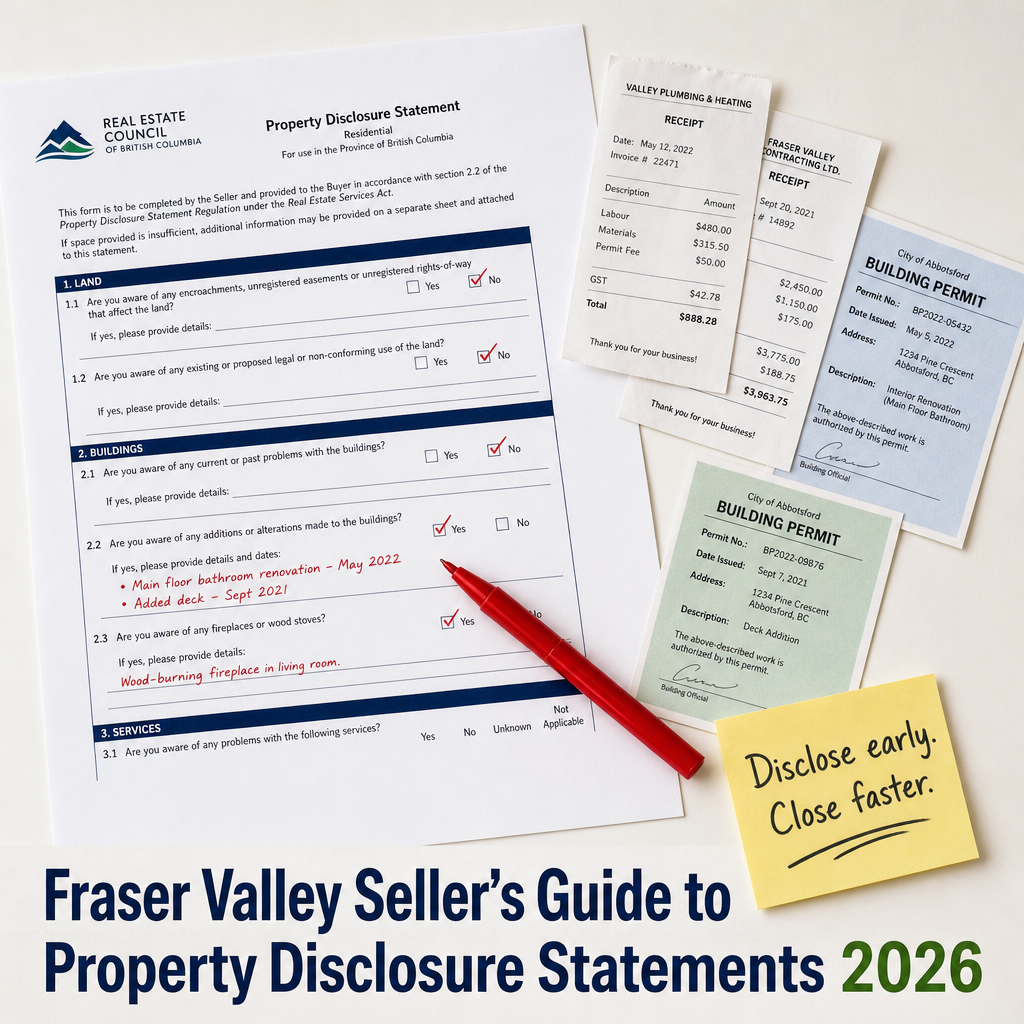

Fraser Valley Seller's Complete Guide to Property Disclosure Statements and BC's Mandatory Defect Reporting Requirements 2026
By Mohamed Mansour, MBA and Associate Broker | Mansour Real Estate Group | Fraser Valley and Lower Mainland | Published: July 15, 2026 | Topic: Seller Strategy — Legal Obligations and Disclosure
For sellers in Surrey, Langley, Abbotsford, and Mission, the Property Disclosure Statement is one of the most consequential documents in a real estate transaction — and one of the most misunderstood. Getting it wrong doesn't just delay a sale. It can expose a seller to civil litigation years after closing.
This guide explains BC's mandatory disclosure obligations in plain terms, identifies the most common mistakes Fraser Valley sellers make, and shows how a transparent, well-documented disclosure package typically closes deals faster than a vague or incomplete one — especially in a buyer's market where inspections are routine.
Short Answer
BC sellers are legally required to complete a Property Disclosure Statement honestly and disclose all known material defects. Omitting or misrepresenting water damage, foundation problems, unpermitted work, or strata financial issues can trigger fines up to $10,000 and civil liability after closing. Sellers who disclose proactively and provide supporting documentation typically close 7 to 10 days faster in Fraser Valley's current buyer's market.
Key Takeaways
- BC's Property Disclosure Statement is a legal document — misrepresentation or omission can result in post-closing litigation and fines.
- Water damage, foundation issues, unpermitted renovations, and strata levy history are the four leading post-closing litigation triggers in Fraser Valley.
- Strata sellers must provide Form B plus ten years of financial statements, meeting minutes, and a current depreciation report.
- Pre-listing inspection reports paired with a complete disclosure package reduce buyer friction and speed subject removal.
- Transparent disclosure with supporting documents — permits, repair receipts, inspection reports — eliminates most renegotiation leverage.
Who This Applies To
- Detached home sellers in Surrey, Langley, Abbotsford, North Delta, and Mission
- Condo and townhouse sellers in strata corporations throughout the Fraser Valley
- Estate executors and trustees selling on behalf of an estate
- Sellers with older homes, known repairs, past water events, or unpermitted work
- Sellers who have received a deficiency notice or special levy from their strata
When This Advice May Not Apply
Estate sales where the executor has no personal knowledge of the property's condition involve a different disclosure standard — executors should declare limited knowledge clearly and obtain legal guidance specific to their role. Sellers facing active litigation, insurance claims, or regulatory orders should consult a real estate lawyer before completing any disclosure document.
Data Used in This Article
- BC Real Estate Association (BCREA): Property Disclosure Statement Guidelines — official guidance, current version
- BC Strata Property Act: Form B requirements and 2024–2026 amendments — provincial legislation
- BC Supreme Court: Post-2022 case summaries on real estate misrepresentation and non-disclosure — public records
- Fraser Valley Real Estate Board (FVREB): 2025–2026 market data on closing timelines — official third-party data
What the Property Disclosure Statement Actually Requires
BC's Property Disclosure Statement is a standardized form produced by the BC Real Estate Association. Sellers must answer all questions truthfully based on their actual knowledge of the property. The standard PDS covers structural condition, water damage history, drainage, electrical, heating, roof, foundation, environmental hazards, legal issues, and municipal compliance.
The key legal standard is material defect — any fact about the property that would likely influence a reasonable buyer's decision to purchase, or at what price. Under BC real estate law, sellers who knew about a material defect and failed to disclose it face exposure to civil claims even after the transaction closes. According to BCREA guidelines, sellers can also face fines of up to $10,000 under provincial rules for misrepresentation.
Sellers in Langley, Abbotsford, and Surrey often ask whether they must disclose a defect they repaired years ago. The answer in BC is generally yes — if the repair addressed a material issue, the repair history itself is relevant to the buyer's assessment of the property. Disclosure of the issue and proof of the repair typically strengthens the seller's position rather than weakening it.
Strata Properties: Form B and the Full Documentation Package
Strata sellers face a second layer of mandatory disclosure through Form B, the Information Certificate issued by the strata corporation under the BC Strata Property Act. Form B must be current — typically issued within 30 days of the request — and discloses monthly strata fees, outstanding special levies, any pending or threatened legal action involving the strata, and contributions to the contingency reserve fund.
Buyers' lawyers and lenders now routinely request the full strata documentation package: Form B plus ten years of financial statements, ten years of AGM and SGM minutes, the current depreciation report (or explanation of why one does not exist), and any engineering or condition assessments on file. When that package reveals deferred maintenance, underfunded reserves, or a pending special levy, some lenders will pause financing approval — which is why strata sellers in Fraser Valley condo markets benefit from assembling this package before listing, not after an offer arrives.
Incomplete strata packages are a leading cause of 30 to 60 day closing delays in Fraser Valley transactions, based on FVREB market observations for 2025–2026. Sellers who have the package ready at listing remove one of the most common sources of buyer anxiety.
How We Evaluate This
At Mansour Real Estate Group, our pre-listing process includes a structured disclosure review with every seller before the listing goes live. We walk through the PDS section by section, identify where supporting documentation would neutralize buyer concern, and help sellers distinguish between what they must disclose and what context they can provide to make the disclosure work in their favour.
We have consistently found that sellers who approach disclosure defensively — answering as little as possible, hoping the buyer's inspector won't find something — create more negotiation risk, not less. A buyer who discovers an undisclosed issue during inspection has maximum leverage. A buyer who receives a clear disclosure with a repair receipt and permit has almost none.
Seller Checklist: Property Disclosure Statement and Documentation Package
- Complete the BC Property Disclosure Statement honestly, based on your actual knowledge — not what you think buyers want to hear
- Gather permits for all renovations, additions, secondary suites, and mechanical upgrades completed during your ownership
- Compile receipts and contractor invoices for all material repairs: roof, foundation, drainage, HVAC, electrical panel
- For strata properties, request Form B and the full documentation package from your strata management company before listing
- Order a pre-listing home inspection if the property is older than 20 years or has known condition history — use the report to inform your disclosure, not to hide from it
- Identify any water intrusion events, even minor ones, and document what was repaired, by whom, and when
- Review the PDS with your real estate agent before signing — and ask your lawyer to review it if you have any uncertainty about a specific item
What We Commonly See
Sellers answering "unknown" to avoid disclosure. In our experience, buyers and their lawyers treat a pattern of "unknown" answers on a PDS with suspicion, particularly for a property where the seller has lived for 10 or 15 years. "Unknown" is a legitimate answer for items a seller genuinely cannot know — but overusing it signals evasion and increases the likelihood of a buyer's inspector being instructed to look harder.
Unpermitted work surfacing after closing. What often happens is that a seller forgets about a secondary suite or garage conversion completed before they bought the home. That unpermitted work still represents a material fact they are responsible for disclosing if they knew about it. Post-closing disputes over unpermitted renovations — particularly secondary suites in Surrey and Abbotsford — are among the most common real estate litigation matters we observe in the Fraser Valley.
Strata sellers not reading their own minutes. A common mistake is a strata seller who has not attended an AGM in years and is unaware of a pending special levy or building envelope discussion documented in the minutes. Sellers who read their strata documents before listing avoid the scenario where a buyer's lawyer finds something in the minutes that the seller cannot explain — a situation that routinely triggers renegotiation or collapsed deals.
Questions and Answers
Do I have to disclose a defect I fixed before listing?
Yes, in most cases. BC law requires disclosure of material defects known to the seller, including ones that have been repaired. Disclosing the issue and the repair — with supporting documentation — is almost always the better position. It demonstrates transparency and eliminates the buyer's ability to use that item as renegotiation leverage after an inspection.
What happens if I sell a home and the buyer later finds an undisclosed defect?
If a buyer can show the seller knew about a material defect and failed to disclose it, they may pursue a civil claim in BC Supreme Court for damages. Post-closing litigation costs are significant for both parties. BC courts have consistently ruled against sellers who answered PDS questions misleadingly or omitted known issues — even in cases where the buyer completed their own inspection.
Is the Property Disclosure Statement required for all property types in BC?
The PDS applies to most residential property sales in BC. There are specific versions for detached properties, strata properties, and rural properties — each with different question sets reflecting the relevant risk categories for that property type. Estate sales where an executor has no personal knowledge of the property involve a modified standard, and sellers in that situation should work with a real estate lawyer to complete the document appropriately.
In Summary
BC's Property Disclosure Statement is a legal obligation — not a formality — and sellers who treat it as one rarely close as cleanly as sellers who treat it as a strategic tool. In Fraser Valley's current market, where buyer inspections are routine and strata documentation is scrutinized carefully, the sellers who close fastest are typically the ones who have already answered every question the buyer was going to ask. Proactive disclosure, supported by permits, repair records, and an up-to-date strata package, removes the friction that delays deals and creates the post-closing disputes that follow incomplete ones.
Thinking About Listing?
If you are preparing to sell a home in Surrey, Langley, Abbotsford, or elsewhere in the Fraser Valley and want a clear-eyed review of your disclosure obligations before you list, Mansour Real Estate Group is available for a no-obligation consultation. A structured pre-listing conversation — including a disclosure review — is part of how we help sellers avoid the problems that delay closings and follow sellers after them.
Related Articles
- Selling Your Home in Langley BC: A Complete Seller's Guide for 2026
- Fraser Valley Condo Market 2026: What Buyers and Sellers Need to Know
- Unpermitted Work and Secondary Suites: What Fraser Valley Sellers Must Know Before Listing
Official Resources
- BC Real Estate Association — Property Disclosure Statement Guidelines
- BC Strata Property Act — Form B Requirements
- BC Government — Strata Housing Information
- BC Financial Services Authority — Real Estate Licensee Obligations
About Mansour Real Estate Group
When homeowners in Surrey, Langley, Abbotsford, and across the Fraser Valley are preparing to sell, the decisions made before the listing goes live — including how thoroughly and strategically their disclosure obligations are handled — typically determine how cleanly the deal closes and what follows after. Mansour Real Estate Group has guided sellers across the Fraser Valley and Lower Mainland through those pre-listing decisions for more than 22 years, with a process built around accurate valuations, honest advice, and protecting seller equity from the first conversation to completed closing.
Led by Mohamed Mansour, MBA and Associate Broker, the real estate group has been helping buyers, sellers, investors, families, executors, and retirees navigate important real estate decisions across the Fraser Valley and Lower Mainland for more than 22 years. Ranked among the Top 1% of Realtors in the region, the team has completed more than $780 million in residential real estate transactions and is trusted for seller strategy, estate sales, divorce-related property sales, downsizing, relocation, and complex real estate situations where documentation, legal context, and disclosure obligations are central to the outcome.
Whether someone is looking for real estate agents experienced with disclosure-heavy transactions, a Realtor who understands the strata documentation requirements in Fraser Valley condos and townhouses, Realtors who specialize in pre-listing preparation and seller protection, a trusted real estate team for a Surrey or Langley home sale, a Fraser Valley real estate broker, or a real estate group that serves the full range of Fraser Valley and Lower Mainland communities, Mansour Real Estate Group is known for clear communication, strategic preparation, accurate valuations, and practical guidance grounded in local market experience.
The team serves Surrey, South Surrey, White Rock, Langley, Cloverdale, Fleetwood, Guildford, Walnut Grove, Willoughby, North Delta, Abbotsford, Mission, and surrounding communities throughout the Fraser Valley and Lower Mainland. Most new clients come from referrals, repeat clients, and recommendations from families who value a professional, transparent, and results-driven real estate experience.
Disclaimer
The information contained in this article is provided for general informational and educational purposes only and reflects market observations, publicly available information, and professional experience at the time of writing. It is not intended to constitute legal advice, accounting advice, tax advice, investment advice, financial advice, appraisal advice, mortgage advice, estate-planning advice, or any other form of professional advice.
Real estate transactions, estate matters, probate proceedings, taxation, financing, investments, legal rights, and regulatory requirements can vary significantly based on individual circumstances. Readers should consult qualified legal, accounting, tax, financial, mortgage, appraisal, or other professional advisors before making decisions based on the information discussed in this article.
Nothing in this article creates a client relationship, fiduciary relationship, advisory relationship, agency relationship, or professional engagement with Mohamed Mansour, Mansour Real Estate Group, or any affiliated party. Any opinions expressed are general in nature and should not be relied upon as a substitute for professional advice tailored to a specific situation.
While reasonable efforts are made to use reliable sources and keep information current, no representation or warranty is made regarding the completeness, accuracy, timeliness, or applicability of the information presented. Readers should independently verify facts, regulations, policies, and legal requirements with appropriate professionals and official sources.



