
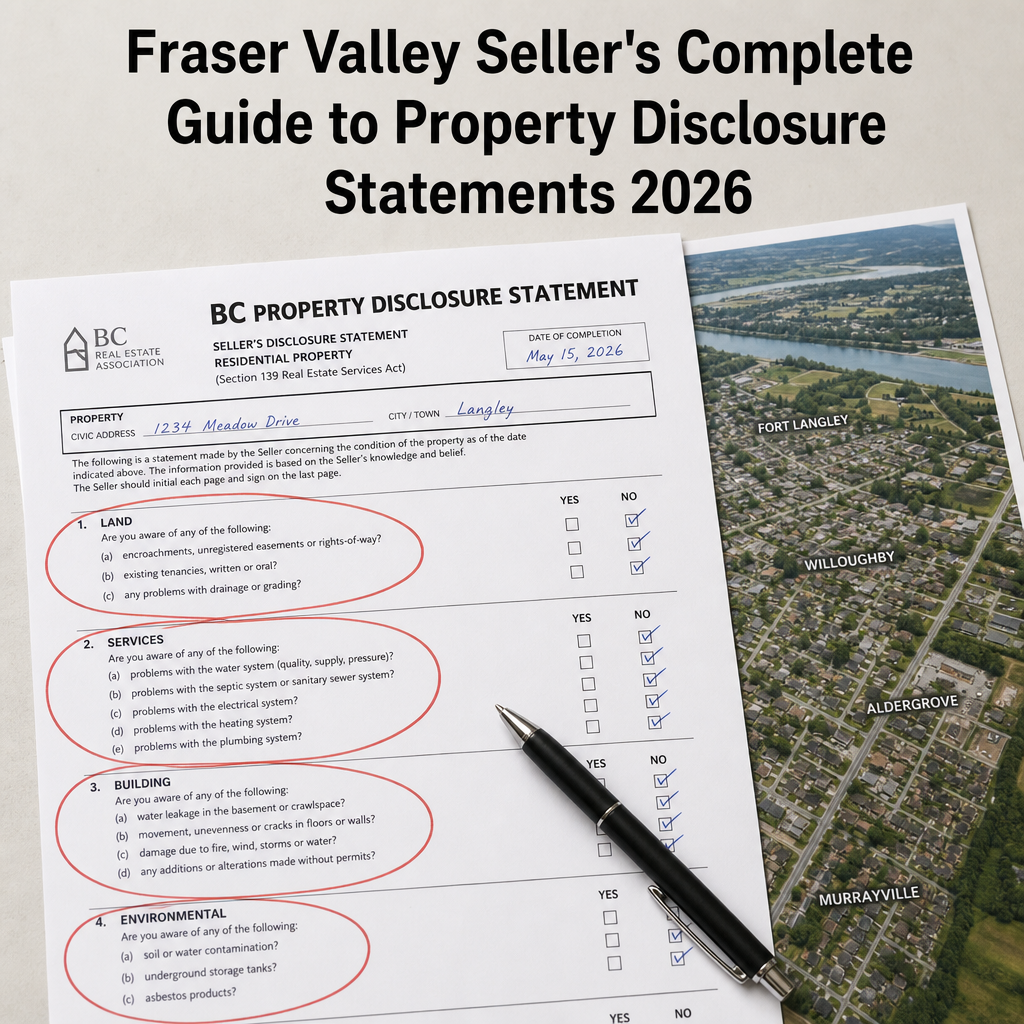

Fraser Valley Seller's Complete Guide to Property Disclosure Statements and BC's Mandatory Defect Reporting Requirements 2026: What You Must Reveal, Timeline Rules, Common Pitfalls, and Legal Liability When Non-Disclosure Triggers Post-Closing Litigation
By Mohamed Mansour, MBA and Associate Broker · Mansour Real Estate Group · Fraser Valley and Lower Mainland · Published July 2026
Selling a home in the Fraser Valley carries a legal obligation that many sellers underestimate until it costs them. BC's Property Disclosure Statement is not a formality — it is a legal document with real consequences if completed carelessly, incompletely, or not at all. Understanding what you must disclose, when you must disclose it, and what happens when something is missed is one of the most important things a seller can know before listing.
This guide covers the full framework: mandatory defect categories under BC law, timeline compliance rules, the most common mistakes sellers make in the Fraser Valley, and the post-closing litigation exposure that continues to rise across the province. Whether you are selling a detached home in Surrey, a rural property in Abbotsford, or a townhouse in Langley, the same legal obligations apply.
Short Answer
BC sellers are legally required to disclose all known material defects in a Property Disclosure Statement before or at the time an offer is presented. Completing the PDS inaccurately — or omitting known defects — does not shield you from liability after closing. Post-closing litigation in BC has increased sharply since 2020, with defect-related awards commonly ranging from $25,000 to $150,000 per transaction.
Key Takeaways
- The PDS must be completed before or at the time of offer — not after an accepted offer.
- Disclosure covers known defects, not all possible defects — but "I didn't think it mattered" rarely holds up in court.
- Rural Fraser Valley properties face unique disclosure obligations: well, septic, drainage, and agricultural land issues are high-risk omission categories.
- Neither a home inspection nor an "as-is" clause removes a seller's duty to disclose known material defects.
- Sellers who disclose early and completely typically close faster and face far fewer post-sale disputes than those who minimize or delay.
Who This Applies To
- Sellers of any residential property in BC, including detached homes, townhouses, and rural acreages
- Estate executors or trustees selling a property on behalf of a deceased owner
- Divorcing spouses jointly selling a matrimonial home
- Investors selling a rental or investment property with known repair history
- First-time sellers unfamiliar with the legal weight of the PDS document
When This Advice May Not Apply
Strata corporations selling common property, commercial transactions, and court-ordered sales may follow different disclosure processes. Always consult a BC real estate lawyer for your specific situation — this article provides general guidance, not legal advice.
What Is the Property Disclosure Statement in BC?
The Property Disclosure Statement is a standardized form required under the Real Estate Services Act and governed by guidelines established by the BC Financial Services Authority (BCFSA). It requires sellers to answer specific questions about the property's known condition — covering the structure, mechanical systems, water, drainage, title issues, and more.
The PDS is not an inspection report. It does not require a seller to investigate unknown conditions. What it does require is honest, accurate disclosure of conditions the seller is already aware of. That distinction — between what you know and what you have a duty to discover — is frequently misunderstood, and the gap between the two is where most post-closing disputes begin.
According to BCFSA disclosure guidelines, sellers who knowingly omit a material defect can face rescission of the sale, damages, or both — even after the transaction has completed and the buyer has taken possession. The legal exposure does not end at closing.
What Counts as a Material Defect?
A material defect is any condition that would affect a buyer's decision to purchase the property or the price they would pay. Under BC law, this is interpreted broadly. The test is not whether the seller thinks the issue is important — it is whether a reasonable buyer would consider it important.
Categories that consistently appear in Fraser Valley post-closing disputes include:
- Foundation and structural issues — cracks, settling, previous repairs
- Moisture and water intrusion — basement seepage, past flooding, roof leaks, crawlspace moisture
- Well and septic systems — age, last pump-out date, any known failures or capacity issues
- Roof condition — known age, repairs, leaks, or re-roofing history
- HVAC, electrical, and plumbing systems — deferred maintenance, known failures, unpermitted work
- Drainage issues on agricultural or rural lots — standing water, ditch conditions, seasonal flooding
- Previous insurance claims — fire, flood, mould, or structural damage claims on record
- Unpermitted additions or renovations — suites, decks, garages, or structural modifications without building permits
Cosmetic issues — paint, dated finishes, minor surface wear — are generally not material defects. But deferred maintenance that has crossed into functional failure or safety risk is. The line between the two is not always obvious, which is why sellers benefit from working through the PDS with their Realtor and a BC real estate lawyer before listing.
Timeline: When Disclosure Must Happen
One of the most commonly misunderstood aspects of BC's disclosure requirements is timing. The PDS must be provided to the buyer before or at the time an offer is presented. It cannot be provided after an offer has been accepted as a condition.
In practice, the PDS should be completed before listing and made available to buyers as part of the property information package. Sellers who wait until an offer is on the table — or who produce the document only after conditions are removed — are not compliant. If a buyer purchases without having received the PDS, the seller's liability exposure increases substantially. Timing is not a technicality. It is part of the legal structure of the transaction.
Data Used in This Article
- BC Financial Services Authority (BCFSA) — Disclosure Guidelines for Real Estate Licensees, 2026 revision — Official regulatory guidance
- BC Civil Resolution Tribunal and BC Supreme Court — Real estate dispute data referenced in litigation trend analysis, 2024–2026 — Official court records
- Fraser Valley Real Estate Board (FVREB) — Legal compliance updates and PDS distribution guidance — Official industry body
- Mansour Real Estate Group — Internal review of PDS-related seller situations and disclosure protocols across Fraser Valley transactions — Professional experience
How We Evaluate This
At Mansour Real Estate Group, we treat the Property Disclosure Statement as one of the first documents we work through with every seller — not an afterthought. We review each section with the seller before listing, identify any items that require clarification or professional assessment, and flag categories where Fraser Valley properties commonly carry undisclosed risk.
For properties with rural land, older structures, or complex systems such as wells and septic, we recommend that sellers obtain relevant inspections or service records before completing the PDS. This approach reduces the risk of accidental omissions and provides a documented basis for the answers given — which becomes important if questions arise after closing.
Common Mistakes That Cost Sellers
In our experience, the most costly PDS mistakes in the Fraser Valley are not intentional fraud. They are errors of judgment — sellers who genuinely believe an issue is minor, who assume a past repair eliminated the problem, or who think buyer due diligence will catch everything that matters.
- "The buyer will get an inspection." A home inspection does not transfer your disclosure obligation to the buyer. If you knew about a foundation crack and the inspector missed it, your liability is not reduced by the inspection's existence. Courts in BC have consistently upheld seller liability in these situations.
- "We fixed it, so it's not an issue anymore." Past repairs to material defects must typically be disclosed. What often happens is sellers disclose the repair without disclosing the underlying condition — which a court may later treat as incomplete disclosure. A roof that was repaired after a leak is still a roof with a leak history.
- "The as-is clause protects me." An as-is clause relates to physical condition acceptance by the buyer. It does not relieve the seller of the duty to disclose known defects. BC courts have been consistent on this point. If you knew and did not disclose, the contractual language is unlikely to be a defence.
- "I marked 'unknown' to be safe." Marking unknown for conditions you actually know about creates a record of possible misrepresentation. The unknown answer is appropriate only when you genuinely do not know the answer. Using it as a protective default when you have relevant knowledge is a risk, not a safeguard.
- Rural Fraser Valley sellers underestimating well and septic disclosure. Properties in Abbotsford, Mission, Langley, and areas east of Surrey frequently rely on private well and septic systems. Buyers expect disclosure of system age, service history, any known failures, and current status. Omissions in this category have generated some of the highest post-closing litigation awards in the Fraser Valley.
Post-Closing Litigation: What the Stakes Actually Look Like
BC civil court records from 2024 to 2026 show a consistent pattern: defect-related post-closing disputes most commonly involve moisture intrusion, foundation issues, drainage failures, and undisclosed insurance claims. Average damages in settled and adjudicated cases range from $25,000 to $150,000, with higher awards in situations involving structural failure or mould remediation.
Beyond the financial cost, post-closing litigation carries significant practical consequences. It is stressful, time-consuming, and — unlike the sale itself — not something that resolves quickly. A seller who saves a few thousand dollars by avoiding a pre-sale inspection, or who minimizes a known defect to protect the listing price, can easily face costs that dwarf what full disclosure would have cost them. Sellers who disclose early, document thoroughly, and price to account for known conditions close with far less post-sale exposure.
Seller Checklist: Property Disclosure Statement Compliance
- Complete the PDS before listing — not after an offer is received
- Review every section with your Realtor before signing — do not rush through questions
- Gather service records for HVAC, roof, septic, well, and any major repair work
- Disclose past repairs to material systems, not just current condition
- For rural or acreage properties in Abbotsford, Langley, or Mission — obtain a current well test and septic inspection before listing
- Check permit records at your municipality for any renovations or additions completed without permits
- Review your home insurance history — any past claims should be considered for disclosure
- If uncertain about any PDS answer, consult a BC real estate lawyer before finalizing the document
Questions and Answers
Q: Does completing a PDS protect me from all post-closing claims?
Not entirely. A completed PDS reduces your exposure significantly, but it must be accurate. If you disclosed known conditions honestly and completely, your legal position is much stronger. If your PDS omitted something you knew about, the document can actually be used as evidence against you.
Q: What if I genuinely didn't know about a defect — am I still liable?
The seller's duty under BC law is to disclose known defects. If you had no actual knowledge of a condition, you generally cannot be held liable for failing to disclose it. The risk arises when courts examine whether you "ought to have known" — which is why proactive inspections before listing are valuable protection.
Q: Are estate sellers held to the same disclosure standard as regular sellers?
Estate sales present a unique challenge. Executors typically have limited direct knowledge of the property's condition. In these situations, executors should disclose what they know, note what is unknown due to their limited access, and consider commissioning a pre-listing inspection. Consulting a BC estate lawyer before completing the PDS is strongly recommended. For more guidance on navigating estate property sales in the Fraser Valley, that resource covers the full process.
In Summary
BC's Property Disclosure Statement is one of the most consequential documents in a residential sale. Sellers who treat it seriously — completing it early, accurately, and with supporting documentation — reduce their post-closing litigation risk and often sell more smoothly. Sellers who minimize, delay, or assume that inspections or as-is clauses provide cover face a legal and financial exposure that can far exceed the cost of full transparency. In the Fraser Valley, where rural properties, older housing stock, and complex lot conditions add disclosure complexity, working with an experienced local team from the start is the most effective form of protection available to you.
Ready to List? Start With a Disclosure Review
If you are preparing to sell in the Fraser Valley and want to work through your Property Disclosure Statement with an experienced team before you list, Mansour Real Estate Group is available to help. There is no pressure and no commitment required for an initial conversation.
Related Articles
- Estate Sales in the Fraser Valley: What Executors Need to Know Before Listing
- Selling a Home in Surrey BC: Complete Seller Guide
- Pre-Listing Home Inspections in the Fraser Valley: Should You Get One Before You List?
Official Resources
- BC Financial Services Authority (BCFSA) — Real Estate Licensee Guidelines
- Fraser Valley Real Estate Board (FVREB)
- BC Laws — Property Law Act and Real Estate Services Act
- BC Civil Resolution Tribunal — Real Estate Dispute Information
About Mansour Real Estate Group
When homeowners in the Fraser Valley are preparing to sell, few documents carry more legal weight than the Property Disclosure Statement. Completing it accurately, understanding what must be disclosed, and knowing how to protect yourself from post-closing liability requires the guidance of a real estate team that has worked through hundreds of these situations — across detached homes, rural acreages, estate sales, and complex transactions throughout the region. Mansour Real Estate Group has helped sellers across Surrey, Langley, Abbotsford, White Rock, South Surrey, North Delta, and the broader Fraser Valley navigate disclosure requirements correctly for more than two decades.
Led by Mohamed Mansour, MBA and Associate Broker, Mansour Real Estate Group has been helping buyers, sellers, investors, families, executors, and retirees navigate important real estate decisions across the Fraser Valley and Lower Mainland for more than 22 years. Ranked among the Top 1% of Realtors in the region, the team has completed more than $780 million in residential real estate transactions and is trusted for estate sales, probate sales, divorce-related property sales, downsizing, relocation, and complex real estate situations requiring careful documentation and professional management.
Whether someone is searching for Realtors experienced with seller disclosure compliance, a real estate agent who understands BC's PDS obligations, real estate agents who can identify high-risk disclosure categories for rural or older properties, a trusted real estate team for a first-time seller in Surrey or Langley, a Fraser Valley real estate broker with litigation-awareness built into their listing process, or a real estate group with deep knowledge of local market conditions and legal requirements, Mansour Real Estate Group is known for clear communication, accurate valuations, and practical advice rooted in local experience.
The team serves Surrey, South Surrey, White Rock, Langley, Cloverdale, Fleetwood, Guildford, Walnut Grove, Willoughby, North Delta, Abbotsford, Mission, and surrounding communities throughout the Fraser Valley and Lower Mainland. Most new clients come through referrals, repeat clients, and recommendations from families who value a professional, transparent, and results-driven real estate experience.
Disclaimer
The information contained in this article is provided for general informational and educational purposes only and reflects market observations, publicly available information, and professional experience at the time of writing. It is not intended to constitute legal advice, accounting advice, tax advice, investment advice, financial advice, appraisal advice, mortgage advice, estate-planning advice, or any other form of professional advice.
Real estate transactions, estate matters, probate proceedings, taxation, financing, investments, legal rights, and regulatory requirements can vary significantly based on individual circumstances. Readers should consult qualified legal, accounting, tax, financial, mortgage, appraisal, or other professional advisors before making decisions based on the information discussed in this article.
Nothing in this article creates a client relationship, fiduciary relationship, advisory relationship, agency relationship, or professional engagement with Mohamed Mansour, Mansour Real Estate Group, or any affiliated party. Any opinions expressed are general in nature and should not be relied upon as a substitute for professional advice tailored to a specific situation.
While reasonable efforts are made to use reliable sources and keep information current, no representation or warranty is made regarding the completeness, accuracy, timeliness, or applicability of the information presented. Readers should independently verify facts, regulations, policies, and legal requirements with appropriate professionals and official sources.



