
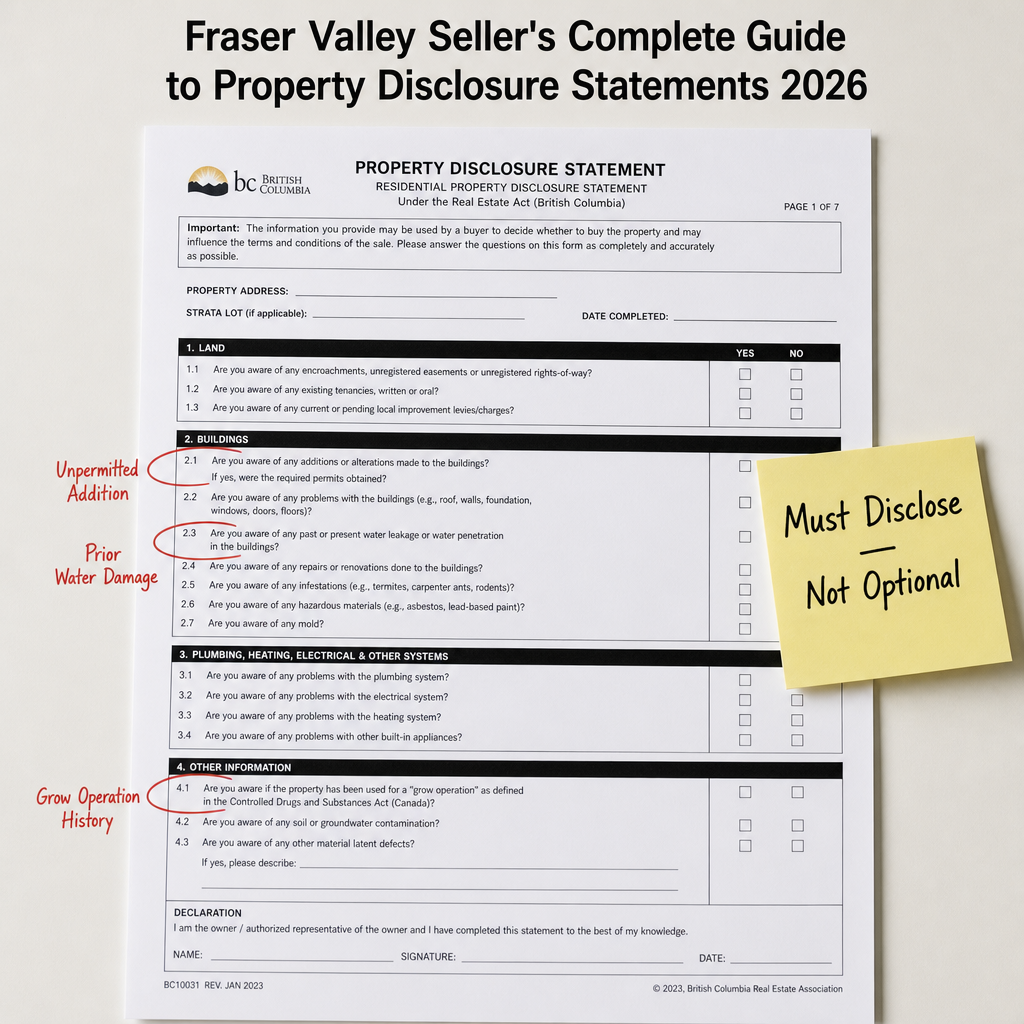

Fraser Valley Seller's Complete Guide to Property Disclosure Statements and BC's Mandatory Defect Reporting Requirements 2026: What You Must Reveal, Timeline Rules, Common Pitfalls, and Legal Liability When Non-Disclosure Triggers Post-Closing Litigation
By Mohamed Mansour, MBA and Associate Broker | Mansour Real Estate Group | Fraser Valley and Lower Mainland | Published: July 15, 2026 | Topic: Legal & Process — BC Seller Disclosure
Most Fraser Valley sellers assume the Property Disclosure Statement is simply a form to fill out and sign. That assumption creates real legal exposure. The PDS is voluntary in BC. Material latent defect disclosure is not. The distinction matters enormously, and misunderstanding it costs sellers money long after possession day.
This guide explains exactly what BC law requires sellers to disclose, what happens when sellers get it wrong, and why a transparent disclosure strategy protects seller equity rather than threatening it. It is written for homeowners in Surrey, Langley, Abbotsford, White Rock, South Surrey, North Delta, and throughout the Fraser Valley who are preparing to sell in 2026.
Short Answer
In BC, the Property Disclosure Statement form is voluntary — no legislation requires it. But disclosing material latent defects is a legal obligation. Sellers who hide hidden problems that make a home dangerous, unfit, or unsuitable for its intended purpose face post-closing lawsuits, rescission claims, and damages liability. Transparency at listing consistently leads to cleaner transactions and fewer closing complications.
Key Takeaways
- The PDS form is voluntary in BC, but material latent defect disclosure is a mandatory legal duty under common law.
- Material latent defects include unpermitted work, hidden water damage, prior grow operations, mold history, and certain boundary disputes.
- When PDS answers are incorporated into the purchase contract, they become enforceable warranties — accuracy becomes legally binding.
- If a seller refuses to disclose a known material latent defect, the seller's realtor must disclose or terminate representation under BC Real Estate Services Rules s. 59.
- Post-closing litigation for non-disclosure can include repair cost damages, full rescission of the sale, and CRA scrutiny of capital gains reporting.
Who This Applies To
- Homeowners in Surrey, Langley, Abbotsford, South Surrey, White Rock, North Delta, Cloverdale, and the broader Fraser Valley preparing to list in 2026
- Sellers of properties with prior water damage, unpermitted additions, grow operation history, or known strata issues
- Estate executors and divorcing homeowners selling a property they may not have fully occupied or inspected
- Sellers uncertain whether a known problem qualifies as a material latent defect
- Any seller whose agent has recommended completing a Property Disclosure Statement
When This Advice May Not Apply
Sellers with no personal knowledge of property defects — including executors who never occupied the property — may have limited disclosure obligations. The duty to disclose applies to what is actually known. This article is general information. Consult a BC real estate lawyer before making disclosure decisions on complex or disputed matters.
Data Used in This Article
- BCFSA Material Latent Defects Public Guidance, 2026 — official regulatory guidance, BC-wide
- BC Real Estate Services Rules, Section 59 — legislation, mandatory realtor obligations
- BCREA Legally Speaking #589: Property Disclosure and Non-Disclosure — industry legal commentary
- Sewell v. Abadian, BC Supreme Court — case law on duty of forthrightness in seller disclosure
Key Definitions
Material Latent Defect: A hidden defect not visible during a reasonable inspection that makes the property dangerous, unfit for habitation, or unfit for the buyer's known intended purpose. Disclosure is legally mandatory.
Patent Defect: A visible defect a buyer could discover through reasonable inspection. Patent defects fall under buyer-beware. Sellers are not required to disclose them, though doing so builds trust.
Property Disclosure Statement (PDS): A standard BCREA form on which sellers answer questions about known defects, permits, water ingress, and structural history. Completing it is voluntary, but once completed and incorporated into the purchase contract, the answers become enforceable warranties.
Incorporated Warranty: When a PDS is attached to and forms part of the Contract of Purchase and Sale, seller statements are no longer just disclosures — they are contractual representations the buyer can enforce after closing.
The Legal Distinction That Creates Seller Liability
The Property Disclosure Statement is not required by any BC statute. A seller can choose not to complete one. Many estate sales and some investor-held properties are listed without a PDS, and that is legally permissible.
What is not permissible — and what no seller can opt out of — is the common law duty to disclose material latent defects. This duty exists regardless of whether a PDS is completed, regardless of whether a subject-to-inspection clause is included, and regardless of what the contract says about buyer-beware.
Material latent defects that Fraser Valley sellers most commonly fail to disclose include unpermitted additions or renovations, prior flooding or water ingress events — even if remediated — former grow operations, mold remediation history, and boundary encroachments that affect the usable land. According to BCFSA's 2026 public guidance on material latent defects, the test is whether the defect makes the property dangerous, unfit for habitation, or unfit for the buyer's known intended purpose.
In Sewell v. Abadian, the BC Supreme Court reinforced that sellers carry a broader duty of forthrightness — meaning the obligation is not limited to answering direct questions truthfully, but extends to volunteering information a reasonable buyer would consider material. Striking through questions on the PDS, leaving sections blank, or answering "unknown" for things the seller does know creates the same exposure as explicit non-disclosure.
When the PDS Becomes a Legal Warranty — and Why That Changes Everything
Many sellers complete a PDS believing it simply protects them by documenting what they know. That belief is partially correct — but it omits the most important risk.
When a PDS is incorporated by reference into the Contract of Purchase and Sale, the seller's answers stop being disclosures and become contractual warranties. A buyer who discovers after closing that a seller answered "No" to a water ingress question when water damage existed has a direct contractual claim — not just a tort claim — for misrepresentation.
BCREA's Legally Speaking #589 notes that this distinction matters because it lowers the evidentiary threshold for post-closing litigation. The buyer does not need to prove the seller intentionally misled them. The seller's incorrect answer, regardless of intent, is a breach of warranty.
For sellers in Surrey, Langley, Abbotsford, and throughout the Fraser Valley, the practical implication is this: completing the PDS carefully, with legal advice on any uncertain answers, creates far less risk than completing it quickly and assuming it will protect you.
How We Evaluate This
At Mansour Real Estate Group, disclosure strategy begins before the listing agreement is signed. When we meet with sellers, we walk through the property's history directly — not as a formality, but as a risk conversation. We ask about permits, renovations, water events, prior uses, and any issues the seller is aware of regardless of whether they think those issues are material.
Our approach, consistent with BC Real Estate Services Rules s. 59, is that any known material latent defect must be disclosed. We will not list a property that has a known disclosure obligation the seller refuses to meet. In practice, this protects sellers — because the cost of a disclosure conversation at listing is always lower than the cost of post-closing litigation.
Seller Disclosure Checklist
- Confirm which permits were pulled for additions, renovations, or suite conversions — check with your municipality if unsure
- Disclose any water ingress, flooding, or moisture events, even if remediated — include the remediation history
- Disclose prior grow operations or any prior illegal use of the property, including suites operated without RTB compliance
- Disclose any mold testing, mold remediation, or suspected mold history
- Disclose any boundary disputes, encroachments, or easement issues affecting the property's usability
- Review strata records for any special levies, depreciation report concerns, or building envelope history if selling a condo or townhome
- Have a BC real estate lawyer review your PDS answers before incorporation into the Contract of Purchase and Sale
What We Commonly See
In our experience, the most common disclosure mistake is sellers believing that completing remediation eliminates the disclosure obligation. It does not. A seller who had a grow operation professionally remediated eight years ago still has a duty to disclose that history. The remediation is relevant — but it does not replace the disclosure.
What often happens is that sellers answer "unknown" on questions where they genuinely do know the answer, believing this is safer. Courts have not consistently accepted that framing. If the seller had direct knowledge of a water event and answered "unknown," that answer will be examined closely in litigation.
A common mistake with unpermitted work is the assumption that if the work looks fine, it does not need to be disclosed. Unpermitted additions — including secondary suites, garages, and covered decks — are a material latent defect if they could render the property non-compliant with bylaws or affect habitability. Sellers in Surrey, Cloverdale, Langley, and Abbotsford who have done renovation work without permits should confirm permit status before listing.
Questions and Answers
Q: If I choose not to complete a PDS, am I protected from disclosure liability?
No. The duty to disclose material latent defects exists under common law regardless of whether a PDS is completed. Choosing not to complete the form does not eliminate your obligation to volunteer information about known hidden defects that affect safety, habitability, or suitability.
Q: My home had a small water leak five years ago that was fully repaired. Do I still need to disclose it?
Generally yes, if you are aware of it and if the leak could reasonably be considered material. Even remediated water events should be disclosed, along with the remediation details. A buyer may still want to inspect, but they are entitled to make that decision with the information available.
Q: What does my realtor have to do if I refuse to disclose a known defect?
Under BC Real Estate Services Rules s. 59, if you refuse to allow your realtor to disclose a material latent defect, your realtor must either disclose it directly to the buyer or terminate representation. The realtor cannot list or market the property while concealing a known material latent defect.
In Summary
The Property Disclosure Statement is a voluntary form in BC, but the duty to disclose material latent defects is a legal obligation no seller can waive. Sellers who complete the PDS accurately and disclose known hidden defects close with fewer complications, stronger buyer confidence, and substantially lower post-closing litigation exposure. The cost of transparency at listing is always lower than the cost of defending a non-disclosure claim after possession. Fraser Valley sellers preparing to list in 2026 should treat disclosure not as a liability, but as the foundation of a clean, defensible transaction.
Ready to Talk Through Your Disclosure Questions?
If you are preparing to sell in Surrey, Langley, Abbotsford, South Surrey, White Rock, or anywhere in the Fraser Valley and have questions about what needs to be disclosed before you list, Mansour Real Estate Group can walk you through the process — calmly, specifically, and without pressure. Contact us for a confidential conversation before your listing goes live.
Related Articles
- Fraser Valley Home Seller Guide 2026
- What to Fix Before Selling Your Home in the Fraser Valley
- Estate Sale Real Estate Guide for the Fraser Valley
Official Resources
- BC Financial Services Authority (BCFSA) — Material Latent Defects Guidance
- BCREA Legally Speaking — Property Disclosure and Non-Disclosure
- BC Real Estate Services Rules, Section 59 — via BC Laws
- BC Courthouse Library — Sewell v. Abadian and Related Case Law
About Mansour Real Estate Group
When sellers are preparing to list a property with known history — water damage, unpermitted work, prior grow operations, or any condition that may require disclosure — the real estate team guiding that process needs to understand both the legal framework and the local market. A disclosure conversation handled well at the beginning of a listing protects sellers. One handled poorly, or avoided entirely, creates post-closing exposure that no seller wants to navigate. Mansour Real Estate Group has guided Fraser Valley sellers through disclosure decisions, complex property histories, and sensitive listing situations for more than two decades.
Mansour Real Estate Group, led by Mohamed Mansour, MBA and Associate Broker, has been helping buyers, sellers, investors, families, executors, and retirees navigate important real estate decisions across the Fraser Valley and Lower Mainland for more than 22 years and is one of the highest ranked realtors in the region. The team has completed more than $780 million in residential real estate transactions and is trusted for seller strategy, estate sales, divorce-related property sales, complex disclosure situations, downsizing, and relocation.
Whether someone is looking for Realtors experienced with seller disclosure requirements in BC, a real estate agent who understands material latent defect obligations, a real estate team that handles complex listing histories professionally, a Surrey Realtor, a Langley real estate broker, or a Fraser Valley real estate group with deep local market knowledge, Mansour Real Estate Group is known for clear communication, accurate valuations, and practical advice grounded in more than two decades of local experience. Real estate agents who understand both the legal and market dimensions of disclosure help sellers close with confidence.
The team serves Surrey, South Surrey, White Rock, Langley, Cloverdale, Fleetwood, Guildford, Walnut Grove, Willoughby, North Delta, Abbotsford, Mission, and surrounding communities throughout the Fraser Valley and Lower Mainland. Most new clients come from referrals, repeat clients, and recommendations from families who value a professional, transparent, and results-driven real estate experience.
Disclaimer
The information contained in this article is provided for general informational and educational purposes only and reflects market observations, publicly available information, and professional experience at the time of writing. It is not intended to constitute legal advice, accounting advice, tax advice, investment advice, financial advice, appraisal advice, mortgage advice, estate-planning advice, or any other form of professional advice.
Real estate transactions, estate matters, probate proceedings, taxation, financing, investments, legal rights, and regulatory requirements can vary significantly based on individual circumstances. Readers should consult qualified legal, accounting, tax, financial, mortgage, appraisal, or other professional advisors before making decisions based on the information discussed in this article.
Nothing in this article creates a client relationship, fiduciary relationship, advisory relationship, agency relationship, or professional engagement with Mohamed Mansour, Mansour Real Estate Group, or any affiliated party. Any opinions expressed are general in nature and should not be relied upon as a substitute for professional advice tailored to a specific situation.
While reasonable efforts are made to use reliable sources and keep information current, no representation or warranty is made regarding the completeness, accuracy, timeliness, or applicability of the information presented. Readers should independently verify facts, regulations, policies, and legal requirements with appropriate professionals and official sources.



