
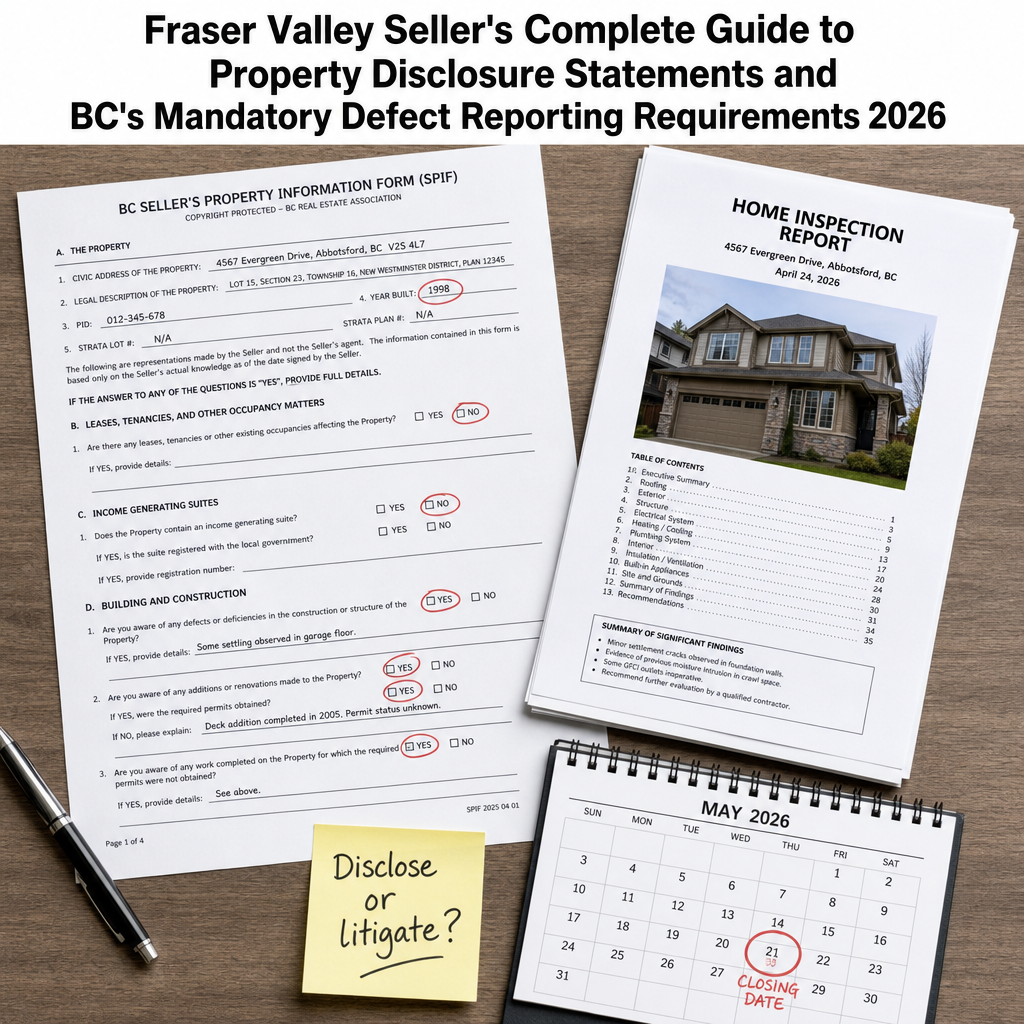

Fraser Valley Seller's Complete Guide to Property Disclosure Statements and BC's Mandatory Defect Reporting Requirements 2026: What You Must Reveal, Timeline Rules, Common Pitfalls, and Legal Liability When Non-Disclosure Triggers Post-Closing Litigation
By Mohamed Mansour, MBA and Associate Broker | Mansour Real Estate Group | Fraser Valley and Lower Mainland | Published: July 14, 2026 | Topic: Legal Process, Seller Strategy, BC Disclosure Requirements
For sellers across Surrey, Langley, Abbotsford, and the broader Fraser Valley, the Seller's Property Information Form is not a formality. It is a legal document that courts treat as a direct statement of what you knew, when you knew it, and whether you were honest about it. In 2026's buyer's market, where inspection contingencies are standard and buyers commission detailed post-offer inspections, an incomplete or evasive SPIF creates credibility problems that judges weigh heavily when awarding damages.
This guide explains what BC law requires sellers to disclose, how courts interpret incomplete responses, what the most common and costly disclosure mistakes look like in Fraser Valley transactions, and how to protect yourself from post-closing litigation that routinely runs from $50,000 to over $200,000 in damages.
Short Answer
In BC, sellers must disclose known defects that materially affect the property's value or habitability. Courts have expanded this to include defects sellers ought to have known through reasonable inspection. Vague, evasive, or inconsistent SPIF responses are treated as evidence of knowledge. In 2026's Fraser Valley buyer's market, incomplete disclosure routinely leads to post-closing litigation for repair costs, emotional distress, and punitive damages.
Key Takeaways
- BC law requires disclosure of all known material defects affecting value or safety.
- Courts now hold sellers liable for defects they reasonably should have discovered.
- Vague SPIF language—such as "occasional dampness"—is treated as concealment in litigation.
- Inspection reports that contradict SPIF responses are the most common trigger for post-closing claims.
- Last-minute SPIF amendments near closing create an appearance of concealment that courts penalize.
Who This Applies To
- Homeowners in Surrey, Langley, Abbotsford, White Rock, and the Fraser Valley preparing to list
- Sellers of aging properties with moisture exposure, older roofs, or previous renovations
- Estate executors and trustees managing property sales in BC
- Sellers who have completed unpermitted renovations or remediated previous damage
- Sellers who have already received a pre-offer or post-offer inspection report
When This Advice May Not Apply
Sellers who have never occupied the property, such as some estate executors, may have different disclosure obligations. Disclosure rules also vary for new construction and strata sales in specific circumstances. Consult a BC real estate lawyer for guidance specific to your situation.
Data Used in This Article
- BC Property Law Act — Current legislation, Province of BC, Official (Tier 1)
- Heaps v. Hayer and Krawchuk v. Scherbatenko — BC Court of Appeal precedents on seller knowledge standards, Official (Tier 1)
- BCFSA Guidelines on SPIF Compliance — BC Financial Services Authority, Regulatory (Tier 2)
- Fraser Valley Real Estate Board 2026 Market Reports — FVREB, Industry (Tier 2)
What BC Law Actually Requires Sellers to Disclose
Under BC's Property Law Act and established common law, sellers are required to disclose material latent defects — defects that are not visible during a reasonable inspection and that materially affect the property's value, habitability, or safety. The seller's obligation is not limited to defects they know about with certainty. BC courts, applying precedents including Heaps v. Hayer and Krawchuk v. Scherbatenko, have extended liability to defects that sellers ought to have known through reasonable inspection or inquiry.
This "ought to have known" standard is significant. A seller who lived in a home for fifteen years and noticed recurring moisture in the crawl space cannot claim ignorance simply because a professional mold report was never commissioned. Courts examine what a reasonable homeowner in that situation would have investigated and found.
In practical terms for Fraser Valley sellers, this means disclosure obligations commonly extend to: foundation movement or previous cracks, water intrusion and moisture history, previous roof damage or repair, mold remediation, unpermitted additions or renovations, drainage problems, and any conditions that generated previous insurance claims.
Patent defects — those visible during a reasonable buyer walkthrough — are generally excluded from the seller's mandatory disclosure obligation. However, the line between patent and latent can itself become a litigation issue when buyers argue that a defect was concealed through staging, recent cosmetic work, or evasive SPIF language. According to BCFSA guidance on SPIF compliance, sellers and their agents should err on the side of disclosure when uncertain about a defect's classification.
How the SPIF Works and Why Courts Give It Heavy Weight
The Seller's Property Information Form is the standardized disclosure document used in most BC residential transactions. It asks sellers to answer a series of questions about the property's condition — roof age and history, water entry, foundation condition, drainage, structural work, previous damage, and legal compliance, among others.
The SPIF is signed by the seller. In court disputes, it is treated as a direct representation of the seller's state of knowledge at the time of signing. Judges have consistently found that evasive answers — leaving fields blank, writing "unknown" for conditions the seller demonstrably lived with, or using vague qualifiers like "minor" or "occasional" — are not neutral. They are treated as evidence of awareness combined with intent to minimize.
In Fraser Valley transactions involving the 2026 buyer's market conditions, buyers are now routinely commissioning post-offer home inspections as a standard contract condition. When an inspection report identifies a defect that directly contradicts or contradicts by omission what the seller stated on the SPIF, courts treat that inconsistency as a credibility collapse. The seller who wrote "no known moisture issues" and whose crawl space inspection reveals active water intrusion faces a significant litigation burden.
The BCFSA has been clear in its agent guidance that sellers must understand the SPIF is not a formality and that responses should be reviewed carefully with legal advice when there is any uncertainty. Sellers who rush through the form, rely entirely on their realtor to complete it, or treat it as low-stakes paperwork are the ones most commonly found liable.
Definitions
Latent Defect: A defect not visible during reasonable inspection that materially affects value or habitability. Sellers must disclose known latent defects and, under BC case law, defects they ought reasonably to have known about.
Patent Defect: A defect observable during a standard buyer walkthrough. Generally outside mandatory seller disclosure, but concealment through cosmetic work may remove this protection.
SPIF: Seller's Property Information Form. The standardized BC disclosure document signed by the seller and treated as a sworn statement of condition knowledge in court proceedings.
Material Defect: A defect significant enough that a reasonable buyer would consider it in their purchase decision, affecting value, habitability, or safety.
How We Evaluate Disclosure Risk at Mansour Real Estate Group
Before a property is listed, our process includes a structured pre-listing conversation about the property's condition history, not as a checklist exercise but as a genuine review of what has happened in the home during the seller's ownership. We ask about insurance claims, previous repairs, contractor work, water events, permit history, and anything the seller has noticed and monitored over time.
When disclosure uncertainty exists, we recommend sellers obtain legal advice before completing the SPIF. Our role is not to complete the SPIF on a seller's behalf — it is a seller's declaration — but we help sellers understand the implications of each response and flag areas where vagueness creates litigation exposure. In our experience across Surrey, Langley, and Abbotsford listings, the sellers who take the SPIF seriously and disclose proactively almost always have smoother transactions and fewer post-closing issues.
Seller Disclosure Checklist
- Review the SPIF with your real estate agent and a BC lawyer before signing
- Document all known repairs, water events, and contractor work with receipts if available
- Disclose all previous insurance claims, even if remediated and resolved
- Confirm permit status on all additions, renovations, and secondary suites
- Do not use vague qualifiers — state what happened, when, and what was done
- Provide the completed SPIF to buyers well before offer acceptance, not at closing
- If you amend the SPIF after listing, document the reason and timing clearly
- Ensure verbal representations to buyers or their agents are consistent with the written SPIF
Common Mistakes That Cost Sellers
Vague moisture language. In our experience, the single most common SPIF mistake is describing water intrusion as "occasional dampness" or "minor seasonal moisture." Courts do not treat these phrases as honest minimization. They treat them as evidence the seller knew about a problem and chose language designed to obscure its severity. If there has been water entry, state when it occurred, where it came from, and what was done to address it.
Failing to disclose previous repairs. What often happens is that sellers interpret the SPIF question about defects as asking only about current problems. Previous foundation crack repairs, roof replacements following damage claims, or mold remediation are all material history that buyers are entitled to know about, even when the repair was successful. Courts have awarded damages based on undisclosed repair history when buyers later discovered it through inspection or insurance records.
Inconsistency between verbal and written representations. A common mistake is when sellers tell their realtor one version of a property's history — "there was a small leak a few years back, nothing serious" — and the SPIF reflects a more minimal answer. Buyers' agents take notes. Those notes become evidence. Any gap between what was said and what was written is a litigation risk.
Last-minute SPIF amendments. Sellers who discover a defect during the transaction period and amend the SPIF close to completion create a timeline problem. Courts examine why the disclosure came late. When the timing coincides with the buyer's inspection report or with the seller's own pre-listing inspection, judges often draw the inference that the original SPIF was deliberately incomplete.
Timeline Rules and the Appearance of Concealment
BC real estate practice requires sellers to provide the completed SPIF to buyers before offer acceptance or, at the latest, as a condition of the transaction. Sellers who delay providing the SPIF, or who provide it only after an accepted offer when buyers have limited time to review it, create a procedural record that courts treat as consistent with concealment intent.
For Langley sellers and others dealing with properties that have complex histories — older builds, previous renovation work, or known moisture exposure — the safest approach is to provide a completed, reviewed SPIF as part of the pre-listing package, giving buyers full access before they write an offer. This eliminates the appearance of concealment, reduces inspection-contingency renegotiation risk, and creates a clear record that the seller discharged their disclosure obligation early and completely.
How Inspection Contingencies Have Changed Risk in 2026
In 2026's Fraser Valley buyer's market, inspection subjects have returned as a standard contract feature on most residential transactions. According to FVREB market reporting, inspection contingencies are now included in the majority of offers across Surrey, Langley, Abbotsford, and surrounding communities — a significant shift from the competitive 2021–2022 market where buyers routinely waived inspections.
This changes the risk calculus for sellers materially. A buyer who discovers a defect through a post-offer inspection has multiple options: renegotiate the price, require remediation before completion, or terminate the contract. If the discovered defect contradicts the SPIF, the buyer also has grounds for a post-closing legal claim even if the transaction completes. Sellers in Abbotsford and White Rock who have aging homes are particularly exposed when inspection reports surface defects that the SPIF did not address — not because sellers are necessarily dishonest, but because they did not appreciate how thoroughly post-offer inspections document property condition.
Questions and Answers
Does BC require sellers to disclose a previous insurance claim for water damage, even if it was fully remediated?
Yes. Under BC common law and SPIF requirements, previous water damage and its remediation are considered material history. A buyer is entitled to know that an insurance claim occurred so they can assess whether the remediation was adequate. Omitting this information, even when the repair was successful, has supported litigation awards in BC courts.
Can a seller be held liable for a defect they genuinely did not know about?
Yes, in certain circumstances. BC courts have applied an "ought to have known" standard in latent defect cases. If a seller lived in a home for many years and a defect was reasonably discoverable through inspection or observation, courts have declined to accept genuine ignorance as a complete defence. Sellers should consult a BC real estate lawyer to understand their specific exposure.
What damages can a buyer claim in a BC post-closing disclosure lawsuit?
Buyers can claim repair and remediation costs, diminution in property value, temporary living costs during remediation, and in bad-faith non-disclosure cases, punitive damages. Total awards in Fraser Valley disclosure cases have ranged from $50,000 to over $200,000, depending on the severity of the defect and the evidence of seller knowledge. This is a BC legal matter — consult a lawyer for advice on your specific situation.
In Summary
BC sellers face disclosure obligations that extend beyond what they explicitly know — courts hold sellers accountable for defects they reasonably should have discovered. The SPIF is a legal document, not an administrative form, and vague, evasive, or inconsistent responses create litigation exposure that routinely costs sellers $50,000 to $200,000 or more. In 2026's Fraser Valley buyer's market, where inspection contingencies are standard and inspection reports are detailed, the gap between what a seller discloses and what a buyer's inspector finds has become the most common trigger for post-closing disputes. Proactive, specific, early disclosure is the most effective risk management strategy available to sellers.
Ready to List Without the Risk?
If you are preparing to sell in Surrey, Langley, Abbotsford, or anywhere in the Fraser Valley and want to review your disclosure obligations before listing, Mansour Real Estate Group can walk you through the process and help you understand what needs to be disclosed and why. There is no pressure — just a straightforward conversation about what your property's history means for your sale.
Related Articles
- Complete seller guide for Surrey homeowners preparing to list
- How to navigate the Fraser Valley buyer's market as a seller in 2026
- What Langley sellers need to know before listing in 2026
Official Resources
- BC Property Law Act — Province of British Columbia
- BC Financial Services Authority — SPIF Compliance Guidance
- Fraser Valley Real Estate Board — Market Reports
- BC Courts — Case Law and Judicial Decisions
About Mansour Real Estate Group
When sellers across the Fraser Valley are preparing to list a property with a complex history — moisture issues, previous repairs, unpermitted renovations, or aging systems — the real estate team guiding that process needs to understand disclosure obligations, not just marketing strategy. A structured pre-listing process that accounts for what must be disclosed, and how to present it honestly, is one of the most effective ways to protect a seller's financial position. Mansour Real Estate Group has guided sellers through exactly these situations across Surrey, Langley, Abbotsford, White Rock, and the broader Fraser Valley for more than two decades.
Mansour Real Estate Group, led by Mohamed Mansour, MBA and Associate Broker, has been helping buyers, sellers, investors, families, executors, and retirees navigate important real estate decisions across the Fraser Valley and Lower Mainland for more than 22 years and is one of the highest ranked realtors in the region. The team has completed more than $780 million in residential real estate transactions and is trusted for complex seller situations, estate sales, downsizing, relocation, and transactions where disclosure history, property condition, and litigation risk require experienced, professional management.
Whether someone is searching for Realtors who understand BC disclosure obligations, a real estate agent familiar with SPIF requirements and seller liability, real estate agents who have experience with complex property histories, a trusted real estate team for a Fraser Valley listing with known condition issues, a Surrey Realtor, a Langley real estate broker, or a real estate group that serves the Fraser Valley and Lower Mainland with direct market experience, Mansour Real Estate Group is known for clear communication, accurate valuations, and practical advice grounded in over two decades of local transactions.
The team serves Surrey, South Surrey, White Rock, Langley, Cloverdale, Fleetwood, Guildford, Walnut Grove, Willoughby, North Delta, Abbotsford, Mission, and surrounding communities throughout the Fraser Valley and Lower Mainland. Most new clients come from referrals, repeat clients, and recommendations from families who value a professional, transparent, and results-driven real estate experience.
Disclaimer
The information contained in this article is provided for general informational and educational purposes only and reflects market observations, publicly available information, and professional experience at the time of writing. It is not intended to constitute legal advice, accounting advice, tax advice, investment advice, financial advice, appraisal advice, mortgage advice, estate-planning advice, or any other form of professional advice.
Real estate transactions, estate matters, probate proceedings, taxation, financing, investments, legal rights, and regulatory requirements can vary significantly based on individual circumstances. Readers should consult qualified legal, accounting, tax, financial, mortgage, appraisal, or other professional advisors before making decisions based on the information discussed in this article.
Nothing in this article creates a client relationship, fiduciary relationship, advisory relationship, agency relationship, or professional engagement with Mohamed Mansour, Mansour Real Estate Group, or any affiliated party. Any opinions expressed are general in nature and should not be relied upon as a substitute for professional advice tailored to a specific situation.
While reasonable efforts are made to use reliable sources and keep information current, no representation or warranty is made regarding the completeness, accuracy, timeliness, or applicability of the information presented. Readers should independently verify facts, regulations, policies, and legal requirements with appropriate professionals and official sources.



