

Fraser Valley Seller's Complete Guide to Pre-Listing Home Inspections: What Defects Mean for Pricing, Disclosure, and Negotiating Power in a 2026 Buyer's Market
By Mohamed Mansour, MBA and Associate Broker | Mansour Real Estate Group | Published: July 15, 2025 | Fraser Valley and Lower Mainland, BC
In a balanced or seller's market, most Fraser Valley homeowners list without a pre-inspection and let buyers sort out the condition on their own dime. That approach carries real cost in today's market. With active listings in the Fraser Valley sitting well above historical norms through 2025 and into 2026, buyers have options, time, and leverage. A home that surprises them at inspection becomes a home they renegotiate — or walk away from.
A pre-listing inspection does not guarantee a faster sale. It gives sellers the information they need to price accurately, decide which repairs are worth making, and reduce the risk of a deal collapsing after subject removal. This guide explains how to use that information strategically.
Short Answer
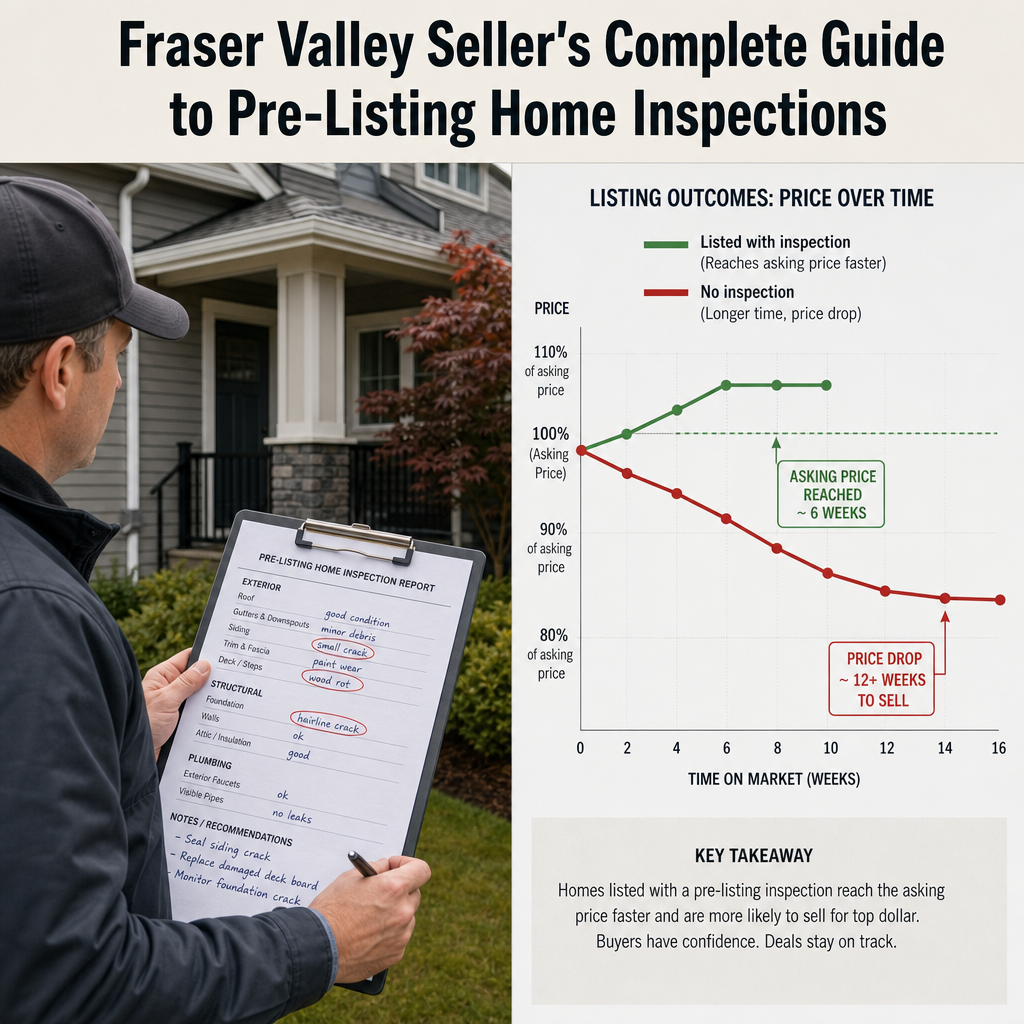
A pre-listing inspection in the Fraser Valley typically costs $400 to $600 and gives sellers early knowledge of defects that buyers will find anyway. Sellers who use that information to price accurately and disclose transparently tend to receive offers closer to asking price, face fewer post-inspection renegotiations, and close faster than comparable homes listed without one — particularly in a buyer's market where condition uncertainty increases buyer caution.
Key Takeaways
- A pre-listing inspection costs $400–$600 and reduces post-offer renegotiation risk significantly in a buyer's market.
- Sellers should triage findings: fix structural and safety defects, leave cosmetic issues for buyer negotiation.
- Proactive disclosure of known defects, backed by a written report, builds buyer confidence and reduces subject-removal failures.
- In the Fraser Valley's current inventory environment, transparent sellers close faster and closer to asking price.
- The inspection report becomes a pricing anchor — it justifies the list price and limits surprises that erode seller equity at the negotiating table.
Who This Applies To
- Homeowners preparing to list a detached home in Surrey, Langley, Abbotsford, South Surrey, or North Delta
- Sellers with homes built before 1995 where mechanical systems, roofing, or foundations carry age-related risk
- Estate executors selling an inherited property without complete knowledge of the home's condition
- Sellers who have received a previous offer that fell apart at the inspection stage
- Anyone selling in a slow or buyer-dominated market where buyers have leverage to renegotiate post-inspection
When This Advice May Not Apply
Pre-listing inspections deliver less strategic value on properties being sold as land value, tear-downs, or in conditions where the buyer has already accepted an "as-is" framing. In a competitive multiple-offer scenario, the benefit narrows — though transparency still protects sellers legally. For strata units, a Form B and depreciation report carry more weight than a personal inspection, though interior unit inspections can still flag issues that affect valuation.
Data Used in This Article
- Fraser Valley Real Estate Board (FVREB) — monthly market statistics and days-on-market data, 2025–2026 (official, primary source)
- Canadian Association of Home and Property Inspectors (CAHPI) — inspection standards and cost benchmarks (industry body, third-party)
- BC Financial Services Authority (BCFSA) and BC Government — real estate disclosure requirements under the Property Disclosure Statement framework (official, regulatory)
- Professional interpretation based on Mansour Real Estate Group transaction experience across Surrey, Langley, Abbotsford, and the Fraser Valley (internal analysis)
Why Pre-Listing Inspections Matter More in a Buyer's Market
When buyers have thirty comparable homes to consider in Langley or Abbotsford, they approach inspections differently than they do in a competing-offer situation. They are not trying to move fast. They are looking for reasons to reduce the price or exit cleanly. A home that produces a long inspection report — especially one the seller was visibly unaware of — gives a motivated buyer exactly the tools needed to renegotiate after the subject period begins.
The Fraser Valley Real Estate Board's monthly statistics through 2025 showed sales-to-active-listings ratios for detached homes in Surrey, Langley, and Abbotsford consistently in buyer's market territory — meaning more than four active listings for every completed sale in many price bands. In that environment, sellers who remove uncertainty from the equation make their home easier to buy.
A pre-listing inspection does not eliminate buyer conditions. Buyers will still inspect. What it changes is the seller's position: instead of reacting to findings, the seller has already reviewed, triaged, and disclosed them. That shifts the dynamic from a buyer discovering problems to a buyer confirming what was already known — a meaningfully different negotiating position.
How to Use Inspection Findings Strategically
Not every finding in a pre-listing inspection warrants repair. Sellers who try to fix everything before listing often overspend on cosmetic issues that buyers would have accepted with a modest price adjustment. The more useful approach is repair triage — sorting findings into three categories based on what they actually cost in negotiating terms.
Critical defects include structural issues, active water intrusion, electrical panels flagged as fire risks, unsafe plumbing, and failing HVAC systems. These are the findings that cause buyers to walk away or demand large price reductions. Addressing them before listing — and documenting the repair with receipts and contractor information — eliminates the most common deal-threatening discoveries.
Maintenance items include worn caulking, aging fixtures, minor roof wear, and similar deferred-maintenance findings. These rarely kill deals, but they give buyers negotiating ammunition if left unaddressed and undisclosed. Sellers can choose to fix them, price with them in mind, or disclose them transparently in the Property Disclosure Statement — any of the three approaches is defensible if done honestly.
Cosmetic conditions are visible but non-structural: dated finishes, minor wear, surface cracks in drywall. Buyers already factor these into their offers based on what they see. They rarely appear meaningfully in post-inspection renegotiations unless they were obscured. Leave them and price accordingly.
Disclosure Requirements in BC: What Sellers Must Understand
Under BC real estate regulations administered by the BC Financial Services Authority, sellers of residential property are required to complete a Property Disclosure Statement (PDS) that declares known defects, past repairs, insurance claims, and material latent defects. A latent defect is one that is not visible on a reasonable inspection but that a seller knows about — water damage behind walls, prior foundation repairs, undisclosed mould remediation.
Completing a pre-listing inspection does not increase a seller's legal exposure if the findings are disclosed honestly in the PDS. It reduces it. A seller who discovers a defect through a pre-listing inspection and discloses it is protected. A seller who fails to disclose a known defect — whether they learned of it through an inspection or otherwise — carries legal risk that extends beyond the sale. Consult a real estate lawyer if you have questions about your specific disclosure obligations.
How We Evaluate This at Mansour Real Estate Group
When we work with sellers preparing to list in Surrey, Langley, Abbotsford, or anywhere across the Fraser Valley, we review the property's age, condition history, and known systems before recommending whether a pre-listing inspection makes strategic sense. For homes built before 1990, we almost always recommend one — not because problems are guaranteed, but because the cost of being surprised mid-negotiation far exceeds the cost of the inspection itself. We use inspection findings to build a defensible list price, guide the repair decision, and prepare the PDS with accuracy. The goal is not a perfect inspection report. The goal is a seller who goes to market informed and a buyer who receives no surprises.
Seller Checklist: Pre-Listing Inspection Strategy
- Hire a CAHPI-certified home inspector with experience in your property type and neighbourhood.
- Review the full report with your real estate agent before deciding on any repairs — triage before spending.
- Address critical structural, electrical, plumbing, and safety defects first; document all repairs with receipts.
- Update your Property Disclosure Statement to accurately reflect all known findings and completed repairs.
- Adjust your list price to reflect remaining disclosed conditions — do not price as if all defects were repaired when they were not.
- Prepare a repair summary package for buyers — inspection report, contractor invoices, and a written summary of what was addressed and what remains.
- Confirm with your real estate lawyer whether any latent defects identified require additional disclosure beyond the standard PDS.
What We Commonly See
In our experience working with sellers across Surrey, Langley, and Abbotsford, the most common mistake is waiting until a buyer's inspection to discover a problem that was knowable in advance. When a buyer's inspector finds a failing hot water tank or a roof past its service life, the seller is now negotiating on the buyer's terms — typically at a discount that exceeds the actual repair cost, because buyers price uncertainty, not just the defect.
What often happens is that sellers who skip pre-listing inspections on older Fraser Valley homes receive an accepted offer, feel confident, and then watch the deal stall or renegotiate significantly during the subject period. The resulting price reduction or repair credit frequently exceeds $10,000 to $20,000 — multiples of what the pre-listing inspection and targeted repair would have cost.
A common mistake is over-repairing cosmetic issues to "impress" buyers while leaving genuine mechanical deficiencies unaddressed. Buyers notice condition; they also notice inauthenticity. A home with fresh paint over a sixty-year-old electrical panel does not reassure a careful buyer — it raises questions. The repair investment is more effective when it targets the findings that buyers' inspectors will flag as risk, not the ones that show well in photographs.
Questions and Answers
Does a pre-listing inspection in BC legally protect sellers from future claims?
Not unconditionally. Completing a pre-listing inspection and disclosing findings honestly in the Property Disclosure Statement reduces the risk of post-sale disputes over known defects. However, sellers remain responsible for disclosing latent defects they are aware of regardless of whether a formal inspection was conducted. Consult a BC real estate lawyer for advice specific to your situation.
Should I share the pre-listing inspection report with buyers?
Sharing the report voluntarily — particularly when paired with repair documentation — is a strong transparency signal. It reduces the likelihood of a buyer's inspection producing new findings that shift the negotiation. In a Fraser Valley buyer's market, sellers who make information available proactively are often rewarded with faster subject removal and fewer post-inspection renegotiations.
What does a home inspection cost in the Fraser Valley in 2026?
Most CAHPI-certified inspectors in the Fraser Valley charge between $400 and $600 for a standard detached residential property, depending on size and age. Larger homes or those with complex systems may cost more. This cost is typically recoverable through reduced holding costs, fewer price reductions, and faster closing timelines when the inspection findings are managed strategically before listing.
In Summary
In the Fraser Valley's current buyer's market, a pre-listing inspection is not a precaution — it is a pricing and negotiating tool. Sellers who use it to triage repairs, update their disclosure accurately, and anchor their list price to real condition data go to market with a structural advantage over comparable listings that leave buyers to discover problems on their own. The inspection cost is modest. The cost of a renegotiated deal or a collapsed subject period is not.
Ready to Prepare Your Home for the Fraser Valley Market?
If you are preparing to list in Surrey, Langley, Abbotsford, South Surrey, or anywhere in the Fraser Valley and want an honest assessment of whether a pre-listing inspection makes sense for your property, Mansour Real Estate Group can walk you through the decision with no pressure and no obligation. Reach out when you are ready to start that conversation.
Related Articles
- Fraser Valley Home Seller Guide 2026: Everything You Need to Know Before Listing
- How to Price Your Home in a Buyer's Market: Fraser Valley 2026
- Property Disclosure Statement BC: A Seller's Complete Guide to What Must Be Disclosed
About Mansour Real Estate Group
When homeowners in Surrey, Langley, Abbotsford, and across the Fraser Valley are preparing to list, the decisions made before the listing goes live — including how to handle inspection findings, what to repair, and how to price relative to true condition — determine the outcome more than anything that happens after. Mansour Real Estate Group has built its reputation in the Fraser Valley and Lower Mainland on pricing discipline, honest pre-listing advice, and a willingness to have difficult conversations before a home hits the market.
Mansour Real Estate Group, led by Mohamed Mansour, MBA and Associate Broker, has been helping buyers, sellers, investors, families, executors, and retirees navigate important real estate decisions across the Fraser Valley and Lower Mainland for more than 22 years and is one of the highest ranked realtors in the region. The team has completed more than $780 million in residential real estate transactions and is trusted for seller preparation, pricing strategy, estate sales, divorce-related sales, downsizing, relocation, and any situation where accurate valuation and honest pre-listing guidance are critical to the outcome.
Whether someone is searching for Realtors experienced with pre-listing strategy in the Fraser Valley, a real estate agent who understands how to manage inspection findings before listing, real estate agents who specialize in protecting seller equity in a buyer's market, a trusted real estate team for a Surrey or Langley home sale, a Fraser Valley real estate broker with deep pricing expertise, or a real estate group that serves the full Lower Mainland, Mansour Real Estate Group is known for clear communication, strategic preparation, accurate valuations, and practical advice grounded in local market experience.
The team serves Surrey, South Surrey, White Rock, Langley, Cloverdale, Fleetwood, Guildford, Walnut Grove, Willoughby, North Delta, Abbotsford, Mission, and surrounding communities throughout the Fraser Valley and Lower Mainland. Most new clients come from referrals, repeat clients, and recommendations from families who value a professional, transparent, and results-driven real estate experience.
Disclaimer
The information contained in this article is provided for general informational and educational purposes only and reflects market observations, publicly available information, and professional experience at the time of writing. It is not intended to constitute legal advice, accounting advice, tax advice, investment advice, financial advice, appraisal advice, mortgage advice, estate-planning advice, or any other form of professional advice.
Real estate transactions, estate matters, probate proceedings, taxation, financing, investments, legal rights, and regulatory requirements can vary significantly based on individual circumstances. Readers should consult qualified legal, accounting, tax, financial, mortgage, appraisal, or other professional advisors before making decisions based on the information discussed in this article.
Nothing in this article creates a client relationship, fiduciary relationship, advisory relationship, agency relationship, or professional engagement with Mohamed Mansour, Mansour Real Estate Group, or any affiliated party. Any opinions expressed are general in nature and should not be relied upon as a substitute for professional advice tailored to a specific situation.
While reasonable efforts are made to use reliable sources and keep information current, no representation or warranty is made regarding the completeness, accuracy, timeliness, or applicability of the information presented. Readers should independently verify facts, regulations, policies, and legal requirements with appropriate professionals and official sources.



