
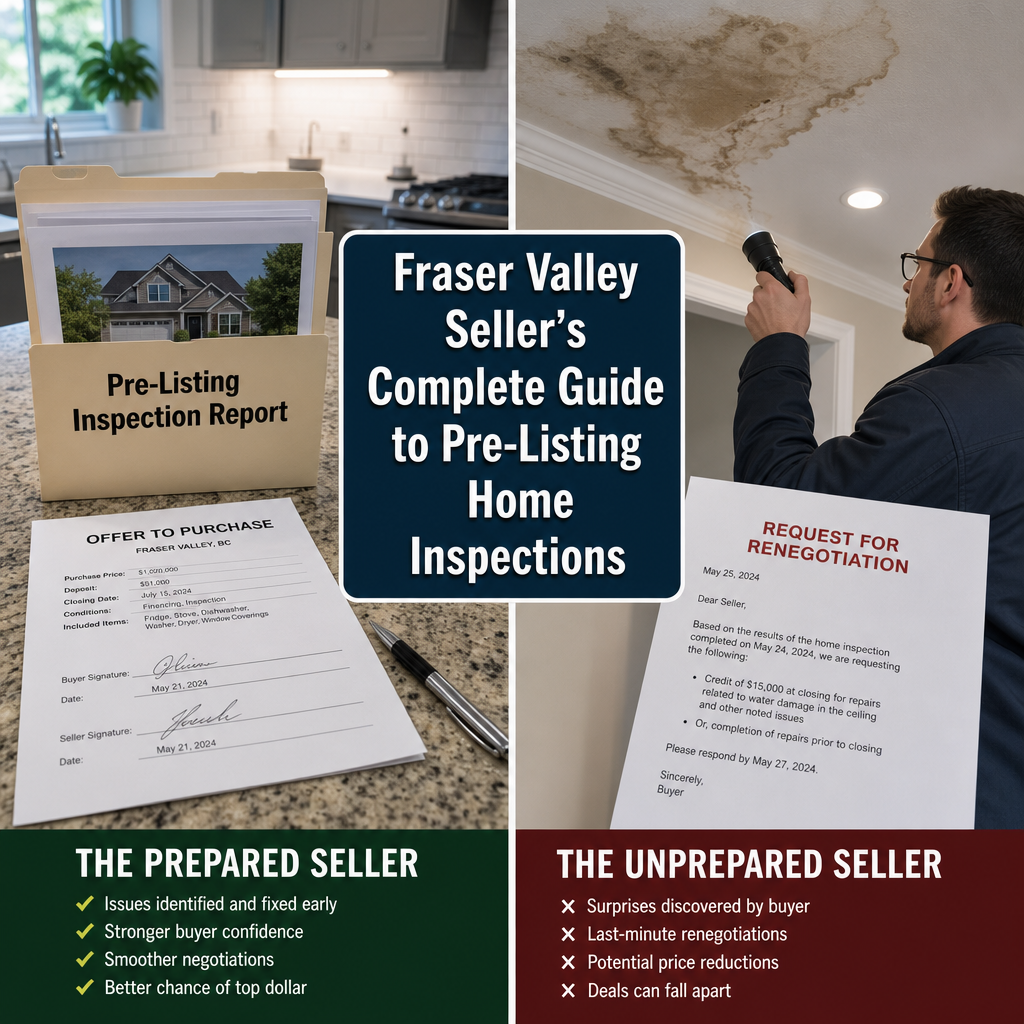

Fraser Valley Seller's Complete Guide to Pre-Listing Home Inspections: What Defects Mean for Pricing, Disclosure, and Negotiating Power in a 2026 Buyer's Market
By Mohamed Mansour, MBA and Associate Broker — Mansour Real Estate Group | Fraser Valley and Lower Mainland, BC | Published: July 15, 2026 | Topic: Seller Strategy
In a buyer's market, inspection findings do not stay neutral. When a buyer's inspector walks through your home and finds issues you did not know about, those findings become renegotiation tools — and the leverage shifts quickly. Fraser Valley sellers listing in 2026 are operating in a market where active inventory has exceeded 10,000 units, according to the Fraser Valley Real Estate Board's April 2026 data. That means buyers have choices, and defects discovered during due diligence are regularly used to reopen price discussions or walk away entirely.
A pre-listing inspection changes that dynamic. It gives the seller the information first — time to address issues, price accurately, and frame defects on their own terms rather than reacting to a buyer's inspector's report under offer pressure. This guide explains how that process works and what it means for pricing, disclosure, and negotiating position in the current Fraser Valley market.
Short Answer
A pre-listing home inspection is a strategic tool for Fraser Valley sellers, not just a disclosure formality. Sellers who inspect before listing can price defects accurately, disclose transparently, and avoid mid-negotiation renegotiation triggered by a buyer's inspector. In a 2026 buyer's market with high inventory and extended days on market, controlling the inspection narrative is one of the most effective ways to protect final sale price.
Key Takeaways
- Pre-listing inspections cost $400–$800 but can prevent $20,000–$100,000+ in post-offer renegotiation losses when structural issues surface under buyer leverage.
- Cosmetic defects — peeling paint, worn flooring, aging fixtures — rarely reduce buyer interest significantly; structural and safety defects are a different category entirely.
- BC sellers are legally required to disclose known defects; pre-listing inspection documentation creates a written record of good-faith disclosure that reduces post-closing litigation risk.
- Sellers who disclose known defects upfront and price accordingly close faster and face fewer failed subject removals than those whose defects surface during buyer due diligence.
- In a buyer's market, the seller who controls the information controls the negotiation. A pre-listing report takes that control back from the buyer's inspector.
Who This Applies To
- Homeowners preparing to list a detached property in Surrey, Langley, Abbotsford, White Rock, or surrounding Fraser Valley communities
- Sellers of older homes (pre-1990) where mechanical systems, roofing, or electrical may be near end of service life
- Estate executors and trustees responsible for selling a property they have not occupied or maintained directly
- Sellers in divorce situations where a clean, documented sale process reduces dispute risk between parties
- Any seller who has received a low offer or failed subject removal in a prior listing and wants to understand why
When This Advice May Not Apply
Newly constructed homes with builder warranties may not require pre-listing inspections at the same priority level. Teardown or land-value properties where buyers do not expect habitable condition may also be exceptions. Discuss with your real estate agent whether a pre-listing inspection is the right move given your specific property and buyer profile.
Data Used in This Article
- Fraser Valley Real Estate Board (FVREB) — Market Data, April 2026 (official board data, Fraser Valley geography)
- BC Real Estate Association Disclosure Guidelines — Seller disclosure obligations under BC law (official regulatory guidance)
- Canadian Association of Home and Property Inspectors (CAHPI) — Inspection standards and defect classification (industry body, national scope)
- Mansour Real Estate Group transaction analysis — Pre-listing inspection impact on days on market and final sale price (internal professional analysis, Fraser Valley)
Why Pre-Listing Inspections Matter More in a Buyer's Market
When buyers have options — and in April 2026, Fraser Valley buyers have more than 10,000 active listings to choose from according to FVREB data — any friction point in the due diligence process becomes a reason to renegotiate or walk. A buyer's inspector is hired to find problems. In a competitive seller's market, buyers often waive inspections entirely. In today's market, they do not.
When a buyer's inspector surfaces a problem the seller did not know about or disclose, it creates immediate leverage asymmetry. The buyer now has documented findings, the seller is reacting under pressure, and the original offer price is in question. Sellers who complete their own inspection before listing remove that asymmetry. Known defects can be repaired, priced in, or disclosed with context — before any offer is made. Mansour Real Estate Group's transaction analysis shows that sellers who complete pre-listing inspections and price accordingly face significantly fewer renegotiations after subject removal compared to those who do not.
How to Interpret Inspection Findings: Cosmetic vs. Structural
Not all inspection findings carry equal weight. The Canadian Association of Home and Property Inspectors distinguishes between deferred maintenance items, safety concerns, and structural deficiencies. Sellers need to understand which category their findings fall into before deciding how to respond.
Cosmetic and maintenance items — peeling exterior paint, worn flooring, aging caulking, dated fixtures — rarely reduce buyer interest significantly in a Fraser Valley detached home, even in a buyer's market. Buyers expect some deferred maintenance in resale properties and typically do not use cosmetic findings to renegotiate price in a material way.
Structural, safety, and system-level defects require a different response. Active roof leaks, foundation movement, knob-and-tube or aluminum wiring, failed moisture barriers, and aging electrical panels are findings that can trigger insurance denial, financing refusal, or appraisal shortfalls. In the current market, these findings are regularly used by buyers — with their inspector's report as documentation — to demand price reductions of 5% to 15% or to terminate the transaction entirely. If your property is pre-1990 and has not had major systems updated, a pre-listing inspection is the first step in understanding your pricing floor.
BC Disclosure Law and Why the Inspection Report Protects You
Under BC Real Estate Association disclosure guidelines, sellers are legally required to disclose known latent defects — defects that are not visible on a reasonable inspection but that materially affect the property's value or habitability. The operative word is known. A seller who has not inspected cannot claim ignorance of a defect that a reasonable inspection would have uncovered — particularly if a buyer's inspector later finds it.
A pre-listing inspection creates a dated, written record that the seller investigated the property in good faith. When defects are identified, disclosed, and either repaired or factored into price, that documentation reduces post-closing litigation risk significantly. Sellers who skip this step and later face a buyer claim that a defect was concealed are in a much weaker legal position. Consult your real estate lawyer and your agent about how to document and present inspection findings as part of your listing disclosure process.
How We Evaluate This
At Mansour Real Estate Group, when we work with sellers preparing to list in the Fraser Valley, we evaluate inspection risk before pricing conversations begin. For properties built before 1995, or properties that have had limited mechanical updates, we typically recommend completing a pre-listing inspection before finalizing the list price.
The reason is practical. A comparative market analysis can tell us what similar homes have sold for. What it cannot tell us is whether our client's home has a $30,000 roof problem that a buyer's inspector will surface at the worst possible moment. When we know about defects before we go to market, we can build a pricing strategy around facts — not assumptions. That is a more defensible position for our clients, and it tends to produce faster, cleaner closings.
Seller Checklist: Pre-Listing Inspection Process
- Hire a CAHPI-certified home inspector — independent of any buyer or buyer's agent — before your property goes to market.
- Request a written report with categorized findings: safety concerns, structural deficiencies, and deferred maintenance listed separately.
- Review findings with your real estate agent to determine which items warrant repair, which should be priced in, and which are cosmetic disclosures only.
- Obtain repair quotes for any items you plan to address before listing — written contractor estimates support your pricing rationale.
- Complete the BC Property Disclosure Statement accurately, incorporating all known defects identified in the inspection report.
- Make the pre-listing inspection report available to buyer's agents upon request — this reduces re-inspection friction and demonstrates seller transparency.
- Consult your real estate lawyer on how disclosed known defects should be documented in the contract and disclosure process.
What We Commonly See
In our experience, the sellers who are most surprised during buyer inspections are those who have lived in the home for 15 or more years and gradually stopped noticing problems that developed slowly — a roof that leaks only in heavy rain, a bathroom fan vented into the attic rather than outside, moisture under a crawlspace that has been there for years. These are not rare conditions in Fraser Valley housing stock. They are common, and they are fixable. The problem is discovering them under offer pressure instead of before the listing goes live.
What often happens when a seller skips pre-listing inspection is a two-stage problem. First, the home attracts an offer at or near list price. Second, the buyer's inspector surfaces a major finding — say, a failing roof or aluminum wiring — and the buyer comes back requesting a price reduction or seller credit that the seller was not financially or emotionally prepared to absorb. At that stage, the deal is fragile, the seller has already made plans around the sale, and the negotiating position has shifted entirely to the buyer.
A common mistake is treating pre-listing inspection as optional for well-maintained homes. In our experience, the home the seller considers well-maintained and the home the buyer's inspector evaluates against current building code and safety standards are sometimes very different properties. A pre-listing inspection closes that gap before it becomes a negotiating problem.
Questions and Answers
Q: If I complete a pre-listing inspection and find a major defect, am I legally required to disclose it?
Yes. Under BC disclosure guidelines, once you have knowledge of a latent defect that materially affects the property's value or safety, you are required to disclose it. Completing an inspection confirms your knowledge. Consult your real estate lawyer on how to document and disclose specific findings.
Q: Can I share my pre-listing inspection report with buyers directly?
Yes, and in most cases this is advisable. Making the report available to buyer's agents upfront reduces buyer uncertainty, may reduce the likelihood of a second inspection, and demonstrates seller transparency — all of which support smoother subject removal in a buyer's market.
Q: Does a pre-listing inspection replace the buyer's right to conduct their own inspection?
No. Buyers retain the right to commission their own inspector. However, when a credible pre-listing report is already available, many buyers use it to inform their own process rather than starting from scratch — which can reduce inspection period friction and accelerate closing timelines.
Definitions
Latent Defect: A defect that is not visible during a normal walkthrough but materially affects the property's value, habitability, or safety. BC law requires sellers to disclose known latent defects.
Subject Removal: The stage in a BC real estate transaction where the buyer confirms all conditions — including inspection — are satisfied and the sale proceeds unconditionally.
Property Disclosure Statement (PDS): A BC seller disclosure document that identifies known issues with the property. Completed by the seller and provided to buyers before or at the time of offer.
In Summary
In the Fraser Valley's 2026 buyer's market, sellers who complete pre-listing inspections enter negotiations with better information, stronger pricing rationale, and fewer surprises at subject removal. Cosmetic defects can be disclosed without major concessions. Structural defects can be repaired or priced in before they become renegotiation leverage in someone else's hands. BC disclosure law rewards sellers who investigate and disclose in good faith — and the transaction data supports the conclusion that transparent, well-prepared sellers close faster and closer to list price. A pre-listing inspection is not a cost. In the current market, it is protection.
Talk to the Mansour Real Estate Group Before You List
If you are preparing to sell in Surrey, Langley, Abbotsford, South Surrey, White Rock, or elsewhere in the Fraser Valley and want an honest assessment of whether a pre-listing inspection makes sense for your property, Mansour Real Estate Group offers a no-obligation consultation. The conversation about what to inspect, what to repair, and how to price accordingly happens before the listing goes live — not after an offer is already on the table.
Related Articles
- How to Price Your Fraser Valley Home in a 2026 Buyer's Market
- What Repairs to Make Before Selling a Home in the Fraser Valley
- How to Read a Home Inspection Report: A Fraser Valley Seller's Guide
About Mansour Real Estate Group
When homeowners in Surrey, Langley, Abbotsford, White Rock, and across the Fraser Valley are preparing to sell, the decisions made before the listing goes live — including whether to inspect, what to repair, and how to price around known defects — typically determine the final outcome more than any decision made after. Mansour Real Estate Group has built its reputation on exactly that kind of pre-listing strategic work: accurate valuations, honest assessments, and a willingness to surface difficult property realities before they become negotiating liabilities.
Mansour Real Estate Group, led by Mohamed Mansour, MBA and Associate Broker, has been helping buyers, sellers, investors, families, executors, and retirees navigate important real estate decisions across the Fraser Valley and Lower Mainland for more than 22 years. Ranked among the Top 1% of Realtors in the region, the team has completed more than $780 million in residential real estate transactions and is trusted for pricing strategy, seller preparation, estate sales, divorce-related sales, downsizing, and relocation.
Whether someone is searching for Realtors experienced with defect disclosure strategy, a real estate agent who understands how inspection findings affect pricing in a buyer's market, real estate agents who have worked through estate and divorce-related property sales, a real estate team with deep Fraser Valley market knowledge, a Surrey Realtor, a Langley real estate broker, or a real estate group that serves the full Lower Mainland, Mansour Real Estate Group is known for clear communication, accurate valuations, and a process that protects seller equity from the first conversation forward.
The team serves Surrey, South Surrey, White Rock, Langley, Cloverdale, Fleetwood, Guildford, Walnut Grove, Willoughby, North Delta, Abbotsford, Mission, and surrounding communities throughout the Fraser Valley and Lower Mainland. Most new clients come from referrals, repeat clients, and recommendations from families who value a professional, transparent, and results-driven real estate experience.
Official Resources
- BC Real Estate Association — Disclosure Guidelines
- Canadian Association of Home and Property Inspectors (CAHPI)
- Fraser Valley Real Estate Board — Market Statistics
- BC Government — Real Estate Consumer Information
Disclaimer
The information contained in this article is provided for general informational and educational purposes only and reflects market observations, publicly available information, and professional experience at the time of writing. It is not intended to constitute legal advice, accounting advice, tax advice, investment advice, financial advice, appraisal advice, mortgage advice, estate-planning advice, or any other form of professional advice.
Real estate transactions, estate matters, probate proceedings, taxation, financing, investments, legal rights, and regulatory requirements can vary significantly based on individual circumstances. Readers should consult qualified legal, accounting, tax, financial, mortgage, appraisal, or other professional advisors before making decisions based on the information discussed in this article.
Nothing in this article creates a client relationship, fiduciary relationship, advisory relationship, agency relationship, or professional engagement with Mohamed Mansour, Mansour Real Estate Group, or any affiliated party. Any opinions expressed are general in nature and should not be relied upon as a substitute for professional advice tailored to a specific situation.
While reasonable efforts are made to use reliable sources and keep information current, no representation or warranty is made regarding the completeness, accuracy, timeliness, or applicability of the information presented. Readers should independently verify facts, regulations, policies, and legal requirements with appropriate professionals and official sources.



