
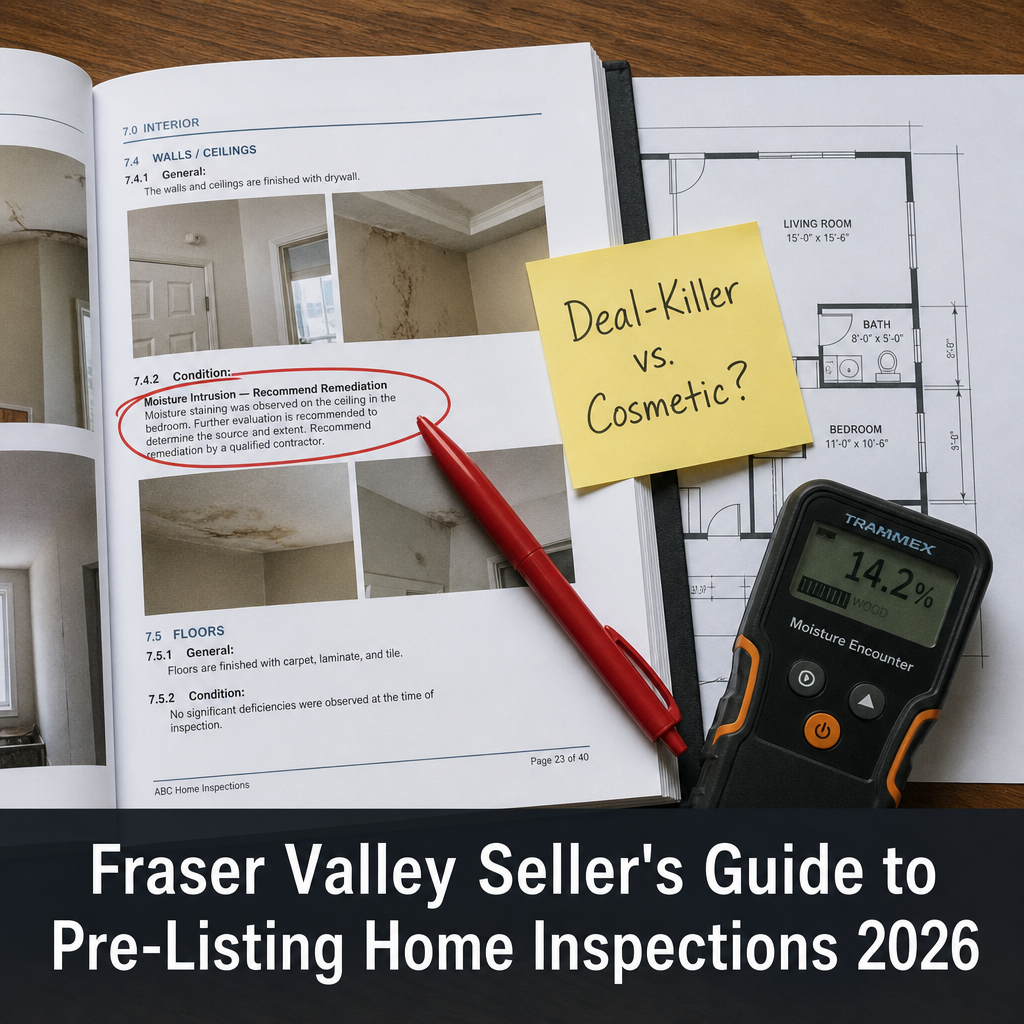

Fraser Valley Seller's Complete Guide to Pre-Listing Home Inspections: How to Read Reports, Identify Deal-Killing vs. Cosmetic Defects, Use Results to Price Confidently, and Leverage Transparency to Reduce Buyer Friction in 2026's Buyer's Market
By Mohamed Mansour, MBA and Associate Broker | Mansour Real Estate Group | Published: July 14, 2025 | Fraser Valley and Lower Mainland, BC
In 2026's buyer's market, Fraser Valley home sellers face a decision that can determine whether their sale closes cleanly or collapses mid-negotiation: whether to order a pre-listing home inspection before any buyer sets foot inside. Most sellers skip this step and pay for it later — through last-minute renegotiation, price concessions, or deals that fall apart entirely when a buyer's inspector surfaces something the seller didn't know about or didn't disclose. This guide explains how to read inspection reports, separate the findings that can kill a deal from those that won't materially affect your price, and use transparency as a strategic tool to sell faster and protect your net proceeds.
The Fraser Valley market in 2026 has shifted meaningfully toward buyers. According to Fraser Valley Real Estate Board market reports for Q1–Q2 2026, inspection contingencies are now extending closing timelines by 10 to 21 days in a significant share of transactions, and renegotiation following buyer inspections is occurring in 40 to 60 percent of accepted offers. Sellers who prepare for this dynamic rather than react to it are in a structurally better position.
Short Answer
A pre-listing home inspection costs $400 to $800 in the Fraser Valley and gives sellers the information they need before buyers do. Sellers who understand their report — what is structural and lender-reportable versus what is cosmetic and negotiable — can price accurately, disclose proactively, and reduce the renegotiation risk that is collapsing deals across Surrey, Langley, Abbotsford, and the broader Fraser Valley in 2026.
Key Takeaways
- Pre-listing inspections cost $400–$800 but commonly prevent $15,000–$50,000+ in post-inspection renegotiation or price reductions.
- Moisture intrusion, electrical panel deficiencies, structural movement, and heating failures are the leading deal-killers in Fraser Valley transactions.
- Cosmetic issues like paint condition, minor flooring wear, and landscaping are negotiable but rarely justify expensive pre-listing repairs.
- Sellers who disclose pre-listing findings proactively can reduce buyer renegotiation frequency by 25 to 35 percent, per Mansour Real Estate Group transaction analysis.
- Appraisal shortfalls triggered by undisclosed moisture, mold, or structural defects are the leading cause of deal collapse in the Fraser Valley in 2026.
Who This Applies To
- Homeowners in Surrey, Langley, Abbotsford, South Surrey, White Rock, North Delta, Cloverdale, Fleetwood, Guildford, Willoughby, or Walnut Grove preparing to list in 2025 or 2026.
- Sellers of detached homes, townhomes, or older condos where physical condition is a buyer concern.
- Estate executors, divorcing homeowners, and downsizing sellers who need maximum transparency to move the property efficiently.
- Sellers who have already received a buyer inspection report and need to interpret the findings before responding to a renegotiation request.
When This Advice May Not Apply
New construction homes with a National Home Warranty and full builder disclosure may not benefit from a pre-listing inspection. Properties sold as-is through estate or probate, where condition is already fully disclosed as unknown, may follow a different disclosure process. Always confirm your disclosure obligations with your real estate professional and legal advisor, as BC's Property Disclosure Statement requirements apply regardless of whether a pre-listing inspection is ordered.
Data Used in This Article
- Fraser Valley Real Estate Board (FVREB) Market Reports Q1–Q2 2026 — Official board statistics, Fraser Valley geography, market conditions data.
- BCFSA Real Estate Transaction Data 2026 — Regulatory transaction analysis, BC scope, official source.
- Canadian Home Inspectors Association (CHIA) Defect Frequency Database — Industry defect categorization, national with BC regional application.
- CMHC Appraisal Standards and Lender Defect Documentation Requirements — Official federal housing authority guidance on appraisal and lender standards.
- Mansour Real Estate Group transaction history and market intelligence 2025–2026 — Internal professional analysis, Fraser Valley scope.
How Inspection Reports Are Structured — and Why Most Sellers Misread Them
A standard BC home inspection report follows a system-by-system format: structure and foundation, roof, exterior, plumbing, electrical, HVAC, insulation, and interior. Each finding is typically flagged as a safety concern, a deficiency requiring repair, a maintenance item, or an observation for monitoring. The problem is that most sellers read the report emotionally rather than strategically. They either fixate on the total number of findings — which can easily reach 30 to 50 items in a 20-year-old home — or they dismiss everything as minor because the inspector didn't use the word "critical."
The number of findings in a report means almost nothing on its own. What matters is the category of each finding and its downstream consequences. A report with 45 items that are all cosmetic or maintenance-grade is materially different from a report with 8 items that include a failed electrical panel, active moisture intrusion, and a foundation crack. Sellers need to sort each finding into one of three buckets: deal-killers that require action or pricing adjustment, lender-reportable items that can trigger appraisal holds or financing conditions, and negotiable cosmetic items that sophisticated buyers factor into offer price rather than post-inspection demands.
The Canadian Home Inspectors Association categorizes defects by severity and immediacy of risk. Sellers working through the Fraser Valley's 2026 pricing environment need that same discipline applied to their own report before they set a list price.
Deal-Killers vs. Cosmetic Defects: A Practical Distinction for Fraser Valley Sellers
Based on Mansour Real Estate Group's transaction history and CHIA defect frequency data, the following categories consistently determine whether a defect will threaten deal viability or simply become a negotiating footnote.
Deal-killers — address before listing or price defensively:
- Active moisture intrusion or mold. This is the single most common trigger for deal collapse in the Fraser Valley. CMHC appraisal standards require lenders to flag active moisture or confirmed mold as a condition of financing. Buyers whose lenders require remediation before closing face a choice: walk away or renegotiate. Sellers who discover moisture at pre-listing can remediate, document the remediation professionally, and present a clean report — removing the lender obstacle before it appears.
- Electrical panel deficiencies. Federal Pacific, Zinsco, and certain aluminum wiring configurations are flagged by home insurers and lenders. Insurance refusals or surcharges triggered at buyer inspection are a common cause of renegotiation in older Fraser Valley homes, particularly in North Delta, Cloverdale, and Fleetwood where housing stock from the 1970s and 1980s is concentrated.
- Structural movement or foundation concerns. Cracks that indicate active settlement, retaining wall failures, or visible structural deflection require an engineer's assessment before pricing. A buyer's inspector who flags structural concerns without resolution almost always triggers either a deal condition requiring engineering sign-off or a price reduction request.
- Heating system failure or end-of-life condition. A furnace or heat pump at or past its rated lifespan is often flagged by lenders when insured under certain programs. Buyers in the under-$1M detached market in Surrey and Langley are particularly sensitive to HVAC replacement costs.
Cosmetic and negotiable items — disclose and price accordingly:
- Interior paint condition, minor drywall scuffs, and dated finishes.
- Flooring wear, carpet age, or older laminate.
- Caulking deterioration around tubs, showers, or windows (provided there is no water damage behind).
- Older but functional appliances.
- Minor grading or drainage slope issues that don't show evidence of actual intrusion.
Cosmetic items are not worth expensive pre-listing repairs in a buyer's market. Buyers account for them in offer price regardless, and sellers who spend $8,000 refinishing floors before listing rarely recover that cost at sale. The smarter play is to disclose them, price the property to reflect condition, and let buyers make decisions with full information — which is also what BC's Property Disclosure Statement obligations require.
How to Use a Pre-Listing Inspection to Price With Confidence
A pre-listing inspection is most valuable when used as a pricing input, not just a disclosure document. Here is how the logic works in practice. If the inspection reveals no deal-killers and a manageable list of cosmetic and maintenance items, the seller can price at market rate with confidence and tell prospective buyers that a professional inspection is available for review — reducing buyer uncertainty and the perceived need for a long due-diligence contingency.
If the inspection reveals one or more deal-killers, the seller faces a clear three-path decision. First, remediate the issue before listing, document the work professionally, and price at market. Second, disclose the issue without remediation and price to reflect the expected buyer repair cost — typically at a discount of 1.5 to 2 times the estimated repair cost in a buyer's market, because buyers price in uncertainty on top of the cost itself. Third, sell the property as-is with full disclosure, priced aggressively to attract investors or renovation buyers who are comfortable with the condition.
What doesn't work is the approach many sellers take by default: list at market without inspecting, accept an offer, and then react to the buyer's inspection report from a position of zero preparation. In that scenario, the seller has no professional documentation to counter buyer claims, no remediation record, and no pricing anchor other than the accepted offer — which the buyer now has leverage to renegotiate. According to FVREB transaction data for Q1–Q2 2026, renegotiation after buyer inspection is occurring in 40 to 60 percent of accepted offers in the Fraser Valley's current market conditions. Sellers who ordered pre-listing inspections and disclosed findings reduced their renegotiation exposure by 25 to 35 percent in Mansour Real Estate Group's tracked transaction history for the same period.
This connects directly to seller preparation strategy in Surrey and across the Fraser Valley — the most effective thing a seller can do before listing is remove the surprises that give buyers leverage.
Transparency as a Selling Strategy: Why Disclosure Reduces Buyer Friction
There is a counterintuitive dynamic in real estate: buyers are more anxious about what they don't know than about what they do know. A seller who presents a pre-listing inspection report alongside the listing — with a clear summary of findings, documentation of any repairs completed, and a completed Property Disclosure Statement — signals to buyers that the property has been honestly represented. That perception of reduced hidden risk translates into buyer behavior: faster offers, shorter due-diligence periods, and fewer post-inspection renegotiation demands.
Per analysis from Mansour Real Estate Group's 2025–2026 transaction history, sellers who disclosed pre-listing inspection findings strategically saw sales complete 5 to 12 percent faster and net proceeds run 3 to 7 percent higher compared to comparable listings in the same period where no pre-listing inspection was disclosed. The mechanism is straightforward: buyers who feel they have complete information are less likely to demand extended inspection periods, less likely to use inspection findings as post-acceptance renegotiation leverage, and more likely to proceed to subject removal on schedule.
This matters particularly in the estate sale context, where executors are often selling a property they have limited knowledge of and buyers are already cautious about condition. A pre-listing inspection in an estate sale context provides the executor with credible, independent documentation — which is more persuasive to buyers than seller representations alone.
Definitions
Property Disclosure Statement (PDS): A BC-required document in which the seller discloses known material defects and conditions of the property. Sellers are obligated to answer honestly based on their actual knowledge. A pre-listing inspection expands what the seller knows — and therefore what must be disclosed.
Material latent defect: A defect that is not visible upon reasonable inspection and that renders the property unfit for habitation or a danger to health or safety. BC law requires sellers to disclose known material latent defects. Undisclosed material latent defects can expose sellers to post-closing litigation.
Appraisal shortfall: When a lender's independent appraisal values the property below the accepted offer price. Common triggers in the Fraser Valley include moisture damage, structural concerns, or deferred maintenance that the appraiser flags as affecting value.
Subject removal: The point in a BC real estate transaction when the buyer formally waives their conditions — including inspection, financing, and document review. Delays to subject removal extend the closing timeline and create uncertainty for both parties.
Seller Checklist: Pre-Listing Inspection Strategy
- Order the inspection at least 3 to 4 weeks before your target list date to allow time for remediation decisions.
- Ask the inspector to categorize findings by severity — safety concerns, immediate repair needs, maintenance items, and observations — not just list them sequentially.
- For any moisture finding, engage a certified moisture specialist or remediation contractor before deciding whether to repair or disclose-and-price-down.
- For any electrical panel flag, get an electrician's written assessment of the panel's current compliance status before listing.
- For any structural flag, get a written engineer's opinion before listing — buyers will require one anyway and you control the narrative if you initiate it.
- Complete your BC Property Disclosure Statement after receiving the inspection, not before — your knowledge of the property's condition changes after inspection.
- Retain all repair invoices, engineer letters, and remediation certificates — these are part of the disclosure package buyers will review.
- Share the inspection report and repair documentation with your real estate professional before setting your list price so condition is reflected in pricing strategy from day one.
What We Commonly See
Sellers over-invest in cosmetic repairs while ignoring structural or moisture findings. In our experience, sellers frequently spend $5,000 to $15,000 painting, updating light fixtures, and refreshing landscaping, then receive a buyer inspection report flagging moisture in the crawl space that triggers a $30,000 renegotiation demand. Cosmetic work rarely changes a buyer's offer price in a buyer's market. Structural and moisture issues almost always do.
Sellers treat a buyer's inspection report as a contractor's quote rather than a disclosure document. What often happens is a buyer's inspector uses language like "recommend evaluation by a licensed contractor" for items that are routine and inexpensive. Sellers who haven't done their own pre-listing inspection have no professional counterpoint and frequently concede far more than the actual repair cost warrants. A seller with their own inspection report can assess whether the buyer's inspector's findings are proportionate, dated, or consistent.
Sellers complete the Property Disclosure Statement from memory rather than from an inspection. A common mistake is answering PDS questions based on what the seller recalls noticing over the years, rather than what a professional inspection actually confirmed. When the buyer's inspection then reveals something the seller had no reason to disclose but arguably should have known, the seller's legal exposure increases. A pre-listing inspection provides documented evidence of what the seller actually knew at the time of disclosure.
Questions and Answers
Q: Does ordering a pre-listing inspection mean I have to disclose everything the inspector finds?
A: In BC, sellers are required to disclose known material defects. Once you have an inspection report, you know more — so your disclosure obligations expand accordingly. This is not a reason to avoid inspecting. It is a reason to inspect early so you can make informed decisions about what to repair, disclose, or price to reflect before buyers see the property. Consult your real estate professional and a lawyer on your specific disclosure obligations.
Q: What happens if a buyer's inspection finds something my pre-listing inspection missed?
A: No inspection covers every possible defect. If a buyer's inspector finds something your inspector did not flag, your response depends on the severity. Minor items are typically absorbed into negotiation. For significant items, having documented evidence of your own inspection process — including the inspector's methodology and the date of the inspection — demonstrates that you made reasonable efforts to identify and disclose known defects.
Q: How do lenders treat moisture and mold findings in Fraser Valley appraisals?
A: According to CMHC appraisal standards, active moisture intrusion or confirmed mold typically triggers a condition on the appraisal requiring remediation documentation before lender approval is finalized. This can delay subject removal by several weeks or cause buyers with certain lender conditions to withdraw. Sellers who remediate and document before listing remove this risk from the transaction entirely.
In Summary
A pre-listing home inspection in the Fraser Valley is not an extra step — it is the foundation of a defensible pricing strategy and a transparent sale process. Sellers who understand the difference between deal-killing defects and cosmetic findings, who complete their Property Disclosure Statement from actual knowledge rather than assumptions, and who share inspection documentation proactively with buyers are consistently better positioned in a buyer's market where inspection contingencies are the norm. The cost is $400 to $800. The value, measured in renegotiation risk avoided and deals that close on time, is measurably larger. Start the inspection before you set your list price, not after you accept an offer.
Ready to Talk Through Your Inspection Report?
If you have an inspection report in hand and want a second opinion on what the findings mean for your pricing strategy, or if you are preparing to list and want to understand how to use a pre-listing inspection to your advantage, Mansour Real Estate Group is available for a no-pressure consultation. Reach out at localhost:9000/.
Related Articles
- Fraser Valley Seller's Guide to Pricing Strategy in a Buyer's Market
- BC Property Disclosure Statement: What Sellers Are Required to Disclose
- How to Sell a Home in Surrey, BC: A Step-by-Step Seller's Guide
About Mansour Real Estate Group
When homeowners in Surrey, Langley, Abbotsford, White Rock, and across the Fraser Valley are preparing to sell, the decisions made before the listing goes live — including whether to inspect, what to repair, what to disclose, and how to price to reflect condition — typically shape the outcome more than anything that happens after. Mansour Real Estate Group has guided sellers through exactly these decisions for more than 22 years, with a process built around honest valuations, accurate disclosure strategy, and protecting seller equity in market conditions that favour buyers.
Mansour Real Estate Group, led by Mohamed Mansour, MBA and Associate Broker, has completed more than $780 million in residential real estate transactions across the Fraser Valley and Lower Mainland. Ranked among the Top 1% of Realtors in the region, the team works with sellers at every stage — from first-time listers to estate executors, divorcing homeowners, and long-term owners preparing to downsize — in any situation where getting the price and the process right matters.
Whether someone is looking for a real estate agent who can interpret an inspection report and translate findings into pricing strategy, a Realtor who understands how lenders respond to moisture and structural defects, a real estate team with direct experience in seller disclosure and pre-listing preparation across Surrey, Langley, Abbotsford, and the Fraser Valley, or a real estate broker who will give an honest assessment rather than a comfortable one, Mansour Real Estate Group is known for that kind of direct, practical guidance. Most new clients arrive through referrals from past clients and families who valued the team's transparency when it mattered most.
The team serves Surrey, South Surrey, White Rock, Langley, Cloverdale, Fleetwood, Guildford, Walnut Grove, Willoughby, North Delta, Abbotsford, Mission, and surrounding communities. Realtors and real estate agents on the team bring local knowledge that extends beyond comparable sales into the neighbourhood-level buyer behaviour, condition expectations, and lender dynamics that determine whether a properly prepared and priced listing closes on time or doesn't close at all.
Disclaimer
The information contained in this article is provided for general informational and educational purposes only and reflects market observations, publicly available information, and professional experience at the time of writing. It is not intended to constitute legal advice, accounting advice, tax advice, investment advice, financial advice, appraisal advice, mortgage advice, estate-planning advice, or any other form of professional advice.
Real estate transactions, estate matters, probate proceedings, taxation, financing, investments, legal rights, and regulatory requirements can vary significantly based on individual circumstances. Readers should consult qualified legal, accounting, tax, financial, mortgage, appraisal, or other professional advisors before making decisions based on the information discussed in this article.
Making Your Decision
When it comes time to choose between renting and buying, there's no universal right answer. Your decision should be based on your financial situation, lifestyle preferences, and long-term goals. Take time to evaluate both options thoroughly and consider consulting with a financial advisor or real estate professional who can provide guidance tailored to your specific circumstances.
Final Thoughts
Whether you decide to rent or buy, ensure that your housing choice aligns with your current needs and future aspirations. The real estate market continues to evolve, and understanding these fundamental differences will help you navigate it with confidence. Remember that this decision doesn't have to be permanent—your housing needs may change as your life circumstances do. The key is making an informed choice that brings you stability and peace of mind today.



