

Fraser Valley Seller's Complete Guide to Pre-Listing Home Inspections: How to Read Reports, Identify Deal-Killing vs. Cosmetic Defects, Price Strategically, and Use Transparency to Accelerate Sales in a Buyer's Market
By Mohamed Mansour, MBA and Associate Broker | Mansour Real Estate Group | Fraser Valley and Lower Mainland, BC | Published: July 8, 2025
In a Fraser Valley market where active listings have climbed and buyer hesitation is a documented pattern, sellers who list without knowing what an inspector will find are negotiating blind. A buyer's inspector will find something. The question is whether that something surfaces as a surprise after an offer — or as a managed, disclosed fact before one is ever written.
This guide is for Fraser Valley homeowners preparing to sell a detached home, townhome, or older condo who want to understand what a pre-listing inspection reveals, how to classify what it finds, and how to use that information to price more accurately and close with less friction.
Short Answer
A pre-listing home inspection in BC typically costs $400 to $600 and gives sellers a documented picture of their property's condition before pricing. Sellers who use the report to fix deal-killing defects, disclose cosmetic issues transparently, and price with confidence often sell faster and with less renegotiation than sellers who list uninspected and absorb the buyer's post-offer findings as a surprise.
Key Takeaways
- Pre-listing inspections cost $400–$600 and can reduce selling timelines by 7–14 days by eliminating subject-removal friction.
- Deal-killing defects — foundation, mold, electrical hazards, failing HVAC — require repair or a meaningful price adjustment before listing.
- Cosmetic issues disclosed upfront rarely affect final price; surprises found post-offer almost always do.
- In a market with an 11% sales-to-active ratio, documented transparency is a competitive differentiator, not just a courtesy.
- Repairing high-ROI safety and systems items while leaving disclosed minor defects often nets more than attempting total perfection.
Who This Applies To
- Owners of detached homes built before 2005 in Surrey, Langley, Abbotsford, North Delta, or White Rock
- Sellers in estate or probate situations where the property has not been actively maintained
- Homeowners who have owned the property for more than 10 years without major renovation
- Sellers of strata townhomes and older condos where building envelope issues are a known concern
- Anyone listing in a neighbourhood with 60+ competing active listings where buyer hesitation is measurable
When This Advice May Not Apply
Newer homes under five years old with Travellers or new home warranty coverage often have limited inspection risk. Properties where a buyer has already waived inspection conditions in writing present a different calculation. Consult your Realtor before spending on an inspection if the sale is already conditionally structured without a buyer inspection clause.
Data Used in This Article
- FVREB Market Statistics, April 2026 — official board data; sales-to-active ratio and active listing volume for the Fraser Valley
- CAHPI and NAHI Inspection Guidance — professional body standards on pre-listing vs. post-offer inspection timing
- BC Property Disclosure Statement requirements — BC Government / BCFSA framework for seller disclosure obligations
- Mansour Real Estate Group field experience — internal analysis of deal timelines, subject-removal outcomes, and post-inspection renegotiation patterns in Fraser Valley transactions
Why the Fraser Valley Market Makes This Matter Now
According to the Fraser Valley Real Estate Board's April 2026 statistics, the Fraser Valley's sales-to-active ratio sits at approximately 11%. That ratio places the market firmly in buyer's territory, where buyers have time, choices, and negotiating leverage. With more than 9,000 active listings across the board's jurisdiction, a seller's ability to differentiate from competing inventory matters more than it did during the constrained market years of 2021 and 2022.
In that environment, buyer hesitation is not emotional — it is rational. Buyers are managing interest rate uncertainty, extended subject periods, and the real risk of paying above market for a property that turns out to need significant repair. A seller who removes that uncertainty with documented disclosure is not being generous. They are being strategic. That is the entire premise of a pre-listing inspection used correctly.
What a Pre-Listing Inspection Actually Covers
A qualified home inspector — certified through CAHPI or an equivalent professional body — evaluates the visible and accessible components of a property. This includes the roof, attic, foundation, basement, structural framing, exterior cladding, windows, electrical panel and visible wiring, plumbing systems, HVAC, insulation, and interior finishes. The report documents observations, assigns severity levels, and recommends action categories ranging from safety hazards requiring immediate attention to maintenance items that are informational only.
What inspectors do not assess includes environmental testing (radon, asbestos, oil tanks), engineering evaluations of specific structural components, or invasive investigation behind walls. If your property was built before 1990 or has known environmental concerns, a separate specialized assessment may be warranted before listing. Your real estate agent can help you determine which additional assessments are appropriate for your specific property and neighbourhood.
How to Classify Defects: Deal-Killing vs. Manageable vs. Cosmetic
Not all defects carry equal weight with buyers or lenders. Understanding the difference before you price is the core value of a pre-listing inspection. The classification framework used by experienced Fraser Valley real estate agents — and reflected in how buyers and their agents respond — generally falls into three tiers.
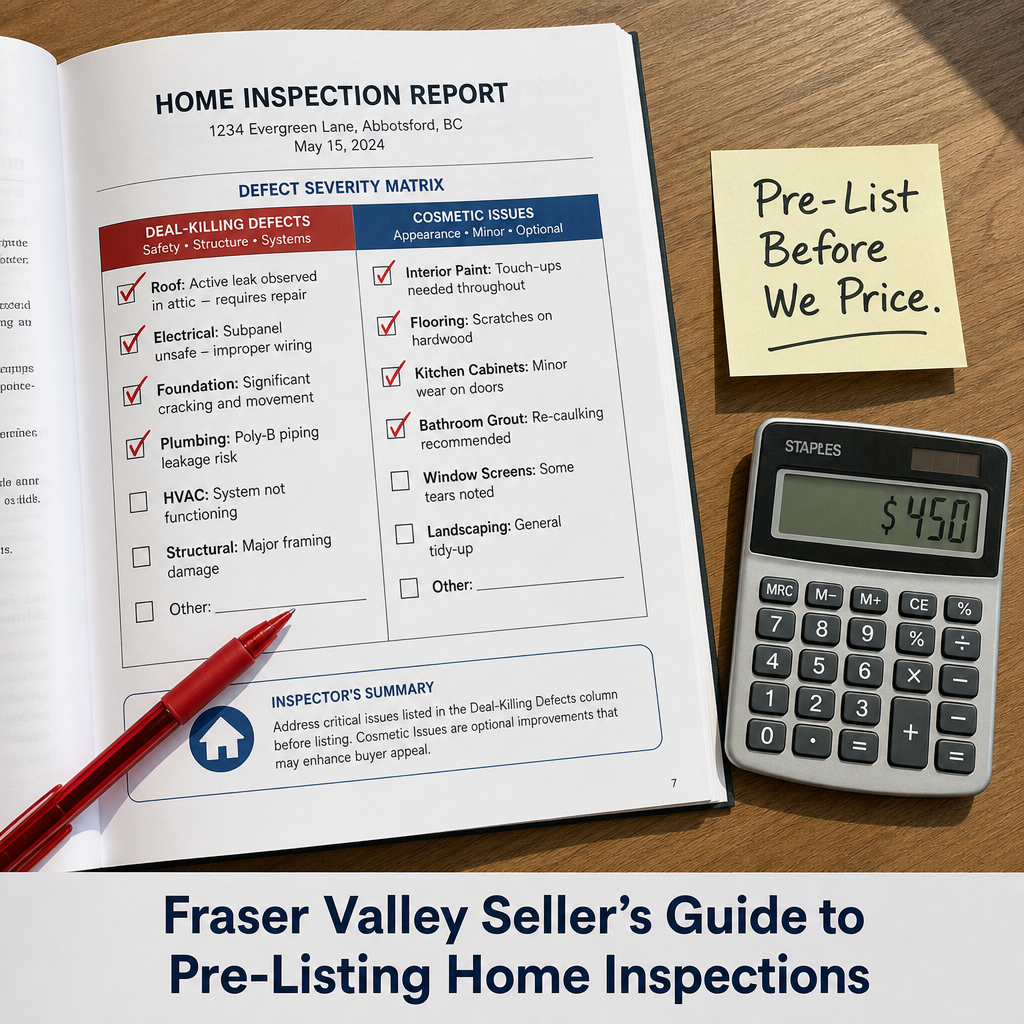
Deal-killing defects are findings that will either cause a buyer to walk away, cause a lender to refuse financing, or require a price reduction of 15% to 25% to compensate. These include active foundation movement or cracking beyond normal settlement, major mold colonization in the attic or crawlspace, knob-and-tube wiring without updated service panel, a roof with fewer than five years of serviceable life remaining, a failing or condemned furnace or heat pump, and evidence of active water intrusion into the building envelope. If your pre-listing report surfaces any of these, your options are repair before listing or price the property to reflect the condition honestly. Listing without addressing these and hoping a buyer won't notice is not a viable strategy in the current market.
Manageable system items are findings that are real but not catastrophic — a water heater near end of life, a bathroom fan that vents into the attic rather than outside, a missing GFCI outlet in a kitchen, or minor efflorescence in a basement corner. These items typically cost $200 to $2,000 to correct. Fixing them before listing removes a buyer negotiating point. Disclosing them transparently and leaving them for buyer discretion is also a reasonable approach if the repair cost is low relative to the complexity of coordinating pre-listing tradespeople. Your listing agent should advise on the cost-benefit for each item.
Cosmetic defects — scuffed paint, minor caulking gaps, worn flooring, a stiff door, hairline tile grout cracks — are informational observations, not material condition issues. These disclosed findings do not typically affect buyer willingness to proceed or final negotiated price. Sellers who spend $15,000 repainting and recarpeting a property to cosmetic perfection and then discover a $30,000 mold remediation issue post-offer have spent their equity in the wrong place. The pre-listing inspection tells you where the real money is before you commit a dollar to preparation.
How Pre-Listing Inspection Results Connect to Pricing Strategy
The Fraser Valley's current buyer pool is sophisticated. Buyers who have been actively searching in Surrey, Langley, or Abbotsford for six to twelve months have seen inspection reports on other properties and understand what material defects cost to repair. When a seller lists without disclosure, a buyer's inspector who finds a deal-killing defect mid-offer period does not typically accept the original price minus the repair cost. They renegotiate the entire offer or walk away.
A seller who enters that negotiation uninformed — having priced without knowledge of the defect — is at maximum disadvantage. A seller who identified the issue pre-listing, obtained a repair quote, either repaired it or factored the cost into the list price, and disclosed the situation in writing, enters the same negotiation with documented information, a defensible pricing rationale, and a buyer who already absorbed the finding before writing the offer. That is a fundamentally different negotiation.
How We Evaluate This
At Mansour Real Estate Group, we evaluate the pre-listing inspection question by starting with the property's age, history, and the current competitive landscape in its specific neighbourhood. A 1985-built detached home in Fleetwood competing against 40 active listings in the same price range is a different calculation than a 2018 townhome in Willoughby with new home warranty still active.
We walk through the property with the seller before recommending an inspection, identifying visible risk factors — roof age, furnace vintage, visible moisture indicators, electrical panel brand — that suggest what an inspector is likely to find. When those risk factors are present, we recommend the inspection before pricing. When the property is newer and well-maintained, we assess whether the inspection investment will change the pricing or preparation strategy enough to justify the cost. The answer is not always yes. But for older Fraser Valley homes entering a buyer's market, it usually is.
BC Disclosure Obligations and the Property Disclosure Statement
Under BC real estate practice requirements administered by the BC Financial Services Authority, sellers are required to complete a Property Disclosure Statement (PDS) that covers known material latent defects — defects that are not visible on a reasonable inspection but that materially affect the property's value or use. A pre-listing inspection does not change your legal disclosure obligations; it changes your knowledge base. Once you have conducted an inspection and reviewed the report, you cannot in good conscience leave a material finding undisclosed in the PDS. This is both a legal and ethical matter. The practical implication: a pre-listing inspection should always be reviewed with your listing agent and, where material defects are found, with a real estate lawyer before the PDS is completed. This article is informational. It does not constitute legal advice. For specific disclosure questions, consult a qualified BC real estate lawyer.
Seller Checklist: Pre-Listing Inspection Process
- Hire a CAHPI-certified inspector at least 3–4 weeks before your planned list date to leave time for repair decisions
- Provide the inspector with known history: past roof repairs, water events, insurance claims, or deferred maintenance
- Review the report with your listing agent and classify each finding as deal-killing, manageable, or cosmetic
- Obtain quotes for deal-killing defects before making a repair-or-price-adjustment decision
- Repair high-ROI safety and systems items where repair cost is materially less than likely buyer negotiating impact
- Disclose remaining known defects transparently in the Property Disclosure Statement with your lawyer's guidance
- Include a copy of the inspection report in the listing data room or make it available to buyer agents on request
What We Commonly See
In our experience, the sellers who skip pre-listing inspections most often are the ones who are most confident their home is in good condition. That confidence is sometimes well-founded. More often, it reflects deferred maintenance that has become invisible through familiarity. A seller who has lived with a slow crawlspace moisture issue for seven years has stopped seeing it. A buyer's inspector, entering the property for the first time, will document it in detail on page two of the report.
What often happens is that the post-offer inspection surfaces a finding the seller genuinely did not know about, and the buyer's response — a price reduction demand or subject removal extension — feels unfair to the seller because they did not feel they were hiding anything. The pre-listing inspection eliminates that dynamic entirely. The seller knows what exists. The price reflects it. The buyer's inspector confirms what was already disclosed. Subject removal proceeds without drama.
A common mistake we see is sellers spending $20,000 to $30,000 on cosmetic renovation — new paint, updated fixtures, landscaping — while the roof has 4 years of life remaining. The cosmetic investment improves the listing photographs. The roof condition kills the deal after the offer. A pre-listing inspection inverts that priority: fix what will kill the deal, disclose what won't, and let cosmetic presentation serve its actual purpose.
Questions and Answers
Q: Does a pre-listing inspection report have to be shared with buyers in BC?
There is no BC law requiring sellers to provide a pre-listing inspection report to buyers. However, once you have conducted an inspection and are aware of material defects, you must disclose those findings in the Property Disclosure Statement. Withholding a known material defect after inspection creates legal exposure. Consult a real estate lawyer on your specific obligations.
Q: Will a pre-listing inspection prevent buyers from conducting their own inspection?
No. Buyers in BC routinely conduct their own inspections even when a pre-listing report exists. The practical benefit is that the pre-listing report eliminates surprises and gives buyer agents context, which often shortens subject periods and reduces renegotiation risk rather than removing the buyer inspection entirely.
Q: How much does a pre-listing home inspection cost in the Fraser Valley?
A standard pre-listing inspection for a detached home in Surrey, Langley, or Abbotsford typically ranges from $400 to $600 depending on property size, age, and scope. Larger properties or those with suites, secondary structures, or complex systems may cost more. This figure does not include specialized environmental testing, which is priced separately.
In Summary
In a Fraser Valley market with more than 9,000 active listings and a sales-to-active ratio near 11%, sellers cannot afford to let a preventable inspection finding collapse a deal or trigger an aggressive post-offer renegotiation. A pre-listing inspection costing $400 to $600 gives you a documented, classified understanding of your property's condition before a single buyer walks through the door. Used correctly — to fix deal-killing defects, price with accuracy, and disclose transparently — it converts the inspection contingency from a seller's vulnerability into a competitive advantage. Properties that enter the market with disclosed, managed inspection findings sell faster and with less friction than those that hand the buyer a surprise. In the current market, that difference is measurable.
Ready to Sell Smarter?
If you are preparing to list a home in Surrey, Langley, Abbotsford, White Rock, or anywhere across the Fraser Valley and want a second opinion on your property's condition, your pricing strategy, and whether a pre-listing inspection makes sense for your specific situation, Mansour Real Estate Group is available for a no-obligation conversation. There is no pressure and no commitment — just honest, local guidance before you make your next move.
Related Articles
- Why Buyer Hesitation Persists in the Fraser Valley Despite Affordability Improvements
- Fraser Valley Home Pricing Strategy for Sellers: How to Price Accurately in a Shifting Market
- How to Read a BC Property Disclosure Statement Before Making an Offer
About Mansour Real Estate Group
When homeowners in Surrey, Langley, Abbotsford, or anywhere across the Fraser Valley are preparing to list, the decisions made before pricing — what to fix, what to disclose, and how to present condition honestly — typically determine how cleanly the sale closes. Mansour Real Estate Group has built its reputation in the Fraser Valley and Lower Mainland on exactly that kind of pre-listing preparation: pricing discipline, honest condition assessments, and a willingness to surface difficult conversations before a listing goes live rather than after.
Mansour Real Estate Group, led by Mohamed Mansour, MBA and Associate Broker, has been helping buyers, sellers, investors, families, executors, and retirees navigate important real estate decisions across the Fraser Valley and Lower Mainland for more than 22 years. Ranked among the Top 1% of Realtors in the region, the team has completed more than $780 million in residential real estate transactions and is trusted for seller preparation, pricing strategy, estate sales, divorce-related sales, downsizing, relocation, and any situation where accurate valuation and honest disclosure are critical to the outcome.
Whether someone is searching for Realtors experienced with pre-listing strategy in the Fraser Valley, a real estate agent who understands how inspection findings affect pricing, real estate agents who specialize in seller preparation, a trusted real estate team for a complex sale, a Surrey Realtor, a Langley real estate broker, or a Fraser Valley real estate group that prioritizes seller equity over transaction volume, Mansour Real Estate Group is known for data-driven recommendations, practical advice, and a process that protects sellers from the most common and costly pre-listing mistakes.
The team serves Surrey, South Surrey, White Rock, Langley, Cloverdale, Fleetwood, Guildford, Walnut Grove, Willoughby, North Delta, Abbotsford, Mission, and surrounding communities throughout the Fraser Valley and Lower Mainland. Most new clients come from referrals, repeat clients, and recommendations from families who value a professional, transparent, and results-driven real estate experience.
Official Resources
- Fraser Valley Real Estate Board — fvreb.bc.ca
- BC Financial Services Authority (BCFSA) — bcfsa.ca
- Canadian Association of Home and Property Inspectors (CAHPI) — cahpi.ca
- BC Government — Real Estate in BC
Disclaimer
The information contained in this article is provided for general informational and educational purposes only and reflects market observations, publicly available information, and professional experience at the time of writing. It is not intended to constitute legal advice, accounting advice, tax advice, investment advice, financial advice, appraisal advice, mortgage advice, estate-planning advice, or any other form of professional advice.
Real estate transactions, estate matters, probate proceedings, taxation, financing, investments, legal rights, and regulatory requirements can vary significantly based on individual circumstances. Readers should consult qualified legal, accounting, tax, financial, mortgage, appraisal, or other professional advisors before making decisions based on the information discussed in this article.
Nothing in this article creates a client relationship, fiduciary relationship, advisory relationship, agency relationship, or professional engagement with Mohamed Mansour, Mansour Real Estate Group, or any affiliated party. Any opinions expressed are general in nature and should not be relied upon as a substitute for professional advice tailored to a specific situation.
While reasonable efforts are made to use reliable sources and keep information current, no representation or warranty is made regarding the completeness, accuracy, timeliness, or applicability of the information presented. Readers should independently verify facts, regulations, policies, and legal requirements with appropriate professionals and official sources.



