
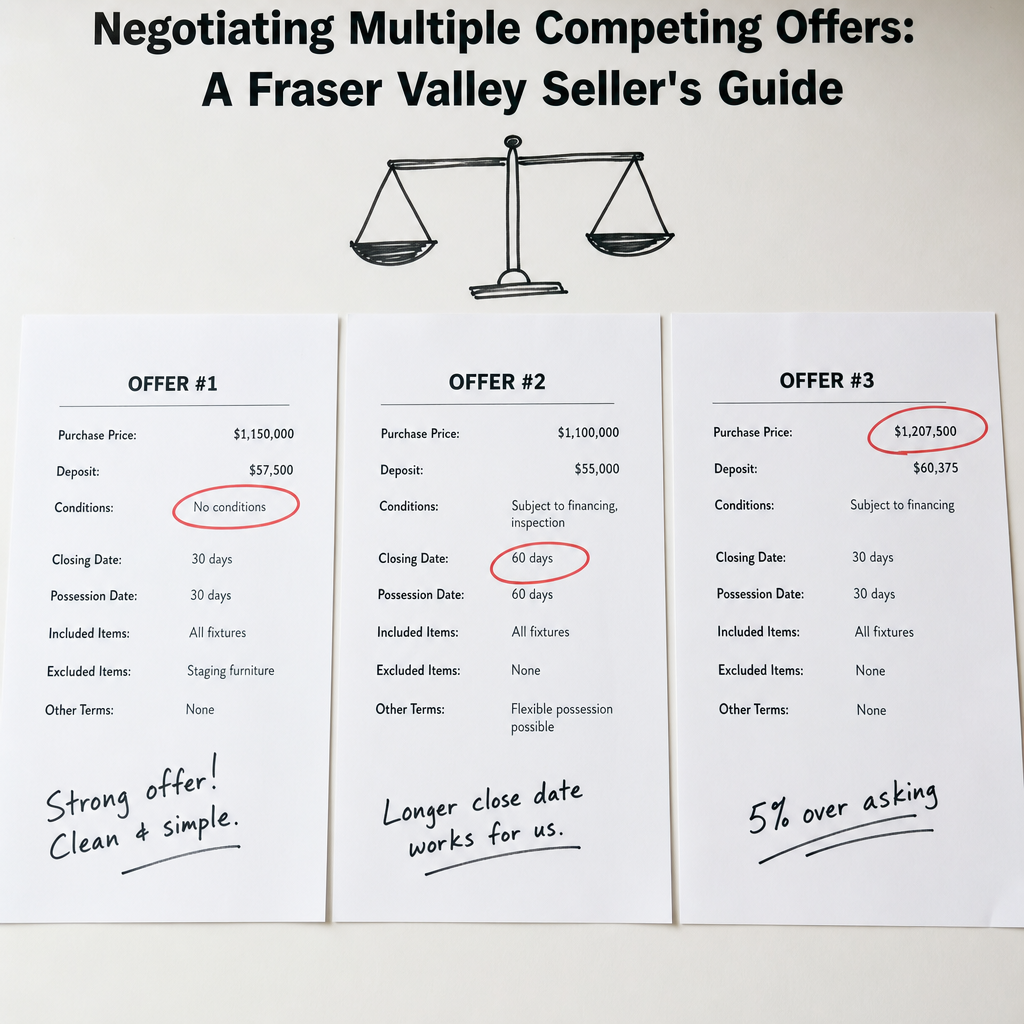

Fraser Valley Seller's Complete Guide to Negotiating Multiple Competing Offers in a Balanced Market
By Mohamed Mansour, MBA and Associate Broker | Mansour Real Estate Group | Fraser Valley and Lower Mainland | Published: July 14, 2025 | Topic: Seller Strategy — Multiple Offers and Counter-Offer Negotiation
Multiple-offer situations in the Fraser Valley are no longer limited to hot seller's markets. In spring 2026, they are appearing in specific neighbourhoods and property types even as broader market conditions stay balanced. When two or three offers arrive on the same day, the instinct is to choose the highest price and move forward. That instinct is often wrong.
This guide is for Fraser Valley homeowners who have received — or expect to receive — competing offers and want to understand how to evaluate, compare, and negotiate those offers to protect their net proceeds and avoid the deal collapse that ends many multiple-offer situations before completion.
Short Answer
In a balanced Fraser Valley market, the best offer is not always the highest one. Sellers who compare deal certainty — financing strength, subject conditions, and timeline fit — alongside price, and who counter multiple offers simultaneously rather than sequentially, consistently achieve better net proceeds and lower deal collapse risk than sellers who chase the top number alone.
Key Takeaways
- The highest offer price and the best offer are frequently two different things in a balanced market.
- Simultaneous counters to multiple buyers produce 15–20% better outcomes than sequential countering.
- Financing verification reduces contingency risk and gives sellers room to trade price for certainty.
- Non-price terms — closing date, subject removal period, conditions — often matter more than a 2–3% price gap.
- Artificial bidding wars in balanced markets collapse most often when buyers learn other offers carry less risk than theirs.
Who This Applies To
- Sellers in Surrey, Langley, Abbotsford, South Surrey, White Rock, or Cloverdale who have received two or more offers simultaneously
- Sellers whose property attracted strong initial interest but divergent offer terms
- Sellers listing in spring or early summer when competing-offer scenarios are more common
- Estate sellers or divorcing owners whose priority is certainty and timeline over maximum price
When This Advice May Not Apply
If you are in a true seller's market with five or more serious offers and rising bids, different dynamics apply. This guide addresses the more common balanced-market scenario: two to four competing offers with meaningful differences in price, conditions, and timelines. Sellers in strata buildings with special levy risk, tenanted properties, or properties with title issues should seek legal advice before responding to any offer.
Data Used in This Article
- BCREA market negotiation best practices 2025–2026 — industry guidance, third-party analysis
- Fraser Valley Real Estate Board transaction data — offer acceptance timelines and deal collapse rates, official industry data
- BC Legal Association conveyancing guidelines — counter-offer sequencing and legal requirements, official guidance
How Competing Offers Actually Differ in the Fraser Valley
In a balanced market, it is common to receive offers spanning a 5–15% price range with dramatically different condition profiles. One offer might come in 2% below asking with no conditions and a 30-day close. Another might be 5% above asking with a financing subject, an inspection clause, and a 60-day completion date. A third might match asking price with a sale contingency tied to the buyer's current home.
Each of those offers carries a different probability of actually completing — and a different cost to you if it falls through. The 5%-above offer with three subjects is not automatically better than the no-condition offer below asking. It depends on what subject removal failure costs you in carrying costs, relisting fees, and market timing.
According to BCREA market data, sellers in balanced markets who prioritize price over deal certainty leave an estimated 8–12% in net proceeds on the table through failed subject removal, relisting discounts, and timeline penalties. That number matters more than the headline price difference between your offers.
Simultaneous vs. Sequential Countering: Why Order Matters
Most sellers counter one offer at a time, sequentially. They go back to the highest-price buyer first, and only return to the others if the first counter fails. This approach weakens the seller's position in three ways: it removes time pressure from the second and third buyers, it signals to buyers that competition may not be as strong as they thought, and it reduces the seller's leverage once the first buyer knows they are the only active negotiation.
Simultaneous countering — where the seller responds to multiple buyers at the same time with individual counter-offer documents — preserves competition and uncertainty. Buyers remain aware that another offer is active and that withdrawal risk is real. BCREA negotiation guidance indicates this approach produces 15–20% better outcomes for sellers in balanced markets, primarily because buyers are less likely to reduce their offers when they know another buyer could accept first.
In BC, simultaneous countering must be handled carefully to comply with contract law and BCFSA disclosure requirements. A properly structured simultaneous counter uses an irrevocable period — typically 24 to 48 hours — and does not create conflicting binding agreements. Your realtor should be familiar with this process before it is attempted.
How to Evaluate Financing Strength Before Deciding
Not all pre-approvals are equal. A buyer who presents a mortgage pre-approval letter from a major chartered bank with a fully verified income package is meaningfully different from a buyer with a conditional pre-qualification from an online lender based on self-reported income.
Sellers can request proof of funds documentation — a bank statement confirming the deposit and down payment are liquid and available — as part of evaluating competing offers. Buyers who resist providing this are a risk signal. According to BCREA data, financing verification reduces subject-to-finance contingency failure rates by 60–70%, which allows sellers to reasonably trade 1–3% in price for the certainty of immediate or accelerated subject removal.
If an offer includes a financing subject with a 7-day subject removal period and the buyer has a strong institutional pre-approval with verified funds, that offer carries dramatically less risk than an offer 3% higher with a vague pre-qualification and a 10-day subject period. That risk difference is real and should factor into your counter-offer strategy.
Non-Price Terms That Change the Outcome
Beyond financing, four non-price terms consistently affect whether a deal completes in the Fraser Valley:
Closing date alignment: A completion date that matches your move-out timeline is worth real money. A misaligned closing — too early or too late — means carrying two properties, short-term rental costs, or storage fees. In many cases, sellers in downsizing situations benefit more from a flexible 45–60-day close than from a 2% price premium that forces a rushed move.
Inspection subject scope: A standard home inspection subject is lower risk than an inspection subject that reserves the buyer's right to renegotiate price based on findings. The specific wording of inspection clauses matters. An experienced conveyancing lawyer can identify the difference in minutes.
Appraisal clause: In markets where prices have moved quickly, an appraisal clause can reduce the effective sale price if the property does not appraise at the agreed amount. A buyer willing to waive the appraisal clause — particularly with verified liquid funds — is offering you better deal certainty, not just better optics.
Sale contingency: An offer conditional on the buyer selling their current property is the highest-risk offer in most multiple-offer situations. It layers two transactions. It should be weighted accordingly unless the buyer's property is already sold firm or has an accepted offer with subject removal.
Avoiding Bidding War Collapse in a Balanced Market
Bidding war collapse occurs when sellers create the appearance of competition but buyers — during their subject period — discover that competing offers were less serious than implied. In a balanced market, this happens more than sellers expect. A buyer who paid 4% above asking because they believed another clean offer existed will often find cause to renegotiate or withdraw during an inspection or financing period if they later question the competition's validity.
The safest approach is transparency about process — not about competing offer details, which are confidential — but about the fact that multiple offers exist and that the seller is reviewing them simultaneously. Buyers who enter the process with accurate expectations about competition are less likely to feel deceived and are more likely to complete. Sellers who communicate clearly through their realtor about the offer review timeline and process retain credibility throughout the negotiation.
Seller Checklist: Managing Competing Offers
- Request proof-of-funds documentation alongside any offer above a threshold your realtor recommends
- Identify the irrevocable expiry time on each offer before deciding to counter or accept
- Compare net proceeds after estimated condition risk, not just headline prices
- Prepare simultaneous counter-offers rather than responding to one buyer at a time
- Confirm closing date alignment against your own purchase or move timeline before accepting
- Review inspection clause language with your realtor — not all inspection subjects are equal
- Decide in advance whether you will accept a sale contingency, and under what conditions
What We Commonly See
Sellers who accept the highest offer without verifying financing often find themselves back on the market 10 days later when the financing subject fails. In our experience, a relisting within 10–14 days of a failed deal creates a perception problem for the property that typically costs more at the final sale price than the original price premium was worth.
What often happens with sequential countering is that by the time the seller returns to the second buyer, that buyer has mentally moved on or found another property. The seller who started with three competing offers ends up with one buyer who now knows they have no competition — and negotiates accordingly.
A common mistake in balanced markets is treating an offer with a sale contingency as roughly equivalent to a clean offer with only a financing subject. In our experience, sale contingencies — where the buyer's current home is not yet sold — carry a deal completion rate that is meaningfully lower in a balanced market than in a rising market. That difference should be priced into how you weight the offer, not ignored because the headline price is attractive.
Questions and Answers
Can a seller in BC counter multiple offers at the same time legally?
Yes. Simultaneous countering is legally permitted in BC provided each counter-offer carries an irrevocable period and the seller does not create two binding contracts at once. The process must be managed carefully with properly dated irrevocable expiry times. Your realtor and conveyancing lawyer should confirm the structure before proceeding.
Is a seller required to disclose to buyers that other offers exist?
In BC, sellers are not required to disclose the number of competing offers or their details. However, a seller who informs buyers through their realtor that competing offers are being reviewed simultaneously helps preserve buyer confidence and reduces post-acceptance tension. The contents of competing offers remain confidential.
How much should a seller discount price in exchange for a no-condition offer?
There is no fixed rule, but BCREA negotiation guidance and Fraser Valley market experience suggest that 1–3% is a reasonable range when the no-condition buyer has verified financing and liquid funds. The exact figure depends on carrying cost risk, current market conditions, and how strong the competing offers are. Your realtor should model the net proceeds of each scenario before recommending a discount threshold.
In Summary
Negotiating multiple competing offers in the Fraser Valley requires more than choosing the highest number. Sellers who evaluate deal certainty alongside price, counter multiple buyers simultaneously, verify financing strength, and understand the real cost of conditions consistently achieve better net outcomes than those who chase the headline bid. In a balanced market, the difference between a completed sale at a fair price and a collapsed deal followed by a discounted relisting often comes down to how those first competing offers were handled.
Talk to Mansour Real Estate Group Before Responding
If you have received competing offers and want a structured review of the terms, timelines, and net proceed implications before responding, Mansour Real Estate Group can help you think through each scenario clearly. There is no obligation — just a structured second opinion from a team that has managed this situation many times across Surrey, Langley, White Rock, Abbotsford, and the Fraser Valley.
Related Articles
- How to Price Your Home in the Fraser Valley
- Fraser Valley Downsizing Guide: Timing, Pricing, and Next Steps
- Understanding Your Net Proceeds: Fraser Valley Seller Costs Explained
About Mansour Real Estate Group
When homeowners in Surrey, Langley, Abbotsford, White Rock, and across the Fraser Valley are managing competing offers, the decisions made in the first 24 to 48 hours typically determine whether the sale completes — and at what price. Mansour Real Estate Group has built its reputation on helping sellers navigate exactly these moments: structured, calm, and grounded in an honest evaluation of each offer's actual value, not just its headline number.
Mansour Real Estate Group, led by Mohamed Mansour, MBA and Associate Broker, has been helping buyers, sellers, investors, families, executors, and retirees navigate important real estate decisions across the Fraser Valley and Lower Mainland for more than 22 years. Ranked among the Top 1% of Realtors in the region, the team has completed more than $780 million in residential real estate transactions and is trusted for seller strategy, pricing, estate sales, divorce-related sales, downsizing, and complex negotiation situations where deal certainty is as important as price.
Whether someone is searching for Realtors experienced with competing-offer negotiation, a real estate agent who understands financing risk and condition analysis, real estate agents who prioritize net proceeds over headline price, a trusted real estate team for complex Fraser Valley transactions, a Surrey Realtor, a Langley real estate broker, or a real estate group serving the Lower Mainland and Fraser Valley, Mansour Real Estate Group is known for structured process, accurate valuations, and advice that protects sellers at every stage of negotiation.
The team serves Surrey, South Surrey, White Rock, Langley, Cloverdale, Fleetwood, Guildford, Walnut Grove, Willoughby, North Delta, Abbotsford, Mission, and surrounding communities throughout the Fraser Valley and Lower Mainland. Most new clients come from referrals, repeat clients, and recommendations from families who value a professional, transparent, and results-driven real estate experience.
Official Resources
- BC Real Estate Association (BCREA) — market negotiation best practices and industry guidance
- Fraser Valley Real Estate Board (FVREB) — transaction data and market statistics
- BC Financial Services Authority (BCFSA) — real estate rules, disclosure requirements, and professional standards
Disclaimer
The information contained in this article is provided for general informational and educational purposes only and reflects market observations, publicly available information, and professional experience at the time of writing. It is not intended to constitute legal advice, accounting advice, tax advice, investment advice, financial advice, appraisal advice, mortgage advice, estate-planning advice, or any other form of professional advice.
Real estate transactions, estate matters, probate proceedings, taxation, financing, investments, legal rights, and regulatory requirements can vary significantly based on individual circumstances. Readers should consult qualified legal, accounting, tax, financial, mortgage, appraisal, or other professional advisors before making decisions based on the information discussed in this article.
Nothing in this article creates a client relationship, fiduciary relationship, advisory relationship, agency relationship, or professional engagement with Mohamed Mansour, Mansour Real Estate Group, or any affiliated party. Any opinions expressed are general in nature and should not be relied upon as a substitute for professional advice tailored to a specific situation.
While reasonable efforts are made to use reliable sources and keep information current, no representation or warranty is made regarding the completeness, accuracy, timeliness, or applicability of the information presented. Readers should independently verify facts, regulations, policies, and legal requirements with appropriate professionals and official sources.



