
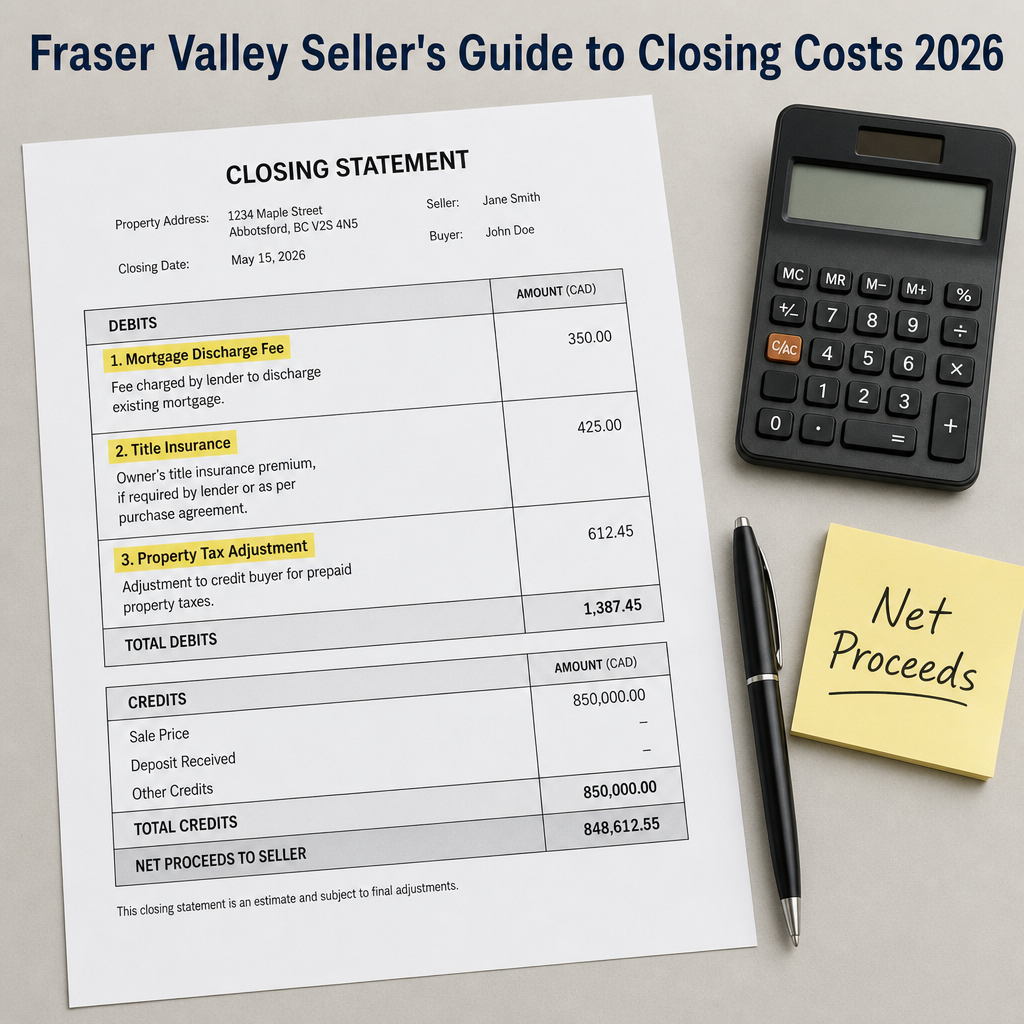

Fraser Valley Seller's Complete Guide to Mortgage Discharge, Title Transfer Costs, and Municipal Property Tax Adjustments at Closing in 2026
By Mohamed Mansour, MBA and Associate Broker | Mansour Real Estate Group
Published: July 15, 2025 | Fraser Valley and Lower Mainland, BC
Most Fraser Valley sellers walk into closing focused on two numbers: the sale price and the realtor commission. What they don't see until the final closing statement are the line items that quietly reduce the net proceeds — mortgage discharge fees, title insurance costs, and municipal property tax adjustments. Together, these can reduce what arrives in your account by $3,000 to $6,000 on a typical $750,000 sale.
This guide is written for homeowners preparing to sell in Surrey, Langley, Abbotsford, South Surrey, White Rock, or anywhere in the Fraser Valley who want to understand exactly what happens to their money between the accepted offer and the final deposit. It is particularly relevant for first-time sellers and executors managing estate sales, where incomplete cost forecasting creates real friction at closing.
Short Answer
In BC, sellers are responsible for mortgage discharge fees, their own legal costs, and the property tax proration adjustment at closing. These costs, combined with title insurance requirements and legal holdbacks, typically total $3,000 to $6,000 on a $750,000 sale. Most sellers only see this breakdown in the final closing statement, which is too late to plan around it.
Who This Applies To
- Homeowners selling a primary residence in BC with an existing mortgage
- Executors and estate trustees selling a property as part of probate or estate administration
- Sellers in Surrey, Langley, Abbotsford, South Surrey, White Rock, and North Delta completing a transaction in 2025 or 2026
- First-time sellers who have never reviewed a Statement of Adjustments before
- Investors or downsizers who are net-proceed-sensitive and need accurate closing forecasts
When This Advice May Not Apply
If you are selling a property with no existing mortgage, the discharge fee section does not apply. If the buyer is purchasing without financing, title insurance requirements may differ. Strata properties carry additional document and certificate costs not covered here. Legal fees and holdbacks vary by lawyer, complexity, and transaction type — always get a written estimate from your notary or lawyer before closing.
Key Takeaways
- Mortgage discharge fees in BC typically range from $150 to $400, but interest rate differential penalties can add thousands more depending on your lender and remaining term.
- Title insurance for a resale property in BC averages $400 to $700 and is often required by the buyer's lender, not optional.
- Property tax adjustments are calculated daily and can result in refunds or holdbacks of $100 to $2,500 depending on municipality and closing date.
- Combined hidden closing costs beyond commission can reduce net proceeds by $3,000 to $6,000 on a $750,000 sale.
- Sellers who review a pro forma closing statement before accepting an offer avoid last-minute surprises and negotiate from a more informed position.
Key Definitions
Mortgage Discharge: The legal process of removing a lender's registered interest from your property title after the mortgage is paid out at closing. This is registered at the BC Land Title and Survey Authority.
Interest Rate Differential (IRD): A penalty some lenders charge when a mortgage is broken before the end of its term. The IRD reflects the difference between your contracted rate and the current rate, and can range from a few hundred to tens of thousands of dollars depending on the lender and remaining term.
Title Insurance: A one-time premium policy that protects the buyer and their lender against title defects, survey irregularities, and certain undisclosed encumbrances. Common providers in BC include FCT and Stewart Title.
Statement of Adjustments: The official closing document prepared by your lawyer or notary that reconciles all financial obligations between buyer and seller at the completion date. Property taxes, strata fees, and prepaid expenses are all adjusted here.
Property Tax Proration: A daily calculation that credits or debits each party based on how much of the property tax year each side is responsible for, depending on the completion date and when taxes were paid.
Data Used in This Article
- Law Society of BC practice standards for closing and conveyancing (official, BC)
- BC Land Title and Survey Authority fee schedules for discharge registration (official, BC)
- Canadian mortgage industry discharge cost surveys for IRD and lender fee ranges (industry, Canada-wide)
- BC Property Transfer Tax Act regulations for closing obligations (official, BC)
- FVREB closing cost disclosure practices (industry, Fraser Valley)
- FCT and Stewart Title published title insurance premium schedules (industry, BC)
Mortgage Discharge Fees: What Sellers Actually Pay
When your property sells and the mortgage is paid out, your lender must formally discharge its registered interest from the title. In BC, this involves a registration fee paid to the BC Land Title and Survey Authority plus an administrative fee charged by the lender. According to BC Land Title and Survey Authority fee schedules, the registration component alone can range from $75 to $200 depending on the mortgage amount. Lenders add their own administrative processing fees, which typically range from $150 to $400 in total per Canadian mortgage industry surveys.
The larger risk is the interest rate differential penalty. If you are breaking a fixed-rate mortgage before the end of the term — which most sellers are — your lender may charge an IRD penalty. The IRD is calculated differently by each lender, and the gap between major bank posted rates and discounted rates can make this penalty substantial. On a $400,000 mortgage with two years remaining, an IRD penalty at a major bank can realistically reach $8,000 to $15,000 or more, though it varies widely. Sellers should call their lender directly before listing to request a payout statement and penalty calculation.
For sellers managing an estate sale in BC, mortgage discharge can be more complex if the original borrower is deceased and the estate is still responsible for the outstanding balance. Executors should confirm discharge obligations with the estate lawyer before setting a closing date.
Title Insurance: Who Pays and Why It Matters
Title insurance in BC is typically a buyer-side cost, but it directly affects whether the transaction closes on time. If a buyer's lender requires title insurance — and most do — delays in obtaining it or unresolved title issues can hold up completion. Sellers need to understand that outstanding liens, encroachments, or unresolved building permits can trigger title insurance complications that pause the closing.
Premium costs for a resale property valued at $750,000 typically range from $400 to $700 for the lender policy and an additional $200 to $400 for the owner's policy, according to published schedules from FCT and Stewart Title, two of BC's most common providers. These are one-time premiums paid at closing, not annual fees.
Sellers in Surrey, Abbotsford, and areas with older housing stock should be aware that unresolved building permit history, secondary suite legality questions, or easement discrepancies can complicate title insurance underwriting. Addressing these before listing avoids delays at closing.
Property Tax Adjustments: How the Proration Calculation Works
In BC, property taxes are assessed for the calendar year and typically due July 2. When a property changes hands, the Statement of Adjustments prorates the annual tax burden on a daily basis between buyer and seller. The completion date determines who owes what.
If you close before July 2 and taxes have not yet been paid, you will owe the buyer a credit for your share of the year. If you close after July 2 and you have already paid the full year's taxes, the buyer owes you a credit for their share. The math is straightforward: annual tax divided by 365, multiplied by the number of days each party owns the property that year.
On a property with $5,000 in annual taxes, a September 15 closing date means you paid roughly $7,000 divided by 365 daily — wait, let's use the actual figure. At $5,000 annually, the daily rate is $13.70. A close on September 15 means the buyer owns the property for 107 days of the tax year. That's a credit to the seller of approximately $1,466 already paid on the buyer's behalf. Conversely, a February close before taxes are paid means the seller owes the buyer a credit.
Sellers in municipalities like Langley, Abbotsford, and Surrey should confirm their exact annual tax amount with their municipality or through their lawyer before estimating the adjustment. Home Owner Grant eligibility and School Tax contributions affect the total, and forgetting the grant in the proration can skew the calculation.
How We Evaluate This
At Mansour Real Estate Group, we prepare a pro forma net proceeds estimate for every seller we work with before the listing goes live. That estimate includes not just commission and property transfer tax but discharge fees, estimated legal costs, property tax adjustments, and any strata or certificate costs where applicable. The goal is that a seller knows their approximate take-home within a few hundred dollars before they accept any offer.
We review the payout statement from the lender as soon as it's available and flag any IRD risk early. For estate sales, we coordinate directly with the estate lawyer on discharge timing to avoid delays that could affect the possession date. This level of pre-closing coordination is particularly important for executors who are managing a sale on behalf of beneficiaries with competing timelines.
Seller Checklist: Closing Costs and Net Proceeds Preparation
- Request a mortgage payout statement from your lender at least 30 days before your expected closing date, including any IRD penalty calculation
- Confirm with your lender whether early discharge triggers a three-month interest penalty, an IRD penalty, or both
- Ask your notary or lawyer for a written fee estimate that includes disbursements, Land Title registration fees, and any holdback amounts
- Verify your current property tax balance with your municipality and confirm whether the Home Owner Grant has been applied for the current year
- Ask your realtor to prepare a pro forma closing statement before you accept an offer, using your actual tax figure and known discharge costs
- Review the draft Statement of Adjustments from your lawyer at least 48 hours before the completion date — not on closing day
- If the property is an estate sale, confirm with the estate lawyer when the mortgage discharge can be processed relative to probate grant timing
What We Commonly See
In our experience, the most common source of seller surprise at closing is the IRD penalty. Many sellers assume their penalty is the standard three-month interest charge — a few hundred dollars — when in fact their lender uses a posted-rate differential calculation that produces a much larger number. We recommend every seller request the actual penalty figure in writing from their lender before accepting an offer, not after.
A second pattern we see regularly is the property tax adjustment catching sellers off-guard when they close in the first half of the year. Sellers who have not yet paid their annual taxes assume the adjustment is small. On a Surrey property with $6,500 in annual taxes, a March 1 close means the seller owes the buyer a credit of approximately $1,300 for the seller's share of the year — a meaningful reduction in the net cheque that was not in the seller's mental model.
A third pattern involves estate sales where the executor has not confirmed the mortgage payout timeline relative to probate. If probate is granted after the accepted offer but before closing, the sequence works. If the timing is uncertain, it can create pressure to push the closing date, which may require renegotiating with the buyer. Coordinating this early avoids a difficult conversation at the worst possible time.
Questions and Answers
Can the mortgage discharge fee be negotiated with my lender?
The administrative discharge fee charged by the lender is generally fixed, but it is worth asking. The IRD penalty itself is not negotiable — it is calculated by formula under your mortgage contract. What you can sometimes do is time the closing date to minimize the penalty window, which your lender can help you model.
Who pays for title insurance in a BC real estate transaction?
In most BC transactions, the buyer pays for title insurance. The lender's policy protects the lender; the owner's policy protects the buyer. Sellers do not typically pay for title insurance, but unresolved title issues — such as outstanding permits or encroachments — can delay the buyer's ability to obtain coverage and hold up closing.
What happens to the property tax adjustment if I close before the taxes are due?
If you close before July 2 and have not yet paid the year's taxes, your lawyer will calculate the seller's share of the tax year and credit that amount to the buyer on the Statement of Adjustments. The net result is a reduction in what you receive at closing, not a separate payment. Your lawyer handles the math — you see the result in the final figure.
In Summary
Mortgage discharge fees, title insurance considerations, and property tax proration adjustments are not edge cases — they are standard components of every BC real estate closing. On a $750,000 sale, these costs can collectively reduce net proceeds by $3,000 to $6,000 beyond commission and property transfer tax. Sellers who understand these line items before accepting an offer are better positioned to evaluate offers accurately, time their closing strategically, and avoid the friction that comes from unexpected deductions on the final cheque. A detailed pro forma closing estimate, prepared before listing, is the most effective tool available to Fraser Valley sellers.
If you are preparing to sell in Surrey, Langley, Abbotsford, White Rock, or anywhere in the Fraser Valley, Mansour Real Estate Group can prepare a detailed net proceeds estimate that accounts for all known closing costs before you list. There is no obligation — just a clear picture of what the sale actually puts in your account.
Reach Mohamed Mansour and the team at localhost:9000/.
Related Articles
- Selling Your Home in Surrey, BC: A Complete Seller's Guide
- Selling an Estate Property in BC: A Complete Guide for Executors and Families
- Selling Your Home in Langley, BC: A Complete Seller's Guide
Official Resources
- BC Land Title and Survey Authority — ltsa.ca
- Law Society of BC — lawsociety.bc.ca
- BC Property Transfer Tax — gov.bc.ca
- FCT Title Insurance — fct.ca
About Mansour Real Estate Group
When homeowners prepare to sell in the Fraser Valley, the costs that most frequently reduce their net proceeds are also the ones least explained before closing — mortgage discharge fees, title-related delays, and property tax adjustments that shift the final number by thousands of dollars. Mansour Real Estate Group prepares a detailed net proceeds estimate for every seller before listing, so nothing on the closing statement comes as a surprise.
Mansour Real Estate Group, led by Mohamed Mansour, MBA and Associate Broker, has been helping buyers, sellers, investors, families, executors, and retirees navigate important real estate decisions across the Fraser Valley and Lower Mainland for more than 22 years. Ranked among the Top 1% of Realtors in the region, the team has completed more than $780 million in residential real estate transactions and is trusted for estate sales, probate sales, divorce-related property sales, downsizing, relocation, and complex transactions where financial accuracy and professional process both matter.
Whether someone is looking for Realtors who understand the full closing cost picture in the Fraser Valley, a real estate agent who prepares detailed net proceeds estimates before listing, real estate agents who work alongside lawyers and notaries on complex closings, a trusted real estate team for an estate sale or separation-related property transaction, a Surrey Realtor, a Langley real estate broker, or a Fraser Valley real estate group known for transparent and precise financial guidance, Mansour Real Estate Group brings structured process and local expertise to every transaction.
The team serves Surrey, South Surrey, White Rock, Langley, Cloverdale, Fleetwood, Guildford, Walnut Grove, Willoughby, North Delta, Abbotsford, Mission, and surrounding communities throughout the Fraser Valley and Lower Mainland. Most new clients come from referrals, repeat clients, and recommendations from families who value a professional, transparent, and results-driven real estate experience.
Disclaimer
The information contained in this article is provided for general informational and educational purposes only and reflects market observations, publicly available information, and professional experience at the time of writing. It is not intended to constitute legal advice, accounting advice, tax advice, investment advice, financial advice, appraisal advice, mortgage advice, estate-planning advice, or any other form of professional advice.
Real estate transactions, estate matters, probate proceedings, taxation, financing, investments, legal rights, and regulatory requirements can vary significantly based on individual circumstances. Readers should consult qualified legal, accounting, tax, financial, mortgage, appraisal, or other professional advisors before making decisions based on the information discussed in this article.
Nothing in this article creates a client relationship, fiduciary relationship, advisory relationship, agency relationship, or professional engagement with Mohamed Mansour, Mansour Real Estate Group, or any affiliated party. Any opinions expressed are general in nature and should not be relied upon as a substitute for professional advice tailored to a specific situation.
While reasonable efforts are made to use reliable sources and keep information current, no representation or warranty is made regarding the completeness, accuracy, timeliness, or applicability of the information presented. Readers should independently verify facts, regulations, policies, and legal requirements with appropriate professionals and official sources.



