
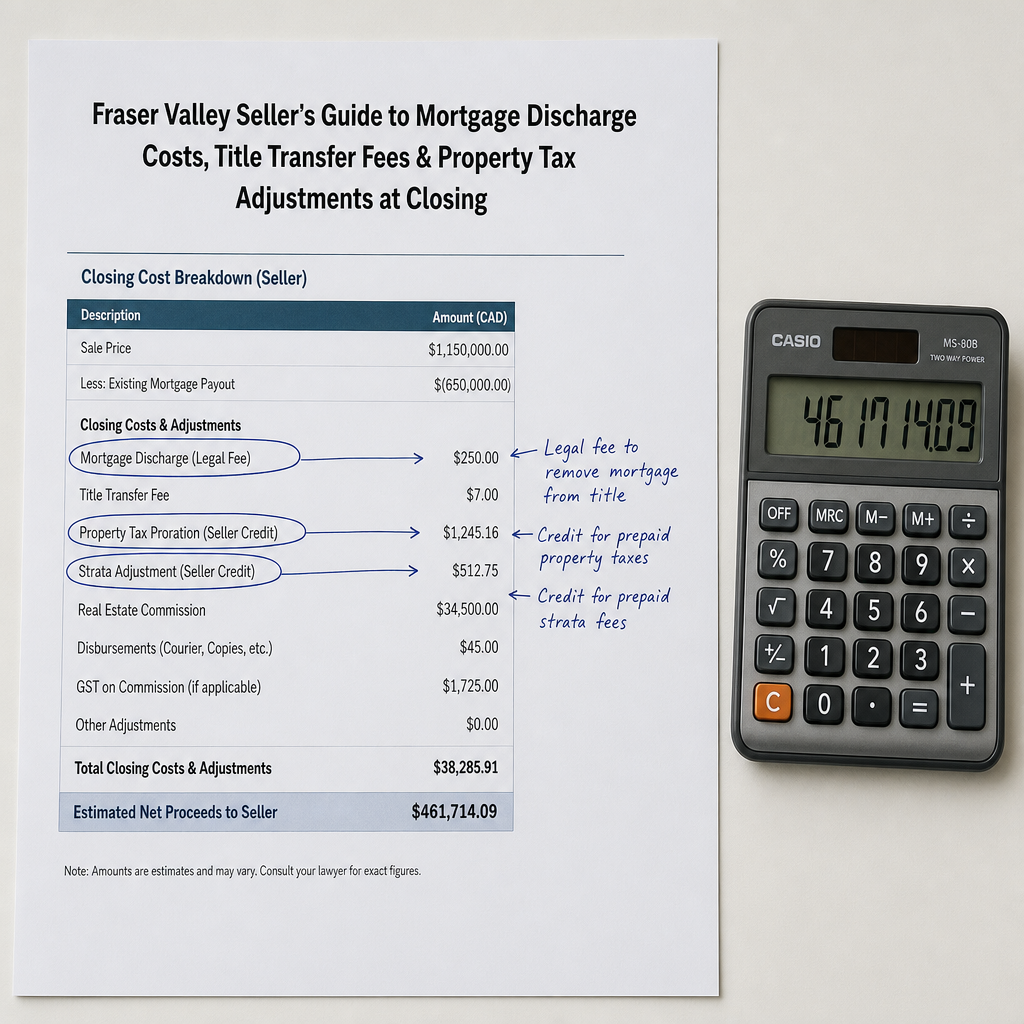

Fraser Valley Seller's Complete Guide to Mortgage Discharge Costs, Title Transfer Fees, and Municipal Property Tax Adjustments at Closing: The Hidden Expenses Beyond Commission and Legal Fees That Reduce Your Net Proceeds in 2026
By Mohamed Mansour, MBA and Associate Broker — Mansour Real Estate Group | Fraser Valley & Lower Mainland | Published: July 15, 2025 | Topic: Seller Strategy — Closing Costs, Net Proceeds
Most Fraser Valley sellers go into a listing knowing roughly what they'll pay in commission and legal fees. What surprises them at final accounting is everything else: the mortgage discharge your lender charges, the interest calculated to the exact day your mortgage closes, a property tax adjustment that can run thousands of dollars depending on your closing date, and strata-related liabilities that appear as line items the night before completion. This guide breaks down every one of those costs with specificity, so you can calculate your true net proceeds before you accept an offer.
In a 2026 Fraser Valley market where elevated inventory is giving buyers more negotiating room, precision on net proceeds isn't optional. It affects whether you sell, when you price, and whether the number on the offer actually matches the number in your bank account.
Short Answer
Beyond commission and legal fees, Fraser Valley sellers typically encounter mortgage discharge fees of $210–$400 per mortgage, potential IRD penalties of $5,000–$50,000+ on fixed-rate mortgages broken early, property tax proration adjustments of $500–$3,000 depending on closing date, and strata-related closing costs of $300–$1,200 for condo sellers. Understanding these before you price is the difference between a planned outcome and an unpleasant surprise.
Key Takeaways
- Mortgage discharge costs include lender fees, Land Title Office registration, and daily interest to the exact payout date.
- IRD penalties on early fixed-rate mortgage breaks can dwarf all other closing costs combined.
- BC's July 1 property tax year creates proration adjustments that either reduce or increase your net proceeds.
- Condo sellers owe prorated strata fees, a Form B preparation fee, and any outstanding special assessments at closing.
- Calculating net proceeds before listing — not after accepting an offer — is the safest approach in a buyer-favoured market.
Who This Applies To
- Fraser Valley homeowners preparing to sell in 2026 who want a precise net proceeds estimate before listing.
- Sellers with a fixed-rate mortgage who may face an IRD penalty if they sell before the term ends.
- Condo and townhouse sellers in Surrey, Langley, Abbotsford, or Willoughby with strata obligations at closing.
- Estate sellers, divorcing couples, or downsizers who need an accurate financial picture before committing to a sale date.
When This Advice May Not Apply
If you own your home free and clear with no mortgage, discharge costs and IRD penalties do not apply. If your closing date falls exactly on July 1, property tax proration becomes negligible. Strata-related closing costs do not apply to detached property sellers. Always verify your specific mortgage terms, property tax balance, and strata account status with your lawyer or notary before closing.
Data Used in This Article
- BC Land Title Office fee schedule (2026) — Official, Land Title and Survey Authority of BC — discharge registration fees
- CMHC mortgage discharge guidelines — Federal agency, official — IRD calculation methodology
- BC property tax year calendar — BC Government, official — July 1 tax year structure and proration mechanics
- Real Estate Council of BC (RECBC) closing cost disclosure standards — Regulatory, official — seller cost disclosure requirements
Mortgage Discharge Costs: What Your Lender Charges and What the Land Title Office Charges
When you sell a home in BC, your existing mortgage must be discharged before title can transfer to the buyer. That discharge process involves two separate cost layers that sellers commonly underestimate.
First, your lender charges an administrative discharge fee. According to CMHC discharge guidelines, this typically runs $150–$300 depending on the institution. Second, the BC Land Title Office charges a registration fee to formally remove the mortgage from title, which runs $60–$100 per discharge under the 2026 fee schedule from the Land Title and Survey Authority of BC. Together, these administrative costs total approximately $210–$400 per mortgage on your property.
On top of those fixed charges, your lender calculates daily interest from your last payment date to the exact date your mortgage is paid out — not the date you accept an offer. If your closing date shifts by even a few days, the interest amount changes. For a $700,000 mortgage at a 5.5% rate, each additional day of interest costs roughly $105. A five-day extension on closing adds over $500 in payout costs alone.
The larger risk for detached home sellers in Surrey, Langley, and Abbotsford who are breaking a fixed-rate mortgage before the term ends is the Interest Rate Differential penalty. IRD penalties are calculated based on the difference between your original mortgage rate and the lender's current rate for the remaining term. In a rate environment where rates have moved significantly, this number can reach $5,000–$50,000 or more. Your lender is required to provide a payout statement — request it before you price, not after you accept an offer.
Property Tax Proration: How BC's July 1 Tax Year Creates Closing Day Adjustments
In BC, the property tax year runs from January 1 to December 31, but tax bills are issued and due around July 2 each year. This creates a proration calculation at every real estate closing that adjusts who owes what based on the exact day the property transfers.
If your closing date falls before July 1, you as the seller owe prorated property taxes for the portion of the year you owned the home. If taxes haven't been paid yet, your lawyer deducts that amount from your sale proceeds and remits it. If your closing date falls after July 1 and you've already paid the full year's taxes, you typically receive a credit from the buyer for their share of the remaining tax year.
For a Langley detached home with annual property taxes of $6,000, closing on March 15 means you owe approximately $1,150 in prorated taxes. Closing on October 1 means you've overpaid and receive roughly a $1,480 credit. That's a $2,630 swing depending solely on closing date — a fact that rarely appears in early net proceeds discussions.
Municipal utility adjustments follow the same proration logic. If you've prepaid water, sewer, or drainage charges for a period that extends past your closing date, your lawyer calculates a prorated credit owed to you from the buyer. These amounts are smaller individually — typically $100–$400 — but they appear as line items that sellers see for the first time at final accounting.
How We Evaluate This
At Mansour Real Estate Group, our approach to net proceeds starts well before an offer is accepted. For sellers with fixed-rate mortgages, we recommend requesting a mortgage payout statement from the lender as soon as a listing decision is made. For strata sellers in Willoughby, Fleetwood, Guildford, or South Surrey, we build strata fee proration and Form B costs into the closing cost estimate before the listing goes live. For any closing scheduled near the July 1 property tax milestone, we flag the tax adjustment direction and amount early so sellers can factor it into their minimum acceptable offer calculation. Precision here isn't complicated — it just requires asking the right questions before the listing, not after the offer.
Strata Closing Costs for Condo and Townhouse Sellers
Condo and townhouse sellers in Fraser Valley strata buildings face a distinct set of closing-day liabilities that detached property sellers don't encounter. Three stand out consistently.
First, strata fees are prorated to the exact closing date. If your monthly strata fee is $550 and you close on the 19th of the month, you owe 19 days of strata fees at closing. Second, your strata corporation is required to provide a Form B Information Certificate to the buyer, disclosing the financial health of the building and any known special levies. The strata can charge up to $35 per document request under BC's Strata Property Act, and lawyers often order multiple documents as part of due diligence, with total Form B preparation and document costs running $100–$200. Third — and most consequential — any outstanding special levy approved by the strata before your completion date is typically your liability as the seller, even if you won't benefit from the improvement. For older Abbotsford or North Delta buildings with deferred maintenance, special levies can reach $5,000–$30,000.
Sellers in strata buildings should request a current strata financial statement, the most recent AGM minutes, and confirmation of any approved special levies before listing. A buyer conducting due diligence will find these documents anyway — sellers who understand them first are in a stronger negotiating position.
Seller Checklist: Closing Costs Beyond Commission and Legal Fees
- Request a mortgage payout statement from your lender before listing to identify IRD penalties and daily interest rates.
- Confirm whether your mortgage is open or closed, and check your prepayment privilege to reduce penalties where possible.
- Ask your lawyer to calculate the property tax proration based on your planned closing date before you accept an offer.
- For strata properties: obtain current strata financial statements, AGM minutes, and written confirmation of any approved special levies.
- Verify any prepaid utility charges (water, sewer, drainage) and confirm whether a credit or debit applies at closing.
- Build all of the above into a written net proceeds estimate before setting your minimum acceptable offer price.
What We Commonly See
In our experience, the most common gap in seller preparation is the IRD penalty. Sellers frequently know they have a fixed-rate mortgage but have never asked their lender what it costs to break it. The payout statement, which takes a few days to obtain, is the single most important document a seller with a closed fixed-rate mortgage should have before pricing their home.
What often happens with strata sellers is that they focus entirely on the gross purchase price and overlook the special levy line on the closing statement. We've seen sellers in older Abbotsford and Fleetwood buildings discover a special levy liability of $8,000–$15,000 at final accounting — an amount that was disclosed in strata minutes that neither the seller nor their previous agent had reviewed before listing.
A common mistake is assuming that because taxes are "handled by the lawyer," they don't require seller attention before closing. The proration calculation is accurate, but its effect on net proceeds should be understood before you price — not explained after the fact.
Questions and Answers
Can I avoid an IRD penalty when selling in BC?
Sometimes. If your mortgage has a portability option, you may be able to transfer it to your next property rather than breaking it. If you have prepayment privileges, you can reduce the outstanding principal before selling, which lowers the penalty amount. Confirm both options with your lender before listing.
What happens to my property tax adjustment if the buyer is late closing?
The proration is recalculated to the actual completion date. If your closing shifts from June 28 to July 5, the direction of the adjustment can reverse entirely — turning a seller liability into a seller credit. Your lawyer recalculates automatically, but the financial effect can be significant.
Who pays for the Form B certificate in a strata sale — the buyer or seller?
In most BC strata transactions, the seller's lawyer orders and pays for the Form B and associated strata documents as part of closing costs, since the seller is responsible for delivering required disclosure. The strata charges the seller's lawyer, and that cost flows through to the seller at final accounting. Confirm the arrangement with your notary or lawyer early.
In Summary
Mortgage discharge fees, IRD penalties, property tax proration, utility adjustments, and strata-related closing costs are not minor line items — for many Fraser Valley sellers they total $2,000–$10,000 or more, and IRD penalties can exceed that by an order of magnitude. The right time to understand these costs is before you set your list price, not after you've accepted an offer. A net proceeds estimate that accounts for all closing layers gives you the clarity to price accurately, negotiate from a position of knowledge, and avoid the surprise that comes from seeing a lower-than-expected wire transfer on completion day.
Thinking About Selling in the Fraser Valley?
If you'd like a complete net proceeds estimate that accounts for your specific mortgage, closing date, strata obligations, and property tax position, Mansour Real Estate Group is available to work through that with you before you make any decisions. There's no commitment required — just a conversation grounded in local expertise and real numbers.
Related Articles
- Selling Your Home in Surrey, BC: A Complete Seller's Guide
- Selling Your Home in Langley, BC
- Fraser Valley Condo Seller Guide: Strata Documents, Depreciation Reports, and Special Levies
About Mansour Real Estate Group
When homeowners in Surrey, Langley, Abbotsford, or White Rock are preparing to sell, understanding the full cost picture — mortgage discharge obligations, property tax proration, strata liabilities, and how closing timing affects net proceeds — is as important as pricing strategy. Mansour Real Estate Group has guided Fraser Valley sellers through the complete financial mechanics of a home sale for more than 22 years, helping families arrive at closing day with clarity rather than surprises.
Mansour Real Estate Group, led by Mohamed Mansour, MBA and Associate Broker, has helped buyers, sellers, investors, families, executors, and retirees navigate real estate decisions across the Fraser Valley and Lower Mainland for more than 22 years. Ranked among the Top 1% of Realtors in the region, the team has completed more than $780 million in residential real estate transactions and is trusted for estate sales, divorce-related property sales, downsizing, investment transactions, and any situation where financial precision and professional process both matter.
Whether someone is searching for a real estate agent who can produce a detailed net proceeds estimate before listing, Realtors who understand mortgage discharge and strata closing costs in the Fraser Valley, a real estate team experienced with complex seller situations in Surrey or Langley, a White Rock real estate broker, a Langley Realtor, or a real estate group that coordinates with lawyers, notaries, and lenders to keep transactions on track — Mansour Real Estate Group is known for clear documentation, accurate valuations, and practical advice grounded in local market knowledge.
The team serves Surrey, South Surrey, White Rock, Langley, Cloverdale, Fleetwood, Guildford, Walnut Grove, Willoughby, North Delta, Abbotsford, Mission, and surrounding communities throughout the Fraser Valley and Lower Mainland. Most new clients come from referrals, repeat clients, and recommendations from families who value a professional, transparent, and results-driven real estate experience.
Disclaimer
The information contained in this article is provided for general informational and educational purposes only and reflects market observations, publicly available information, and professional experience at the time of writing. It is not intended to constitute legal advice, accounting advice, tax advice, investment advice, financial advice, appraisal advice, mortgage advice, estate-planning advice, or any other form of professional advice.
Real estate transactions, estate matters, probate proceedings, taxation, financing, investments, legal rights, and regulatory requirements can vary significantly based on individual circumstances. Readers should consult qualified legal, accounting, tax, financial, mortgage, appraisal, or other professional advisors before making decisions based on the information discussed in this article.
Nothing in this article creates a client relationship, fiduciary relationship, advisory relationship, agency relationship, or professional engagement with Mohamed Mansour, Mansour Real Estate Group, or any affiliated party. Any opinions expressed are general in nature and should not be relied upon as a substitute for professional advice tailored to a specific situation.
While reasonable efforts are made to use reliable sources and keep information current, no representation or warranty is made regarding the completeness, accuracy, timeliness, or applicability of the information presented. Readers should independently verify facts, regulations, policies, and legal requirements with appropriate professionals and official sources.



