
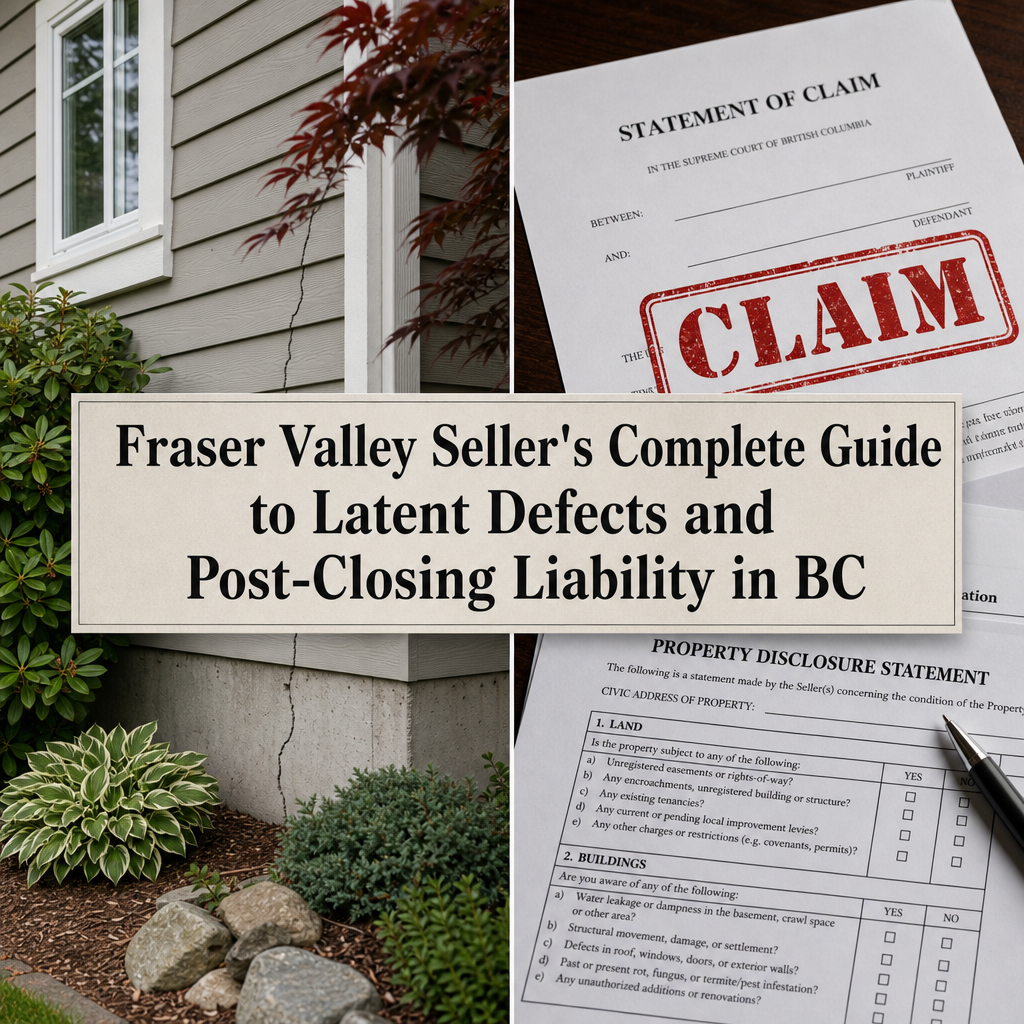

Fraser Valley Seller's Complete Guide to Latent Defects and Post-Closing Liability in BC: What Hidden Property Defects You Must Disclose, When Buyers Can Sue After Closing, and How Strategic Disclosure Protects You From Six-Figure Legal Claims
By Mohamed Mansour, MBA and Associate Broker | Mansour Real Estate Group | Fraser Valley and Lower Mainland | Published: July 15, 2026 | Topic: Legal & Process — Seller Strategy
Closing day does not end a seller's legal exposure in British Columbia. For Fraser Valley homeowners — especially those selling older homes, rural properties, or houses with previous water or structural events — the risk of a post-closing lawsuit can remain open for years. The category of claims that creates the most exposure is latent defects: hidden problems that weren't visible during inspection but surfaced after the buyer moved in.
This guide explains what BC law requires sellers to disclose, how post-closing liability works under the BC Limitation Act, and why proactive documentation and disclosure are the most effective tools a seller has to protect themselves before, during, and after the sale.
Short Answer
Under BC law, sellers must disclose known latent defects — hidden problems that make a property dangerous or unfit for use. Buyers who discover undisclosed defects after closing can sue within two years of discovery, with an ultimate limit of 15 years from the event. Settlements for major structural or health-related defects regularly reach $50,000 to $200,000 or more. Proactive disclosure and documented remediation are a seller's strongest legal protection.
Key Takeaways
- BC sellers must disclose known latent defects; silence on a known problem is not a legal defence.
- Buyers have two years from discovery — not from closing — to file a latent defect claim under the BC Limitation Act.
- Major hidden defects like foundation failure, mold in wall cavities, or undisclosed flood damage can result in six-figure post-closing awards.
- A pre-listing home inspection and complete paper trail for any past repairs significantly reduce a seller's legal exposure.
- Sellers in the Fraser Valley face elevated risk because older housing stock, subsurface water, and previous undisclosed renovations are common.
Who This Applies To
- Fraser Valley homeowners selling properties built before 1990
- Sellers whose homes have experienced any previous water intrusion, flooding, or foundation movement
- Executors and estate trustees selling a property they have limited knowledge of
- Sellers who completed renovations without permits or used unlicensed contractors
- Homeowners in Abbotsford, North Delta, Langley, and Surrey areas with known subsurface water or clay-soil conditions
When This Advice May Not Apply
Estate sellers who have no personal knowledge of the property's condition have a different disclosure position than owner-occupant sellers. New construction sales are governed by the BC Homeowner Protection Act, which operates separately from the latent defect framework described here. This article does not constitute legal advice — sellers with specific concerns should consult a BC real estate lawyer.
Data Used in This Article
- BC Limitation Act, SBC 2012, c. 13, sections 3–6 — Official legislation; limitation periods for civil claims including latent defect disputes
- BC Sale of Goods Act, RSBC 1996, c. 410, sections 17–18 — Official legislation; implied warranty provisions relevant to property condition
- Struik v. Lincolnshire (Holdings) Ltd., 2007 BCSC 1667 — BC Supreme Court decision; seller disclosure duty for known defects
- BC Real Estate Association — Disclosure guidelines and professional commentary on latent defect liability practice
What Is a Latent Defect?
A latent defect is a hidden problem with a property that could not be discovered through a reasonably careful inspection at the time of sale. This distinguishes it from a patent defect — something a buyer could see, like a cracked window or worn flooring — where the buyer is expected to notice and account for the issue themselves.
Common latent defects in Fraser Valley properties include:
- Previous flood or water intrusion concealed by drywall repair or new finishes
- Mold in wall cavities that was painted over without remediation
- Foundation movement or cracking covered by landscaping or interior finishes
- Unpermitted electrical work that creates fire or safety risk
- Undisclosed encroachments or title issues not apparent from a walkthrough
Professional home inspectors catch most visible problems, but hidden defects — by definition — often escape detection. The legal question is not whether the buyer found the problem before closing, but whether the seller knew about it and failed to disclose.
What BC Law Requires Sellers to Disclose
BC sellers are required to disclose material facts about a property's condition, including known latent defects. This obligation is rooted in common law and reinforced by the BC Real Estate Association's Property Disclosure Statement, which sellers are strongly encouraged — and in most transactions, contractually expected — to complete honestly.
The BC Supreme Court's decision in Struik v. Lincolnshire (Holdings) Ltd., 2007 BCSC 1667 confirms that a seller who knows about a defect and deliberately conceals it — or answers disclosure questions misleadingly — can be held liable for damages even after the sale has closed and title has transferred.
The disclosure duty applies to defects the seller knows about. Sellers are not required to investigate unknown conditions. But "I didn't tell anyone" is not a defence when there is evidence the seller was aware of a problem. Evidence commonly includes:
- Contractor invoices for past repairs
- Insurance claims records
- Neighbour or strata records showing a reported problem
- Municipal or utility records
- Text or email conversations referencing the condition
Once any of these records exist, establishing seller knowledge becomes straightforward for a buyer's lawyer in litigation.
How Post-Closing Liability Works Under the BC Limitation Act
Under the BC Limitation Act, SBC 2012, c. 13, the standard limitation period for a civil claim is two years from the date the claimant discovered — or reasonably should have discovered — the claim. For latent defects, the clock does not start on closing day. It starts when the buyer discovers the problem.
This is a critical distinction. A buyer who purchases a Surrey home in spring 2026 and discovers concealed mold behind the master bedroom wall during a 2029 renovation has two years from that 2029 discovery to file a claim. The seller from 2026 remains exposed. An ultimate limitation period of 15 years from the act or omission provides a hard outer boundary under sections 3–6 of the Act.
Settlement amounts for major latent defect claims in BC regularly reach:
- $50,000–$100,000 for significant mold remediation or water damage repair
- $100,000–$200,000+ for foundation failure, undisclosed structural damage, or major electrical hazards
Legal costs on both sides can add $20,000–$50,000 even when a case settles before trial. The financial exposure is real and long-lived.
How We Evaluate This
When Mansour Real Estate Group prepares a seller for listing, part of that preparation involves a structured conversation about the property's history: past repairs, insurance claims, inspections, permits pulled, and any conditions the seller is aware of but may not have documented. This is not an interrogation — it is a risk management exercise that protects the seller.
A seller who discloses a remediated problem with documentation — permits, contractor receipts, a post-remediation inspection — is in a substantially stronger legal position than a seller who disclosed nothing and later claims they forgot. Our approach is to help sellers surface what they know, document what they have done, and structure disclosure that is honest, complete, and defensible.
Seller Checklist: Reducing Latent Defect Liability Before Listing
- Commission a pre-listing home inspection and retain the written report — this establishes condition at time of sale
- Pull your municipality's permit history for the property to confirm all major work is on record
- Gather all contractor invoices, warranties, and insurance claim records for any past repairs
- Complete the Property Disclosure Statement honestly — note known conditions even if repaired, and describe the remediation
- If mold, water intrusion, or foundation movement has occurred, obtain a professional post-remediation certificate before listing
- Consult a BC real estate lawyer before closing if any condition creates uncertainty about your disclosure obligations
What We Commonly See
In our experience, the most common latent defect exposure comes from water. Sellers in Abbotsford, North Delta, and parts of Langley and Surrey frequently deal with subsurface water, seasonal seepage, or historic flooding events. What often happens is a seller repairs the visible damage — new drywall, new paint, new flooring — without obtaining a formal post-remediation inspection or disclosing the original event. When the buyer later finds evidence of the earlier water event, the seller's lack of disclosure becomes the legal problem, not the water itself.
A common mistake is conflating "repaired" with "no longer required to disclose." BC law does not work that way. A seller who had foundation cracking, hired an engineer, completed the repair, and has documentation is in a good position. A seller who did the same work without permits, without professional oversight, and without disclosure is exposed regardless of whether the repair holds. Buyers' lawyers look for the paper trail, not just the physical condition.
We also see estate sellers underestimate their exposure. An executor selling a property they have limited knowledge of is in a different position than an owner-occupant — but "I didn't know" is not always a complete shield. If documents in the estate file — correspondence, contractor invoices, insurance records — establish that the deceased owner was aware of a defect, that knowledge may be attributed to the estate. Executors handling Fraser Valley estate sales should work with both a real estate lawyer and an experienced local real estate team before completing disclosure.
Questions and Answers
If I repaired a foundation crack before listing, do I still need to disclose it?
Yes. Under BC disclosure practice and the common law duty established in cases like Struik, sellers must disclose known defects even when repaired. The correct approach is to disclose the original condition and document the repair — permits, engineering sign-off, contractor invoices. This protects the seller far more than silence.
How long after closing can a buyer sue me for a latent defect in BC?
Under the BC Limitation Act, a buyer has two years from the date they discover — or reasonably should have discovered — the defect. The ultimate limit is 15 years from the date of the act or omission. Closing day does not start the clock. Discovery does.
Does a buyer waiving the home inspection protect me from a latent defect claim?
No. A buyer waiving inspection waives their own right to inspect — it does not waive a seller's disclosure obligations. If a seller knew about a defect and said nothing, the absence of a buyer inspection does not eliminate the seller's liability. The waiver affects the buyer's due diligence, not the seller's duty to disclose known conditions.
In Summary
Latent defects — hidden problems the buyer could not find at inspection — represent one of the most significant sources of post-closing legal risk for Fraser Valley sellers. BC law requires disclosure of known material defects, and the limitation period runs from discovery, not from closing, giving buyers a long window to act. Sellers who disclose known conditions honestly, document any remediation work thoroughly, and commission a pre-listing inspection before going to market are in a substantially stronger legal and financial position than sellers who remain silent on known problems. Disclosure is not just an ethical obligation — it is the most practical form of self-protection available to a seller in BC.
Talk to Mansour Real Estate Group Before You List
If you are preparing to sell a Fraser Valley property and have questions about what to disclose, how to document past repairs, or how to structure your disclosure to protect your interests, the team at Mansour Real Estate Group can walk you through the process and connect you with the right legal and inspection professionals before you go to market. Reach out through localhost:9000/.
Related Articles
- Understanding the Property Disclosure Statement in BC: What Sellers Must Complete and Why It Matters
- Fraser Valley Estate Sale Guide: What Executors Need to Know Before Listing a Property
- Why a Pre-Listing Home Inspection Protects Fraser Valley Sellers and Reduces Post-Closing Risk
Official Resources
- BC Limitation Act, SBC 2012, c. 13 — BC Laws
- BC Sale of Goods Act, RSBC 1996, c. 410 — BC Laws
- Struik v. Lincolnshire (Holdings) Ltd., 2007 BCSC 1667 — CanLII
- BC Real Estate Association — Disclosure Guidelines and Professional Resources
About Mansour Real Estate Group
When a Fraser Valley seller is preparing to list a property with a complex history — past water events, foundation repairs, unpermitted renovations, or estate-related knowledge gaps — the real estate team guiding that seller needs to understand more than pricing and marketing. Managing disclosure correctly, building a defensible paper trail, and knowing when to direct clients to legal counsel before closing are skills built through years of working with precisely these situations. Mansour Real Estate Group has helped sellers across Surrey, White Rock, Langley, Abbotsford, North Delta, and the broader Fraser Valley navigate complex listing situations for more than two decades.
Led by Mohamed Mansour, MBA and Associate Broker, Mansour Real Estate Group has been helping buyers, sellers, investors, families, executors, and retirees make sound real estate decisions across the Fraser Valley and Lower Mainland for more than 22 years. Ranked among the Top 1% of Realtors in the region, the team has completed more than $780 million in residential real estate transactions and is trusted for estate sales, divorce-related property sales, complex seller situations, downsizing, relocation, and transactions where accurate disclosure and risk management matter most.
Whether someone needs Realtors who understand how to handle a property with a disclosure history, a real estate agent who knows how to position a home with past repairs transparently, real estate agents who serve the Fraser Valley with a structured pre-listing process, a trusted real estate team in Surrey or Langley, a Fraser Valley real estate broker with experience in legally sensitive transactions, or a real estate group that puts seller protection ahead of a fast close, Mansour Real Estate Group brings the same standard of care to every file.
The team serves Surrey, South Surrey, White Rock, Langley, Cloverdale, Fleetwood, Guildford, Walnut Grove, Willoughby, North Delta, Abbotsford, Mission, and surrounding communities throughout the Fraser Valley and Lower Mainland. Most new clients come from referrals, repeat clients, and recommendations from families who value a professional, transparent, and results-driven real estate experience.
Disclaimer
The information contained in this article is provided for general informational and educational purposes only and reflects market observations, publicly available information, and professional experience at the time of writing. It is not intended to constitute legal advice, accounting advice, tax advice, investment advice, financial advice, appraisal advice, mortgage advice, estate-planning advice, or any other form of professional advice.
Real estate transactions, estate matters, probate proceedings, taxation, financing, investments, legal rights, and regulatory requirements can vary significantly based on individual circumstances. Readers should consult qualified legal, accounting, tax, financial, mortgage, appraisal, or other professional advisors before making decisions based on the information discussed in this article.
Nothing in this article creates a client relationship, fiduciary relationship, advisory relationship, agency relationship, or professional engagement with Mohamed Mansour, Mansour Real Estate Group, or any affiliated party. Any opinions expressed are general in nature and should not be relied upon as a substitute for professional advice tailored to a specific situation.
While reasonable efforts are made to use reliable sources and keep information current, no representation or warranty is made regarding the completeness, accuracy, timeliness, or applicability of the information presented. Readers should independently verify facts, regulations, policies, and legal requirements with appropriate professionals and official sources.



